Dr. Gymbro
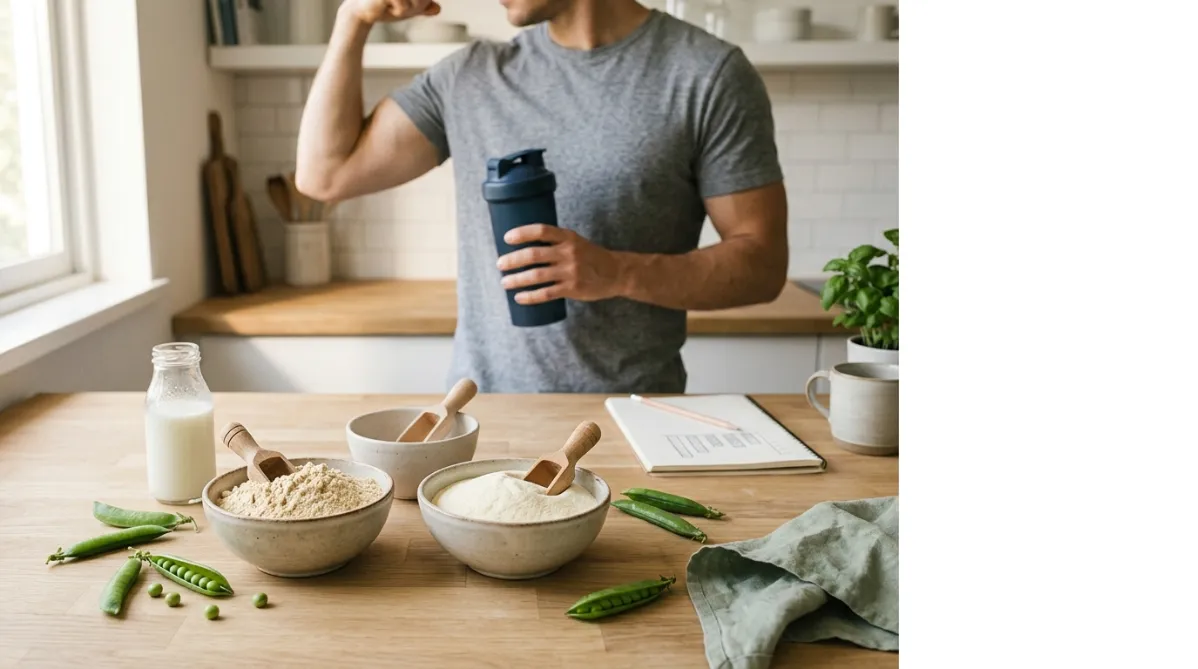
A wide landscape editorial photograph shot from above at a slight angle, showing a bright, minimalist kitchen counter of pale oak wood. Three matching ceramic bowls in soft matte tones (warm cream, sage green, and muted terracotta) sit in a loose row. Each holds a different protein powder: fine ivory whey, slightly coarser beige soy, and speckled pale yellow-green pea protein. A small fourth pile of tiny gray-black chia seeds sits apart on a folded linen napkin, off to the side, to suggest the lone outlier. Wooden scoops rest in each bowl, with a few soft dustings of powder on the surface. In the foreground, a clear glass shaker with a creamy blended drink and a single sprig of fresh mint stands beside a small stack of fresh produce: a halved avocado, a handful of edamame pods, and a few green peas in an open pod. A matte white notebook and a thin brass pen are tucked at the edge of the frame, suggesting research and note-taking. Natural morning light pours in from the left through an unseen window, casting long, soft shadows and gentle highlights on the powder textures. The color palette is calm and earthy, with creams, sage, soft terracotta, and warm wood tones, and a clean, slightly muted editorial grade. Shallow depth of field keeps the bowls crisp while the background, a blurred white tiled wall and a hint of a trailing green plant, melts away. Plenty of negative space on the right side of the frame leaves room for a headline overlay. The overall mood is fresh, trustworthy, and modern, like a contemporary wellness and science journal.
Nutrition

Apakah Whey Tidak Penting untuk Pemula? Kedelai dan Kacang Polong Sama Baiknya

Dr. Gymbro · · 4 min read

Jika Anda baru mulai mengangkat beban dan berada di antara dua botol—satu whey, satu protein kacang polong—dan bertanya-tanya apakah pilihan nabati akan mengorbankan pertumbuhan otot, sebuah meta‑analisis baru memberikan jawabannya. Ketika peneliti menggabungkan hasil uji yang mengukur komposisi tubuh dengan DEXA, kelompok yang mengonsumsi protein nabati tidak menunjukkan kinerja yang secara signifikan lebih buruk dibandingkan kelompok whey. Ini bukan berarti keduanya identik, dan penulis pun menegaskan hal itu.

Studi dalam 30 Detik

Callegari dan rekan‑rekan dari Universitas Negeri São Paulo (UNESP) di Brasil menerbitkan tinjauan sistematis dan meta‑analisis dalam Journal of the International Society of Sports Nutrition (2026;23(1):2752317). Mereka menelusuri PubMed, Web of Science, dan ScienceDirect, mengikuti PRISMA 2020 serta mendaftarkan protokolnya di PROSPERO (CRD420251145410). Lima studi lolos seleksi.

Kriteria inklusi cukup ketat:

  • Populasi: orang dewasa yang tidak terlatih, usia 18‑59 tahun
  • Intervensi: latihan resistensi + suplemen protein berbasis nabati atau whey
  • Ukuran hasil: komposisi tubuh dengan Dual‑Energy X‑Ray Absorptiometry (DEXA)

Studi ini bersifat akses terbuka, dengan DOI https://doi.org/10.1080/15502783.2026.2752317 dan catatan PubMed pada PMID 42954267.

Temuan Utama

Baik protein nabati maupun whey, bila dipadukan dengan latihan resistensi, terkait dengan peningkatan massa bebas lemak dan penurunan lemak tubuh. Antara dua grup tidak ada perbedaan statistik yang signifikan. Penulis menyimpulkan bahwa suplemen berbasis kedelai dan kacang polong dapat mendukung perubahan komposisi tubuh yang menguntungkan pada orang dewasa yang baru memulai latihan resistensi, dan dapat dipertimbangkan sebagai alternatif praktis bagi whey.

Temuan ini penting karena whey selama ini dianggap sebagai protein "terbaik" untuk otot. Pada analisis ini, dengan latihan dan total asupan protein yang disamakan antar grup, sumber protein tidak menghasilkan perbedaan yang terdeteksi pada hasil komposisi tubuh bagi pemula.

Baca Detailnya Sebelum Beralih

"Tidak ada perbedaan signifikan" bukan berarti "terbukti sama". Penulis menekankan hal ini berulang kali. Karena hanya ada lima studi dan interval kepercayaan yang lebar, analisis tidak dapat menyingkirkan adanya perbedaan nyata ke arah mana pun. Makalah tersebut secara eksplisit menyatakan bahwa temuan mereka tidak boleh dibaca sebagai bukti ekivalensi fisiologis dan bahwa percobaan dengan daya statistik yang memadai masih diperlukan.

Tiga batasan tambahan yang penting:

  1. Hanya orang dewasa yang tidak terlatih. Pemula merespons hampir semua kombinasi latihan dan protein yang masuk akal. Hasil ini tidak memberi tahu apa yang terjadi pada atlet berpengalaman, di mana margin lebih tipis dan perbedaan lebih mudah atau lebih sulit terdeteksi.
  2. Protein yang disamakan. Perbandingan ini menjaga total asupan protein dan variabel latihan tetap konstan. Ini tidak menjelaskan apa yang terjadi bila Anda menukar satu scoop whey dengan scoop berukuran sama dari produk nabati yang kualitasnya lebih rendah, atau bila asupan protein Anda secara keseluruhan kurang.
  3. Basis bukti yang kecil. Lima percobaan merupakan fondasi tipis untuk klaim yang luas.

Interpretasi yang adil adalah bahwa whey mungkin tidak esensial bagi pemula, bukan bahwa protein nabati terbukti identik dengan whey.

Bagaimana dengan Protein Chia?

Lewati hype dulu. Tinjauan tersebut hanya menemukan satu studi tentang protein chia, dan studi itu tidak menunjukkan perubahan signifikan pada massa bebas lemak. Penulis menyatakan bahwa kesimpulan kuat mengenai keefektifan chia belum dapat diambil. Kesimpulan tentang kedelai dan kacang polong tidak otomatis berlaku untuk chia.

Takeaway Praktis

Abstrak makalah tidak memberikan dosis, sehingga berikut ini adalah panduan gizi olahraga umum, bukan temuan langsung dari meta‑analisis.

  • Total protein harian adalah yang utama. Patokan yang sering dikutip untuk orang yang berlatih beban adalah sekitar 1,6 g protein per kilogram berat badan per hari. Seorang angkat beban seberat 75 kg akan menargetkan sekitar 120 g protein per hari dari semua sumber. Suplemen membantu Anda mencapai angka itu; ia bukan "sihir" sendiri.
  • Dosis per porsi. Protein nabati biasanya mengandung leusin per gram yang lebih sedikit dibandingkan whey, dan leusin adalah pemicu penting sintesis protein otot. Praktik yang umum adalah menggunakan porsi sedikit lebih besar untuk protein kacang polong atau kedelai, atau memilih campuran, serta menyebarkan asupan protein ke 3‑4 kali makan. Ini adalah langkah pencegahan yang rasional, bukan sesuatu yang diuji dalam studi ini.
  • Timing. Studi ini tidak membahas timing. Konsistensi lebih penting daripada "jendela anabolik" yang kaku. Konsumsilah kapanpun membantu Anda mencapai target harian, misalnya setelah latihan atau sebagai camilan.

Siapa Harus Pilih Apa

Protein nabati (kedelai atau kacang polong) masuk akal bila Anda:

  • vegan atau vegetarian
  • memiliki intoleransi terhadap susu atau laktosa
  • menginginkan opsi yang lebih berkelanjutan, sebagaimana penulis soroti
  • baru mulai angkat beban dan ingin suplemen yang hemat biaya serta cocok dengan diet

Whey tetap masuk akal bila Anda:

  • toleran terhadap susu dan menyukainya
  • menginginkan protein dengan basis penelitian terbesar
  • menemukan whey lebih murah atau lebih praktis di tempat tinggal Anda

Waspadai bila Anda:

  • alergi kedelai atau kacang polong, jadi periksa label
  • atlet tingkat lanjut, karena bukti ini berasal dari orang dewasa yang tidak terlatih
  • berencana menggunakan protein chia untuk otot, karena bukti masih belum ada

Kesimpulan

Asumsi lama bahwa whey secara unik diperlukan bagi pemula tampak lebih rapuh setelah analisis ini. Dengan protein dan latihan yang dipasangkan, kedelai dan kacang polong tidak secara signifikan tertinggal dari whey dalam perubahan massa bebas lemak atau lemak tubuh pada orang dewasa yang tidak terlatih. Namun lima studi dengan interval kepercayaan yang lebar berarti pertanyaan ini masih terbuka, bukan tertutup. Capai total protein harian Anda, latih secara konsisten, dan pilih bubuk yang memang akan Anda gunakan.

Source: Callegari IOM, Silva GM, Oliveira AG. Is plant‑based protein supplementation as effective as whey protein? A systematic review and meta‑analysis in untrained adults undergoing resistance training. J Int Soc Sports Nutr. 2026;23(1):2752317. doi:10.1080/15502783.2026.2752317. PMID: 42954267.
Original study

Read the original research on pubmed.ncbi.nlm.nih.gov →

This article summarizes published research for general information. It is not medical advice.

DG

Written by

Dr. Gymbro

Dr. Gymbro writes for Dr. Gymbro: science-backed fitness, nutrition & performance.

Related Articles

A wide, softly lit editorial flat-lay on a pale oat-colored linen surface, shot from slightly above. Three matte ceramic bowls sit in a loose diagonal across the frame. One holds fine, creamy beige pea protein concentrate, another holds paler, powdery pea protein isolate, and the third holds bright white whey protein isolate. Each bowl has a small wooden scoop resting beside it, with a few fine dustings of powder on the linen. Fresh green pea pods, split open to show round peas, spill naturally in the left foreground. A small glass pitcher of milk sits near the right edge, next to a half-full glass of a smooth, pale green-beige shake with condensation on the surface.

Behind the bowls, a few sprigs of dried wheat and soft eucalyptus leaves add organic texture. In the upper right, a shallow white ceramic plate holds a small arrangement of gut-friendly foods: sliced banana, a spoonful of plain yogurt, and a few oats. Delicate watercolor-style abstract shapes in sage green, warm coral, and soft mustard float subtly in the background. They suggest microscopic organisms, like loose dots, rods, and clustered circles, but stay painterly and minimal, not scientific or futuristic.

Natural window light enters from the left, casting long, gentle shadows and a warm, airy glow. The palette is muted and modern: sage green, cream, warm beige, blush, and touches of terracotta. The composition leaves generous clean negative space on the right third for a headline overlay. The depth of field is shallow, with the nearest pea pods and the front bowl crisp and the background softly blurred. The style is high-end wellness magazine photography with a subtle tactile, handmade feel, calm, fresh, and contemporary, in a 16:9 landscape format.
science research

Serbuk Protein Mana yang Mengubah Usus Anda? Kacang Polong Melakukannya dalam 4 Minggu

BY DR. GYMBRO ·

Sebuah percobaan acak empat minggu di Swedia membandingkan konsentrat protein kacang polong, isolat protein kacang polong, dan isolat whey, dengan komposisi mikrobiota usus sebagai hasil utama. Kedua bentuk protein kacang polong secara signifikan mengubah keragaman usus dan masing‑masing meningkatkan spesies menguntungkan yang berbeda. Konsentrat meningkatkan *Bifidobacterium longum* dan *Anaerobutyricum hallii*, sementara isolat meningkatkan *Lactobacillus crispatus* dan *Limosilactobacillus frumenti*. Peneliti mencatat bahwa belum jelas apa arti pergeseran ini bagi fungsi mikroba. Berikut implikasinya untuk pilihan serbuk protein Anda.

A wide, editorial-style flat lay shot from directly above on a pale oak table in soft morning window light. At the center, an open matte cream-colored protein powder tub sits tipped slightly, with a wooden scoop resting beside it and a small, elegant dusting of fine powder spilling across the wood grain. To the left, a neat balanced arrangement of whole foods: two soft-boiled eggs in a ceramic dish, a small bowl of Greek yogurt with a drizzle of honey, a handful of almonds, and a halved avocado. To the right, a minimalist brass kitchen scale holding a small ceramic bowl, with a handwritten notebook page beside it showing simple pencil-drawn bar charts and a few scribbled numbers, no legible text. A matte shaker bottle in muted sage green stands near the top edge, along with a folded linen napkin in warm oatmeal tone. The color palette is restrained and modern: warm creams, soft sage, terracotta accents, and natural wood, with gentle diffused shadows and subtle film-like grain. Composition leaves generous negative space on the left third of the frame for headline overlay. The mood is calm, thoughtful, and quietly skeptical, like a contemporary health and science magazine cover. Shallow depth of field, crisp textures on powder and ceramic, high-end lifestyle photography, clean and uncluttered.
nutrition

Rahasia Tersembunyi Protein Powder: Manfaat Menghilang Saat Kalori Sesuai

BY DR. GYMBRO ·

Apakah protein powder benar‑benar meningkatkan performa dan pemulihan Anda, atau sekadar menambah kalori lewat kemasan mewah? Meta‑analisis Bayesian pada 75 percobaan acak melibatkan 1.206 atlet menemukan manfaat nyata namun terbatas, terutama ketika asupan energi tidak disamakan. Saran paling konkret: tambahan sekitar 1 g/kg/hari protein dari suplemen, sehingga total menjadi kira‑kira 2 g/kg/hari.

A bright, airy, minimalist kitchen counter in soft morning light, shot from a slightly elevated three-quarter angle in a wide landscape composition. Two matching ceramic bowls sit side by side on a pale oak butcher-block surface. The left bowl holds fine, creamy-beige pea protein powder with a small wooden scoop resting in it. The right bowl holds smooth, ivory-white whey powder with an identical scoop. Between and slightly behind them sits a third, smaller empty bowl with a plain scoop, hinting at the placebo. Scattered around the bowls are fresh green pea pods, some split open to reveal bright, round peas, and a small glass bottle of milk with delicate condensation. A sage-green linen napkin is folded loosely at the edge of the frame.

In the soft-focus background, a young man in a fitted heather-gray t-shirt is seen from the shoulders down, casually flexing one arm while holding a matte shaker bottle, the biceps subtly defined and the pose relaxed and natural. A minimalist notebook with a pencil and a simple hand-drawn bar chart lies open on the counter, suggesting analysis without legible text. A small potted herb plant and a ceramic mug add warmth.

The color palette is muted and editorial: warm cream, sage green, soft terracotta, pale wood, and touches of charcoal. Light streams in from a window on the left, casting gentle long shadows and a subtle golden glow across the powders so their textures look fine and tactile. Shallow depth of field keeps the bowls crisp while the background melts into a creamy blur. The look is modern lifestyle-magazine photography, clean and uncluttered, with generous negative space on the right third of the frame for headline overlay. It is natural, appetizing, and trustworthy, in the style of a contemporary wellness and nutrition journal.
nutrition

Protein Kacang Polong vs Whey: Hasil Tak Terduga pada Pemula

BY DR. GYMBRO ·

Apakah protein nabati memang mampu membangun otot seperti whey? Dalam uji coba 12 minggu yang melibatkan 161 pria, protein kacang polong, whey, dan plasebo dibandingkan secara bersamaan. Pada peserta pemula, ketebalan bisep meningkat 20,2 % dengan kacang polong, dibandingkan hanya 8,6 % pada plasebo. Namun perbedaan antar kelompok secara keseluruhan hanya berupa tren, dan temuan utama berasal dari analisis subkelompok. Artikel ini membahas hasil studi, apa yang sudah terbukti, serta bagaimana para angkat beban vegan atau yang intoleran laktosa dapat memanfaatkan informasinya.

A wide, editorial flat-lay photograph shot from directly above on a pale warm-gray stone countertop, lit by soft natural morning window light with gentle diagonal shadows. On the left, a neatly arranged cluster of whole-food protein sources: two seared chicken breast slices with a golden crust, a small ceramic bowl of creamy Greek yogurt topped with blueberries, three halved soft-boiled eggs with jammy orange yolks, a handful of raw almonds, and a small pile of dried lentils scattered on a linen napkin. At the center, a matte white shaker bottle and a wooden scoop resting in a pile of fine vanilla-colored protein powder, a few grains dusted artfully across the surface. On the right, a minimalist kitchen scale in matte black displaying a portion of food, next to an open notebook with a hand-drawn curve that rises steeply and then flattens into a plateau, drawn in a deep terracotta ink pen, with a small dot marking the bend. A brass pen lies beside the notebook. A single dumbbell with a brushed steel finish sits partially in frame at the upper right corner, grounding the fitness theme without feeling gym-like. Color palette: warm cream, sage green, terracotta, soft charcoal, and butter yellow accents, with generous negative space along the top edge for title overlay. Shallow depth of field, crisp textures, subtle film grain, modern lifestyle magazine aesthetic, clean and calm composition, 16:9 landscape.
nutrition

Berapa Banyak Protein yang Sebenarnya Memaksimalkan Otot? Penjelasan tentang Plateau 1,6 g/kg

BY DR. GYMBRO ·

Bayangkan Anda harus mengonsumsi lebih dari 2 gram protein per pon untuk menambah otot. Sebuah meta‑analisis yang mencakup 49 percobaan dan 1.863 orang dewasa menunjukkan bahwa manfaat pertumbuhan otot mulai melandai di sekitar 1,6 g/kg per hari. Batas atas interval kepercayaan berada di kisaran 2,2 g/kg, memberikan para pengangkat beban rentang asupan yang realistis tanpa harus mengandalkan dosis mega yang arbitrer. Pengangkat yang sudah berpengalaman mendapatkan manfaat paling besar dari suplemen, sementara efeknya berkurang seiring bertambahnya usia. Berikut arti angka‑angka tersebut bagi piring Anda, botol shaker, dan anggaran.

This page is available in