Dr. Gymbro
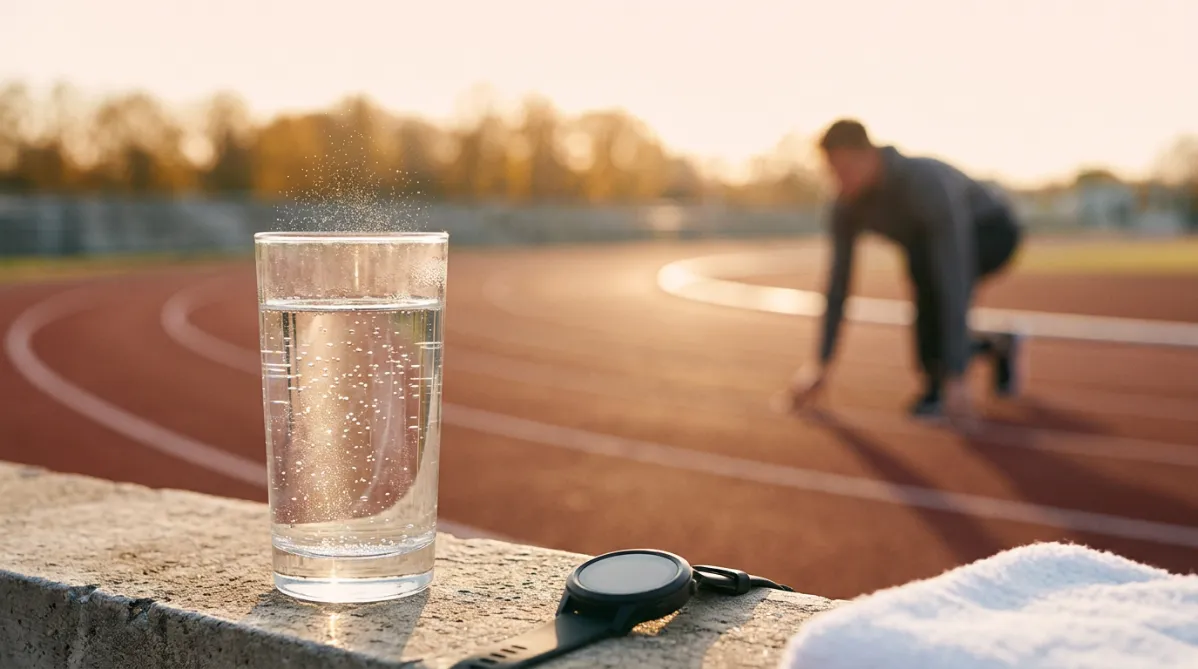
A wide, editorial-style photograph of a clear glass of water on a weathered concrete ledge at the edge of an outdoor running track, shot in soft golden-hour light. Tiny, fine bubbles cling to the inside of the glass and drift upward, catching warm backlight so the water looks luminous and crisp. The glass is about three-quarters full, with delicate condensation beading on its surface. In the softly blurred background, the curved lanes of a terracotta-red track sweep diagonally across the frame, with faint white lane lines leading toward the horizon. A lone sprinter in a charcoal athletic top crouches in a starting position, out of focus, rendered as a muted silhouette. Long shadows stretch across the track, and a hazy line of trees glows amber in the distance.

Foreground details are sharp: a matte black sports watch rests beside the glass, its screen dark, and a folded white towel sits at the edge of the frame. The palette is warm and restrained, with terracotta, sand, soft peach sky, charcoal, and the cool, clean glint of water as the focal accent. Shallow depth of field, 85mm lens look, fine film grain, gentle natural lens flare from the low sun. The composition follows the rule of thirds, with the glass placed on the left third and generous negative space on the right for headline text. The mood is calm, athletic, and modern, like a contemporary health and performance magazine cover, with no text, logos, or futuristic elements.
Science & Research

Banyu Hydrogen Sadurunge Sprint: Tenaga Tetep Tahan lan Pemulihan Cepet

Dr. Gymbro · · 3 min read

What if a single glass of water, drunk about a minute before you started, could blunt the power drop‑off in repeated sprints? That is the claim in a new crossover study from South China Normal University, and the results are interesting enough to take seriously. They are also small enough that you shouldn't rush out and buy a hydrogen machine.

Apa sing tenan diteliti peneliti

Tim sing dipimpin dening Chen Z lan kolegane, lan diterbitake ing Journal of Sports Science and Medicine, ngrekrut 13 atlet universitas lanang kanthi rata‑rata umur 23,9 ± 2,0 taun. Saben wong nindakake loro sesi sing dipisahake seminggu. Ing siji sesi, dheweke ngunjuk 280 mL banyu sugih hydrogen (HRW) sing diprodhuksi kanthi elektrolisis banyu distilasi, kanthi konsentrasi kira‑kira 1600 ppb hydrogen terlarut. Ing sesi liyane, dheweke ngunjuk banyu distilasi biasa minangka plasebo.

Omben‑omben iki dipangan sajrone siji menit sadurunge tes. Latihané prasaja nanging keras: pitung sprint siklus maksimal 6 detik, sabené dipisahake mung 30 detik pemulihan. Desain iki randomisasi, plasebo‑kontrol, lan crossover, dadi saben atlet dadi pembanding kanggo dhèwèké dhéwé. Iki single‑blind, tegesé peserta ora ngerti omben‑ombene sing dipangan, nanging peneliti ngerti.

Temuan utama: tenaga tetep luwih apik

Dibandhingake karo plasebo, percobaan HRW ngasilake rata‑rata output tenaga sing luwih dhuwur sacara signifikan (effect size d = 0,61). Penurunan kerja total uga luwih cilik (d = 0,62), lan indeks keletihan luwih murah (d = 0,64). Ing tembung prasaja, output tenaga para atlet mudhun luwih sithik sajrone pitung sprint nalika dhèwèké ngunjuk banyu hydrogen dhisik.

Ukuran efek iki moderat, dudu angka keajaiban. Nanging kemampuan sprint berulang‑ulang iku sing penting ing akèh momen olahraga tim, ngendi pemain kudu ngasilake usaha berkualitas berulang‑ulang kanthi istirahat sing sithik. Ngurangi penurunan, tinimbang mung nambah puncak tunggal, itulah sing menarik.

Pemulihan sistem saraf cepet

Peneliti uga ngukur pemulihan sistem saraf otonom (ANS) liwat variabilitas denyut jantung (HRV). Sawisé latihan, HRV pulih luwih cepet sacara signifikan ing percobaan HRW ing macem‑macem indikator: RMSSD (d = 0,62), rasio LF/HF (d = 0,82), sample entropy utawa SampEn (d = 0,79), lan DFAα1 (d = 0,79).

Ukuran‑ukuran iki nuduhaké kepiye cepete awak ngalih saka kondisi stres dadi parasimpatik, kondisi istirahat lan pemulihan. Penulis nginterpretasikake iki minangka pemulihan ANS sing luwih cepat sawise sprint keras. Denyut jantung, frekuensi fusi flicker kritis (proxy kanggo keletihan pusat) lan laktat getih uga diukur ing baseline, sajrone latihan, lan nganti 10 menit pasca‑latihan.

Hasil laktat, lan kenapa ora kudu kebablasan

Laktat getih 3 menit sawise latihan kira‑kira 1 mmol/L luwih rendah karo banyu hydrogen (d = 0,64). Penulis maca iki minangka peningkatan pembersihan laktat. Nanging bedane mung katon ing menit ke‑3; ora ana bedane ing menit ke‑10. Iki jendela sing sempit, lan ateges cerita laktat iki luwih lemah tinimbang temuan tenaga lan HRV.

Cara nggunakake gagasan iki: dosis, timing, sapa sing cocok

Iki sing digunakake ing studi, ora resep sing wis dibuktekake:

  • Dosis: 280 mL HRW kanthi kira‑kira 1600 ppb H₂ terlarut.
  • Timing: Diunjuk sakdetik sadurunge sesi. Hydrogen terlarut cepet nguap, mula omben‑omben sing anyar dibukak utawa anyar diprodhuksi penting sacara prinsip.
  • Sapa sing mungkin cocok: Atlet sing olahragane nguntungaké usaha maksimal pendek berulang, kaya pemain olahraga tim, sprinter, lan pelatih HIIT. Protokol iki nganggo sprint 6 detik karo istirahat 30 detik, dadi temuan paling relevan kanggo jinis kerja iki.
  • Sapa sing durung dites: Wanita, wong tuwa, non‑atlet, utawa atlet daya tahan. Studi iki mung melu atlet universitas lanang enom.

Keterbatasan sing penting

Kejujuran iku titik utama, mula pertimbangna watesan iki:

  • Sampel cilik. Mung 13 wong lanang. Studi crossover cilik bisa ngasilake asil sing ora bisa diulang.
  • Single‑blind wae. Peneliti ngerti sapa sing nampa omben‑ombene, lan banyu hydrogen angel dibutake blinding sempurna. Efek ekspektasi marang usaha maksimal dadi perhatian nyata.
  • Akut waé. Iki nguji siji dosis sadurunge siji sesi. Ora ngomong apa-apa babagan panggunaan harian, adaptasi latihan, utawa manfaat jangka panjang.
  • Bedane laktat cendhak. Muncul ing menit ke‑3 lan ilang ing menit ke‑10.
  • Protokol laboratorium. Sprint siklus ing ergometer ora padha karo pertandingan lapangan.

Penulis dhewe nyatakake asil iki minangka saran, ora bukti, yen HRW akut nyuda penurunan tenaga, mempercepat pemulihan ANS, lan nambah pembersihan laktat.

Kesimpulan

Studi iki menehi sinyal awal sing menjanjikan: siji gelas cilik banyu sugih hydrogen, dipangan tepat sadurunge sprint berulang, kaitane karo pemeliharaan tenaga sing luwih baik lan pemulihan autonomik sing luwih cepat ing grup cilik atlet pria enom. Nanging ora definitif. Yen sampeyan penasaran lan wis rutin latihan sprint utawa HIIT, nyoba iku risiko rendah secara prinsip, nanging anggep wae kaya eksperimen tinimbang keunggulan sing wis terbukti. Studi luwih gedhe, double‑blind, kalebu wanita lan olahraga lapangan, kudu dibutuhake kanggo ndeleng apa efek iki tetep ana.
Original study

Read the original research on pubmed.ncbi.nlm.nih.gov →

This article summarizes published research for general information. It is not medical advice.

DG

Written by

Dr. Gymbro

Dr. Gymbro writes for Dr. Gymbro: science-backed fitness, nutrition & performance.

Related Articles

supplements

Rhodiola Nambah Daya Puncak Sprint lan Ngurangi Laktat—Nanging Ora Kabeh

BY DR. GYMBRO ·

Protokol muatan Rhodiola rosea suwene 3 dina nambah daya puncak ing sprint Wingate maksimal lan disertai kadar laktat getih sing luwih endhek ing 3, 10, lan 20 menit sawisé. Nanging, daya rata‑rata lan total kerja ora nuduhaké peningkatan. Uji coba crossover iki melu 23 wong lanang enom sing terlatih lan nganggo washout 5 dina. Peneliti ngandharake yèn mekanisme penurunan laktat durung jelas. Ing ngisor iki protokol persis, sapa sing bisa entuk manfaat, lan apa sing ora bisa dijelasaké déning bukti.

A wide, editorial-style flat lay photographed from above on a pale oat-colored linen surface in soft morning window light. On the left, a small matte white ceramic cup of black coffee with a delicate swirl of steam, beside a few scattered roasted coffee beans. On the right, a second matte sage-green ceramic cup holding a pale, creamy golden tea-like drink, mirroring the first. Between them, two small glass vials with cork stoppers sit side by side: one holding fine white powder, the other holding slightly warmer cream-colored powder, with a tiny brass measuring spoon resting nearby. In the lower foreground, a slim wooden rowing oar lies diagonally across the frame, its blade edge softly entering from the right, painted a muted navy with a thin terracotta stripe. A minimalist analog stopwatch with a brushed-steel case rests near the oar, and a folded cream notebook with a thin pencil suggests data-taking. In the upper corner, a crescent-shaped dried eucalyptus sprig and a small folded gray wool throw hint at sleep and calm without being literal. The palette is warm and restrained: oat, cream, sage, soft navy, terracotta, and espresso brown. Shadows are long and gentle, with shallow depth of field and subtle film grain, giving a refined, modern wellness-magazine feel. Generous negative space on the left third of the composition leaves room for a headline overlay. Clean, calm, tactile, and contemporary, with no text, logos, or futuristic elements.
science research

Paraxanthine vs Kafein: Kombinasi Sing Ngalahaké Plasebo lan Penyelamat Turu

BY DR. GYMBRO ·

Paraxanthine, metabolit utama saka kafein, anyar wae dibandhingaké langsung karo kafein ing uji coba karo 14 rower. Kombinasi 200 mg saben komponen ngalahaké plasebo ing lomba rowing 2000 m, nanging efek sing dicapai mung cilik (d = 0,30). Ora ana siji‑sijine zat sing buktié jelas nambah prestasi. Nanging, paraxanthine dhewe katon luwih ramah kanggo turu subyektif. Kene angka‑angka, watesane, lan sapa sing mungkin entuk manfaat.

A wide, editorial-style photograph of a lone cyclist's legs and torso mid-sprint on a stationary indoor bike in a bright, minimalist performance studio. The scene is shot from a low three-quarter angle with shallow depth of field. The cyclist wears matte charcoal shorts and a fitted sage-green top, with a subtle sheen of sweat catching soft window light. Their hands grip the handlebars and the pedals are caught in a slight motion blur, which conveys explosive effort.

In the foreground, slightly out of focus on a pale oak side table, sit a small matte white scoop and a clear glass of water. Next to them is a little ceramic dish holding a few off-white capsules and a pinch of fine white powder. A folded linen towel and a slim stopwatch rest nearby. The stopwatch face is softly legible, hinting at timed sprint intervals.

The background is warm cream concrete and pale wood, with tall windows casting long diagonal shafts of golden morning light across the floor. Faint dust motes drift in the light. On the wall behind, a clean, abstract line graph is painted in muted terracotta and deep teal. It shows one line rising in steps like five sprint bouts and another line gently falling, a subtle visual nod to power up and lactate down. The graph is minimal and stylized, with no readable numbers or text.

The color palette is earthy and modern: sage green, terracotta, warm cream, soft charcoal, and touches of natural wood. The lighting is soft and directional with gentle highlights and natural shadows. The overall look is calm, refined, and contemporary, like a premium wellness and sports science magazine cover. The composition follows the rule of thirds, with the cyclist on the right and open negative space on the left for a headline. The image is crisp, grainy in a subtle film-like way, and free of any futuristic or sci-fi elements.
science research

Bentuk Carnitine Iki Ngluwihake Daya Sprint nganti 15 % lan Ngurangi Laktat

BY DR. GYMBRO ·

Panliten crossover taun 2009 nemokaké yèn dosis tunggal 4,5 g glycine propionyl‑L‑carnitine (GPLC) bisa nambah daya puncak lan rata‑rata sprint antara 2,6 % nganti 15 % sajrone lima sprint tanpa turu, lan ngurangi kadar laktat getih nganti 16,2 % sawisé 14 menit. Nanging angka 15 % kuwi mung puncak rentang, dudu rata‑rata, lan panliten iki mung ngalibataké 24 wong lanang ing siji laboratorium.

A wide, softly lit editorial flat-lay on a pale warm-gray stone countertop, shot from slightly above. On the left, a small rustic ceramic bowl in matte cream holds a handful of dried guarana seeds, dark glossy brown with pale cream arils, a few spilling onto the surface. Beside it sits a halved fresh guarana fruit in vivid red-orange, split open to show the white flesh and black seed inside, looking like a tiny eye. On the right, two open clear capsules rest side by side. One is filled with fine white caffeine powder, the other with a fine earthy brown guarana powder, and a little of each dusts the stone in delicate, deliberate lines. Between them, a minimalist matte-black espresso cup with a thin ribbon of steam rises on the right edge of the frame. A brushed-steel stopwatch and a slim dark-green linen notebook with a pencil sit in the upper background, slightly out of focus, to hint at performance testing without clutter. A few green leaves of a guarana vine curve in from the top-left corner, catching soft light.

The lighting is natural window light from the left, with gentle long shadows and a subtle warm highlight on the seeds. The palette is muted and modern: warm creams, terracotta red, deep espresso brown, sage green, and charcoal accents. The background is clean with generous negative space on the upper right for headline text. Shallow depth of field, crisp focus on the seeds and capsules, fine grain, and a calm premium magazine look like a contemporary wellness and sports-science journal. No people, no text, no logos, no futuristic elements.
science research

Guarana vs Kafein: Dosis Sing Podho, Mung Guarana Ngluwihi Daya Puncak

BY DR. GYMBRO ·

Dosis kafein sing padha, loro kapsul, lan mung guarana sing nambah daya puncak kanthi signifikan statistik. Ing uji crossover acak karo 18 priya aktif, guarana ngangkat daya puncak nganti 4,0 % dibanding placebo, nalika kafein anhidrat ora nggayuh signifikansi. Senajan guarana ora ngungguli kafein ing perbandingan langsung, bedane mung deskriptif. Artikel iki nerangake data, watesan studi, lan cara ngitung dosis guarana adhedhasar kandungan kafein yen kowe kepengin nyoba.

This page is available in