Dr. Gymbro
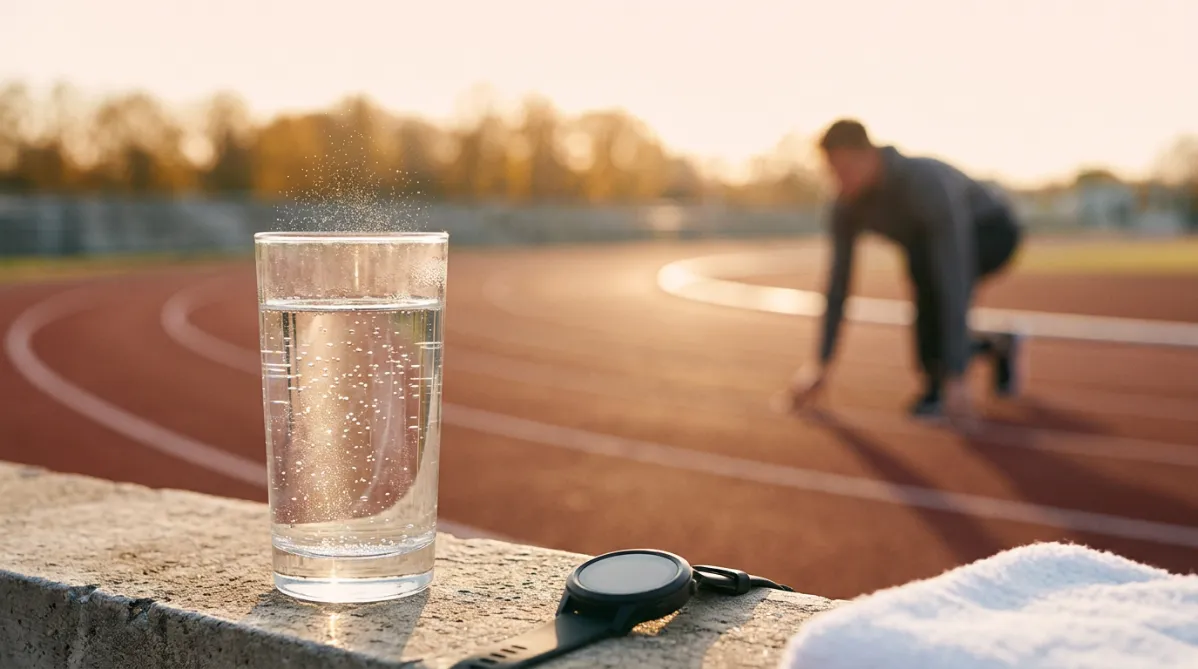
A wide, editorial-style photograph of a clear glass of water on a weathered concrete ledge at the edge of an outdoor running track, shot in soft golden-hour light. Tiny, fine bubbles cling to the inside of the glass and drift upward, catching warm backlight so the water looks luminous and crisp. The glass is about three-quarters full, with delicate condensation beading on its surface. In the softly blurred background, the curved lanes of a terracotta-red track sweep diagonally across the frame, with faint white lane lines leading toward the horizon. A lone sprinter in a charcoal athletic top crouches in a starting position, out of focus, rendered as a muted silhouette. Long shadows stretch across the track, and a hazy line of trees glows amber in the distance.

Foreground details are sharp: a matte black sports watch rests beside the glass, its screen dark, and a folded white towel sits at the edge of the frame. The palette is warm and restrained, with terracotta, sand, soft peach sky, charcoal, and the cool, clean glint of water as the focal accent. Shallow depth of field, 85mm lens look, fine film grain, gentle natural lens flare from the low sun. The composition follows the rule of thirds, with the glass placed on the left third and generous negative space on the right for headline text. The mood is calm, athletic, and modern, like a contemporary health and performance magazine cover, with no text, logos, or futuristic elements.
Science & Research

Sprintlerden Önce Hidrojenli Su: Güç Daha Uzun Korundu ve İyileşme Hızlandı

Dr. Gymbro · · 4 min read

What if a single glass of water, drunk about a minute before you started, could blunt the power drop-off in repeated sprints? That is the claim in a new crossover study from South China Normal University, and the results are interesting enough to take seriously. They are also small enough that you shouldn't rush out and buy a hydrogen machine.

What the researchers actually tested

The team, led by Chen Z and colleagues and published in the Journal of Sports Science and Medicine, recruited 13 male university athletes with an average age of 23.9 ± 2.0 years. Each completed two sessions a week apart. In one, they drank 280 mL of hydrogen-rich water (HRW), made by electrolysing distilled water, at roughly 1600 ppb dissolved hydrogen. In the other, they drank plain distilled water as a placebo.

The drink was consumed within one minute before testing. The workout was brutal in its simplicity: seven all‑out 6‑second cycling sprints, each separated by only 30 seconds of recovery. The design was randomized, placebo‑controlled and crossover, so every athlete served as his own comparison. It was single‑blind, meaning the participants did not know which drink they were getting but the researchers did.

The headline finding: power held up better

Compared with placebo, the HRW trial produced significantly higher average power output (effect size d = 0.61). Total work decrement was significantly lower (d = 0.62), as was the fatigue index (d = 0.64). In plain terms, the athletes' output fell away less across the seven sprints when they had drunk hydrogen water first.

These are moderate effect sizes, not miracle numbers. But repeated‑sprint ability is exactly what decides many moments in team sport, where a player must produce a high‑quality effort again and again with little rest. Slowing the decline, rather than boosting a single peak effort, is the interesting part.

Recovery of the nervous system sped up

The researchers also tracked autonomic nervous system (ANS) recovery through heart rate variability (HRV). After exercise, HRV recovered significantly faster in the HRW trial across several markers: RMSSD (d = 0.62), LF/HF ratio (d = 0.82), sample entropy, or SampEn (d = 0.79), and DFAα1 (d = 0.79).

These measures reflect how quickly the body shifts from a stress‑dominated state back toward parasympathetic, rest‑and‑recover activity. The authors interpret this as faster ANS recovery after hard sprinting. Heart rate, critical flicker fusion frequency (a proxy for central fatigue) and blood lactate were also assessed at baseline, during exercise and through 10 minutes post‑exercise.

The lactate result, and why you shouldn't oversell it

Blood lactate 3 minutes after exercise was about 1 mmol/L lower with hydrogen water (d = 0.64). The authors read this as enhanced lactate clearance. But the difference appeared only at the 3‑minute mark; there was no difference at 10 minutes. That is a narrow window, and it means the lactate story is weaker than the power and HRV findings.

How to use this idea: dose, timing, who it suits

This is what the study used, not a proven prescription:

  • Dose: 280 mL of HRW at approximately 1600 ppb dissolved H2.
  • Timing: Drunk within about 1 minute before the session. Dissolved hydrogen escapes quickly, so a freshly opened or freshly produced drink matters in principle.
  • Who it might suit: Athletes whose sport rewards repeated short, maximal efforts, such as team‑sport players, sprinters and HIIT‑style trainees. The protocol used 6‑second sprints with 30‑second rests, so the findings map best onto that type of work.
  • Who it hasn't been tested on: Women, older adults, non‑athletes, or endurance athletes. The study enrolled only young male university athletes.

The caveats that matter

Honesty is the whole point here, so consider these limits:

  • Tiny sample. Just 13 men took part. Small crossover studies can produce results that don't replicate.
  • Single‑blind only. The researchers knew who got which drink, and hydrogen water is hard to blind perfectly. Expectation effects on all‑out effort are a genuine concern.
  • Acute only. This tested one dose before one session. It says nothing about daily use, training adaptation, or long‑term benefits.
  • Lactate difference was brief. It appeared at 3 minutes post‑exercise and was gone by 10.
  • Lab protocol. Cycling sprints on an ergometer are not the same as a field‑sport match.

The authors themselves frame the results as suggesting, not proving, that acute HRW attenuates power decline, accelerates ANS recovery and enhances lactate clearance.

Bottom line

This study offers a promising early signal: one small glass of hydrogen‑rich water, taken right before repeated sprints, was linked to better power maintenance and faster autonomic recovery in a small group of young male athletes. It is not definitive. If you are curious and already do sprint or HIIT work, a trial is low‑risk in principle, but treat it as an experiment rather than a proven edge. Larger, double‑blind studies, including women and field‑based sport, would show whether this effect holds up.
Original study

Read the original research on pubmed.ncbi.nlm.nih.gov →

This article summarizes published research for general information. It is not medical advice.

DG

Written by

Dr. Gymbro

Dr. Gymbro writes for Dr. Gymbro: science-backed fitness, nutrition & performance.

Related Articles

supplements

Rhodiola Zirve Sprint Gücünü Artırdı ve Laktatı Düşürdü—Ama Hepsi Değil

BY DR. GYMBRO ·

Üç günlük Rhodiola rosea yükleme protokolü, tam gaz bir Wingate sprintinde zirve gücünü artırdı ve ardından 3, 10 ve 20 dakikada kan laktatını düşürdü. Ancak ortalama güç ve toplam işte bir iyileşme görülmedi. Çalışma, 23 genç antrenmanlı erkeği ve 5 günlük bir yıkama süresini içeren çapraz geçişli bir deneme içeriyordu. Araştırmacılar, laktat üzerindeki etkinin mekanizmasının hâlâ belirsiz olduğunu belirtiyor. İşte protokol, kime uygun olabileceği ve kanıtların neyi söylemediği.

A wide, editorial-style flat lay photographed from above on a pale oat-colored linen surface in soft morning window light. On the left, a small matte white ceramic cup of black coffee with a delicate swirl of steam, beside a few scattered roasted coffee beans. On the right, a second matte sage-green ceramic cup holding a pale, creamy golden tea-like drink, mirroring the first. Between them, two small glass vials with cork stoppers sit side by side: one holding fine white powder, the other holding slightly warmer cream-colored powder, with a tiny brass measuring spoon resting nearby. In the lower foreground, a slim wooden rowing oar lies diagonally across the frame, its blade edge softly entering from the right, painted a muted navy with a thin terracotta stripe. A minimalist analog stopwatch with a brushed-steel case rests near the oar, and a folded cream notebook with a thin pencil suggests data-taking. In the upper corner, a crescent-shaped dried eucalyptus sprig and a small folded gray wool throw hint at sleep and calm without being literal. The palette is warm and restrained: oat, cream, sage, soft navy, terracotta, and espresso brown. Shadows are long and gentle, with shallow depth of field and subtle film grain, giving a refined, modern wellness-magazine feel. Generous negative space on the left third of the composition leaves room for a headline overlay. Clean, calm, tactile, and contemporary, with no text, logos, or futuristic elements.
science research

Paraxantin ve Kafein: Kazanan Kombin ve Uyku Kurtarıcısı

BY DR. GYMBRO ·

Paraxantin, kafeinin ana metaboliti olarak 14 erkek kürekçi üzerinde yapılan bir çalışmada kafeinle yan yana karşılaştırıldı. 200 mg’lık her iki maddeyle yapılan kombinasyon, 2000 metrelik kürek testinde plaseboyu geride bıraktı; ancak etkisi sınırlıydı (d = 0.30). Tek başına hiçbir bileşen performansı anlamlı ölçüde artırmadı. Öte yandan, sadece paraxantin uyku kalitesi açısından daha olumlu sonuçlar verdi. İşte çalışmanın bulguları, sınırlamaları ve kimlerin fayda sağlayabileceği.

A wide, editorial-style photograph of a lone cyclist's legs and torso mid-sprint on a stationary indoor bike in a bright, minimalist performance studio. The scene is shot from a low three-quarter angle with shallow depth of field. The cyclist wears matte charcoal shorts and a fitted sage-green top, with a subtle sheen of sweat catching soft window light. Their hands grip the handlebars and the pedals are caught in a slight motion blur, which conveys explosive effort.

In the foreground, slightly out of focus on a pale oak side table, sit a small matte white scoop and a clear glass of water. Next to them is a little ceramic dish holding a few off-white capsules and a pinch of fine white powder. A folded linen towel and a slim stopwatch rest nearby. The stopwatch face is softly legible, hinting at timed sprint intervals.

The background is warm cream concrete and pale wood, with tall windows casting long diagonal shafts of golden morning light across the floor. Faint dust motes drift in the light. On the wall behind, a clean, abstract line graph is painted in muted terracotta and deep teal. It shows one line rising in steps like five sprint bouts and another line gently falling, a subtle visual nod to power up and lactate down. The graph is minimal and stylized, with no readable numbers or text.

The color palette is earthy and modern: sage green, terracotta, warm cream, soft charcoal, and touches of natural wood. The lighting is soft and directional with gentle highlights and natural shadows. The overall look is calm, refined, and contemporary, like a premium wellness and sports science magazine cover. The composition follows the rule of thirds, with the cyclist on the right and open negative space on the left for a headline. The image is crisp, grainy in a subtle film-like way, and free of any futuristic or sci-fi elements.
science research

Bu Karnitin Formu Sprint Gücünü %15’e Kadar Artırdı ve Laktatı Düşürdü

BY DR. GYMBRO ·

2009 yılında yapılan bir çapraz çalışma, tek seferlik 4,5 g glisin propiyonil‑L‑karnitin (GPLC) dozunun beş tam süren bisiklet sprintinde zirve ve ortalama sprint gücünü %2,6 ile %15 arasında artırdığını gösterdi. Kan laktatı da antrenmandan 14 dakika sonra %16,2 daha düşük bulundu. Ancak “%15” ortalama bir artış değil, aralığın üst sınırıdır ve çalışma sadece 24 erkeği tek bir laboratuvarda incelemiştir. Bu makale, GPLC’nin normal L‑karnitin ve ALCAR’dan nasıl farklı olduğunu, azot oksit teorisinin nerede yattığını ve kimlerin fayda sağlayabileceğini ayrıntılı olarak açıklıyor. Ayrıca dozaj, zamanlama ve kanıtların sınırlamalarına da değiniyor.

A wide, softly lit editorial flat-lay on a pale warm-gray stone countertop, shot from slightly above. On the left, a small rustic ceramic bowl in matte cream holds a handful of dried guarana seeds, dark glossy brown with pale cream arils, a few spilling onto the surface. Beside it sits a halved fresh guarana fruit in vivid red-orange, split open to show the white flesh and black seed inside, looking like a tiny eye. On the right, two open clear capsules rest side by side. One is filled with fine white caffeine powder, the other with a fine earthy brown guarana powder, and a little of each dusts the stone in delicate, deliberate lines. Between them, a minimalist matte-black espresso cup with a thin ribbon of steam rises on the right edge of the frame. A brushed-steel stopwatch and a slim dark-green linen notebook with a pencil sit in the upper background, slightly out of focus, to hint at performance testing without clutter. A few green leaves of a guarana vine curve in from the top-left corner, catching soft light.

The lighting is natural window light from the left, with gentle long shadows and a subtle warm highlight on the seeds. The palette is muted and modern: warm creams, terracotta red, deep espresso brown, sage green, and charcoal accents. The background is clean with generous negative space on the upper right for headline text. Shallow depth of field, crisp focus on the seeds and capsules, fine grain, and a calm premium magazine look like a contemporary wellness and sports-science journal. No people, no text, no logos, no futuristic elements.
science research

Guarana vs Kafein: Aynı Dozda Sadece Guarana Zirve Gücünü Artırdı

BY DR. GYMBRO ·

Aynı kafein dozunda uygulanan bir çalışma, sadece guarananın istatistiksel olarak anlamlı bir zirve güç artışı sağladığını gösterdi. 18 aktif genç erkekte yapılan randomize, çift kör, çapraz geçişli bir araştırmada, guarana plaseboya göre %4,0 daha yüksek zirve güç çıkışı verirken, anhidroz kafein hiçbir anlamlı fark yaratamadı. Ancak iki takviye arasındaki farklar istatistiksel olarak üstünlük sağlamadı; aradaki farklılıklar sadece tanımlayıcı düzeydeydi. Sayılar ne diyor, çalışmanın sınırlamaları neler ve guaranayı kafein içeriğine göre nasıl dozlamalısınız, bunları inceleyelim.

This page is available in