Dr. Gymbro
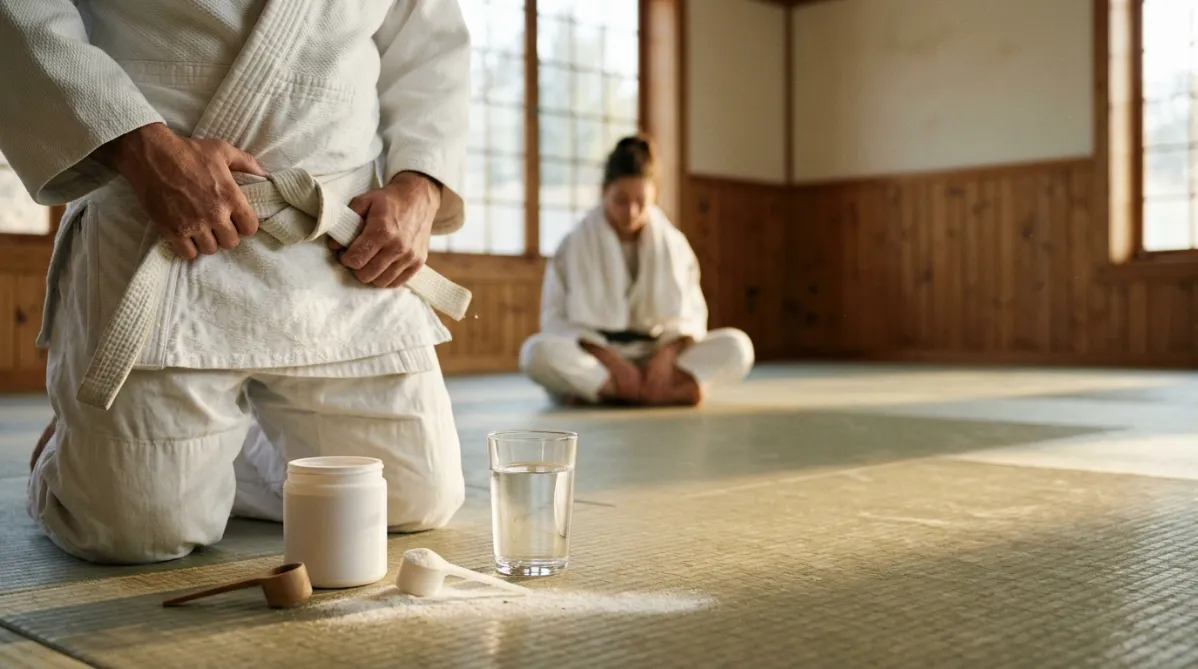
A cinematic, editorial-style photograph of a judoka's hands adjusting a worn white judo gi belt on a tatami mat, shot in soft late-afternoon light streaming through tall dojo windows. In the foreground on the mat sits a small matte white supplement tub with a wooden scoop resting beside it. A single level scoop of fine white powder is spilled in a gentle arc across the straw-colored tatami texture. Beside it is a clear glass of water catching warm golden highlights, with delicate condensation on the surface.

In the softly blurred background, a second athlete in a crisp white gi sits cross-legged, towel draped over the shoulders, head slightly bowed in post-training stillness. Warm wood paneling and a pale plaster wall create a calm, minimalist backdrop. A subtle muted sage-green and cream color palette dominates, with accents of warm amber from the light and a soft terracotta tone from a folded towel.

Composition follows the rule of thirds, with the supplement and spilled powder at lower left and negative space on the right for a title overlay. Shallow depth of field, 50mm lens look, gentle film grain, natural color grading reminiscent of a modern wellness or sports-science magazine. Clean, tactile, understated, and contemplative. Dust motes float in the sunbeams. There is no text, no logos, and no digital effects, just authentic materials: cotton, wood, straw, glass, and powder.
Recovery

Одна доза HMB після дзюдо‑боїв підвищила антиоксидантні ферменти — не креатинкиназу

Dr. Gymbro · · 3 min read

Вважаєте, що HMB — це чарівна таблетка для відновлення? Новий пілотний дослід серед елітних дзюдоістів каже: не так швидко. Сподіванням було зниження м’язових пошкоджень, проте цей показник залишився без змін. Однак інший ефект виявився значним.

Дослідження, опубліковане у Journal of the International Society of Sports Nutrition, надало елітним дзюдоістам одну дозу HMB у вільній формі (HMB‑FA) після інтенсивного блоку імітованих олімпійських поєдинків. Маркер, який більшість людей асоціює з м’язовим ушкодженням, креатинкиназа (CK), не показав різниці між групами. Три антиоксидантні ферменти, навпаки, значно підвищилися в групі, яка отримувала HMB.

Що саме робили дослідники

Тайебі, Мірзаєй та Стут провели рандомізоване, подвійне сліпе, плацебо‑контрольоване пілотне випробування. Двадцять два чоловіки‑елітні дзюдоісти були розподілені на дві групи: одна отримала 1,0 г HMB‑FA (бренду BetaTOR®), інша – плацебо. Добавку приймали після чотирьох імітованих олімпійських поєдинків, а не перед ними.

Кров брали у трьох точках: до тренування, одразу після четвертого поєдинку та через дві години після завершення. Вимірювали CK та лактатдегідрогеназу (LDH) як маркери м’язового ушкодження. Також визначали активність каталази (CAT), глутате‑пероксидази (GPX), супероксиддисмутази (SOD), малонової діальдегіди (MDA – маркер окисного стресу) та загальну антиоксидантну спроможність (TAC). Один учасник з групи плацебо випав через травму, залишилось 21 досліджуваний.

Сюрприз: маркери ушкоджень не змінилися

Якщо ви купували HMB, розраховуючи зменшити біль і розпад м’язових волокон, ця новина вас розчарує. Різниці в CK не виявлено, аналогічно не змінилися MDA та TAC (усі p > 0,05). За цими показниками одинична доза HMB‑FA після бою не знизила м’язове ушкодження чи окисний стрес.

Результат щодо LDH теж не є вигодою HMB. У обох груп LDH знизилася, проте у плацебо‑групи падіння було більш вираженим (‑29,9 %) порівняно з HMB‑FA (‑18,6 %) і взаємодія груп × часу була статистично значущою (p = 0,001). Автори підсумували, що гостра доза HMB‑FA не вплинула суттєво на маркери м’язового ушкодження.

Поворот: антиоксидантні ферменти підскочили

Ось що робить дослідження цікавим. Для трьох ферментів спостерігалися значущі взаємодії груп × час:

  • Каталаза (CAT): +54 % у групі HMB‑FA (p < 0,001)
  • Глутате‑пероксидаза (GPX): +38 % (p = 0,031)
  • Супероксиддисмутаза (SOD): +16 % (p = 0,025)

У групі плацебо підвищення склали лише 7–14 %. Тобто HMB‑FA сприяв більшому зростанню власних антиоксидантних захисних систем. Автори підкреслюють, що цей ефект був тимчасовим і фермент‑специфічним.

Важливо пам’ятати, що це зміни активності ферментів, а не загальної антиоксидантної спроможності. TAC і MDA між групами не відрізнялися, тому підвищення ферментів не відобразилося на загальному стані окисного стресу. Дослідники закликають до використання більш чутливих маркерів та клітинних тестів у майбутніх дослідженнях.

Чому треба бути обережним

Це невеликий пілотний дослід: 22 випадки, 21 проаналізовано, усі — чоловіки‑елітні дзюдоісти. Перевірена лише одна доза, прийнята один раз. Це нічого не говорить про ефекти при щоденному прийомі протягом тижнів, що є звичайною практикою.

Автори також зазначають обмеження методик та час вимірювань. Кров брали лише до двох годин після боїв, тому невідомо, чи зміни ферментів впливають на болісність наступного дня, продуктивність чи тренування наступного дня. Ці результати не були виміряні. Конфліктів інтересів не виявлено, що позитивно, проте пілотний характер дослідження означає, що воно генерує гіпотези, а не дає остаточні висновки.

Практичні висновки: доза, час і цільова аудиторія

  • Перевірена доза: 1,0 г HMB‑FA, один раз.
  • Перевірений час: відразу після четвертого імітованого поєдинку, не перед тренуванням і не протягом декількох днів.
  • Популяція: чоловіки‑елітні дзюдоісти. Результати можуть не поширюватися на аматорів, жінок або інші види спорту.
  • Що спрацювало: підвищення активності CAT, GPX та SOD.
  • Що не спрацювало: зміна CK, MDA або TAC у порівнянні з плацебо.

Чесний висновок: чи варто купувати HMB для відновлення?

Виходячи лише з цього дослідження, ні, це не доведений засіб для відновлення. Найбільш популярний маркер м’язового ушкодження не покращився, LDH знизилася менш вигідно, а даних про підвищену продуктивність чи зниження болю немає. Результат щодо антиоксидантних ферментів цікавий і заслуговує подальшого вивчення, але підвищення їх активності не означає швидше відновлення.

Якщо ви вже приймаєте HMB з інших причин, це дослідження нічого не заперечує, однак не виправдовує інвестиції в однократну дозу після тренування з метою пришвидшення відновлення. Для спортсменів бойових мистецтв у турнірних умовах це обіцянка, а не рекомендація. Наступним кроком мають стати більші дослідження з повторними прийомами, точнішими маркерами окисного стресу та реальними кінцевими показниками відновлення, такими як біль у м’язах та продуктивність наступного дня.

Поки що розглядайте HMB як «можливо», що має захоплюючу біохімічну нотатку, а не як швидку доріжку до відновлення.
Original study

Read the original research on pubmed.ncbi.nlm.nih.gov →

This article summarizes published research for general information. It is not medical advice.

DG

Written by

Dr. Gymbro

Dr. Gymbro writes for Dr. Gymbro: science-backed fitness, nutrition & performance.

Related Articles

A sunlit, minimalist home gym corner photographed in soft golden morning light, with a young athletic man seated on a wooden bench, leaning forward with his elbows resting on his knees, catching his breath after a hard leg session. He wears a muted sage-green t-shirt and charcoal shorts, his face turned slightly away from the camera, calm and focused. A matte ceramic dish in the foreground holds a few small, translucent golden softgel capsules, with a glass of water beside it catching the light and casting a soft caustic shadow across a pale oak floor. Behind him, a loaded barbell rests on a squat rack, slightly out of focus, and a tall window pours warm sunlight diagonally across the scene, creating long gentle shadows and a hazy glow. A small potted green plant sits on a shelf at the edge of the frame. The color palette is warm and editorial: cream, soft gold, sage green, pale wood, and charcoal accents. Shallow depth of field, with crisp focus on the capsules and glass in the lower third and a creamy bokeh background. The composition leaves generous negative space on the right side for a headline overlay. The mood is clean, modern, and aspirational, like a high-end wellness magazine or a trendy health journal feature. Shot on a 50mm lens, natural light, fine film grain, subtle matte finish, landscape 16:9 framing.
recovery

Вітамін D прискорює відновлення сили у чоловіків без дефіциту

BY DR. GYMBRO ·

Чоловіки з цілком нормальним рівнем вітаміну D все ж відновлювали силу швидше після інтенсивного тренування ніг, коли щодня приймали 4 000 МО. У цьому рандомізованому плацебо‑контрольованому дослідженні 28 активних чоловіків показали приблизно 8 % кращий пік ізометричної сили вже через 24 години. Маркери м’язового пошкодження (ALT і AST) підвищувалися менш виразно, але біль у м’язах не знизився.

A wide editorial still life shot from a slightly elevated angle on a pale ash-wood bench in a bright, airy training hall. In the center sits a small matte ceramic dish holding a few translucent coral-red softgel capsules, their glossy surfaces catching soft window light. Beside the dish rests a folded white taekwondo dobok with a black belt loosely coiled on top. A sprig of fresh red microalgae-toned seaweed and a halved blood orange add natural color accents. A clean glass of water with subtle condensation stands to one side.

In the softly blurred background, the silhouette of a martial artist in a white uniform stretches near tall windows, with diffused morning light streaming across a sprung wooden floor. A pair of red and blue sparring gloves hangs on a minimal wall hook. Thin, elegant shadows stretch across the bench.

The palette is restrained and modern: warm off-white, soft sand, muted charcoal, with a vivid coral-red accent pulled from the capsules. Shallow depth of field, crisp focus on the capsules and dish, creamy bokeh behind. Natural, gentle lighting with a subtle film-like grain, reminiscent of a contemporary wellness and science magazine cover. Generous negative space on the left third of the frame for headline text. Calm, precise, and quietly athletic in mood, with no text, logos, or futuristic elements.
science research

12 мг астаксантину протягом 28 днів: пошкодження м’язів і вигорання у бойових спортсменів

BY DR. GYMBRO ·

У новому рандомізованому дослідженні випробували вплив 12 мг щоденної дози астаксантину у молодих чоловіків‑спортивних таеквондистів. Через 28 днів група, яка отримувала добавку, продемонструвала інший динамічний профіль креатинкінази, підвищений рівень SOD і тенденції до зниження MDA та меншого емоційного‑фізичного вигорання. Проте результати щодо вигорання залишаються дослідницькими, без значущої взаємодії група × час. Дослідження було невеликим і орієнтувалося на біомаркери, а не на спортивну продуктивність. Ось що показали дані, чого вони не доводять і кому варто звернути на це увагу.

A wide, softly lit editorial still life on a warm off-white linen surface. At the center-left, a matte ceramic bowl holds a small mound of fine golden-yellow quercetin powder, with a few scattered capsules beside it. Next to the bowl sit fresh red onions (one halved to show its translucent purple layers), a few capers, and a small cluster of ripe apples with the skin on, all natural quercetin sources. On the right side of the frame, a sleek matte-black dumbbell rests at an angle beside a folded slate-gray gym towel. A minimalist glass beaker of water with a thin lemon slice sits just behind it.

Soft diffused morning window light enters from the upper left, casting gentle long shadows and subtle highlights on the powder and glossy onion skin. The color palette is muted and sophisticated: butter yellow, deep plum, warm cream, charcoal, with small touches of sage green from a single eucalyptus sprig. A subtle, out-of-focus background of pale plaster wall and a wooden shelf adds depth.

Shallow depth of field, shot from a slightly elevated three-quarter angle with a 50mm lens feel. Generous negative space in the upper right for a title overlay. The mood is clean, calm, and modern, like a premium wellness and science journal feature: tactile textures, natural materials, restrained composition, high-end editorial photography, and no text or logos.
science research

1 г/день кверцетину перед ексцентричними підйомами: поворот IGF

BY DR. GYMBRO ·

Що станеться, якщо протягом 14 днів перед інтенсивними ексцентричними підйомами приймати 1 г кверцетину щодня? У малому плацебо‑контрольованому крос‑овер дослідженні виявлено зниження маркерів м’язового ушкодження (CK, LDH, міоглобін) і IL‑6, а також посилення реакції IGF‑I та ранній пік IGF‑II. Оскільки дослідження включало лише 12 чоловіків і не містить даних про гіпертрофію, це обнадійливий сигнал для відновлення, а не гарантія росту м’язів.

A wide, softly lit editorial still life on a pale oatmeal linen surface. In the center sits a tall, clear glass filled with deep garnet-red tart cherry juice, with condensation beading on the outside and a faint ruby glow where light passes through it. Around it are a scattering of fresh Montmorency cherries, some with stems and some halved to show pale amber flesh and a single pit. A few drops of juice have splashed onto the linen, leaving small crimson stains. To the right, slightly out of focus, lies a folded charcoal-gray running shirt, a pair of minimalist off-white running shoes, and a small brushed-steel kettlebell, suggesting both endurance and strength training without a gym in view. On the left, a ceramic pitcher in matte sage green holds more juice, and a sprig of fresh mint adds a small contrast.

Window light comes from the upper left, casting long, gentle shadows and creating a warm morning feel. The palette is restrained and modern: deep burgundy, cream, sage, and soft slate, with plenty of negative space in the upper right for headline text. The camera angle is a shallow three-quarter view from slightly above, with a shallow depth of field. The foreground cherries are razor sharp and the background melts into a creamy blur. Subtle film grain, natural color grading, and a clean, minimalist composition give it the polished feel of a contemporary health and science magazine. No text, no logos, no people, and no futuristic elements. The overall mood is calm, fresh, and restorative, hinting at recovery and balance.
recovery

Трюк з кислим вишневим соком: швидше відновлення сили й нижчий рівень IL‑6

BY DR. GYMBRO ·

Бігуни‑марафонці та штангісти клянуться вишневим соком за швидше відновлення, і плацебо‑контрольоване дослідження випробувало цю звичку. У 20 спортсменів ізометрична сила відновилася значно швидше (P=0,024), а рівень IL‑6, CRP і сечовини знизився, а антиоксидантний статус підвищився приблизно на 10 %. Однак креатинкіназа, ЛДГ і м’язова болючість не змінилися суттєво, тому картина складніша, ніж обіцянки реклами. Далі – що саме робили, що виявили і кому це може бути корисним.

This page is available in