Stretching Your Way to Muscle Growth: New Study Reveals How 15-Minute Sessions Build Strength
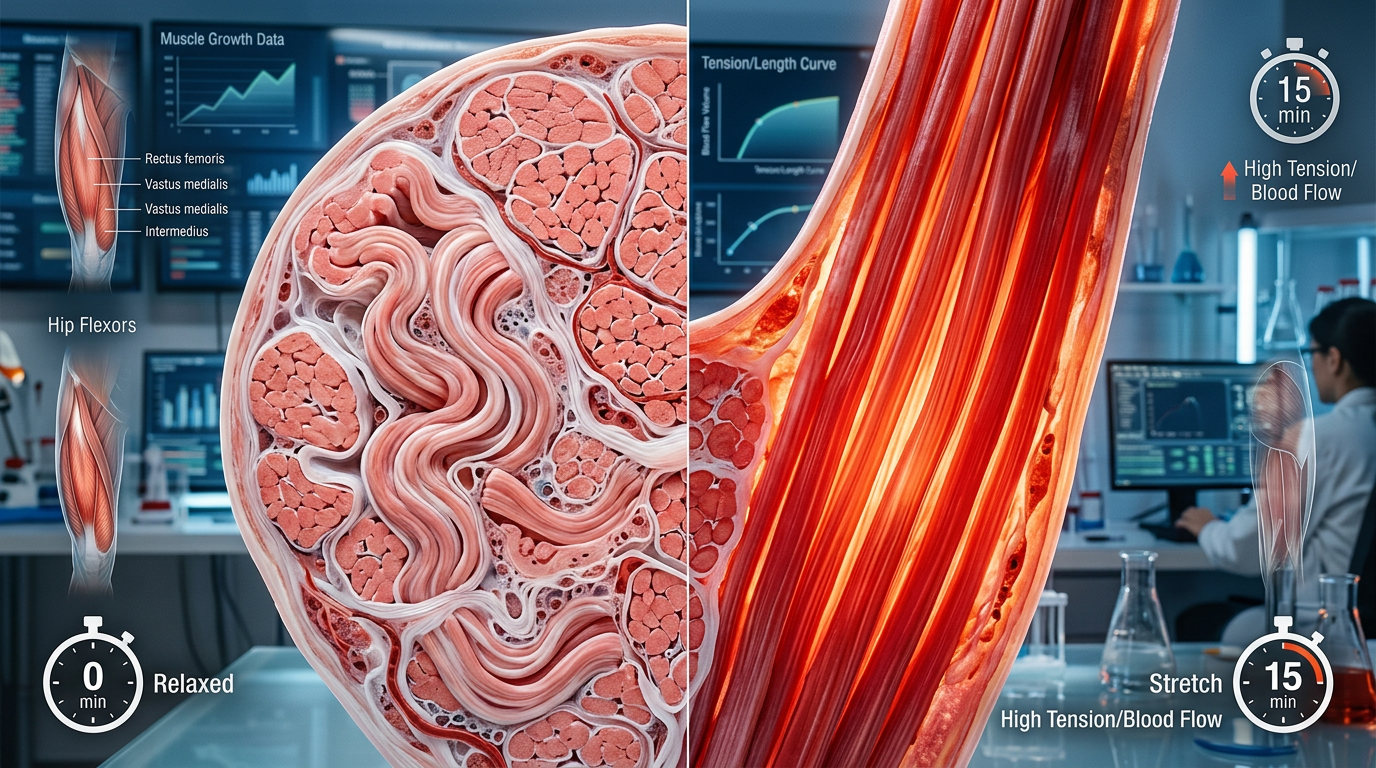
A groundbreaking study from the University of Graz has overturned conventional wisdom about muscle building, demonstrating that high-intensity stretching alone can trigger significant muscle growth and strength gains. The research, published in Scientific Reports, shows that just 15 minutes of supervised stretching performed three times per week can produce measurable hypertrophy in the quadriceps muscles.
The Science Behind Stretch-Mediated Growth
The study followed 49 recreationally active participants over a 4-5 week period, with half undergoing a specialized hip flexor stretching protocol while the control group maintained their normal activities. Using ultrasound imaging, researchers measured muscle thickness changes in the rectus femoris and vastus lateralis muscles before and after the intervention.
The results were remarkable: participants who performed the stretching protocol showed significant increases in muscle thickness, particularly in the rectus femoris muscle. The proximal region of this muscle demonstrated effect sizes ranging from 0.24 to 0.41, while the distal region showed effect sizes between 0.14 and 0.40 - indicating moderate to large improvements in muscle size.
Strength Gains Without Weights
Beyond muscle growth, the stretching intervention also produced measurable strength improvements. Participants demonstrated significant increases in isometric leg extension strength when tested at a 70-degree knee angle, representing the muscle's shortened position. Interestingly, these strength gains were position-specific, appearing only at the shortened muscle length and not at the 110-degree (lengthened) position.
The strength improvements varied between legs, with effect sizes of 0.09 for the right leg and 0.21 for the left leg - suggesting that individual responses to stretch-mediated training may vary based on limb dominance or other factors.
Balance Benefits: An Unexpected Bonus
Perhaps most surprising was the study's finding that the stretching protocol improved dynamic balance performance. Participants showed enhanced stability in multiple directions: anterior movement for the left leg, posterolateral movement for the left leg, and posteromedial movement for the right leg. These improvements in balance could have significant implications for injury prevention and athletic performance.
Implications for Training and Rehabilitation
This research opens new possibilities for individuals who cannot participate in traditional resistance training due to injury, equipment limitations, or other constraints. Dr. Konstantin Warneke, the lead researcher, notes that this represents the first study exploring stretch-mediated effects specifically on the quadriceps muscles, building on previous research that focused primarily on lower leg muscles.
The findings suggest that high-volume, high-intensity stretching could serve as a viable alternative or complement to traditional strength training protocols. This is particularly relevant for rehabilitation settings, where patients may have limited ability to perform conventional resistance exercises but could benefit from supervised stretching programs.
While more research is needed to explore optimal protocols, different muscle groups, and clinical applications, this study provides compelling evidence that the simple act of stretching - when performed with sufficient intensity and duration - can produce meaningful physiological adaptations typically associated with resistance training.