Dr. Gymbro
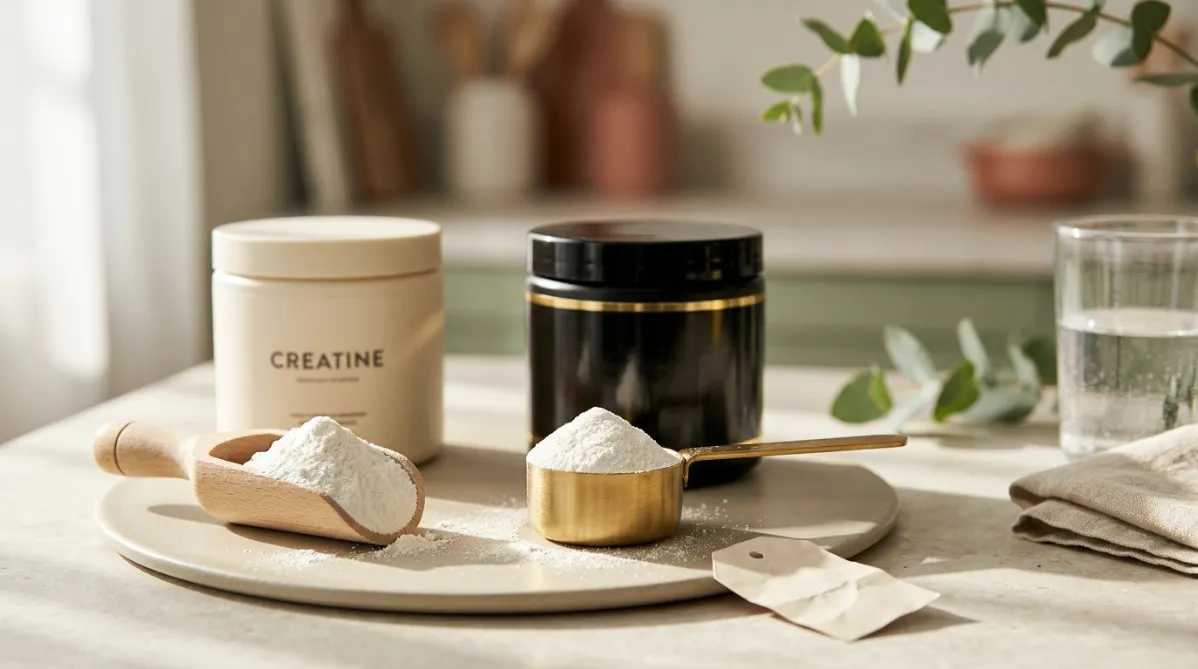
A wide, landscape editorial photograph of a clean, sunlit kitchen counter or pale stone tabletop, styled like a modern wellness magazine spread. Two scoops sit side by side on a matte ceramic surface. The left one is a plain, humble wooden scoop heaped with fine white creatine powder. The right is a glossy, ornate brushed-gold scoop holding the same white powder, which hints at "premium" branding. Behind each scoop stands a tub. The left tub is minimal, matte, and cream-colored with simple sans-serif lettering and no readable words. The right tub is sleek black with metallic gold accents and an overly polished look. A few fine grains of powder are scattered across the surface, catching the light.

The composition uses a shallow depth of field. The foreground scoops are crisp, and the background softly blurs into a warm neutral palette of oatmeal, soft sage green, and muted terracotta. Soft morning window light comes in from the left, casting long, gentle shadows and a subtle highlight along the scoops' edges. A small price tag shape, blank and unmarked, sits near the gold scoop, with a slightly crumpled paper texture to suggest the "pricey" angle without any text. A glass of water with condensation and a folded linen napkin sit at the edge of the frame. A single green sprig or eucalyptus stem adds a natural accent.

The overall mood is calm, intelligent, and quietly skeptical, with the plain option feeling confident and the flashy one a bit overdressed. The color grading is soft and slightly desaturated with creamy highlights, and there is fine film grain. The layout leaves generous negative space on the right third for a headline overlay. It looks like a high-end lifestyle and science journal cover, with a minimalist, tactile, trendy feel and no futuristic or sci-fi elements.
Science & Research

Creatin‑Ethylester vs. Monohydrat – die teure Variante verliert

Dr. Gymbro · · 4 min read

Creatin‑Ethylester vs. Monohydrat – die teure Variante verliert

Supplement‑Marketing liebt das Wort „fortschrittlich“. Wenn eine Grundzutat seit Jahrzehnten erforscht ist, vermarktet jemand eine abgewandelte Version als besser absorbiert, wirksamer und magenfreundlicher. Creatin‑Ethylester (CEE) ist ein Paradebeispiel. Eine randomisierte, doppelblinde Studie aus dem Jahr 2009, veröffentlicht im Journal of the International Society of Sports Nutrition, stellte CEE dem klassischen Creatin‑Monohydrat gegenüber – und die neuere Form überzeugte nicht.

Was CEE behauptet

Creatin‑Monohydrat ist der Standard, die Form, die in den meisten Forschungsstudien zum Einsatz kommt. Viele alternative Formulierungen wurden entwickelt, um die Aufnahme zu maximieren; bei CEE hieß das Versprechen, die Bioverfügbarkeit zu erhöhen. Das Konzept ist simpel: Man füge dem Creatin eine Ethyl‑Ester‑Gruppe an, sodass es schneller in den Blutkreislauf und in die Muskulatur gelangen soll. Dadurch könne man weniger einnehmen und dennoch denselben Nutzen erzielen.

Spillane und Kolleg:innen stellten diese Annahme auf die Probe. Die Frage lautete, ob CEE das Serum‑ und Muskel‑Creatin erhöhen und die Trainingsergebnisse mindestens genauso gut wie Monohydrat verbessern würde.

Studiendesign und Dosierung

Die Forscher rekrutierten 30 gesunde Männer, die bislang kein Krafttraining betrieben hatten. Diese wurden randomisiert und doppelblind einer von drei Gruppen zugeteilt:

  • Placebo (Maltodextrin)
  • Creatin‑Monohydrat (CRT)
  • Creatin‑Ethylester (CEE)

Alle Absolvierten ein intensives Kraft‑Trainingsprogramm über sieben Wochen. Das Supplement‑Protokoll bestand aus einer Ladephase von 0,30 g pro kg fettfreier Körpermasse (ca. 20 g/Tag) für fünf Tage, gefolgt von einer Erhaltungsdosis von 0,075 g / kg fettfreie Masse (ca. 5 g/Tag) für die restlichen 42 Tage. Jede Gruppe erhielt also exakt die gleiche Menge an Creatin – ausschließlich die chemische Form unterschied sich.

Gemessen wurden: Körperzusammensetzung, Muskelmasse, Kraft und Schnellkraft, Serum‑ und Muskel‑Creatin sowie Serum‑Kreatinin.

Die Serum‑Kreatinin‑Erkenntnis

Dieses Ergebnis spricht für sich selbst. Das Serum‑Creatin war im Placebo‑ und im Monohydrat‑Team signifikant höher als im CEE‑Team (p = 0,007 bzw. p = 0,005). Ein „besser absorbiertes“ Creatin, das weniger im Blut verbleibt, passt also nicht zu den Marketing‑Behauptungen.

Gleichzeitig war das Serum‑Kreatinin – das Abbauprodukt von Creatin – im CEE‑Team deutlich höher als im Placebo (p = 0,001) und im Monohydrat‑Team (p = 0,001). Dieser Anstieg zeigte sich an den Messzeitpunkten Tag 6, 27 und 48. Das Muster deutet darauf hin, dass CEE eher zu Kreatinin degradiert wird, anstatt als Creatin genutzt zu werden. Die Studie misst zwar nur Blutmarker, nicht die eigentliche Degradationsgeschwindigkeit, aber die Richtung ist klar: Die Ester‑Form hinterlässt mehr Abfallprodukt.

Ein praktischer Nebeneffekt: Serum‑Kreatinin ist ein Standard‑Marker, den Ärzt*innen zur Einschätzung der Nierenfunktion heranziehen. Ein Supplement, das diesen Wert ansteigen lässt, kann routinemäßige Blutuntersuchungen erschweren. Zwar berichtet die Studie nicht von Nierenschäden, aber bei Bluttests sollte die Creatin‑Einnahme dem Arzt mitgeteilt werden, damit die Werte korrekt eingeordnet werden können.

Ergebnisse zum Muskel‑Creatin

Das Muskel‑Creatin‑Profil war differenzierter. Das totale Muskel‑Creatin war sowohl im Monohydrat‑ als auch im CEE‑Team signifikant höher als im Placebo (p = 0,026 bzw. p = 0,041). Zwischen den beiden Creatin‑Formen bestand jedoch kein signifikanter Unterschied – CEE erhöhte also das Muskel‑Creatin gegenüber Placebo, jedoch nicht mehr als Monohydrat.

Die Autor:innen schlossen, dass CEE nicht so effektiv sei wie Monohydrat, wenn es um die Steigerung von Serum‑ und Muskel‑Creatin gehe. Obwohl die Muskelwerte ähnlich waren, sprachen die Serum‑Ergebnisse eindeutig für Monohydrat, und CEE bot keinen zusätzlichen Nutzen.

Gab es Unterschiede bei Kraft oder Größe?

Nein – und das gilt für alle Gruppen. Körperzusammensetzung, Körperwasser, Muskelkraft und Schnellkraft verbesserten sich im Zeitverlauf signifikant, jedoch zeigten sich zwischen den Gruppen keinerlei signifikante Unterschiede. Auch das Placebo‑Team machte Fortschritte, genau wie die beiden Creatin‑Gruppen.

Die Autor:innen folgerten, dass die Verbesserungen höchstwahrscheinlich auf das Training selbst zurückzuführen sind und nicht auf die Supplementierung. Es handelte sich um eine 7‑wöchige Studie mit antriebslosen Anfängern – einer Population, die schnell von fast jedem gut strukturierten Trainingsplan profitiert. Dadurch können kleine Supplement‑Effekte leicht überdeckt werden.

Die Studie beweist nicht, dass CEE niemals Muskelmasse aufbaut, sondern lediglich, dass unter den gegebenen Bedingungen kein zusätzlicher Nutzen erkennbar war. Gleichzeitig zeigte Monohydrat keinen klaren Vorsprung gegenüber dem Placebo bei Kraft, weshalb die Studie besser als „CEE bietet keinen Vorteil“ gelesen werden sollte, statt als Triumph des Monohydrats.

Fazit und praktische Empfehlungen

Das Marketing versprach bessere Aufnahme. Die Daten zeigten niedrigeres Serum‑Creatin, höheres Serum‑Kreatinin, vergleichbares Muskel‑Creatin zum Monohydrat und keinerlei zusätzliche Gewinne in Körperzusammensetzung, Kraft oder Schnellkraft.

  • Bleiben Sie bei Creatin‑Monohydrat. Es ist die am besten erforschte Form und meist die günstigste. Eine gängige Dosierung liegt bei 3–5 g/Tag.
  • Laden ist optional. Die Studie nutzte eine fünftägige Ladephase von etwa 20 g/Tag; eine konstante Tagesdosis erzielt das gleiche Ergebnis langsamer, ist aber ebenso wirksam.
  • Zahlen Sie keinen Aufpreis für „fortschrittliche“ Varianten, solange es keine überzeugenden Head‑to‑Head‑Daten gibt – bei CEE ist das nicht der Fall.
  • Beachten Sie Ihre Blutwerte. Ein erhöhtes Serum‑Kreatinin, besonders bei CEE, kann Nieren‑Tests verwirren. Informieren Sie Ihren Arzt über die Einnahme von Supplements.
  • Training geht vor. In dieser Studie war das Trainingsprogramm der entscheidende Faktor.

Quelle

Spillane M, et al. The effects of creatine ethyl ester supplementation combined with heavy resistance training on body composition, muscle performance, and serum and muscle creatine levels. J Int Soc Sports Nutr. 2009. DOI: 10.1186/1550-2783-6-6. PubMed: 19228401.
Original study

Read the original research on pubmed.ncbi.nlm.nih.gov →

This article summarizes published research for general information. It is not medical advice.

DG

Written by

Dr. Gymbro

Dr. Gymbro writes for Dr. Gymbro: science-backed fitness, nutrition & performance.

Related Articles

A wide landscape editorial photograph of a bright, airy sunlit living room with pale oak floors and a large window with sheer linen curtains. In the center, a woman in her late 50s with silver-streaked hair, wearing soft sage-green athletic wear, rises from a simple wooden chair, caught mid-motion with a calm, determined expression. Her hands are lightly extended forward for balance. Beside her on a small round oak side table sits a ceramic mug of tea, a glass of water, and a small matte white jar with a wooden scoop resting beside it, a few fine white crystalline grains scattered on the tabletop. In the soft-focus foreground, a pair of light-gray dumbbells and a rolled terracotta-colored yoga mat rest on the floor. A trailing green pothos plant spills from a shelf in the background, with a stack of books and a small analog kitchen timer nearby.

The color palette is warm and muted: cream, sage green, soft terracotta, natural wood, and gentle morning-gold light. Light streams diagonally across the scene, creating long soft shadows and a subtle glow on the woman's shoulders. Shallow depth of field blurs the background gently, while the woman and the table remain crisp. The composition follows the rule of thirds, with the woman on the right and generous negative space on the left, suited for headline overlay. The mood is hopeful, grounded, and modern, like a high-end wellness magazine or a trendy health journal. Natural film-like grain, soft contrast, and a slight matte finish give it a contemporary lifestyle photography feel. There are no futuristic elements, no digital overlays, and no text.
science research

Kreatin half Frauen mit kniegelenkigen Problemen, besser aufzustehen – aber nicht aus dem Grund, den Sie denken

BY DR. GYMBRO ·

Kreatin wird meist jungen Kraftsportlern zugeordnet, doch eine randomisierte, doppelblinde Studie untersuchte das Supplement bei postmenopausalen Frauen mit Kniearthrose. Nach 12 Wochen Beintraining stieg die Sitz‑zu‑Steh‑Zeit der Kreatin‑Gruppe von 15,7 auf 18,1 Punkte, während die Placebo‑Gruppe praktisch unverändert blieb. Zusätzlich verbesserten sich Steifigkeit, fettfreie Muskelmasse und die Lebensqualität. Schmerzreduktion und maximale Beinpresse‑Kraft hingegen waren nicht besser als beim Placebo.

A modern editorial still life photographed from a slightly elevated angle on a pale, matte stone surface in soft natural window light. On the left, a heaping mound of fine white creatine monohydrate powder spills from a matte ceramic scoop, with a few crisp grains scattered across the surface. In the center, a small, minimalist amber glass capsule bottle sits tipped on its side, with a handful of off-white capsules spilling out. The label is blank and clean. On the right, a neat row of three clear glass lab-style vials rests on a slim oak tray. The vials hold different amounts of white powder: the first nearly empty, the second slightly fuller, the third filled almost to the brim. This quietly suggests the difference in dose and result. Beside the tray lies a simple stainless steel measuring spoon and a folded sheet of cream paper with soft, abstract bar-chart lines in muted sage green and terracotta. The lines are hand-drawn and unlabeled.

Behind the objects, slightly out of focus, a lean athletic forearm in a gray linen sleeve rests on the edge of the surface, one hand loosely holding a matte shaker bottle. This hints at a training context without showing a face. A single sprig of eucalyptus in the corner adds a soft organic touch.

The palette is warm neutral: bone white, oatmeal, soft sage, muted terracotta, and touches of amber. Shadows are gentle and long, with a shallow depth of field that gives creamy bokeh in the background. The mood is calm, clean, and trustworthy, like a premium health and science journal's feature spread, with generous negative space at the top and right for headline overlay. The composition is wide, balanced, and uncluttered, with subtle film-like grain and a natural, true-to-life color grade. No text, no logos, no futuristic elements.
nutrition

Kre‑Alkalyns empfohlene Dosis erhöht Muskelkreatin nicht – Biopsien zeigen es

BY DR. GYMBRO ·

Gepufferte Kreatinprodukte wie Kre‑Alkalyn kosten mehr, versprechen eine bessere Aufnahme, geringere Dosen und weniger Aufblähen. In einer doppelblinden Studie der Texas A&M wurde das mit echten Muskelbiopsien bei 36 trainierten Kraftsportlern über 28 Tage geprüft. Bei der empfohlenen Menge von 1,5 g/Tag zeigte das Muskel‑Kreatin fast keinen Anstieg, während reines Kreatin‑Monohydrat deutlich mehr bewirkte. Kraft, Körperzusammensetzung und Nebenwirkungen zeigten keinen Vorteil für das gepufferte Produkt.

A landscape editorial photograph of a clean, sunlit kitchen-counter or light oak table, shot from slightly above at a gentle angle. Three small matte ceramic bowls in muted sage green, warm sand, and soft white sit in a loose row. Each holds a different fine white powder, and each has a small wooden scoop resting beside it. The middle bowl is slightly closer to the camera and sharper in focus, with a faint dusting of powder spilling onto the surface. In the soft-focus background, a stainless steel shaker bottle and a half-peeled orange sit beside a folded linen napkin, suggesting citrus without being literal. A single lemon wedge sits near the left bowl, and a small dried apricot sits near the right, a subtle visual nod to citrate and pyruvate.

In the background, a blurred athletic scene: a running shoe resting on a wooden bench and a small notebook with a pen, suggesting a training log. Soft diffused morning light enters from the left through a window and casts long, gentle shadows. The palette is warm neutrals, creamy whites, soft greens, and a hint of terracotta orange. The look is a modern wellness magazine with a shallow depth of field, a fine-grain film feel, and generous negative space on the right third of the frame for title text. The mood is calm, trustworthy, and scientific yet approachable, with no text, labels, or logos.
nutrition

Creatin‑Pyruvat vs. Creatin‑Citrat: Eine Form hielt die Kraft länger hoch

BY DR. GYMBRO ·

Zwei ausgefallene Creatin‑Formen übertrafen das Placebo in einer 28‑Tage‑Studie, doch nur eine hielt die Muskelkraft über alle zehn Maximal‑Intervalle hinweg aufrecht, während die andere nachließ. Creatin‑Pyruvat steigerte die Kraft in jedem Intervall (p < 0,001), bei Creatin‑Citrat war der Nutzen bereits beim sechsten Intervall verschwunden. Nur Pyruvat verbesserte zudem die Entspannungsgeschwindigkeit und den Ruhe‑Sauerstoffverbrauch. Bevor du dein Creatin‑Pulver gegen die schicker klingende Alternative austauschst, solltest du den entscheidenden Haken kennen: Die Studie hatte keine Creatin‑Monohydrat‑Gruppe. Hier erfährst du, was die Zahlen zeigen, was sie nicht zeigen können und wie du dich entscheiden solltest.

A wide, editorial-style still life photographed from slightly above on a pale oak surface in soft morning window light. At the center, a small matte white supplement tub with a plain, unlabeled front sits tipped on its side, spilling a modest pile of fine white powder across the wood. Beside it, a wooden scoop rests in the powder, and a few white capsules are scattered in a loose arc. To the left, a clean glass of water catches the light and throws a delicate caustic shadow. To the right, a neatly arranged group of whole foods sits in contrast: two brown eggs, a small wedge of salmon fillet on parchment, a handful of raw almonds, and a sprig of rosemary. A matte black steel dumbbell handle is partly visible at the top edge of the frame, grounding the fitness theme. In the lower foreground, a slim, open linen-bound notebook holds a hand-drawn line graph with a single line trending gently downward, a thin ink pen lying across the page. The palette is muted and warm: cream, soft sage green, pale oak, charcoal accents, and a touch of terracotta from a ceramic dish holding the almonds. Shallow depth of field blurs the background, a softly lit minimalist kitchen counter with a hint of a plant leaf. The mood is calm, thoughtful, and scientific without being clinical, like a cover image for a contemporary health and nutrition journal. Natural shadows, subtle film grain, and generous negative space on the upper left leave room for a headline overlay. Crisp focus on the powder and scoop, with refined, understated composition and no text or logos visible.
nutrition

D‑Aspartinsäure senkte Testosteron bei 6 g/Tag in trainierten Kraftsportlern

BY DR. GYMBRO ·

D‑aspartinsäure wird als natürlicher Testosteron‑Booster vermarktet – doch in einer kontrollierten Studie mit 24 Kraftsportlern senkten 6 g/Tag sowohl das Gesamt‑ als auch das freie Testosteron. Die häufige Dosierung von 3 g hatte keinerlei messbare Wirkung. Eine spätere dreimonatige Untersuchung zeigte außerdem keinen Kraft‑ oder Muskelzuwachs. Das erklärt, warum trainierte Männer anders reagieren als Sitzende und wohin das Geld für Nahrungsergänzungsmittel besser fließen sollte.

This page is available in