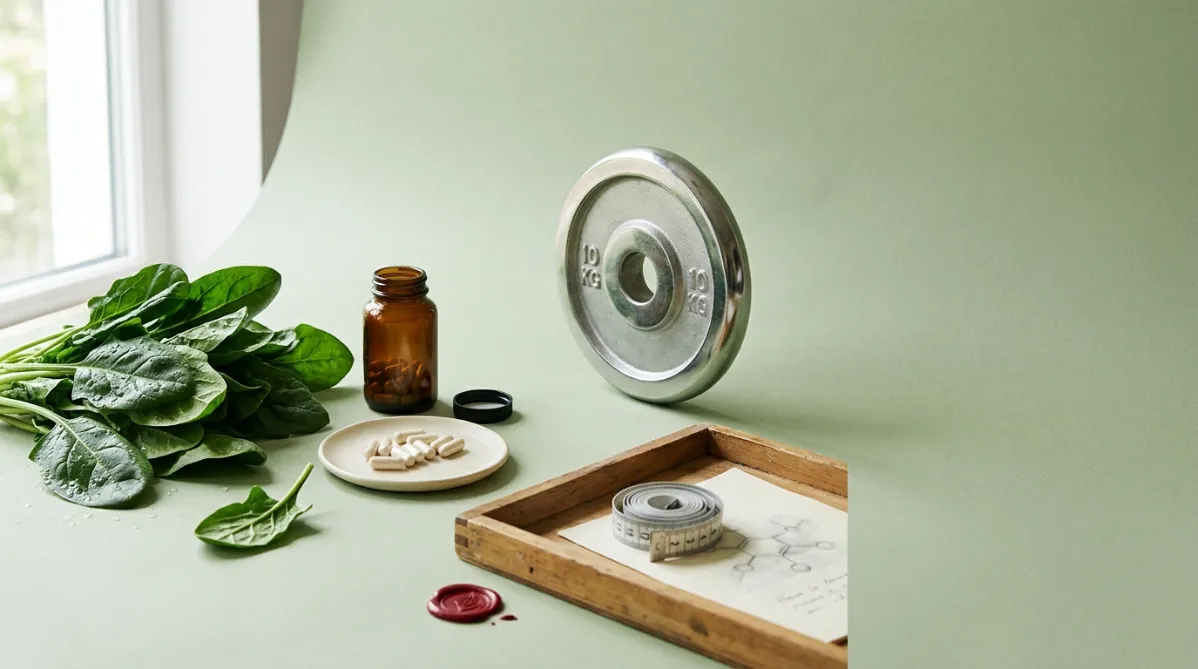
If you've been googling turkesterone, you've probably run into its better-studied cousin: ecdysterone. It's a plant-derived steroid hormone found in sources like spinach. The researchers who tested it in a 10-week lifting trial were funded by the World Anti-Doping Agency (WADA), and they concluded it should be banned.
That's an unusual endorsement for a "natural" supplement. Here is what the study found, what it didn't, and what it means for you.
What the Study Did
The paper is Ecdysteroids as non-conventional anabolic agent: performance enhancement by ecdysterone supplementation in humans, by Isenmann E, Ambrosio G, Joseph JF, Mazzarino M, de la Torre X, Zimmer P, Kazlauskas R, Goebel C, Botrè F, Diel P and Parr MK. It was published in Archives of Toxicology in 2019 (93(7):1807-1816) and is indexed on PubMed.
The design was simple:
- 46 young men completed a 10-week strength-training intervention.
- Participants received different doses of ecdysterone-containing supplements, compared against a control group.
- Blood and urine were analyzed for ecdysterone and potential biomarkers of performance enhancement.
- The team screened participants for prohibited performance-enhancing substances, so the effects could be pinned on ecdysterone and not a hidden drug.
- The supplement itself was tested beforehand for contamination with anabolic steroids.
The contamination checks matter. Supplement trials are often undermined by mislabeled or spiked products, and this one took steps to rule that out.
The Results: What the Numbers Say
The abstract reports two headline outcomes:
- Muscle mass: Participants dosed with ecdysterone showed significantly higher increases in muscle mass than the others.
- Strength: They also showed significantly more pronounced increases in one-repetition-maximum (1RM) bench press.
The researchers also saw the same hypertrophic effect in vitro, in C2C12 myotubes (a mouse muscle cell culture model). On safety, they saw no increase in biomarkers of liver or kidney toxicity.
The abstract does not give exact percentage gains or milligram doses, so we won't invent them. What it does give is a clear direction: more muscle and a bigger bench in the ecdysterone groups over 10 weeks.
Why It Might Work (It's Not Testosterone)
The authors cite recent work suggesting ecdysterone's anabolic effect is mediated by estrogen receptor (ER) binding, specifically ER-beta, rather than the androgen receptor. That distinction is why it's marketed as a steroid-like compound without the usual androgenic baggage.
The same paper notes that in a recent rat study, ecdysterone was even more effective than prohibited anabolic agents such as metandienone. That is animal data, not proof of equal power in humans, but it helps explain why anti-doping scientists took notice.
Why WADA-Funded Researchers Want It Banned
This trial was funded by WADA (grant 15C18MP). The authors state that their results "strongly suggest" adding ecdysterone to the prohibited list under class S1.2, "other anabolic agents."
That recommendation is the real story for competitive lifters. The researchers aren't calling it a dud. They're saying it works well enough to count as performance enhancement.
Turkesterone and the Phytoecdysteroid Boom
People searching for turkesterone are looking at the same family of compounds, phytoecdysteroids from plants such as spinach, Cyanotis and Ajuga. Ecdysterone is the main compound in many products of this type. Turkesterone is a related molecule, and this study tested ecdysterone-containing supplements, not turkesterone itself. Don't assume the results transfer directly to every product with "ecdysteroid" on the label.
Limitations You Should Know
- Single, relatively small trial. Forty-six men is a modest sample, and one study is not a consensus.
- Young men only. The results don't tell us about women, older lifters or elite athletes.
- Dose is unsettled. The trial tested different doses, but the effective dose in humans has not been established.
- Short duration. Ten weeks says nothing about long-term safety, and "no increase in liver or kidney biomarkers" is not the same as proof of long-term safety.
- Cell data is supportive, not definitive. The C2C12 experiment is a lab model.
- Funding context. The sponsor was an anti-doping body. That is not a flaw in itself, but the conclusions are framed around doping policy.
Practical Takeaways
Dose and timing: The paper doesn't give an established human dose in its abstract, and we won't guess one. The trial used a 10-week training block with supplementation alongside it, so any realistic expectation involves consistent training over weeks, not a quick fix. Product potency varies widely, so label claims deserve skepticism.
Who it might interest: Recreational, non-tested lifters who are already training hard, eating enough protein and calories, and sleeping well, and who are curious about a plant-derived option with early human data behind it.
Who should skip it:
- Tested or competitive athletes. The study's authors recommend prohibition, so the risk of a future ban or a problem with a drug‑testing program is real. Check your federation's rules, and treat ecdysterone as high‑risk until they say otherwise.
- Anyone with a hormone‑sensitive condition, since the proposed mechanism involves estrogen receptors. Talk to a physician first.
- Anyone who is pregnant, or has liver or kidney disease.
- Anyone wanting proven results. One trial is promising, not definitive.
Bottom Line
Ecdysterone has gone from a niche "spinach compound" to a supplement that anti‑doping researchers consider potent enough to ban. In a 10‑week, 46‑man trial it was linked to greater muscle gains and a bigger 1RM bench, with no rise in liver or kidney toxicity markers. But it was a single small study, the human dose isn’t pinned down, and the long‑term picture is unknown. Treat it as an interesting early signal, and be especially careful if you compete in tested sport.
Source: Isenmann E, et al. Ecdysteroids as non-conventional anabolic agent: performance enhancement by ecdysterone supplementation in humans. Arch Toxicol. 2019;93(7):1807-1816. doi:10.1007/s00204-019-02490-x. PubMed.