Dr. Gymbro
A landscape editorial still life on a pale oatmeal-colored linen surface, photographed in soft morning window light with long, gentle shadows. On the left, a small matte ceramic bowl holds fine white creatine powder, with a wooden measuring spoon resting beside it, a few grains scattered across the fabric. Next to it sits a minimalist amber glass supplement jar with a plain cream label and no readable text, its lid set beside it. In the center, a rumpled white cotton pillow and a loosely folded sage-green blanket suggest a night without sleep. On top rests a vintage brass alarm clock with its hands at a pre-dawn hour. To the right, a thin glass of water and a ceramic mug of black coffee send up a faint curl of steam, backed by a half-drawn sheer curtain that lets in pale blue-gray dawn light with a warm peach glow at the horizon.

Along the back edge, a few delicate botanical stems of dried eucalyptus and a small sprig of green leaves add organic texture. Nearby lies an open notebook with abstract hand-drawn graph lines, a simple line chart with two diverging curves, and a pencil. The notebook symbolizes the study's mixed findings, one line rising and the other flat, without any legible words or numbers.

The palette is muted and modern: warm cream, soft sage, dusty terracotta, muted amber, and cool dawn blue. The composition follows the rule of thirds, with generous negative space on the upper right for headline overlay. The shallow depth of field blurs the background into a creamy bokeh. The mood is quiet, contemplative, and slightly tired but hopeful, like a trendy wellness and science journal cover with a refined, tactile, natural feel. High-resolution photography with subtle film grain, no people, no text, and no futuristic elements.
Science & Research

Creatina + GAA após uma noite sem dormir: impulso cerebral ou miragem?

Dr. Gymbro · · 4 min read

Uma noite sem dormir, um suplemento e um sinal cerebral inesperado

Você passou a noite inteira estudando ou trabalhando e acabou tomando um suplemento à base de creatina. O estudo analisado revelou que isso pode ter aumentado a quantidade de oxigênio nas regiões frontal e temporal do seu córtex. No entanto, não houve melhora perceptível no seu desempenho cognitivo. Essa disparidade entre o que as imagens cerebrais mostraram e o que os testes de atenção revelaram é o ponto mais interessante do novo ensaio randomizado conduzido por um grupo de pesquisadores sérvios, publicado em Nutrition and Health.

O que é GAA e por que combiná‑la com creatina?

O ácido guanidinoacético (GAA) é o precursor direto da creatina. O organismo o produz a partir dos aminoácidos arginina e glicina e, em seguida, converte‑o em creatina numa etapa final de metilação. Ambos os compostos estão envolvidos no amortecimento da energia celular, o que desperta o interesse de quem estuda a bioenergética muscular e cerebral. O ensaio testou um produto combinado de creatina‑GAA, em vez de cada composto isoladamente.

Como o estudo foi conduzido

Vinte e dois adultos jovens e saudáveis completaram um protocolo de privação de sono de 24 h. Eles foram randomizados para uma das quatro condições:

  • creatina‑GAA;
  • inalação de hidrogênio molecular;
  • cafeína;
  • placebo.

Os pesquisadores mediram a oxigenação cerebral regional usando espectroscopia funcional de infravermelho próximo (fNIRS) nas áreas frontal, temporal e occipital. As medições foram feitas enquanto os participantes realizavam um teste de atenção de rede modificado, que gerou pontuações de alerta, controle executivo, orientação, tempo de reação e precisão.

O que melhorou

O grupo que recebeu creatina‑GAA apresentou aumentos claros na saturação de oxigênio:

  • Córtex frontal: de 50,8 % ± 4,1 % para 61,0 % ± 5,9 % (p = 0,01; d de Cohen = 2,00);
  • Córtex temporal: de 63,1 % ± 4,8 % para 70,2 % ± 2,6 % (p = 0,01; d de Cohen = 1,83).

As interações tempo‑por‑tratamento, que verificam se os grupos mudaram de forma diferente ao longo do tempo, foram significativas para a saturação de oxigênio frontal (p = 0,043), temporal (p = 0,021) e hemoglobina total occipital (p = 0,022). Os autores destacam as regiões frontal e temporal como os principais locais de benefício.

O que não melhorou

Esta é a ressalva principal: não houve diferenças significativas entre os grupos nos desfechos de atenção. Alerta, controle executivo, orientação, tempo de reação e precisão não distinguiram os tratamentos de forma mensurável. O resumo relata que os ganhos de oxigenação ocorreram "sem melhorias mensuráveis no desempenho atencional". Em outras palavras, uma melhor oxigenação nas imagens não se traduziu em melhor desempenho nos testes.

Leia os números com cautela

Várias limitações se aplicam, e os próprios autores consideram os achados preliminares:

  • Amostra diminuta. Vinte e duas pessoas distribuídas em quatro braços deixam muito poucos participantes por grupo (cerca de cinco ou seis em cada, se a divisão fosse uniforme). Estudos pequenos costumam gerar tamanhos de efeito inflacionados, e um d de Cohen próximo de 2 é incomumente grande.
  • Apenas adultos jovens e saudáveis. Os resultados podem não ser aplicáveis a pessoas mais velhas, a populações clínicas ou a indivíduos com restrição crônica de sono.
  • Desenho agudo de dose única. Foi uma única intervenção de curto prazo após uma noite sem dormir, sem informação sobre efeitos de uso repetido.
  • Desfecho substituto. A oxigenação medida por fNIRS é um indicador indireto; o artigo não demonstra que isso conduza a ganhos funcionais no mundo real.
  • Ensaio humano, mas pequeno. Não se trata de estudo em animais ou em cultura de células, porém está longe de ser definitivo. Os autores solicitam ensaios randomizados maiores.

O resumo também não descreve como os braços comparativos (cafeína e hidrogênio) se comportaram em termos de oxigenação, impedindo conclusões diretas sobre creatina‑GAA versus esses tratamentos.

Dose e cronograma: o que podemos e não podemos dizer

O artigo não informa a dose de creatina‑GAA, a proporção entre os dois compostos nem o momento exato da ingestão em relação ao teste. Consulte o texto completo (DOI: 10.1177/02601060261499900) antes de reproduzir qualquer protocolo. Qualquer recomendação de dose aqui seria mera suposição.

Quem pode se interessar (e quem não deve exagerar)

Os públicos‑alvo óbvios são trabalhadores em turnos, estudantes que enfrentam sessões de estudo madrugada adentro e atletas que lidam com sono interrompido ou viagens. O estudo não demonstra benefícios práticos para nenhum desses grupos. Avaliou apenas adultos jovens saudáveis após uma única noite de privação de sono e não encontrou melhora na atenção. Para esses grupos, a descoberta é um indício de pesquisa, não uma estratégia de performance.

A GAA também difere da creatina monoidratada padrão, que possui um volume muito maior de pesquisas sobre segurança e eficácia. O resumo não menciona efeitos colaterais; portanto, qualquer pessoa com condição médica, grávida ou em uso de medicação deve consultar um profissional de saúde antes de experimentar um novo suplemento.

Conclusões práticas

  1. O sono ainda vem em primeiro lugar. Nenhum suplemento neste ensaio restaurou a atenção após uma noite sem dormir.
  2. O sinal de oxigenação é real, mas seu significado ainda não foi comprovado. É um resultado preliminar intrigante, não evidência de melhora cognitiva.
  3. Dose e cronograma não estão especificados no resumo. Consulte o artigo completo, não a propaganda de suplementos.
  4. Aguarde a replicação. Ensaios randomizados maiores com desfechos funcionais são necessários antes que isso se torne uma recomendação.

Conclusão

A combinação de creatina‑GAA parece elevar a saturação de oxigênio nas regiões frontal e temporal do cérebro após 24 h sem sono. Se isso tem relevância para foco, segurança ou desempenho ainda não foi respondido. Por enquanto, trata‑se de um sinal promissor para pesquisadores e não de motivo para mudar sua rotina de maratona de estudos.
Original study

Read the original research on pubmed.ncbi.nlm.nih.gov →

This article summarizes published research for general information. It is not medical advice.

DG

Written by

Dr. Gymbro

Dr. Gymbro writes for Dr. Gymbro: science-backed fitness, nutrition & performance.

Related Articles

A wide, softly lit morning scene on a pale oak desk beside a window, shot from a slightly elevated three-quarter angle. In the foreground, a clear glass of water is half-filled with dissolved white creatine powder, tiny suspended particles catching the light. A wooden scoop heaped with fine white powder rests beside it, with a few grains scattered across the wood. A matte ceramic mug of black coffee sits slightly out of focus to the right, with a thin curl of steam. Behind them, a rumpled linen-white bed with a muted sage-green throw blanket suggests a sleepless night. Early dawn light spills through sheer curtains and creates long, gentle shadows and a warm peach-and-pale-blue gradient on the wall. On the desk, a minimalist analog alarm clock reads close to 6 a.m., and a small open notebook with a pen lies beside it, its handwriting blurred. A single green plant in a terracotta pot adds a fresh organic touch at the left edge. The color palette is calm and editorial: cream, soft sage, warm oak, dusty peach and muted slate blue. The depth of field is shallow, with crisp focus on the glass and scoop and a creamy bokeh background. The mood is quiet, restorative and contemplative, like a modern wellness magazine or a trendy health journal cover. The composition leaves open negative space in the upper left for title overlay. The image has a natural film-like texture, soft contrast and a clean, minimalist, lifestyle-photography look, with no text, logos or futuristic elements.
nutrition

Uma dose de 0,35 g/kg de creatina combate a névoa cerebral da privação de sono em poucas horas

BY DR. GYMBRO ·

A creatina é o suplemento mais usado nas academias, mas um estudo de 2024 mostra que uma única dose de 0,35 g/kg – cerca de 25‑28 g para a maioria dos adultos – pode reduzir a névoa cerebral provocada pela privação de sono em apenas algumas horas. A pesquisa, ainda limitada e feita em laboratório, observou mudanças nos marcadores de energia cerebral, evitou a queda de pH no cérebro e melhorou o desempenho cognitivo por até 21 horas sem dormir. Apesar do efeito promissor, a dose é cinco vezes maior que a recomendada habitualmente e pode causar desconforto gastrointestinal. Veja o que o estudo realmente demonstra e por que ainda não é recomendável mudar sua rotina.

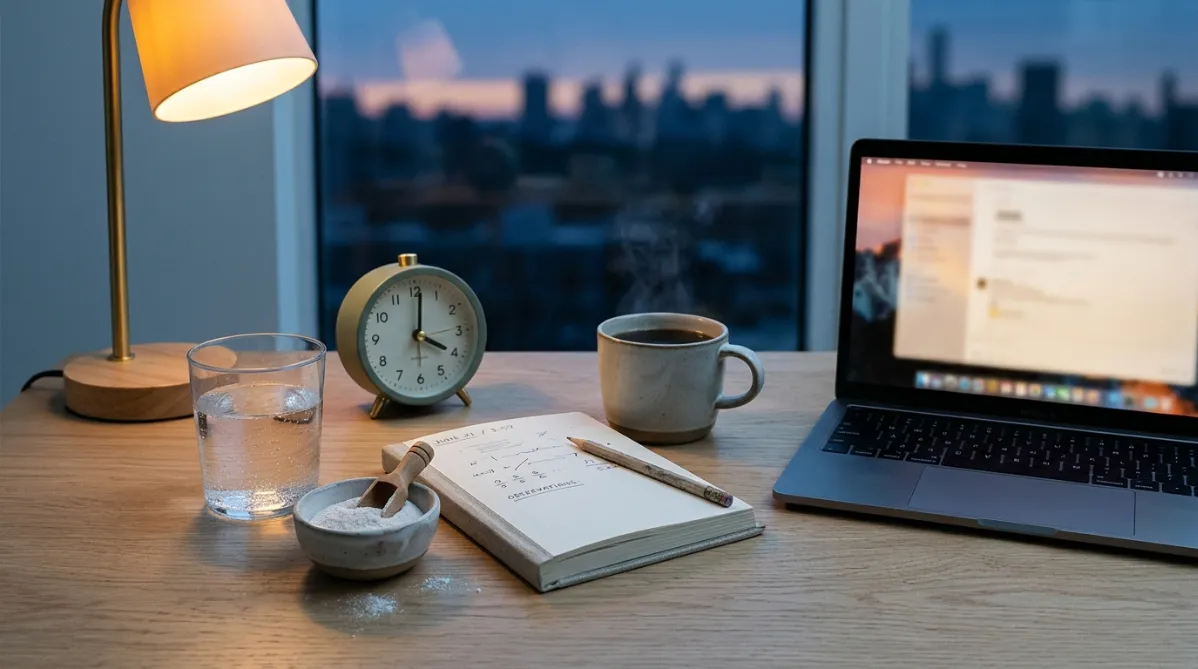
A wide, softly lit editorial still life photographed on a pale oak desk at the blue hour just before dawn. In the center-left foreground, a clear glass of water sits beside a small ceramic dish holding a mound of fine white powder, with a matte wooden scoop resting beside it, a light dusting of powder scattered across the wood grain. Behind them, a minimalist analog alarm clock in muted sage green reads close to 4:00. Next to it is an open linen-bound notebook with a pencil and a few abstract handwritten lines, plus a ceramic mug of black coffee with a thin trail of steam. To the right, a slim laptop is open to a blurred, softly glowing screen with no legible text. A window in the background shows a deep indigo sky turning peach at the horizon, with soft city silhouettes out of focus. Warm light from a small brass desk lamp creates a gentle pool of amber on the desk, contrasting with the cool blue ambient light from the window. The palette is muted and modern: dusty blue, warm cream, soft sage, and a touch of apricot. Shallow depth of field, fine film grain, and generous negative space on the right third for title overlay. The mood is calm, focused, and slightly weary but hopeful, like a contemporary health and science magazine cover. Clean composition, natural textures, subtle shadows, and a high-end lifestyle photography aesthetic.
nutrition

Creatina antes de uma madrugada sem dormir? Uma dose menor ainda reduz o “crash” cerebral

BY DR. GYMBRO ·

E se uma dose única de creatina conseguisse amenizar a névoa mental de uma noite em claro? Um estudo publicado na *Nutrients* revelou que 0,2 g/kg – cerca de 14‑16 g para a maioria dos adultos – reduziram a queda de desempenho em tarefas de lógica, números, velocidade de linguagem e vigilância ao longo de 21 horas acordado, com ganhos de até 12 %. As mulheres pareceram se beneficiar mais. Contudo, o estudo contou apenas 29 participantes, a dose é várias vezes maior que a de manutenção habitual e o efeito foi menor que o observado anteriormente com 0,35 g/kg. Confira o que os dados mostram e o que ainda precisa ser investigado.

A wide, editorial-style still life photographed from slightly above on a pale oat-colored linen surface, lit by soft morning window light from the left. In the center sits a small matte ceramic bowl holding a mound of fine white powder, with a minimalist wooden scoop resting beside it. Next to the bowl is an open amber glass supplement jar with a plain cream label, and a few white capsules spill across the linen in a loose arc.

To the right, a neatly arranged cluster of analog "study" objects suggests careful measurement: a vintage stopwatch with a clean white face, a slim notebook with a sage-green cover open to a hand-drawn bar chart (blurred, no legible text), and a mechanical pencil lying across the page. A small row of six identical ceramic dishes, each holding a pinch of powder, is lined up along the top edge of the frame to hint at the six-week trial. One dish is slightly out of alignment, a subtle visual cue for ambiguity.

A shallow glass of water and a single sprig of green eucalyptus add a calm, organic note in the foreground. Soft, long shadows fall across the textured linen, and the palette stays restrained: warm cream, soft sage, muted terracotta, pale gray, and touches of amber from the glass jar. A few translucent paper cutouts in two tones (sage and blush) overlap in the upper right corner as a modern graphic accent, evoking overlapping data points without showing any numbers.

Depth of field is shallow, with the bowl and stopwatch in crisp focus and the edges gently softened. The composition leaves generous negative space on the left third for title text overlay. The overall mood is thoughtful, balanced, and quietly skeptical, in the style of a contemporary wellness and science magazine: clean, tactile, minimal, with a subtle film-like grain and natural color grading. No people, no futuristic or sci-fi elements, no readable text or logos.
nutrition

GAA: Potencializador Cerebral? Resultado do Estudo de 6 Semanas é Complicado

BY DR. GYMBRO ·

GAA, precursor da creatina vendido como potencializador cerebral, acabou de receber seu primeiro teste humano sério. Em um estudo duplo‑cego de seis semanas com 58 adultos saudáveis, ele acelerou alguns tempos de reação e gerou indícios de mudanças no humor e no estresse. Contudo, a maioria dos testes cognitivos não revelou efeitos, e muitos dos resultados principais foram apenas tendências. Os marcadores de segurança permaneceram dentro da normalidade, mas o estudo foi pequeno, exploratório e não incluiu um grupo comparativo apenas com creatina. Veja o que realmente foi observado, quem pode se interessar e por que o veredicto é misto.

A landscape editorial photograph of a sunlit kitchen table in soft morning light. An older adult's hands, with silver hair and a cream knit sleeve just visible, rest around a ceramic mug. Beside the mug are two small matte white ceramic dishes. One holds a mound of fine white powder, and the other holds a slightly different crystalline white powder. Two wooden spoons lie next to them. A handheld hand-grip dynamometer in muted sage green sits on a linen placemat in the foreground, slightly out of focus. A small open notebook with a pencil and a pair of round tortoiseshell reading glasses sit nearby, with no legible text.

The tabletop is pale oak with a visible grain. Behind it, a window with sheer curtains lets in warm golden light, and the blurred shapes of a trailing green pothos plant and a pale terracotta vase show in the background. The color palette is warm cream, sage green, soft terracotta, and pale wood, with a touch of muted navy from a folded napkin. The mood is calm, thoughtful, and quietly scientific without any laboratory feel.

The composition follows the rule of thirds. The hands and dishes sit in the left-center, and generous negative space on the right is suitable for a title overlay. Shallow depth of field, 50mm lens look, gentle film grain, and soft shadows. Modern lifestyle-magazine and health-journal aesthetic, natural and unstaged, high-end editorial photography.
nutrition

Precursor da Creatina supera a creatina monohidratada na força de preensão em maiores de 65 anos

BY DR. GYMBRO ·

Um pequeno estudo com adultos acima de 65 anos constatou que o ácido guanidinoacetato (GAA), precursor direto da creatina, melhorou a força de preensão mais do que a creatina monohidratada. Contudo, trata‑se de um ensaio piloto de 8 semanas, com apenas 21 participantes que concluíram o protocolo, sem programa de exercícios, e com intervalo de confiança que mal ultrapassa o zero. O GAA também promoveu maior supressão da miostatina e ganhos nos índices musculares medidos por BIA, embora parte desses valores possa refletir retenção hídrica. A homocisteína é a principal questão de segurança, já que a síntese de creatina a partir do GAA consome grupos metil e pode elevá‑la. A seguir, veja o que o estudo encontrou, o que ele não pode nos dizer e por que a creatina monohidratada continua sendo a escolha comprovada.

This page is available in