Dr. Gymbro
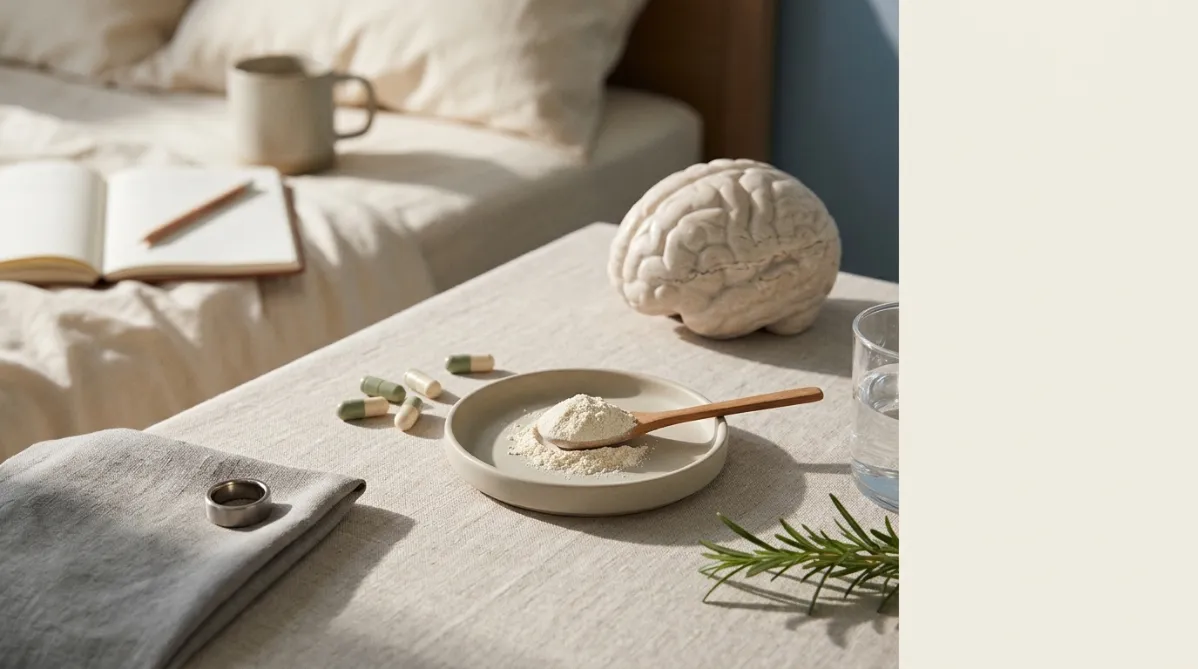
A wide, editorial still life photographed in soft natural window light on a pale oatmeal linen surface. At the center sits a small matte ceramic dish holding a modest scoop of fine off-white powder, with a few loose capsules in muted sage green and cream scattered beside it. A slim wooden scoop rests at the dish's edge. To the left, a minimalist smart ring in brushed titanium sits on a folded stone-gray cloth, catching a thin highlight. To the right, a glass of water with soft refraction and a sprig of fresh rosemary add a touch of organic color.

In the background, a softly blurred bedside scene: a rumpled cream bedsheet, a ceramic mug, and an open notebook with a pencil, suggesting sleep tracking and cognitive testing without any readable text. A single sculptural brain-shaped form carved from pale travertine stone sits slightly behind the dish, cool and understated, with subtle veining that echoes the linen texture. Long, gentle shadows stretch across the table from a morning sun source on the upper left.

The palette is calm and modern: warm neutrals, sage green, soft sand, and muted terracotta accents, with a hint of dusty blue in the shadows. Shallow depth of field, crisp focus on the powder and ring, creamy bokeh in the background. Generous negative space on the right third for headline overlay. The mood is quiet, thoughtful, and trustworthy, like a contemporary health and science journal's cover photograph, clean, tactile, and airy, with fine film-like grain and balanced contrast.
Science & Research

Magnésio L‑Treonato: 6 semanas, 7,5 anos mais jovem na idade cerebral?

Dr. Gymbro · · 4 min read

Um novo ensaio randomizado relata que um suplemento de magnésio reduziu em cerca de 7,5 anos a “idade cognitiva cerebral” em apenas seis semanas. Porém, o mesmo estudo não encontrou alteração no sono medido objetivamente, que é a principal razão pela qual a maioria das pessoas compra magnésio. A seguir, o que o estudo revelou e o que ele não pode afirmar.

O que os pesquisadores realmente testaram

O estudo, publicado em Frontiers in Nutrition por Lopresti e Smith, da Clinical Research Australia, foi um ensaio de dois braços, com duração de 6 semanas, randomizado, duplo‑cego e controlado por placebo. Inscreveu 100 adultos de 18 a 45 anos que se descreviam insatisfeitos com o sono. Metade recebeu 2 g por dia de magnésio L‑treonato (Magtein®) e a outra metade recebeu placebo.

A equipe avaliou a cognição com o NIH Toolbox baseado em computador e com as Matrizes Progressivas de Raven versão 2, além de incluir um teste de tempo de reação. Sono e humor foram avaliados por autorrelato. A fisiologia, incluindo frequência cardíaca em repouso (HR) e variabilidade da frequência cardíaca (HRV) durante o sono, foi obtida por meio de um anel Oura.

Resultado principal: melhor cognição e um cérebro “mais jovem”

Em comparação ao placebo, o Magtein esteve associado a uma melhora maior na cognição geral medida pelo NIH Total Cognition Composite (p = 0,043). Os autores relataram efeitos de tratamento maiores na memória de trabalho e memória episódica. O tempo de reação também melhorou mais no grupo Magtein (p = 0,031).

O artigo ainda menciona uma redução de 7,5 anos na idade cognitiva cerebral estimada. Trata‑se de uma estimativa modelada a partir do desempenho nos testes, não de uma ressonância magnética ou de uma medida biológica de envelhecimento. É uma forma impactante de apresentar a mudança no escore cognitivo, mas não significa que o cérebro de alguém ficou fisicamente 7,5 anos mais jovem.

Nem tudo mudou. Raven's Progressive Matrices, medida de raciocínio abstrato, não apresentou diferença entre os grupos (p = 0,953). O benefício parece específico para memória e velocidade, e não um aumento geral de QI.

A reviravolta no sono

O magnésio é popular como auxílio para o sono, portanto esta parte é a mais importante. Os resultados foram mistos:

  • Comprometimento relacionado ao sono auto‑relatado (quanto o sono ruim afeta a função diurna) melhorou mais com Magtein (p = 0,043).
  • Distúrbios do sono (p = 0,316), sono restaurador (p = 0,439) e bem‑estar geral (p = 0,436) não diferiram entre os grupos.
  • Em um subconjunto com problemas de sono mais graves, os distúrbios do sono diferiram entre os grupos (p = 0,031). Resultados de subgrupos são exploratórios e não devem ser superinterpretados.
  • No anel Oura, não houve diferenças entre os grupos nos desfechos de sono.

Portanto, se você busca sono mais profundo ou maior duração, este ensaio não oferece evidência objetiva de que o Magtein proporcione isso.

Frequência cardíaca noturna mais baixa e HRV mais alta

O dispositivo realmente detectou algo. Usuários de Magtein apresentaram uma redução maior na frequência cardíaca em repouso (p = 0,030) e um aumento maior na HRV (p = 0,036) durante o sono. Os autores descrevem a HRV como um marcador de redução do estresse e melhor equilíbrio autonômico. Isso indica um estado fisiológico mais calmo durante a noite, ainda que a duração e os estágios do sono não tenham mudado. Os p‑values são modestos, e os dados de anéis de consumo são menos precisos que monitoramento de laboratório.

Conclusões práticas

Dose: o ensaio utilizou 2 g por dia de Magtein. Esse é o peso do composto, não do magnésio elementar. Aproximadamente 144 mg de magnésio elementar constituem uma dose modesta segundo os padrões de suplementação. Não confunda esses dois números na rotulagem.

Duração: os resultados foram medidos após 6 semanas. O estudo não fornece informações sobre efeitos a longo prazo.

Horário: o artigo não informa como a dose foi dividida nem em que momento do dia foi ingerida. Consulte o texto completo antes de reproduzir o protocolo.

Para quem pode ser adequado: os dados se aplicam a adultos saudáveis de 18 a 45 anos que relatam insatisfação com o sono. Ainda não se sabe se funciona para pessoas com sono adequado, adultos mais velhos ou populações clínicas.

Segurança: o Magtein foi bem tolerado, sem relatos significativos de reações adversas. Quem tem problemas renais ou faz uso de medicação deve consultar um profissional de saúde antes de suplementar magnésio.

Leia isto antes de comprar

As ressalvas são importantes:

  1. Financiamento da indústria. O estudo foi financiado pela Threotech Inc., que também forneceu a propriedade intelectual e o produto, e ajudou a conceber o desenho do estudo. O autor principal dirige uma organização de pesquisa contratada que já recebeu financiamento de empresas de nutracêuticos.
  2. Estatísticas limítrofes. Os resultados principais estão em p = 0,043, 0,031, 0,030 e 0,036. Esses valores estão próximos do limiar convencional de 0,05, e muitas variáveis foram testadas, podendo alguns achados ser por acaso.
  3. Muitos resultados nulos. As matrizes de Raven, a maioria das medidas de sono auto‑relatadas, bem‑estar e todas as métricas de sono do Oura não apresentaram diferenças entre os grupos.
  4. Um único ensaio. Um estudo com 100 participantes, sem replicação independente, é um sinal promissor, mas não prova definitiva.
  5. Existe uma correção. O artigo inclui um erratum publicado; verifique a versão corrigida ao analisar os detalhes.

Conclusão

Este ensaio sugere que o Magtein pode melhorar modestamente a memória, o tempo de reação e os escores cognitivos gerais em adultos jovens e de meia‑idade com baixa satisfação do sono. Também parece direcionar a fisiologia noturna para uma frequência cardíaca mais baixa e maior HRV. Não demonstra melhora no sono medido, e a manchete “7,5 anos mais jovem” refere‑se a um escore modelado, não a uma reversão biológica. Considere‑o como um indicativo interessante, financiado pela indústria, que necessita de replicação independente.
Original study

Read the original research on pubmed.ncbi.nlm.nih.gov →

This article summarizes published research for general information. It is not medical advice.

DG

Written by

Dr. Gymbro

Dr. Gymbro writes for Dr. Gymbro: science-backed fitness, nutrition & performance.

Related Articles

A calm, sunlit bedroom scene in soft editorial photography style, shot in landscape format. In the foreground, a rumpled bed with crisp oatmeal-colored linen sheets and a cream waffle-knit blanket, morning light spilling across it through sheer curtains. On a light oak nightstand sits a clear glass of water beside a small ceramic bowl holding a loose scoop of fine white powder, a wooden spoon resting next to it. A minimalist fabric wristband in muted sage green lies casually on the nightstand, suggesting sleep tracking without any screens or glowing displays. A slim open notebook with a pencil rests beside it, hinting at research and reflection. A potted olive branch in a terracotta vase adds an organic touch. The wall behind is warm off-white plaster with soft, gently shifting shadows of leaves. Color palette: warm sand, muted sage, soft blush, creamy white, and touches of terracotta. The mood is quiet, restorative, and thoughtful, like a modern wellness journal feature. Shallow depth of field, a soft film-like grain, natural diffused light, and generous negative space on the right side of the frame for title overlay. The composition is balanced and uncluttered, with a gentle golden-hour glow. The style is contemporary lifestyle editorial, tactile and understated, with no text, no people's faces, and no futuristic elements.
science research

Creatina não acelera o cérebro de perimenopáusicas; sono, porém, conta outra história

BY DR. GYMBRO ·

A creatina prometia aguçar o cérebro de mulheres perimenopáusicas, mas o teste principal de velocidade de pensamento não mostrou vantagem. Entretanto, um estudo exploratório com 51 participantes revelou maior oxigenação pré‑frontal, 7,4 pontos percentuais a mais de consistência do sono na sexta semana e menos dias de sensibilidade à temperatura. Todos, inclusive o grupo placebo, ficaram mais rápidos no teste de Stroop. O desenho, a dosagem, as limitações e os vínculos dos autores com a creatina e a WHOOP são detalhados aqui, para que você avalie o peso dos achados.

A softly lit bedside table in a calm, modern bedroom at dusk, photographed in wide landscape format with shallow depth of field. In the foreground, a matte white shaker bottle sits beside a tall frosted glass of creamy, pale vanilla-colored protein shake, with a few condensation droplets catching warm light. Next to the glass rests a slim fitness band on a dark charcoal fabric strap, its small LED glowing a gentle green, lying casually on a light oak wooden surface. A small scoop of fine white protein powder rests on a ceramic dish nearby, with a light dusting of powder on the wood.

In the soft-focus background, a neatly made bed with oatmeal-colored linen bedding and a textured knit throw blanket. A sheer curtain filters the last peach and lavender light of evening from a large window. A small potted olive branch in a terracotta vase and a closed paperback book add a quiet editorial touch. A bedside lamp with a warm, cream-colored shade casts a golden glow across the scene and creates gentle highlights on the glass.

The palette is muted and harmonious: warm cream, soft sand, oatmeal beige, faint sage green accents, and touches of dusty lavender in the window light. The mood is peaceful, reassuring, and clean, like a contemporary wellness magazine or a trendy health journal feature. Lighting is natural and cinematic, with soft shadows and a subtle film-like grain. The composition follows the rule of thirds, with the shake and band on the left third and open negative space on the right for headline overlay. Minimalist, Scandinavian-inspired styling, high-end lifestyle photography, crisp details, and a tranquil, premium editorial feel.
recovery

Caseína antes de dormir não prejudica o sono, dados da WHOOP mostram

BY DR. GYMBRO ·

Já ouviu dizer que um shake de proteína pesado antes de deitar atrapalha o sono e impede a recuperação? Um estudo randomizado com 21 atletas universitárias de alto nível, monitoradas por pulseiras WHOOP 4.0, não encontrou efeitos negativos na duração, eficiência, frequência cardíaca de repouso ou HRV. Alfa‑lactalbumina e carboidrato apresentaram resultados equivalentes, mas nenhum dos suplementos melhorou o sono. Confira o que os dados revelam, as limitações do estudo e quem ainda deve evitar o shake noturno.

A wide, softly lit editorial still life photographed on a pale oak desk at the blue hour just before dawn. In the center-left foreground, a clear glass of water sits beside a small ceramic dish holding a mound of fine white powder, with a matte wooden scoop resting beside it, a light dusting of powder scattered across the wood grain. Behind them, a minimalist analog alarm clock in muted sage green reads close to 4:00. Next to it is an open linen-bound notebook with a pencil and a few abstract handwritten lines, plus a ceramic mug of black coffee with a thin trail of steam. To the right, a slim laptop is open to a blurred, softly glowing screen with no legible text. A window in the background shows a deep indigo sky turning peach at the horizon, with soft city silhouettes out of focus. Warm light from a small brass desk lamp creates a gentle pool of amber on the desk, contrasting with the cool blue ambient light from the window. The palette is muted and modern: dusty blue, warm cream, soft sage, and a touch of apricot. Shallow depth of field, fine film grain, and generous negative space on the right third for title overlay. The mood is calm, focused, and slightly weary but hopeful, like a contemporary health and science magazine cover. Clean composition, natural textures, subtle shadows, and a high-end lifestyle photography aesthetic.
nutrition

Creatina antes de uma madrugada sem dormir? Uma dose menor ainda reduz o “crash” cerebral

BY DR. GYMBRO ·

E se uma dose única de creatina conseguisse amenizar a névoa mental de uma noite em claro? Um estudo publicado na *Nutrients* revelou que 0,2 g/kg – cerca de 14‑16 g para a maioria dos adultos – reduziram a queda de desempenho em tarefas de lógica, números, velocidade de linguagem e vigilância ao longo de 21 horas acordado, com ganhos de até 12 %. As mulheres pareceram se beneficiar mais. Contudo, o estudo contou apenas 29 participantes, a dose é várias vezes maior que a de manutenção habitual e o efeito foi menor que o observado anteriormente com 0,35 g/kg. Confira o que os dados mostram e o que ainda precisa ser investigado.

A wide, editorial-style photograph of a runner's morning ritual on a quiet paved path at the edge of a park, shot in soft golden-hour light with a shallow depth of field. In the foreground, a small frosted glass bottle of pale amber liquid sits on a weathered wooden bench, beside a sleek analog stopwatch and a folded linen towel. Condensation beads on the glass and catches warm sunlight. The background melts into a creamy blur of a lone runner in a muted sage-green jacket and charcoal tights, mid-stride, heading away along a tree-lined track, with soft mist hovering above the grass.

The color palette is calm and modern: warm honey and amber tones, soft sage green, off-white, and touches of deep navy in the shadows. Subtle film grain and gentle natural contrast give it a contemporary lifestyle-magazine feel. Long, delicate shadows stretch across the path.

On the bench, a small open notebook with a loose hand-drawn sketch of a head profile and a simple line graph sits next to a pencil, hinting at cognition and measurement without any text legible. A few fallen autumn leaves add texture. The composition follows the rule of thirds, with the bottle and stopwatch on the left third, negative space on the right for headline overlay, and the runner small in the distance to suggest that speed is not the story.

The mood is thoughtful, clean, and quietly intelligent, evoking wellness science journalism: minimal, airy, organic, and refined. No futuristic elements, no neon, no digital effects, just natural light, tactile materials, and a considered, understated aesthetic.
supplements

Ester de Cetona Não Acelerou os Corredores — Mas Aguçou a Mente

BY DR. GYMBRO ·

Bebidas com éster de cetona são vendidas como atalho para correr mais rápido, mas um ensaio de 31 dias não mostrou melhora no 5 km. O que mudou foi notável: respostas mais rápidas em testes de Stroop e troca de tarefas, glicemia reduzida em 15 % e VO₂ maior em teste incremental, mesmo após o término da suplementação. O ponto fraco do estudo é o tamanho da amostra – apenas 18 corredores recreacionais em um desenho single‑blind. Veja o que os dados revelam, o que eles não mostram e quem deve evitar um regime de 90 g/dia.

This page is available in