Dr. Gymbro
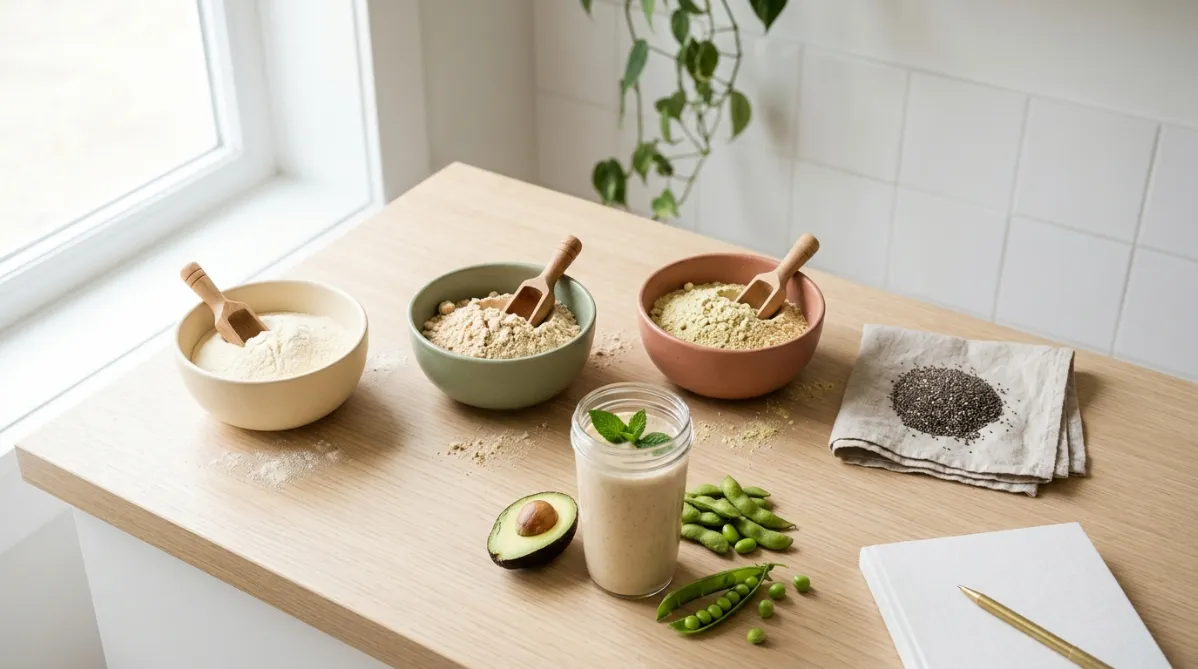
A wide landscape editorial photograph shot from above at a slight angle, showing a bright, minimalist kitchen counter of pale oak wood. Three matching ceramic bowls in soft matte tones (warm cream, sage green, and muted terracotta) sit in a loose row. Each holds a different protein powder: fine ivory whey, slightly coarser beige soy, and speckled pale yellow-green pea protein. A small fourth pile of tiny gray-black chia seeds sits apart on a folded linen napkin, off to the side, to suggest the lone outlier. Wooden scoops rest in each bowl, with a few soft dustings of powder on the surface. In the foreground, a clear glass shaker with a creamy blended drink and a single sprig of fresh mint stands beside a small stack of fresh produce: a halved avocado, a handful of edamame pods, and a few green peas in an open pod. A matte white notebook and a thin brass pen are tucked at the edge of the frame, suggesting research and note-taking. Natural morning light pours in from the left through an unseen window, casting long, soft shadows and gentle highlights on the powder textures. The color palette is calm and earthy, with creams, sage, soft terracotta, and warm wood tones, and a clean, slightly muted editorial grade. Shallow depth of field keeps the bowls crisp while the background, a blurred white tiled wall and a hint of a trailing green plant, melts away. Plenty of negative space on the right side of the frame leaves room for a headline overlay. The overall mood is fresh, trustworthy, and modern, like a contemporary wellness and science journal.
Nutrition

Por que o whey não é especial para iniciantes? Soja e ervilha apenas o igualaram

Dr. Gymbro · · 4 min read

Por que o whey não é especial para iniciantes? Soja e ervilha apenas o igualaram

Se você acabou de começar a treinar e está encarando um pote de whey e outro de proteína de ervilha, se perguntando se a opção vegetal vai comprometer seus ganhos, uma nova meta‑análise tem algo a dizer. Quando os pesquisadores reuniram os ensaios avaliados por DEXA, o grupo que recebeu proteína vegetal não ficou significativamente pior que o grupo que usou whey. Isso não equivale a provar que são idênticos, e os autores deixam isso claro.

O estudo em 30 segundos

Callegari e colegas da Universidade Estadual de São Paulo (UNESP) publicaram uma revisão sistemática e meta‑análise no Journal of the International Society of Sports Nutrition (2026;23(1):2752317). Eles buscaram no PubMed, Web of Science e ScienceDirect, seguiram o PRISMA 2020 e registraram o protocolo no PROSPERO (CRD420251145410). Cinco estudos foram incluídos.

Critérios de inclusão:

  • População: adultos não treinados, de 18 a 59 anos;
  • Intervenção: treinamento de resistência + suplementação de proteína vegetal ou whey;
  • Desfecho: composição corporal medida por Densitometria por Absorção Dual de Raios‑X (DEXA).

O estudo é de acesso aberto, com DOI https://doi.org/10.1080/15502783.2026.2752317 e registro no PubMed sob PMID 42954267.

Conclusão principal

Tanto a proteína vegetal quanto o whey, combinados ao treinamento de resistência, estiveram associados a melhorias na massa magra e na massa de gordura. Entre os dois grupos, não houve diferenças estatisticamente significativas. Os autores concluem que suplementos à base de soja ou ervilha podem favorecer alterações positivas na composição corporal de adultos que iniciam treinamento de resistência, podendo ser considerados alternativas práticas ao whey.

Esse achado é relevante porque o whey tem sido considerado a proteína "padrão" para hipertrofia muscular. Nesta análise, com treinamento e ingestão total de proteína equiparados entre os grupos, a origem da proteína não gerou diferença detectável nos resultados de composição corporal para iniciantes.

Leia os detalhes antes de mudar

“Nenhuma diferença significativa” não é o mesmo que “provado como igual”. Os autores enfatizam isso repetidamente. Com apenas cinco estudos e intervalos de confiança amplos, a análise não pode descartar uma diferença real em qualquer direção. O artigo afirma explicitamente que seus achados não devem ser interpretados como evidência de equivalência fisiológica e que ensaios com poder estatístico adequado ainda são necessários.

Três outras limitações são importantes:

  • Apenas adultos não treinados. Iniciantes respondem fortemente a quase qualquer combinação sensata de treino e proteína. Os resultados não dizem o que acontece com praticantes avançados, onde as margens são menores e as diferenças podem ser mais fáceis ou difíceis de detectar.
  • Proteína equiparada. A comparação manteve a ingestão total de proteína e as variáveis de treinamento constantes. Não informa o que ocorre se você trocar uma dose de whey por uma dose do mesmo tamanho de colher de um produto vegetal menos concentrado, ou se consumir menos proteína no geral.
  • Base de evidência reduzida. Cinco ensaios constituem uma fundação fina para afirmações abrangentes.

A leitura equilibrada é que o whey provavelmente não é essencial para iniciantes, mas também não se pode afirmar que a proteína vegetal seja seu equivalente comprovado.

E a proteína de chia?

Deixe o hype de lado por enquanto. A revisão encontrou apenas um estudo com proteína de chia, e ele não mostrou mudanças significativas na massa magra. Os autores afirmam que conclusões firmes sobre a eficácia da chia ainda não podem ser tiradas. As conclusões sobre soja e ervilha não se estendem à chia.

Principais aplicações práticas

O resumo do artigo não prescreve dosagens; o que segue é orientação geral de nutrição esportiva, não achado desta meta‑análise.

A ingestão total diária de proteína vem em primeiro lugar. Um referencial amplamente citado para quem treina com pesos é cerca de 1,6 g de proteína por kg de peso corporal por dia. Um levantador de 75 kg deveria buscar aproximadamente 120 g diários de todas as fontes. Um suplemento ajuda a alcançar esse número; não é “mágico” por si só.

Dose por porção. As proteínas vegetais costumam conter menos leucina por grama que o whey, e a leucina é um gatilho chave para a síntese proteica muscular. Uma prática comum é usar uma porção ligeiramente maior de soja ou ervilha, ou escolher um blend, e distribuir a proteína em 3‑4 refeições ao longo do dia. Trata‑se de uma precaução razoável, não de algo testado neste estudo.

Timing. O estudo não aborda o timing. A consistência vale mais que uma “janela anabólica” rígida. Consuma quando isso ajudar a atingir sua meta diária, como após o treino ou como lanche.

Quem deve escolher o quê

Proteína vegetal (soja ou ervilha) faz sentido se você:

  • é vegano ou vegetariano;
  • tem dificuldade com laticínios ou lactose;
  • prefere uma opção mais sustentável, ponto mencionado pelos autores;
  • está começando a levantar e quer um suplemento econômico que se encaixe na dieta.

Whey ainda faz sentido se você:

  • tolera bem os laticínios e já os utiliza;
  • quer a proteína com a maior base de pesquisas;
  • a acha mais barata ou conveniente onde mora.

Tenha cautela se:

  • tem alergia a soja ou ervilha – verifique os rótulos;
  • é um levantador avançado, já que a evidência vem de adultos não treinados;
  • planejava usar proteína de chia para ganhar músculo, pois a evidência ainda não está lá.

Conclusão

A antiga suposição de que o whey é exclusivamente necessário para iniciantes parece mais frágil após esta análise. Com proteína e treinamento equiparados, soja e ervilha não ficaram significativamente atrás do whey nas mudanças de massa magra ou de gordura em adultos não treinados. Contudo, cinco estudos e intervalos de confiança amplos deixam o caso aberto, não fechado. Atinja sua ingestão total de proteína, treine de forma consistente e escolha o pó que realmente vá usar.

Fonte: Callegari IOM, Silva GM, Oliveira AG. Is plant‑based protein supplementation as effective as whey protein? A systematic review and meta‑analysis in untrained adults undergoing resistance training. J Int Soc Sports Nutr. 2026;23(1):2752317. doi:10.1080/15502783.2026.2752317. PMID: 42954267.
Original study

Read the original research on pubmed.ncbi.nlm.nih.gov →

This article summarizes published research for general information. It is not medical advice.

DG

Written by

Dr. Gymbro

Dr. Gymbro writes for Dr. Gymbro: science-backed fitness, nutrition & performance.

Related Articles

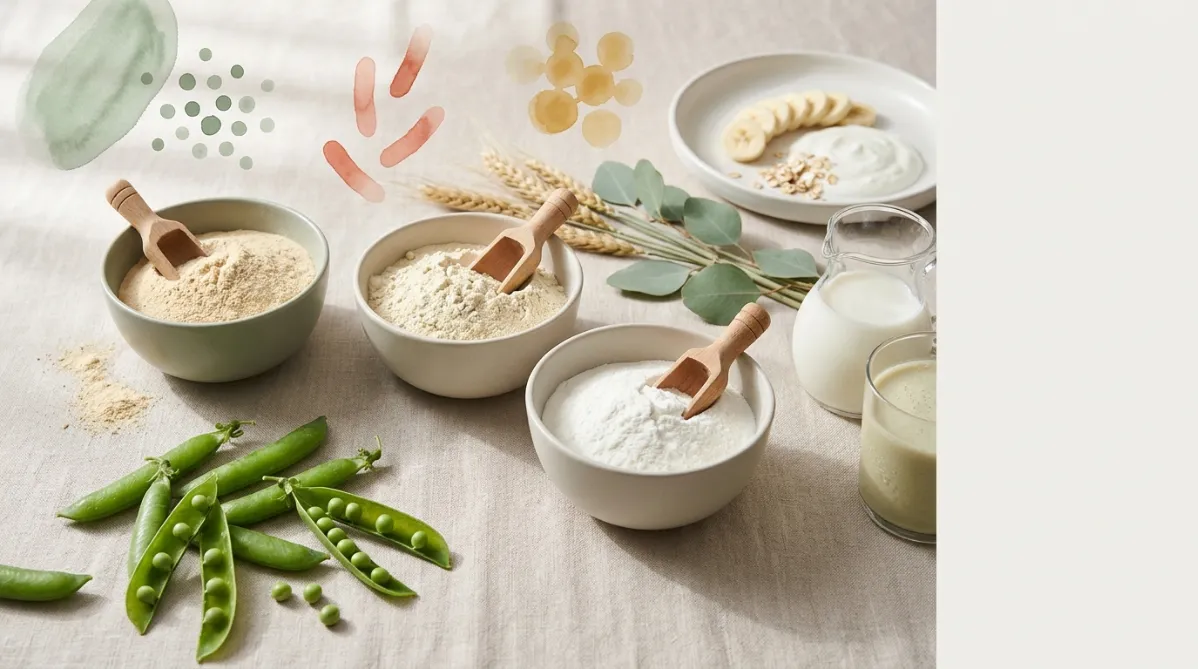
A wide, softly lit editorial flat-lay on a pale oat-colored linen surface, shot from slightly above. Three matte ceramic bowls sit in a loose diagonal across the frame. One holds fine, creamy beige pea protein concentrate, another holds paler, powdery pea protein isolate, and the third holds bright white whey protein isolate. Each bowl has a small wooden scoop resting beside it, with a few fine dustings of powder on the linen. Fresh green pea pods, split open to show round peas, spill naturally in the left foreground. A small glass pitcher of milk sits near the right edge, next to a half-full glass of a smooth, pale green-beige shake with condensation on the surface.

Behind the bowls, a few sprigs of dried wheat and soft eucalyptus leaves add organic texture. In the upper right, a shallow white ceramic plate holds a small arrangement of gut-friendly foods: sliced banana, a spoonful of plain yogurt, and a few oats. Delicate watercolor-style abstract shapes in sage green, warm coral, and soft mustard float subtly in the background. They suggest microscopic organisms, like loose dots, rods, and clustered circles, but stay painterly and minimal, not scientific or futuristic.

Natural window light enters from the left, casting long, gentle shadows and a warm, airy glow. The palette is muted and modern: sage green, cream, warm beige, blush, and touches of terracotta. The composition leaves generous clean negative space on the right third for a headline overlay. The depth of field is shallow, with the nearest pea pods and the front bowl crisp and the background softly blurred. The style is high-end wellness magazine photography with a subtle tactile, handmade feel, calm, fresh, and contemporary, in a 16:9 landscape format.
science research

Qual pó de proteína redesenha seu intestino? A ervilha fez isso em quatro semanas

BY DR. GYMBRO ·

Um ensaio sueco de quatro semanas comparou concentrado de proteína de ervilha, isolado de proteína de ervilha e isolado de proteína whey, tendo a microbiota intestinal como principal desfecho. Ambos os pós de ervilha alteraram significativamente a diversidade intestinal, e cada forma favoreceu diferentes espécies benéficas. O concentrado aumentou *Bifidobacterium longum* e *Anaerobutyricum hallii*, enquanto o isolado elevou *Lactobacillus crispatus* e *Limosilactobacillus frumenti*. Os pesquisadores ressaltam que ainda não sabemos o que essas mudanças significam em termos de função. Veja o que isso implica para o próximo pote de pó que você comprar.

A wide, editorial-style flat lay shot from directly above on a pale oak table in soft morning window light. At the center, an open matte cream-colored protein powder tub sits tipped slightly, with a wooden scoop resting beside it and a small, elegant dusting of fine powder spilling across the wood grain. To the left, a neat balanced arrangement of whole foods: two soft-boiled eggs in a ceramic dish, a small bowl of Greek yogurt with a drizzle of honey, a handful of almonds, and a halved avocado. To the right, a minimalist brass kitchen scale holding a small ceramic bowl, with a handwritten notebook page beside it showing simple pencil-drawn bar charts and a few scribbled numbers, no legible text. A matte shaker bottle in muted sage green stands near the top edge, along with a folded linen napkin in warm oatmeal tone. The color palette is restrained and modern: warm creams, soft sage, terracotta accents, and natural wood, with gentle diffused shadows and subtle film-like grain. Composition leaves generous negative space on the left third of the frame for headline overlay. The mood is calm, thoughtful, and quietly skeptical, like a contemporary health and science magazine cover. Shallow depth of field, crisp textures on powder and ceramic, high-end lifestyle photography, clean and uncluttered.
nutrition

O Lado Sombrio do Whey: Ganhos Desaparecem Quando as Calorias São Igualadas

BY DR. GYMBRO ·

O whey realmente aprimora seu desempenho e a recuperação, ou você está apenas consumindo calorias a mais? Uma meta‑análise bayesiana de 75 ensaios randomizados com 1.206 atletas encontrou benefícios reais, porém modestos. O detalhe é que todos os resultados significativos surgiram em estudos onde a ingestão energética não foi igualada entre os grupos. A recomendação mais concreta do artigo refere‑se à dose: cerca de 1 g/kg/dia extra de suplemento, totalizando aproximadamente 2 g/kg/dia.

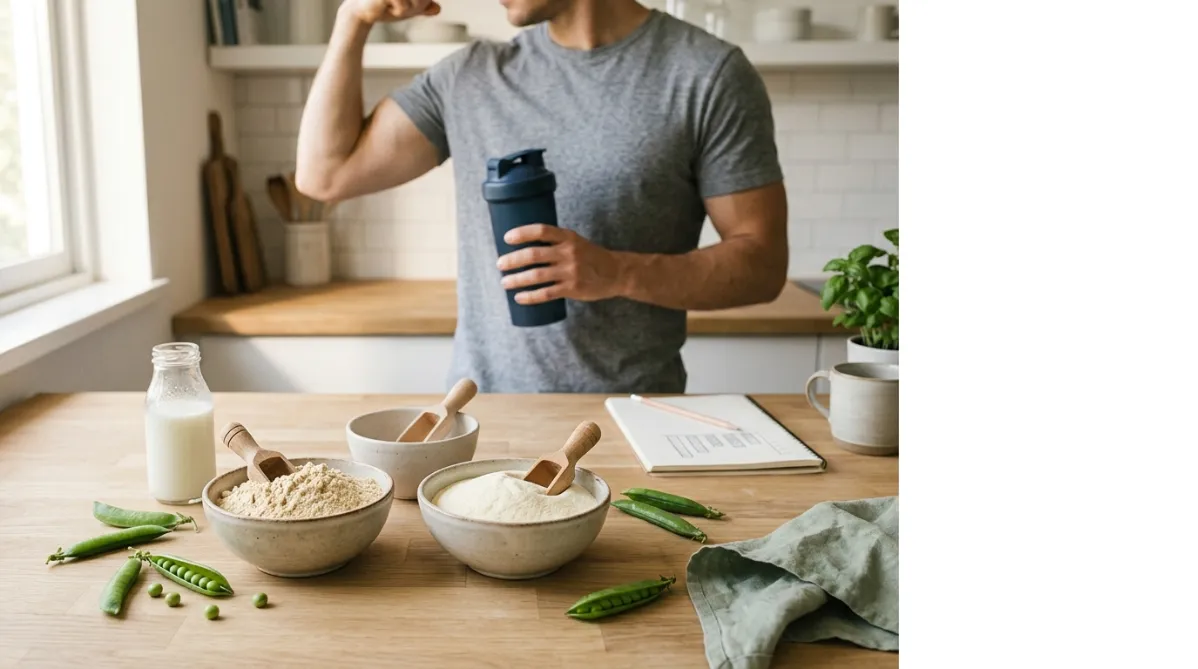
A bright, airy, minimalist kitchen counter in soft morning light, shot from a slightly elevated three-quarter angle in a wide landscape composition. Two matching ceramic bowls sit side by side on a pale oak butcher-block surface. The left bowl holds fine, creamy-beige pea protein powder with a small wooden scoop resting in it. The right bowl holds smooth, ivory-white whey powder with an identical scoop. Between and slightly behind them sits a third, smaller empty bowl with a plain scoop, hinting at the placebo. Scattered around the bowls are fresh green pea pods, some split open to reveal bright, round peas, and a small glass bottle of milk with delicate condensation. A sage-green linen napkin is folded loosely at the edge of the frame.

In the soft-focus background, a young man in a fitted heather-gray t-shirt is seen from the shoulders down, casually flexing one arm while holding a matte shaker bottle, the biceps subtly defined and the pose relaxed and natural. A minimalist notebook with a pencil and a simple hand-drawn bar chart lies open on the counter, suggesting analysis without legible text. A small potted herb plant and a ceramic mug add warmth.

The color palette is muted and editorial: warm cream, sage green, soft terracotta, pale wood, and touches of charcoal. Light streams in from a window on the left, casting gentle long shadows and a subtle golden glow across the powders so their textures look fine and tactile. Shallow depth of field keeps the bowls crisp while the background melts into a creamy blur. The look is modern lifestyle-magazine photography, clean and uncluttered, with generous negative space on the right third of the frame for headline overlay. It is natural, appetizing, and trustworthy, in the style of a contemporary wellness and nutrition journal.
nutrition

Proteína de Ervilha vs Whey: O Resultado Surpreendente em Iniciantes

BY DR. GYMBRO ·

A proteína vegetal pode realmente construir músculos como o whey? Um estudo de 12 semanas com 161 homens comparou proteína de ervilha, whey e placebo, e os resultados nos iniciantes chamaram atenção: aumento de 20,2 % na espessura do bíceps com a ervilha versus 8,6 % com o placebo. Contudo, a diferença no grupo total foi apenas uma tendência, e a descoberta mais marcante veio de uma análise de subgrupos. Veja o que o estudo revelou, o que ele não provou e como praticantes veganos ou intolerantes à lactose podem utilizá‑lo.

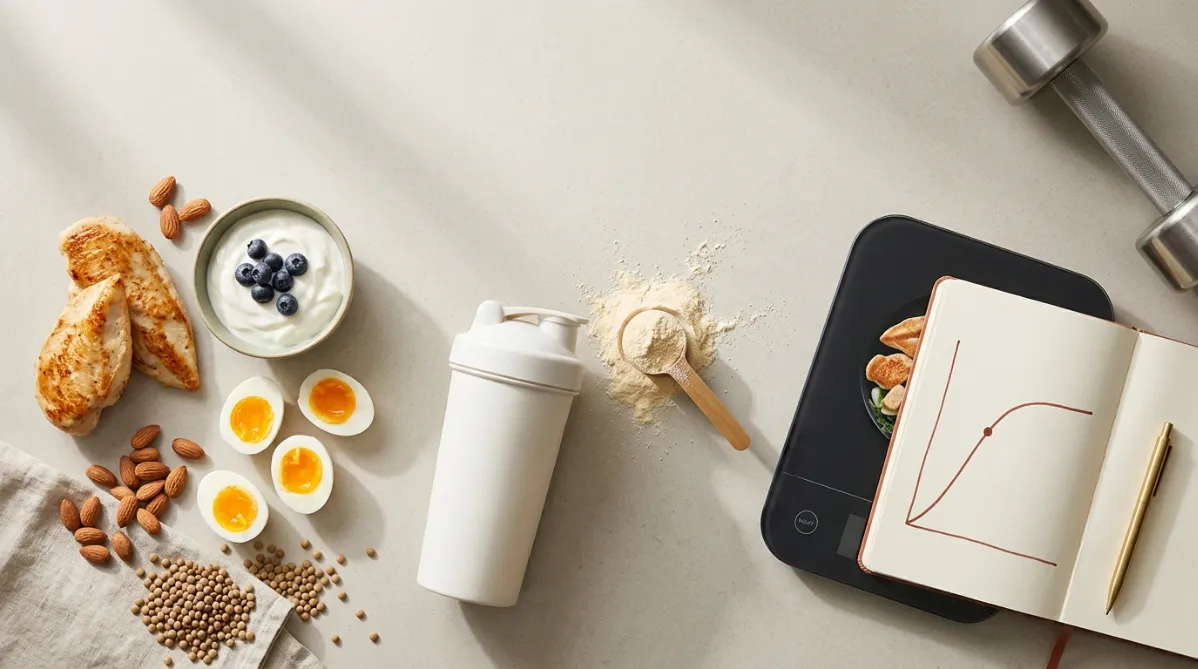
A wide, editorial flat-lay photograph shot from directly above on a pale warm-gray stone countertop, lit by soft natural morning window light with gentle diagonal shadows. On the left, a neatly arranged cluster of whole-food protein sources: two seared chicken breast slices with a golden crust, a small ceramic bowl of creamy Greek yogurt topped with blueberries, three halved soft-boiled eggs with jammy orange yolks, a handful of raw almonds, and a small pile of dried lentils scattered on a linen napkin. At the center, a matte white shaker bottle and a wooden scoop resting in a pile of fine vanilla-colored protein powder, a few grains dusted artfully across the surface. On the right, a minimalist kitchen scale in matte black displaying a portion of food, next to an open notebook with a hand-drawn curve that rises steeply and then flattens into a plateau, drawn in a deep terracotta ink pen, with a small dot marking the bend. A brass pen lies beside the notebook. A single dumbbell with a brushed steel finish sits partially in frame at the upper right corner, grounding the fitness theme without feeling gym-like. Color palette: warm cream, sage green, terracotta, soft charcoal, and butter yellow accents, with generous negative space along the top edge for title overlay. Shallow depth of field, crisp textures, subtle film grain, modern lifestyle magazine aesthetic, clean and calm composition, 16:9 landscape.
nutrition

Quanto proteína realmente maximiza o músculo? O platô de 1,6 g/kg explicado

BY DR. GYMBRO ·

Acha que precisa de mais de 2 g de proteína por quilograma para ganhar músculo? Uma meta‑análise de 49 ensaios com 1.863 adultos mostrou que o benefício estabiliza por volta de 1,6 g/kg/dia, com o limite superior da confiança em torno de 2,2 g/kg. Levantadores experientes obtiveram os maiores ganhos com a suplementação, enquanto o efeito diminuía com a idade. Veja como esses números se traduzem no seu prato, no seu copo de shake e no seu bolso.

This page is available in