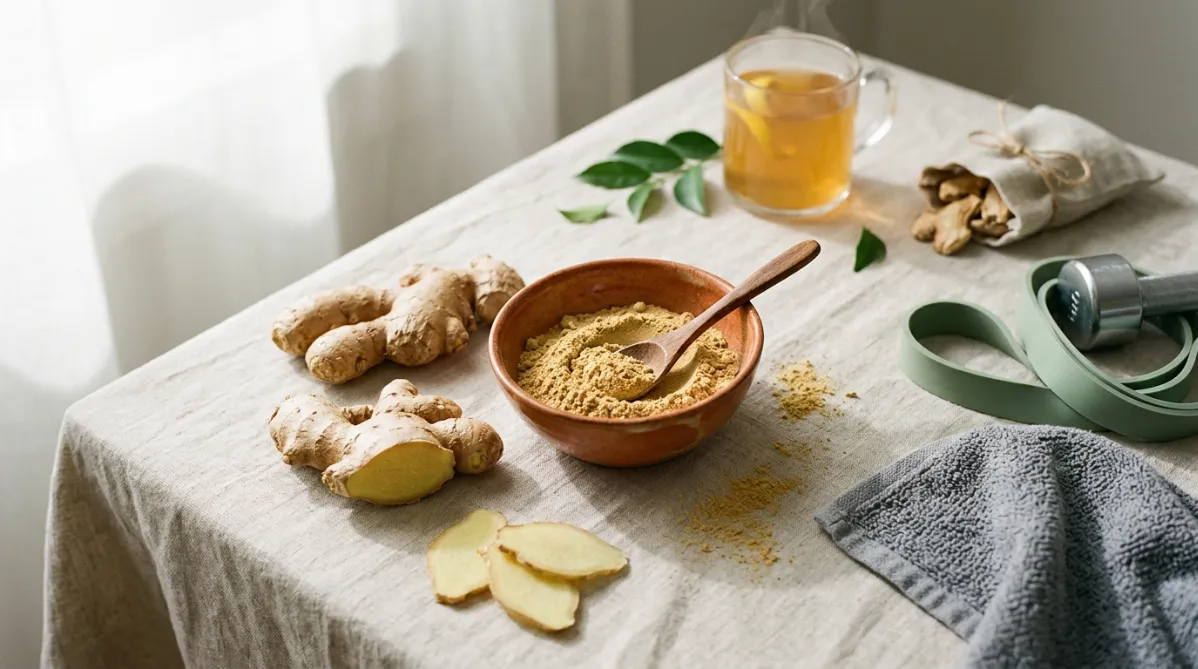
The Kitchen Spice Hiding in Plain Sight
You can grind it into a stir-fry, steep it in tea, or find it in the back of your spice rack. Researchers have also tested it against one of the most universal gym complaints: the stiff, achy soreness that shows up a day after a hard session.
A 2010 study in The Journal of Pain asked whether 2 grams of ginger per day could blunt delayed-onset muscle soreness (DOMS). Across two experiments, the answer was a cautious yes. Ginger takers reported roughly 25% less pain 24 hours after a brutal eccentric workout than people taking a placebo.
This is not a story about ginger beating ibuprofen. The study never tested that. It is a story about a cheap food-based option with a modest, real, but limited effect.
The Two Trials
The research team, led by Christopher Black at Georgia College and State University, ran two identical double-blind, placebo-controlled, randomized experiments:
- Study 1: 34 volunteers, raw ginger vs. placebo
- Study 2: 40 volunteers, heat-treated ginger vs. placebo
Participants took 2 grams of ginger or placebo for 11 consecutive days. They then performed 18 eccentric actions of the elbow flexors, which means lowering a load under control with the biceps. Eccentric work is the classic way to produce muscle damage and soreness, which is why lifters feel it after slow negatives, downhill running, or a new exercise.
The researchers tracked pain intensity, perceived effort, plasma prostaglandin E2 (PGE2), arm volume, range of motion, and isometric strength. They measured before exercise and for three days afterward.
The Headline Numbers
At the 24-hour mark, both forms of ginger beat placebo for pain:
- Raw ginger: about 25% lower pain (-0.78 SD, P = .041)
- Heat-treated ginger: about 23% lower pain (-0.57 SD, P = .049)
The authors described these as moderate-to-large reductions. Heating the ginger did not improve the result. The idea that cooking or heat-treating ginger makes it a stronger pain reliever did not hold up here. Either form worked about equally well.
What Didn't Move Much
This is where the clickbait version of the story falls apart. The abstract reports only smaller effects between ginger and placebo on the other outcomes, which included strength, swelling (arm volume), and range of motion. Ginger did not appear to speed up the return of strength or make the arm look or move dramatically better.
If you hope ginger will let you train hard on sore muscles without a performance dip, this study doesn't support that. What it supports is that the pain itself felt lower at the 24-hour peak.
Why Might Ginger Work?
The proposed mechanism is anti-inflammatory. Ginger has shown anti-inflammatory effects in rodents, and the researchers measured plasma PGE2, a prostaglandin involved in pain and inflammation signaling. Many common painkillers act on the prostaglandin pathway, so this is a plausible route for ginger to dampen soreness.
Treat this as a hypothesis, not a proven explanation. The abstract does not describe a clear PGE2 story, and the pain relief may involve other mechanisms. The authors also note that the findings fit with earlier work showing pain-relieving effects of ginger in people with osteoarthritis.
Limitations You Should Know
- Small samples: 34 and 40 people is modest, and the p-values (.041 and .049) sit close to the usual significance threshold.
- One muscle model: The test used the elbow flexors in a controlled lab protocol, not a full leg day or a marathon.
- Narrow benefit: The clearest effect was on pain at 24 hours, not on strength recovery or swelling.
- Capsule delivery: The ginger was given as capsules of ground ginger, so results may not carry over to tea, chews, or sprinkling it on food.
A short-term lab study can show that ginger is worth trying. It can't show that ginger will transform your recovery.
Practical Takeaways
Dose: The studies used 2 grams per day of ground ginger, in capsule form.
Timing: This was a loading habit, not a one-off. Participants took ginger daily for 11 consecutive days. Taking a pinch after a brutal workout is not what was tested.
Who it might suit: Lifters and runners who get frequent DOMS, especially during a new block, a return from a layoff, or a stretch with lots of eccentric work. If you are rarely sore, the payoff is small.
Realistic expectations: Think of it as taking the edge off, not erasing soreness. A 25% drop in pain is noticeable but not magic. Sleep, protein, gradual progression, and sensible volume still do the heavy lifting.
Safety Notes
Ginger is a common food, but 2 grams a day is more than a casual seasoning. A few cautions:
- Blood thinners or bleeding risk: Ginger is often discussed as having mild antiplatelet effects. If you take anticoagulants or antiplatelet drugs, or have a bleeding disorder, talk to your doctor first.
- Digestive upset: Some people get heartburn, reflux, or stomach discomfort from ginger supplements. Taking it with food may help, and stopping is reasonable if it bothers you.
- Medications and pregnancy: If you take other medications, are pregnant, or have a medical condition, check with a clinician before adding a daily supplement.
The Bottom Line
This trial pair suggests that two grams of ginger a day, taken for about 11 days, may cut next-day muscle pain by around a quarter in an eccentric-exercise model. It won't fix strength loss or swelling, and it hasn't been tested head-to-head against standard painkillers. For regular DOMS sufferers who want a low-cost, food-based experiment, it is a reasonable option, provided you stay realistic and mind the safety caveats.