Dr. Gymbro
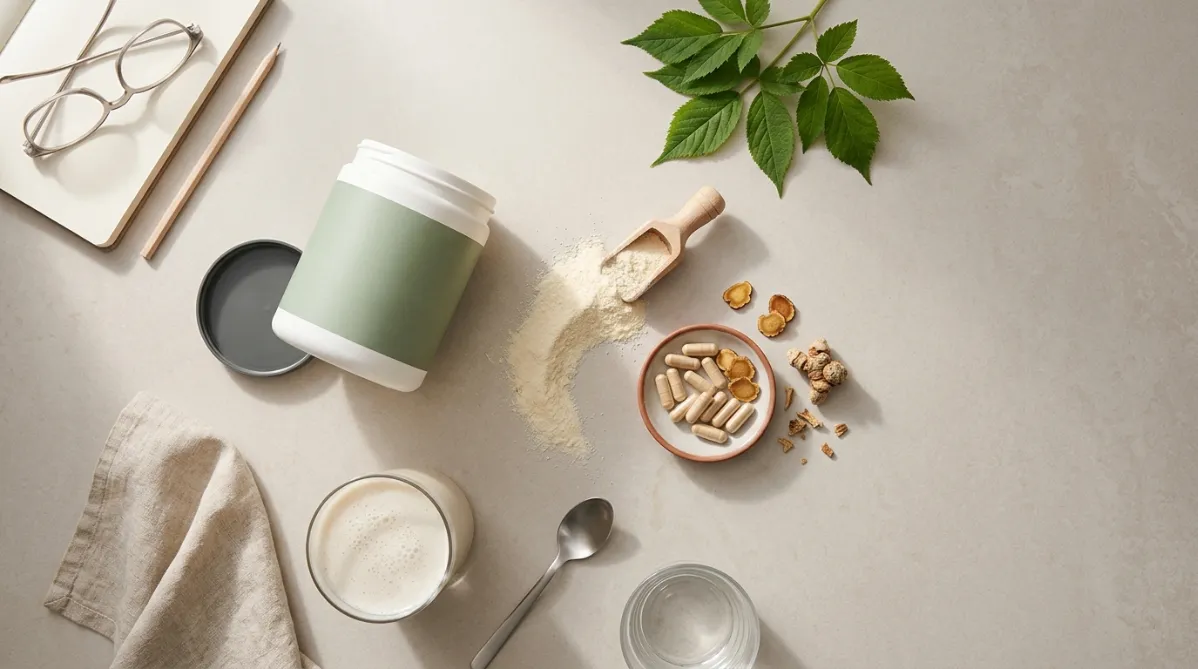
A clean, editorial flat-lay photograph shot from above on a pale warm-grey stone countertop, bathed in soft diffused morning light from the left. At the center sits a matte white supplement tub with a minimal sage-green label, its lid resting beside it. A small wooden scoop spills fine cream-colored whey powder in a gentle arc across the surface, creating delicate natural texture and soft shadows. Next to the powder, a small ceramic dish holds a handful of pale tan capsules and a few tiny golden-brown ginseng root slices and fragments of dried Panax notoginseng root, hinting at the botanical origin of the ingredient. A sprig of fresh green leaves with serrated edges adds a touch of organic color on the upper right.

In the foreground, a tall glass of milky shake with a subtle frothy surface, condensation beads on its sides, sits beside a folded linen napkin in oatmeal tone. A slim brushed-steel spoon and a minimal glass of water complete the arrangement. A pair of simple, elegant reading glasses and a closed notebook with a thin pencil rest at the upper left, suggesting a researcher's desk and a thoughtful review of data, with no legible text visible.

The palette is soft and modern: warm cream, sage green, muted terracotta, pale wood, and gentle off-white, with one small accent of deep amber from the ginseng slices. Composition follows the rule of thirds with generous negative space on the right side for title overlay. Shallow depth of field, crisp focus on the powder and capsules, with the edges gently softened. The mood is calm, trustworthy, and wellness-focused, evoking a contemporary health and science magazine aesthetic. High-resolution, natural color grading, subtle film grain, minimal and airy, 16:9 landscape.
Nutrition

AstraGin: The Hidden Label Ingredient That Boosted Whey Absorption

Dr. Gymbro · · 4 min read

You've probably scanned right past it. Tucked at the bottom of a pre-workout or protein label, in tiny type, sits a word that sounds more like a fantasy novel than a supplement: AstraGin. A new human pilot trial suggests this little-known ingredient may help your body pull more essential amino acids out of whey protein, with the biggest gains showing up in people over 60. Before you rush to buy anything, here is what the study found, and what it didn't.

What Is AstraGin, and Why Is It in So Many Supplements?

AstraGin is a branded blend from NuLiv Science combining extracts of Astragalus membranaceus and Panax notoginseng. The active components are saponins, plant compounds that are thought to influence how nutrients cross the intestinal lining. The pitch to supplement makers is simple: add a small amount and the other ingredients may absorb better. That is why it shows up in pre-workouts, protein powders, and multi-ingredient formulas.

The researchers call the combination APS (Astragalus and Panax saponins). Until now, whether it actually helps with whey protein in humans was unclear, which is what makes this trial worth a look.

How the Study Was Designed

The trial, published in Nutrients in 2026 by a Taiwan-based team (Zhuang, Yen, Lin, and Shen), was a randomized, double-blind, placebo-controlled crossover study. Thirty healthy adults were split evenly into three age groups: 18-25, 26-59, and 60-80 years, so just 10 people per group.

There were two phases:

  • Single-dose phase: participants took whey with APS or placebo, and researchers tracked how fast and how much amino acid appeared in the blood.
  • Four-week phase: daily supplementation was paired with light resistance training (chair squats, wall push-ups, hip bridges, three sets) and whey at 0.8 g/kg per day. Researchers measured amino acid kinetics, muscle function, and gut health markers.

According to reporting from Ergo-Log, the dose was 50 mg of AstraGin twice daily, or 100 mg per day.

The Numbers That Got Attention

After a single dose, the area under the curve (a measure of total amino acid exposure) was 6.67% higher for valine, 3.62% higher for leucine, and just 0.15% higher for isoleucine versus placebo. Modest, and in the case of isoleucine, basically nothing.

The four-week results were more eye-catching:

  • Valine absorption: +14.07%
  • Leucine absorption: +8.34%
  • Isoleucine absorption: +6.33%
  • Total essential amino acids in 60-80 year-olds: +12.74%
  • Blood zonulin: -13.01% with APS versus -0.9% with placebo

Zonulin is a protein often used as a marker of intestinal permeability, so a drop hints at a tighter gut barrier. That is an intriguing mechanism for better absorption, though zonulin as a biomarker is itself debated, and the study cannot prove that barrier changes caused the amino acid gains.

The older-adult signal matters because aging tends to blunt the muscle response to dietary protein, a phenomenon called anabolic resistance. Anything that nudges more leucine and other essential amino acids into circulation is of obvious interest for that group.

What Was NOT Significant

Here is where the headline needs some cold water. Grip strength rose 5.20% with APS versus 2.44% with placebo, and muscle mass rose 0.85% versus 0.68%. The authors framed these as improvements in muscle function, but as Ergo-Log points out, the differences in strength and muscle mass were not statistically significant. Only some of the amino acid changes reached significance as well.

In plain terms: the absorption signal looks promising, but there is no solid evidence here that AstraGin builds more muscle or strength. A 0.17-percentage-point gap in muscle mass is well within what you would expect from noise in a group this small.

On safety, liver and kidney function markers showed no adverse effects over four weeks.

Dose: 100 mg a Day vs. the 35 mg EFSA Figure

One detail deserves attention. The study dose of 100 mg per day is nearly three times the 35 mg per day safe-intake figure that the European Food Safety Authority (EFSA) set in its 2020 assessment. Four weeks without liver or kidney issues in healthy adults is reassuring, but it is not long-term safety data. If you are searching for an AstraGin dosage, note that many commercial products use far less than the trial amount, and the effective dose in real-world products may not match what was tested.

Does AstraGin Work? An Honest Verdict

This is a small pilot with 30 people, four weeks, and light bodyweight training. Ingredient-focused trials like this one also tend to involve a branded, commercially valuable product, so independent replication matters. The absorption findings are interesting, not definitive.

Practical Takeaways

  • Who might benefit most: older lifters and anyone with suspected poor protein absorption or digestive issues, since the biggest effect appeared in the 60-80 group.
  • How to use it: in the trial, it was taken alongside whey protein, so pairing it with protein is the logical approach.
  • Don't overspend: if your protein intake and training are already dialed in, a 5-14% bump in specific amino acids is unlikely to transform your results.
  • Cover the basics first: total protein, even distribution across meals, progressive overload, and sleep still dwarf any absorption enhancer.
  • Check labels: many products list AstraGin in a proprietary blend, so you may not know your actual dose.

AstraGin may be a clever helper for getting more out of your protein, particularly as you age. But until larger, longer, independent trials show real gains in muscle and strength, treat it as a promising maybe, not a must-have.
Original study

Read the original research on pubmed.ncbi.nlm.nih.gov →

This article summarizes published research for general information. It is not medical advice.

DG

Written by

Dr. Gymbro

Dr. Gymbro writes for Dr. Gymbro: science-backed fitness, nutrition & performance.

Related Articles

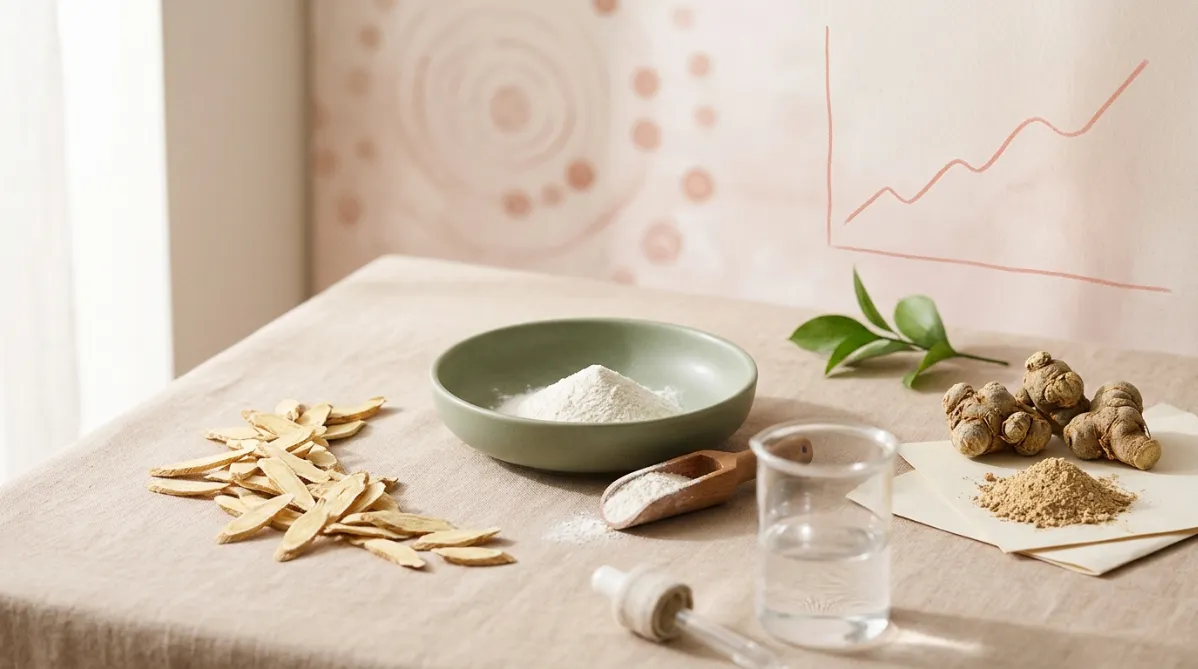
A landscape editorial still life on a soft, warm oat-colored linen surface, lit by diffused natural window light from the left. In the center sits a shallow matte ceramic bowl in muted sage green holding a small mound of fine white arginine powder. Beside it rests a wooden scoop dusted with powder. To the left, a loose arrangement of dried Astragalus root slices, pale golden and delicate, fans out in a graceful curve. To the right, a few whole Panax notoginseng roots, knobbly and earthy brown, sit next to a small pile of finely ground tan powder on a folded cream paper. A single sprig of fresh green leaf adds a gentle accent in the background.

In the foreground, a minimalist glass beaker with clear water and a thin linen-wrapped glass dropper sit slightly out of focus. Behind the objects, a softly blurred backdrop in pale blush and sand tones carries a faint, abstract pattern of soft circular shapes, like ripples or molecular dots drawn in subtle terracotta ink. A thin hand-drawn line graph in dusty coral rises gently across the upper right of the background, as if sketched on textured paper, with no readable text.

The composition uses generous negative space on the upper left, which leaves room for a headline overlay. The palette is earthy and calm: sage, cream, terracotta, honey gold, and soft blush. The shallow depth of field gives creamy bokeh. Gentle shadows fall to the right. The overall feel is clean and contemporary, like a wellness and science journal cover, with subtle film grain, high-end editorial photography, and tactile natural textures.
nutrition

The Add-On That Boosted Arginine Absorption 17% in a Small Trial

BY DR. GYMBRO ·

A 2023 crossover trial found that pairing 5 g of arginine with Astragalus and Panax notoginseng saponins raised arginine absorption by 17.3% and lifted the arginine-to-ADMA ratio by 167.1%. Urinary nitrate and cGMP, two nitric oxide markers, also rose. But only 24 people were analysed after six were excluded for large individual differences, and nobody measured workout performance. Here's what the data show, what they don't, and who should think twice.

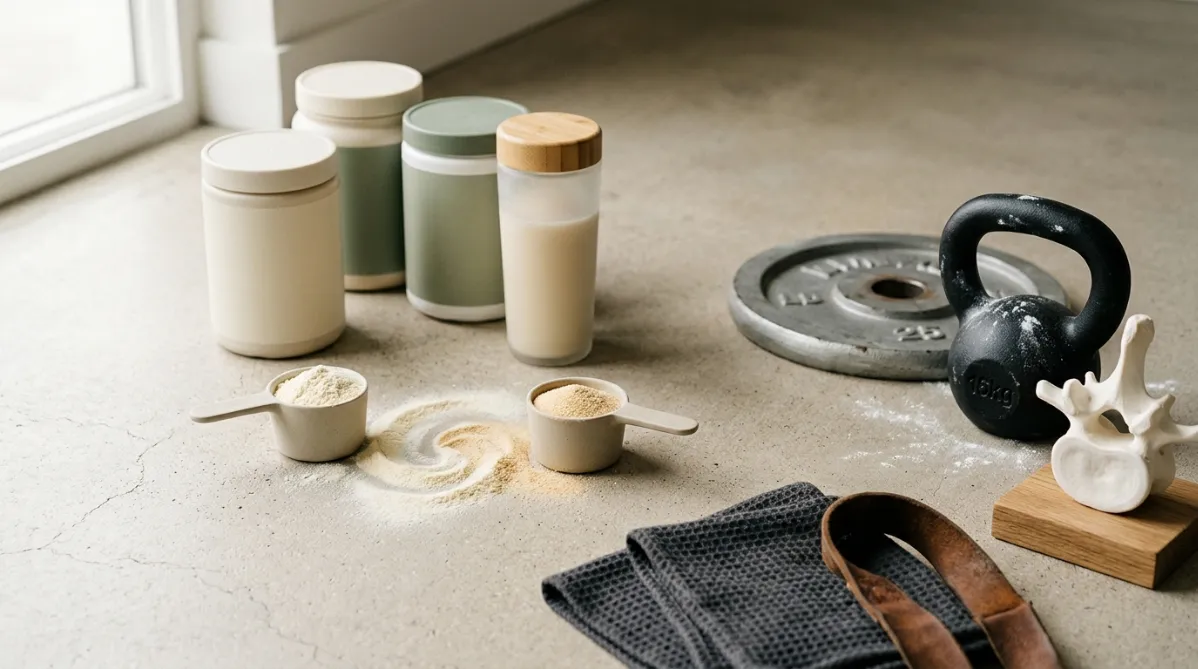
A wide, softly lit editorial still life on a pale warm-gray concrete surface, shot from a slightly elevated three-quarter angle. In the center-left, two matte ceramic scoops sit side by side. One holds fine ivory whey powder, the other holds slightly coarser, pale golden collagen peptide powder. A small, elegant dusting of both powders spills between them and blends into a soft swirl. Behind them, three minimalist cream and sage-green supplement tubs with no legible text stand in a staggered row, with a frosted glass shaker bottle of creamy liquid beside them.

On the right, a brushed-steel barbell plate and a compact chalk-dusted kettlebell rest slightly out of focus, suggesting resistance training. Pale wisps of chalk hang in the air. A folded charcoal gym towel and a pair of worn leather lifting straps lie in the foreground. A single cross-section of a clean white bone model, a stylized vertebra, rests on a small oak block at the far right. It subtly signals the bone-density theme without looking clinical.

Natural window light enters from the left, casting long, gentle shadows and a warm highlight on the powders. The palette is muted and modern: oatmeal, bone white, sage green, soft charcoal, and touches of warm amber. Shallow depth of field keeps the scoops tack-sharp and melts the background into creamy blur. Leave generous negative space in the upper right for headline overlay. The overall feel is a premium health and science journal cover: clean, tactile, minimalist, with fine film-like grain and a calm, editorial mood.
nutrition

Whey Plus Collagen Beat Either Alone in Lifters—With a Catch

BY DR. GYMBRO ·

Mixing 30 g of whey with 10 g of collagen beat whey alone, collagen alone and placebo on every outcome in a new 8-week trial of resistance-trained men. The stack added 2.66 kg of muscle (by BIA), lifted lumbar spine BMD and improved squat, bench and bone turnover markers. Collagen alone moved bone, and whey alone moved muscle. But with only 40 participants, unmatched protein totals and a surprisingly big BMD jump, there is a catch. Here is what the stack won, who it may suit and who should skip it.

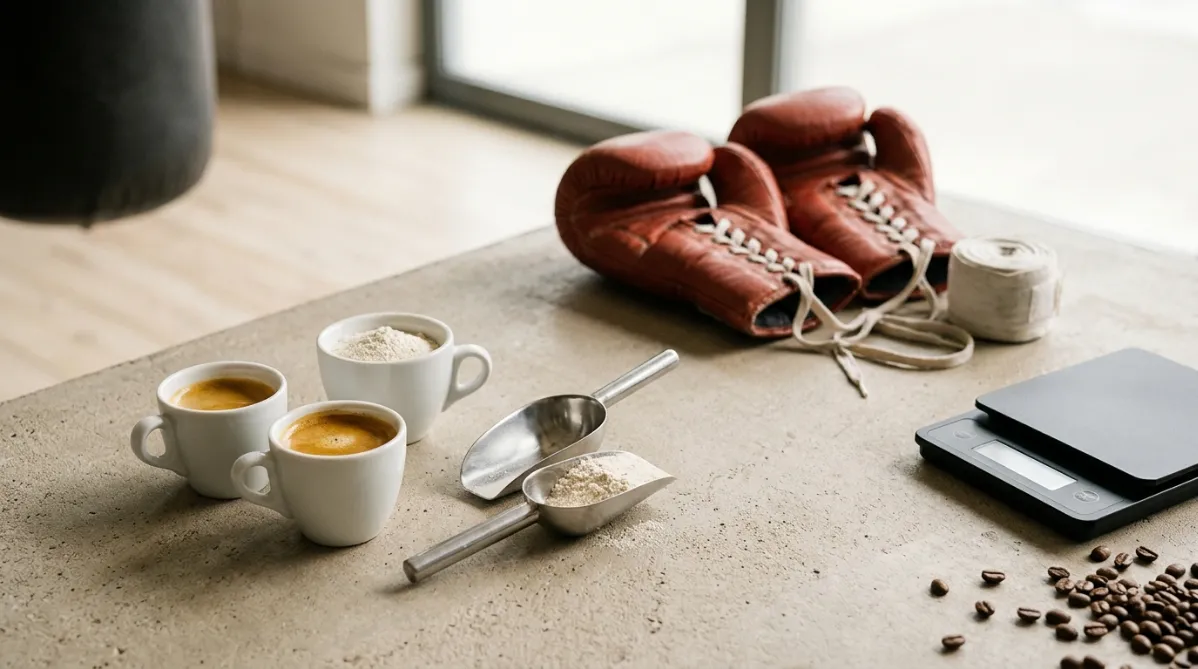
A landscape editorial photograph with a modern, clean magazine feel, shot on a pale warm-gray concrete surface in soft natural window light from the left. In the foreground, two matte white ceramic espresso cups sit side by side. The left cup holds a small amount of dark espresso with golden crema. The right cup is filled twice as high. Beside them, two small stainless steel scoops hold fine coffee-colored powder, one half full and one heaped, suggesting a dose comparison without any text or labels. A pair of worn red leather boxing gloves rests slightly out of focus behind the cups, laces loosely draped, with a white hand wrap rolled neatly beside them. A minimalist digital kitchen scale in matte black sits at the edge of the frame, with a few roasted coffee beans scattered across the surface. In the soft-focus background, a boxing gym corner appears: a hanging heavy bag in muted charcoal, pale wood plank flooring, and a tall window with diffused morning light. The palette is warm cream, espresso brown, brick red, and soft slate gray, with gentle shadows and a shallow depth of field. The composition follows the rule of thirds, with the cups and scoops in the lower left third and open negative space on the right for headline overlay. The look is tactile and refined, like a high-end health and performance journal. It has natural grain, subtle contrast, and a calm, confident mood. There are no people, no text, no logos, and no futuristic elements.
nutrition

Doubling Your Caffeine Barely Helped Boxers—Here's What Did

BY DR. GYMBRO ·

Think a double scoop of pre-workout means double the performance? A new crossover trial in 15 competitive boxers compared 3 mg/kg and 6 mg/kg of caffeine, and the bigger dose was not consistently better. Both doses raised jump height and power at 60 minutes, while 6 mg/kg only pulled ahead on a few outcomes like ballistic push-up power and knee torque. Here is the mg-per-kg conversion for common body weights, the timing the data supports, and the honest caveats, including that punching itself was never tested.

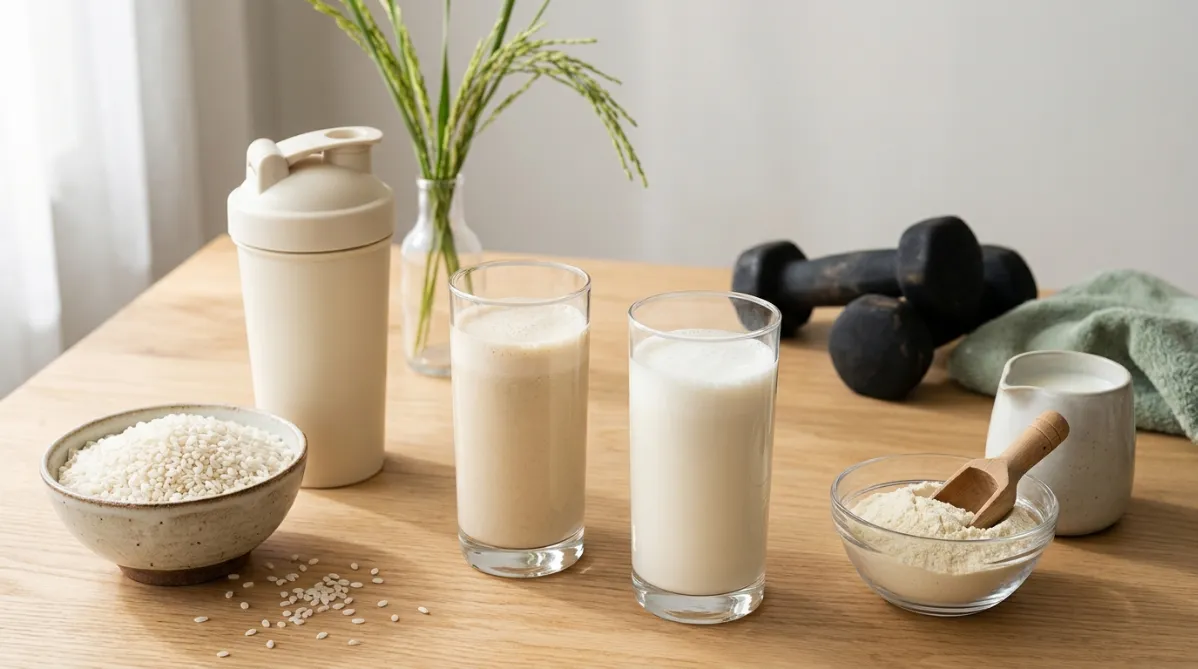
A bright, minimalist editorial still life on a pale oak table, shot from a slightly elevated three-quarter angle in soft natural window light. On the left sits a rustic ceramic bowl of uncooked short-grain white rice, with a few grains scattered across the wood. Beside it is a matte cream-colored shaker bottle. On the right is a small glass bowl of fine ivory whey powder with a wooden scoop resting in it, and a small pitcher of milk behind it. Two identical tall glasses of creamy, lightly frothed shake stand side by side in the center, one a touch warmer beige and the other a soft white. They suggest equal outcomes without any text or labels. A pair of worn black neoprene-coated dumbbells and a folded sage-green gym towel sit slightly out of focus in the background. A sprig of green rice stalks in a slim vase adds a fresh, natural accent.

The palette is warm neutrals: cream, oatmeal, soft sage, and muted terracotta, with gentle shadows and a shallow depth of field. The surface has subtle grain, and fine powder dust is caught in the light. The composition is clean and balanced, with generous negative space on the upper right for a headline overlay. The mood is calm, modern, and health-forward, like a contemporary nutrition magazine or wellness journal. Photorealistic, crisp detail, creamy bokeh, and a gentle matte film-like finish.
nutrition

48 g of Rice Protein Matched Whey for Muscle and Strength in 8 Weeks

BY DR. GYMBRO ·

Plant protein is supposed to lose to whey, but a 2013 trial in trained men found otherwise at a big dose. In 24 resistance-trained males, 48 g of rice protein isolate after training produced the same gains in lean mass, muscle thickness, strength, and power as 48 g of whey over eight weeks. Why did rice keep up? The large dose may have closed the leucine gap. Here is what the study showed, where its limits lie, and how vegans and dairy-intolerant lifters can use it.

This page is available in