Dr. Gymbro
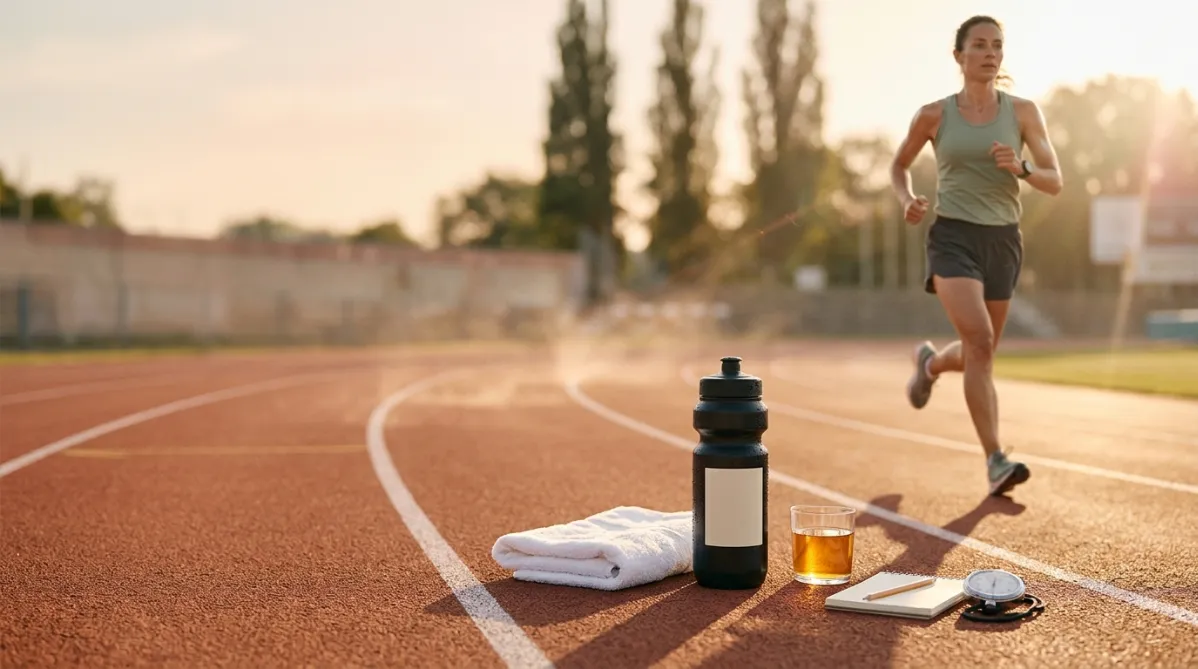
A wide, editorial-style flat lay photographed from above on a pale warm-gray stone countertop in soft morning window light. On the left, a simple white ceramic bowl holds fine white baking soda powder, with a vintage wooden spoon resting beside it and a light dusting of powder spilling across the surface. In the center, three identical clear glass tumblers sit in a neat row, each filled with a slightly different cloudy liquid: one almost clear, one milky white, one faintly yellow-tinged. Small kraft paper labels tied to the glasses with twine remain blank. To the right, a minimalist silver stopwatch lies on a folded navy athletic towel, its hands frozen mid-count. A few fresh lemon halves and a single sprig of mint add a bright, natural accent near the citrate glass. A pair of worn but clean women's running shoes sits partly in frame at the upper right corner, laces loose, hinting at an athlete without showing a person. Subtle long shadows fall diagonally across the scene, giving depth and a calm, modern feel. The color palette is muted and cohesive: chalky whites, soft sage green, warm sand, deep navy, and small pops of lemon yellow. Shallow depth of field gently blurs the edges, with crisp focus on the center glasses and stopwatch. Plenty of clean negative space across the top third leaves room for a headline overlay. The overall look is a trendy health and performance journal: clean, tactile, slightly grainy film-like texture, natural and understated, with no text, no logos, and no futuristic elements.
Nutrition

Baking Soda Beat Sodium Citrate and the Combo by 17 Seconds

Dr. Gymbro · · 4 min read

You'd expect stacking two buffers to beat taking one. In a new study of highly trained female CrossFit athletes, it didn't. Sodium bicarbonate finished first, and the combination of bicarbonate and sodium citrate finished well behind it.

The study, published in the International Journal of Sports Physiology and Performance (2025), compared three buffering strategies against a placebo. Only one of them clearly worked.

What Buffers Actually Do

Hard efforts lasting roughly one to ten minutes produce a lot of hydrogen ions in the muscle and blood. Those ions drive down pH, and that acidity is closely tied to the burning, heavy-legged slowdown late in a hard effort.

Sodium bicarbonate and sodium citrate are "extracellular buffers." They raise the blood's capacity to soak up acid, which may help muscle push hydrogen ions out of the working cells. In theory, a higher blood bicarbonate concentration before exercise means a better chance of holding pace when it hurts.

Bicarbonate is the better-studied option, but it is notorious for causing stomach trouble. Citrate is often pitched as the gentler alternative, and some athletes combine the two hoping for the best of both. This study tested that logic directly.

The Study: Four Conditions, Ten Athletes

Researchers at Edge Hill University and Beijing Sport University recruited ten highly trained female CrossFit athletes. Each completed four 6-km cycling time trials in a randomized, crossover, placebo-controlled design. Before each trial, they took one of the following in enteric-coated capsules:

  • Sodium bicarbonate (SB) at 0.3 g/kg body mass
  • Sodium citrate (SC) at 0.3 g/kg
  • Both combined (SBC), matched to the same total dose
  • Placebo (PLA)

The athletes used a time-to-peak ingestion strategy. Instead of everyone dosing at the same fixed time, timing was individualized around when each athlete's blood buffering peaked. Blood acid-base balance was measured before ingestion, before exercise, and after exercise.

The Results: Bicarbonate Wins Clearly

Before exercise, blood bicarbonate was significantly higher with SB than with both placebo (+6.5 mmol/L) and sodium citrate (+2.3 mmol/L). That gap carried over to the time trial.

The 6-km time trial finishing times for bicarbonate were:

  • 21.5 seconds faster than placebo
  • 11.6 seconds faster than sodium citrate
  • 17.2 seconds faster than the combination

Blood lactate was also higher after the bicarbonate trial than after placebo (about 2.4 mmol/L higher). That isn't a downside. A buffered athlete can often tolerate more glycolytic work, which tends to show up as more lactate in the blood.

The Surprise: Stacking Didn't Help

Neither sodium citrate nor the bicarbonate-plus-citrate combo performed significantly better than placebo. The differences were small and not statistically meaningful (about 9.9 s for SC and 4.3 s for SBC versus placebo).

The stack may feel like insurance, but this result suggests it isn't. When the total dose was held constant, the combination effectively gave athletes less bicarbonate, and the bicarbonate seems to have been the active ingredient. Citrate didn't make up the difference.

The study's design can't prove exactly why the combo underperformed, so treat any mechanism as a hypothesis. A plausible reading is that a half-dose of bicarbonate wasn't enough to raise blood buffering sufficiently, and citrate on its own didn't raise it enough either. The practical message is that more products doesn't mean more benefit.

The Catch: GI Symptoms

Bicarbonate didn't come free. Before exercise, GI symptom scores were higher with SB than with placebo (about 2.4 arbitrary units higher) and with sodium citrate (about 2.2 higher).

That is the usual trade-off with bicarbonate. Even with enteric-coated capsules and individualized timing, it caused more stomach discomfort than the other options. Whether that discomfort is worth about 20 seconds over 6 km is a personal call, and it depends on how your gut reacts.

Practical Takeaways

If you're considering trying this, here is how the study's approach translates to practice:

  • Dose: 0.3 g/kg body mass of sodium bicarbonate, the dose used in the study. A 65 kg athlete would take about 19.5 g.
  • Form: Enteric-coated capsules, which are designed to reduce stomach upset by releasing the bicarbonate further along the gut.
  • Timing: Individualize it. Ingestion timing in bicarbonate research typically falls somewhere around 60 to 180 minutes before exercise, because each person's blood bicarbonate peaks at a different time. Test your own peak in practice if you can.
  • Food: Take it with a carbohydrate-containing meal, which many athletes find eases GI side effects.
  • Who it's for: Efforts of roughly 1 to 10 minutes, including CrossFit workouts, rowing, and 400 to 1,500 m running or similar events.
  • Trial first: Never debut a buffer on competition day. Rehearse the dose, timing, and meal in training so you know how your stomach responds.
  • Skip the stack: Based on this study, adding citrate isn't worth the complexity.

Limitations

This was a small study of ten women. That is a respectable sample for a tightly controlled crossover trial of highly trained athletes, but it limits how confidently the findings extend to other people. The test was also a 6-km cycling time trial rather than an actual CrossFit workout, so the results may not transfer perfectly to mixed-modality events. A published erratum also exists for the paper, so anyone citing exact figures should check the journal's current version. Larger studies with sport-specific tests would help confirm the result.

Bottom Line

In this group of trained female CrossFit athletes, sodium bicarbonate at 0.3 g/kg in enteric-coated capsules improved blood buffering and cut 6-km time trial time by 21.5 seconds against placebo. Sodium citrate and the combination didn't clearly beat placebo. The price was more GI discomfort, so rehearse the plan in training before relying on it in competition.
Original study

Read the original research on pubmed.ncbi.nlm.nih.gov →

This article summarizes published research for general information. It is not medical advice.

DG

Written by

Dr. Gymbro

Dr. Gymbro writes for Dr. Gymbro: science-backed fitness, nutrition & performance.

Related Articles

A wide, editorial-style still life shot from a slightly elevated angle on a pale, warm-gray concrete surface lit by soft natural window light from the left. In the center foreground, a clear glass of cloudy water sits beside a small white ceramic bowl heaping with fine white baking soda powder, a wooden measuring spoon resting beside it with a light dusting of powder spilling across the surface in a graceful arc. Next to them, a minimalist digital kitchen scale in matte white shows a small portion of powder in a shallow dish. Slightly behind, an orange basketball is partially in frame, its pebbled texture catching the light, resting beside a pair of clean white and coral athletic sneakers with the laces loosely undone. A folded charcoal gray towel and a stainless steel stopwatch lie to the right, the stopwatch face crisp and legible. Three small, neatly arranged piles of white powder on a slate tile in the midground, in ascending sizes, hint at different doses without any text or labels. In the soft-focus background, the faint outline of an indoor basketball court with warm honey-colored hardwood floor and blurred lane lines stretches across the frame, glowing with golden-hour light. The color palette is restrained and modern: warm off-white, soft gray, burnt orange, and touches of sage green from a single sprig of mint or eucalyptus laid near the glass. Shallow depth of field, crisp textures on powder grains and the ball's surface, gentle shadows, subtle film-like grain. Clean negative space in the upper right for headline overlay. The mood is calm, sleek, and contemporary, like a premium health and sports science magazine cover, with a fresh, minimalist composition and no people, no text, and no futuristic elements.
nutrition

Baking Soda + Sprints: The Dose That Beat Placebo on Every Test

BY DR. GYMBRO ·

A new randomized trial in basketball players found that adding sodium bicarbonate (baking soda) to four weeks of sprint interval training beat placebo on jumping, sprinting, agility, Yo-Yo distance and Wingate power. The higher dose of 0.45 g/kg then outperformed 0.3 g/kg on every single measure. That makes it a cheap, tempting add-on for team-sport athletes. But the stomach is the catch, and the study is small, short and male-only. Here's the dose math, the GI-distress workarounds, and who this actually applies to.

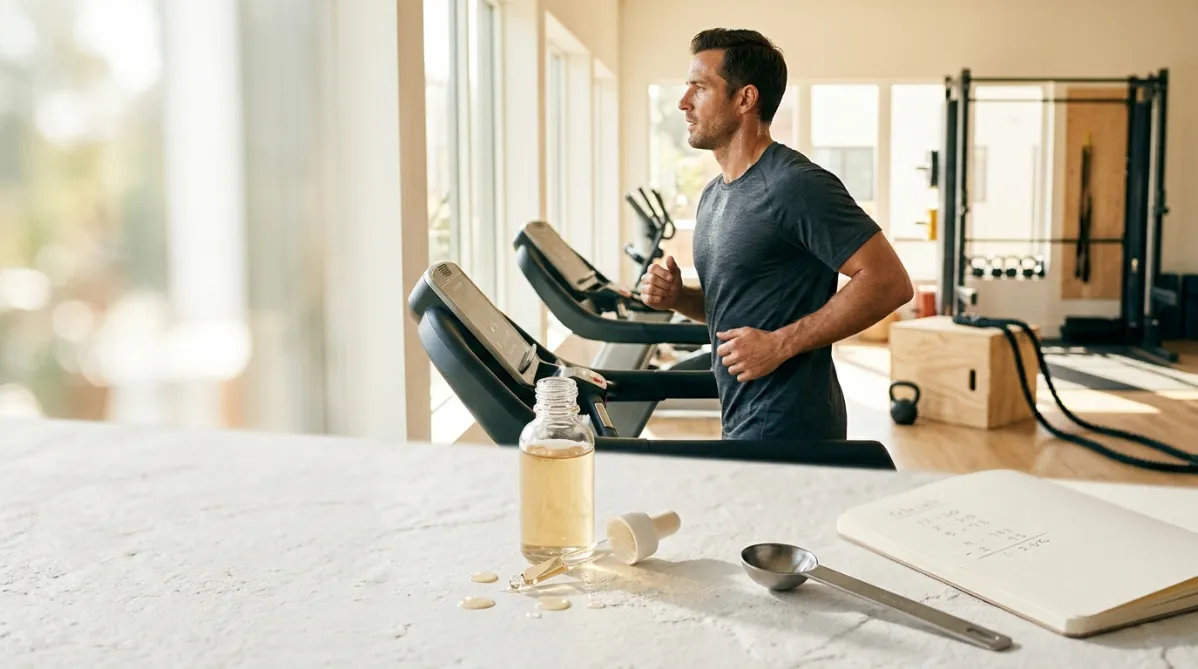
A wide, landscape editorial photograph with a modern wellness-journal feel. In the foreground, a clear glass vial of pale amber liquid sits on a matte white stone surface, with a small dropper beside it and a few droplets catching soft light. A slim brushed-steel measuring spoon and a minimalist notebook with handwritten dose calculations in pencil rest nearby. The numbers are blurred and unreadable.

In the softly blurred background, a bright, airy modern gym with large windows and morning light. A fit man in his thirties, in a charcoal athletic shirt, is mid-stride on a treadmill in profile, with a gentle sheen of sweat and a focused expression. Behind him, a wooden plyo box, a kettlebell, and a rope are arranged neatly, suggesting functional training.

The palette is calm and refined: warm cream, soft sage green, muted terracotta, and touches of deep navy. Natural golden side-light makes long, gentle shadows. Shallow depth of field with a crisp foreground and creamy bokeh. Clean composition with negative space on the left third for a title overlay. Premium magazine photography, subtle film grain, realistic textures, no text or logos, and no futuristic or digital elements.
nutrition

HMB Boosted Cardio Fitness, Not Strength, in New 2026 Trial

BY DR. GYMBRO ·

HMB is usually sold as a way to hold onto muscle and build strength, but a new triple-blind trial found something different. In 90 men, a high personalized dose of liquid HMB free acid (90 mg per kg of fat-free mass daily) plus high-intensity functional training raised VO2max and threshold markers more than placebo. The effect was clearest in trained men, and isometric leg strength did not budge. Here is the dose math, how it compares with the standard 3 g, and who might actually benefit.

A sunlit outdoor running track in late afternoon, shot from a low angle with shallow depth of field. In the foreground, a matte black bottle with a minimal off-white label sits on the edge of a warm terracotta-colored track lane, beside a folded white towel and a small glass of amber liquid catching golden light. Condensation beads on the bottle. A faint heat shimmer rises from the track surface and softens the background.

In the midground, slightly out of focus, a lean athlete in a sage-green tank top and charcoal shorts runs on a treadmill-like stretch of track, a thin sheen of sweat on their shoulders, their expression focused and calm. Their motion is gently blurred, suggesting endurance and rhythm. Long soft shadows stretch across the lane lines.

The background fades into hazy peach, apricot, and pale yellow tones, with the suggestion of tall trees and a distant stadium wall. Warm sun flare enters from the upper right, creating a subtle glow and a few soft light streaks across the frame.

Subtle editorial touches: a small notebook with a pencil and a stopwatch rest beside the bottle, hinting at data and timing without any text legible. The color palette is warm and muted, with terracotta, cream, sage, and charcoal accents, and a fine film-like grain. The composition leaves open negative space on the left third for a headline overlay. The overall mood is clean, modern, and health-journal inspired, natural and aspirational, with a calm scientific curiosity rather than hype.
nutrition

Ketone Drinks in the Heat: Longer Endurance and Sharper Memory?

BY DR. GYMBRO ·

Ketone drinks are supposed to be for fat-burning biohackers, but a new heat-stress trial suggests they might also help you finish stronger. In 17 trained men, ketone monoester plus caffeine extended time to exhaustion to 8.9 minutes versus 7.0 with carbs plus caffeine, after 90 minutes of loaded treadmill work at 34 °C. Working-memory accuracy on the 1-back task improved too, while heart rate and core temperature didn't differ meaningfully. But 2-back, reaction time and the hit-and-avoid task showed no benefit, and the study was small, male-only and single-session. Here's what the data show, and what they don't.

A clean, modern editorial flat-lay on a pale oat-colored linen surface, shot from slightly above in soft diffused natural window light. At the center sits an amber glass supplement bottle with a minimalist cream label, unbranded, with a few capsules spilling onto the fabric in soft greens and ivory tones. Around it are fresh botanical elements: a sprig of green tea leaves, sliced ginger root, a small bundle of dried hibiscus petals, and a few pale green pineapple and papaya slices hinting at digestive enzymes. A small ceramic bowl of creamy plain yogurt with a wooden spoon suggests probiotics. To the left, a flexible tailor's measuring tape in soft blush pink loosely curls across the linen, with a slim brushed-brass scale partly visible at the frame edge. On the right, a minimalist white notebook lies open with a hand-drawn simple line chart showing two diverging lines, one trending downward and one flat, with no readable text. A pair of reading glasses with thin gold frames rests beside it, and a tiny pair of balanced brass scales sits in the background, subtly suggesting weighing evidence and caution.

The palette is muted sage green, warm cream, soft terracotta, and touches of blush and brass. Shadows are gentle and long, the depth of field is shallow with a creamy blurred background, and the negative space on the left third of the frame leaves room for a headline overlay. The overall feel is a contemporary health and science journal, calm, trustworthy, and slightly skeptical, in the style of a premium wellness magazine photographed with a 50mm lens, with crisp texture on linen, glass, and botanicals.
nutrition

SlimSEB Probiotic-Enzyme Blend Beat Placebo—But There's a Catch

BY DR. GYMBRO ·

A probiotic, enzyme and botanical blend called SlimSEB beat placebo in a 12-week randomized trial of 87 adults at risk of type 2 diabetes. Obese participants lost 4.5 kg more than placebo and trimmed their waists by 11 cm, while cholesterol and insulin resistance also improved. But the product was supplied by its maker, the trial was small and short, and the multi-ingredient formula means no single component can take credit. Here is what the data show, how they compare with GLP-1 drugs, and who should think twice.

This page is available in