Dr. Gymbro
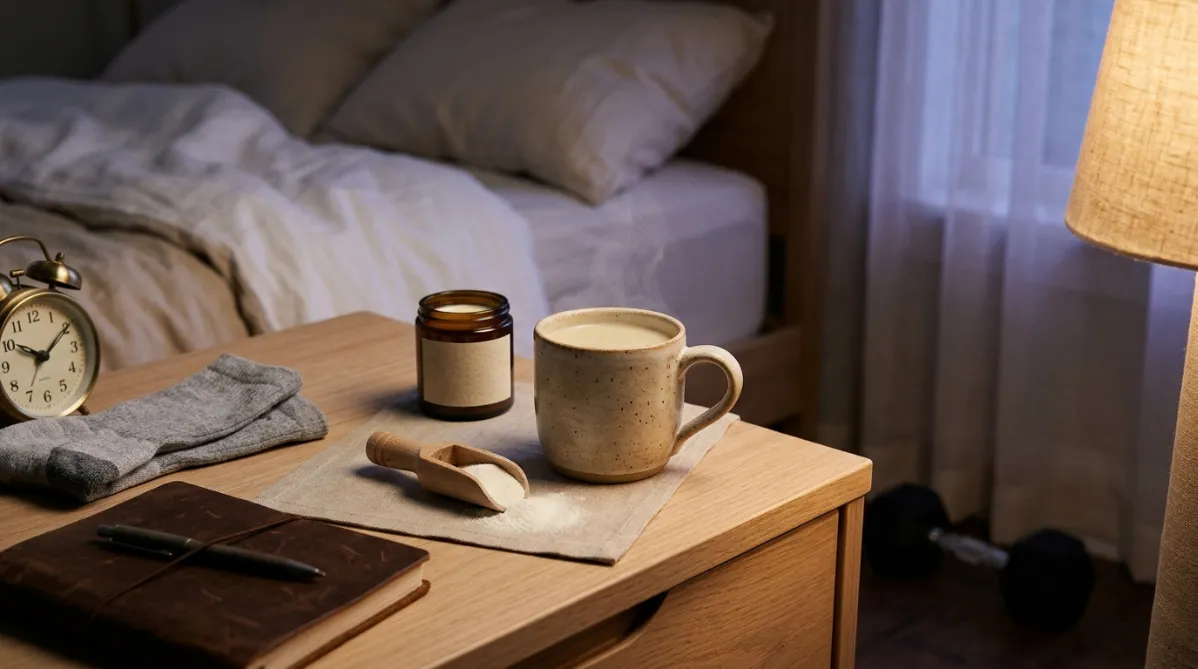
A softly lit bedroom nightstand scene in landscape format, photographed in a modern editorial lifestyle style. In the center of the frame sits a handmade ceramic mug in warm oatmeal tones, filled with a pale creamy drink. A thin wisp of steam rises from it. Beside the mug, a small wooden scoop rests on a matte linen-textured surface with a fine dusting of white collagen powder. A minimal amber glass jar with a cream label stands just behind, with no readable text. The nightstand is pale oak with subtle grain.

To the left, a neatly folded pair of gray cotton athletic socks and a worn leather-bound training journal with a pen on top hint at a lifter's routine. A small brass alarm clock reads about 9:30 and is slightly out of focus. On the right side, a sheer curtain filters the last blue-violet twilight from a window, while a warm bedside lamp with a linen shade casts a honey-colored glow across the scene. The glow contrasts gently with the cool dusk tones.

Behind the nightstand, the edge of a rumpled bed with soft white and sand-colored bedding is visible, with a dumbbell resting quietly on the floor in the soft-focus background to suggest recovery after training. The depth of field is shallow, with the mug and scoop in crisp focus and the background dissolving into creamy bokeh.

The palette is calm and earthy: warm beige, soft cream, muted terracotta, and dusk blue accents. The lighting is cinematic and low-key, with gentle highlights on the ceramic rim and a subtle rim light on the steam. The composition follows the rule of thirds, with the mug placed on the left third and generous negative space on the right for title overlay. The mood is serene, restorative, and quietly scientific without any clinical elements. The finish is clean, high-end, and magazine-worthy, with fine film grain and natural color grading, like a wellness feature in a contemporary online journal.
Recovery

The 15 g Bedtime Collagen Trick That Cut Night Wake-Ups by 27%

Dr. Gymbro · · 4 min read

You can hit every set, eat every meal and still wreck your progress if you spend the night surfacing from sleep. Fragmented sleep is the hidden leak in many lifters' recovery. A small 2024 trial in European Journal of Nutrition suggests that a scoop of collagen peptides before bed might patch it. The result is interesting, but it comes with caveats you should know before you buy a tub.

Why Collagen at Bedtime? It's the Glycine

Collagen is unusually rich in glycine, an amino acid that makes up roughly one in three of its amino acid residues. Most protein powders contain far less. Glycine has long been studied as a sleep aid, and earlier small trials using around 3 g before bed reported better subjective sleep quality. Collagen peptides are a cheaper, more familiar way for lifters to get glycine, alongside other amino acids.

The researchers, from Loughborough University and collaborators, wanted to know whether a glycine-rich collagen peptide supplement could improve sleep in physically active men who already had sleep complaints.

The Study: What Was Actually Done

The design was strong for a small trial:

  • Participants: 13 athletic men, average age 24, training about 7 hours per week
  • Sleep problems: an average Athens Insomnia Scale score of 9, indicating real sleep complaints
  • Intervention: 15 g of collagen peptides or a placebo, taken 1 hour before bedtime for 7 nights
  • Format: randomized crossover, so each man did both conditions, with at least 7 days between trials and a 7-night familiarisation period beforehand
  • Measurements: sleep diaries and actigraphy for all 7 nights, plus polysomnography (the lab gold standard) and core temperature on night 7. Cognition, inflammation and hormones were assessed that night and the next morning.

The crossover format matters because each athlete served as his own control, which reduces noise in a tiny sample.

What Improved: Fewer Awakenings and a Sharper Morning

Fewer awakenings. Polysomnography recorded 21.3 ± 9.7 awakenings with collagen versus 29.3 ± 13.8 with placebo (P = 0.028). That is 8 fewer wake-ups per night, about a 27% reduction.

The diaries pointed the same way. Over the 7 days, self-reported awakenings averaged 1.3 ± 1.5 with collagen versus 1.9 ± 0.6 with placebo (P = 0.023). Objective and subjective measures agreeing is a good sign.

Better morning Stroop accuracy. The morning after night 7, participants answered a higher proportion of baseline Stroop trials correctly with collagen (1.00 ± 0.00) than with placebo (0.97 ± 0.05; P = 0.009). The Stroop test measures attention and the ability to override automatic responses. A perfect score against 0.97 is a small gap, and it hints at a possible ceiling effect. It is encouraging but not proof of a big mental edge.

What Didn't Improve: The Reality Check

This is where the clickbait ends. Collagen did not change:

  • Total sleep time
  • Sleep latency (how fast you fall asleep)
  • Sleep efficiency
  • Core temperature
  • Hormones or inflammatory markers
  • Subjective sleepiness, fatigue or overall sleep quality
  • Other cognitive tests

So collagen is not a sedative, and it didn't help people drift off faster or sleep longer. The one thing that moved was how often sleep was interrupted. If your problem is lying awake for an hour, this study offers little for you.

Limitations You Should Know About

  • Tiny sample: 13 men. Small trials often overestimate effects and can't show whether results apply to women, older adults or non-athletes.
  • Short duration: 7 nights. We don't know whether the benefit lasts, grows or fades.
  • Single-night lab data: polysomnography was recorded only on night 7, so the headline awakenings figure comes from one night per condition.
  • Industry-supplied product: the supplement was supplied by Rousselot, and two authors are employees of the company. That doesn't invalidate the work, but independent replication would carry more weight.
  • Many outcomes: a lot of measures were tested, and only a few reached significance, so some findings could be chance.

How to Use This: Practical Takeaways

The protocol studied: 15 g of collagen peptides, about 1 hour before bed.

Who it might suit: athletes and lifters who sleep poorly because of frequent awakenings, not those who struggle to fall asleep. If you track your sleep and see many mid-night wake-ups, a 1–2 week self-experiment is low-risk. Keep everything else constant, and judge it by how many times you wake and how you feel in the morning.

Collagen vs. 3 g glycine: Pure glycine at around 3 g is the more studied sleep-specific option, and it's cheap and compact. Collagen offers glycine plus other amino acids and fits easily into a nightly shake, but you need a much larger dose, and the evidence for it is thinner. Collagen is not a complete protein, so it shouldn't replace your main protein sources. Treat it as an add-on, not a swap. If you want the simplest, best-evidenced route to glycine, plain glycine is reasonable. If you already use collagen, the 15 g bedtime serving is a logical test.

The Bottom Line

A 27% drop in night-time awakenings is a real, measurable result, but it comes from 13 men over one week with an industry-supplied product. Collagen peptides before bed look like a promising, low-risk experiment for lifters with fragmented sleep, not a proven cure. Try it, track it honestly, and keep the fundamentals in place: consistent bedtimes, a cool dark room, and caffeine cut-offs.

Source: Thomas C, et al. Eur J Nutr. 2024;63(1):323-335. doi: 10.1007/s00394-023-03267-w.
Original study

Read the original research on pubmed.ncbi.nlm.nih.gov →

This article summarizes published research for general information. It is not medical advice.

DG

Written by

Dr. Gymbro

Dr. Gymbro writes for Dr. Gymbro: science-backed fitness, nutrition & performance.

Related Articles

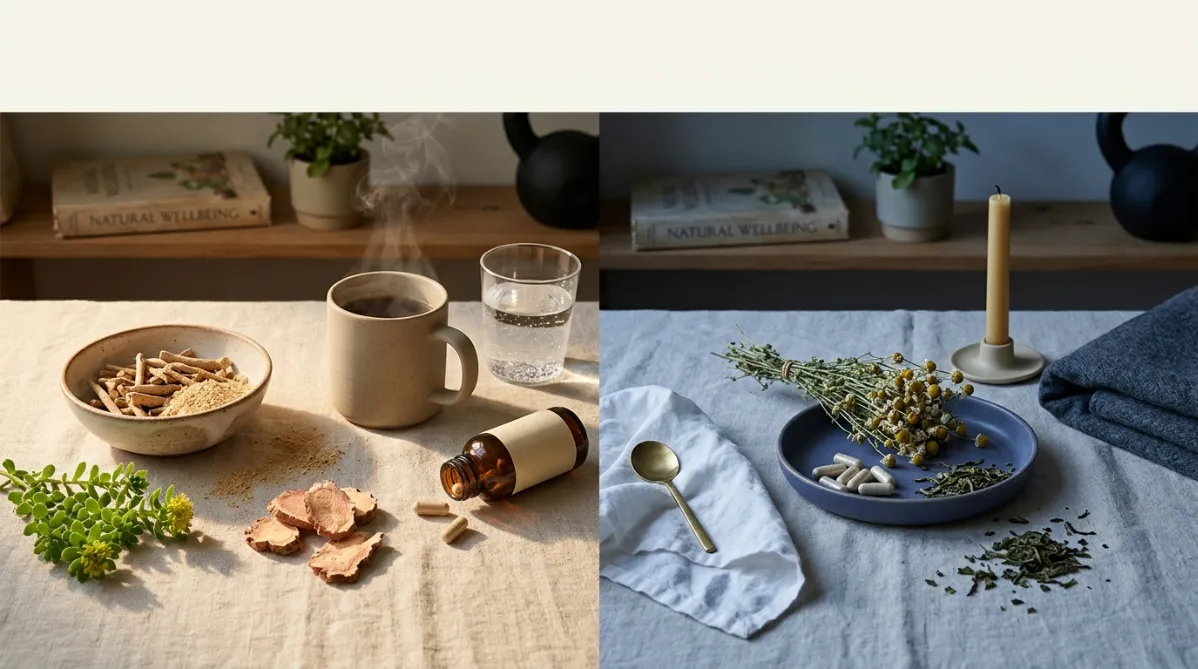
A landscape editorial still life shot from slightly above on a pale oat-colored linen surface, lit by soft morning window light with gentle long shadows. On the left, in warm golden sunlight, sits a small ceramic bowl of dried ashwagandha root pieces and a scatter of fine tan powder. Beside it are a few rough, rosy-gold slices of Rhodiola rosea root and a sprig of tiny succulent-like green leaves with yellow blossoms. A matte sand-colored stoneware mug of steaming tea and a simple glass of water stand nearby. A small amber glass bottle with a minimal unbranded label tips out two capsules.

The right side of the frame is cooler and bluer, as if dusk is arriving. It holds a muted indigo ceramic dish with a few pale capsules, a small bundle of dried chamomile flowers (the source of apigenin), and a few green tea leaves. A slim, unlit beeswax candle and a folded charcoal wool blanket suggest evening. The warm and cool halves meet softly in the center, where a rumpled white cotton napkin sits beneath a small brass spoon.

In the background, out of focus, a wooden shelf holds a worn paperback, a small potted plant, and the edge of a kettlebell in matte black, hinting at an active lifestyle. Subtle film grain, shallow depth of field, and a muted palette of cream, terracotta, sage green, and deep indigo give it a clean, modern wellness-magazine feel. Leave generous negative space in the upper third for a headline overlay. No text, no logos, no people.
recovery

Ashwagandha + Rhodiola Worked. The Evening Sleep Stack Didn't.

BY DR. GYMBRO ·

A new four-arm trial throws a curveball at the supplement-stacking crowd. In 103 healthy, active adults, a morning combo of 600 mg ashwagandha and 300 mg Rhodiola rosea was linked to lower perceived stress, better sleep quality and improved mood. The popular evening stack of magnesium L-threonate, L-theanine and apigenin added nothing, and taking both looked worse on positive affect. Here's what the study found, why it needs caution (only two weeks, small groups), and how lifters might use it.

A wide, softly lit editorial still life on a pale oatmeal-colored linen surface, shot from a slightly elevated three-quarter angle. In the center-left, a small matte ceramic dish holds a tiny pile of fine white powder, with a single minuscule measuring spoon resting beside it. To the right, a much larger wooden scoop is heaped high with the same pale powder, spilling gently onto the linen, creating a striking visual contrast of tiny versus large quantity. Behind them, a cream-colored supplement tub with a blank, minimalist label sits slightly out of focus, along with a few amber glass capsules scattered casually.

In the soft-focus background, a runner's well-worn sneaker and a chalk-dusted, wrapped knee sleeve rest on a light ash-wood bench, hinting at gym and road without showing a person. A thin brushed-steel stopwatch lies in the foreground, its hands paused, subtly suggesting timing and endurance. A sprig of dried eucalyptus and a folded sheet of paper with out-of-focus handwritten notes add a quiet, editorial research feel.

Natural morning light streams in from the left through a sheer curtain, casting long, gentle shadows and a warm, creamy glow. The palette is restrained and modern: warm ivory, sand, soft sage green, muted terracotta, and touches of brushed silver. Shallow depth of field with crisp detail on the powders and stopwatch, creamy bokeh in the background. The composition leaves open negative space on the right third for headline text. The overall mood is calm, trustworthy, and contemporary, like a premium health and wellness journal cover, with fine film-like grain and clean, minimalist styling.
recovery

A 40 mg Collagen Dose Doubled Time to Knee Pain. Here's the Catch

BY DR. GYMBRO ·

Achy knees under the bar or on the road? One randomized trial found that just 40 mg a day of undenatured type II collagen (UC-II) was linked to knee pain starting later, from 1.4 to 2.8 minutes, and to better knee extension. That is about 250 times less than a typical 10 g scoop of hydrolyzed collagen, and it is a different kind of product. But the study was small, industry-linked, and done in healthy people rather than arthritis patients. Here's what the data show, where the headline needs context, and how to read a label.

A sunlit, minimalist home gym corner photographed in soft golden morning light, with a young athletic man seated on a wooden bench, leaning forward with his elbows resting on his knees, catching his breath after a hard leg session. He wears a muted sage-green t-shirt and charcoal shorts, his face turned slightly away from the camera, calm and focused. A matte ceramic dish in the foreground holds a few small, translucent golden softgel capsules, with a glass of water beside it catching the light and casting a soft caustic shadow across a pale oak floor. Behind him, a loaded barbell rests on a squat rack, slightly out of focus, and a tall window pours warm sunlight diagonally across the scene, creating long gentle shadows and a hazy glow. A small potted green plant sits on a shelf at the edge of the frame. The color palette is warm and editorial: cream, soft gold, sage green, pale wood, and charcoal accents. Shallow depth of field, with crisp focus on the capsules and glass in the lower third and a creamy bokeh background. The composition leaves generous negative space on the right side for a headline overlay. The mood is clean, modern, and aspirational, like a high-end wellness magazine or a trendy health journal feature. Shot on a 50mm lens, natural light, fine film grain, subtle matte finish, landscape 16:9 framing.
recovery

Vitamin D Sped Strength Recovery in Men Who Weren't Deficient

BY DR. GYMBRO ·

Men with perfectly normal vitamin D levels still recovered strength faster after a brutal leg workout when they took 4,000 IU daily. In this randomized, placebo-controlled trial of 28 active men, peak isometric force bounced back about 8% better at 24 hours. Muscle-damage markers ALT and AST also rose less. But there's a twist: soreness didn't improve at all. Here's what the study found, where it falls short, and who might actually care.

A softly lit bedside table in a calm, modern bedroom at dusk, photographed in wide landscape format with shallow depth of field. In the foreground, a matte white shaker bottle sits beside a tall frosted glass of creamy, pale vanilla-colored protein shake, with a few condensation droplets catching warm light. Next to the glass rests a slim fitness band on a dark charcoal fabric strap, its small LED glowing a gentle green, lying casually on a light oak wooden surface. A small scoop of fine white protein powder rests on a ceramic dish nearby, with a light dusting of powder on the wood.

In the soft-focus background, a neatly made bed with oatmeal-colored linen bedding and a textured knit throw blanket. A sheer curtain filters the last peach and lavender light of evening from a large window. A small potted olive branch in a terracotta vase and a closed paperback book add a quiet editorial touch. A bedside lamp with a warm, cream-colored shade casts a golden glow across the scene and creates gentle highlights on the glass.

The palette is muted and harmonious: warm cream, soft sand, oatmeal beige, faint sage green accents, and touches of dusty lavender in the window light. The mood is peaceful, reassuring, and clean, like a contemporary wellness magazine or a trendy health journal feature. Lighting is natural and cinematic, with soft shadows and a subtle film-like grain. The composition follows the rule of thirds, with the shake and band on the left third and open negative space on the right for headline overlay. Minimalist, Scandinavian-inspired styling, high-end lifestyle photography, crisp details, and a tranquil, premium editorial feel.
recovery

Casein Before Bed Won't Wreck Your Sleep, WHOOP Data Shows

BY DR. GYMBRO ·

Does a 40 g casein shake before bed secretly sabotage your sleep? A randomized, double-blind crossover trial in 21 NCAA Division I female athletes tracked sleep with WHOOP 4.0 bands and found no hit to sleep time, efficiency, resting heart rate or HRV. Alpha-lactalbumin and carbohydrate performed the same. But there's a twist: none of them improved sleep either. Here's what the data show, where the study falls short, and who should still skip the late-night shake.

This page is available in