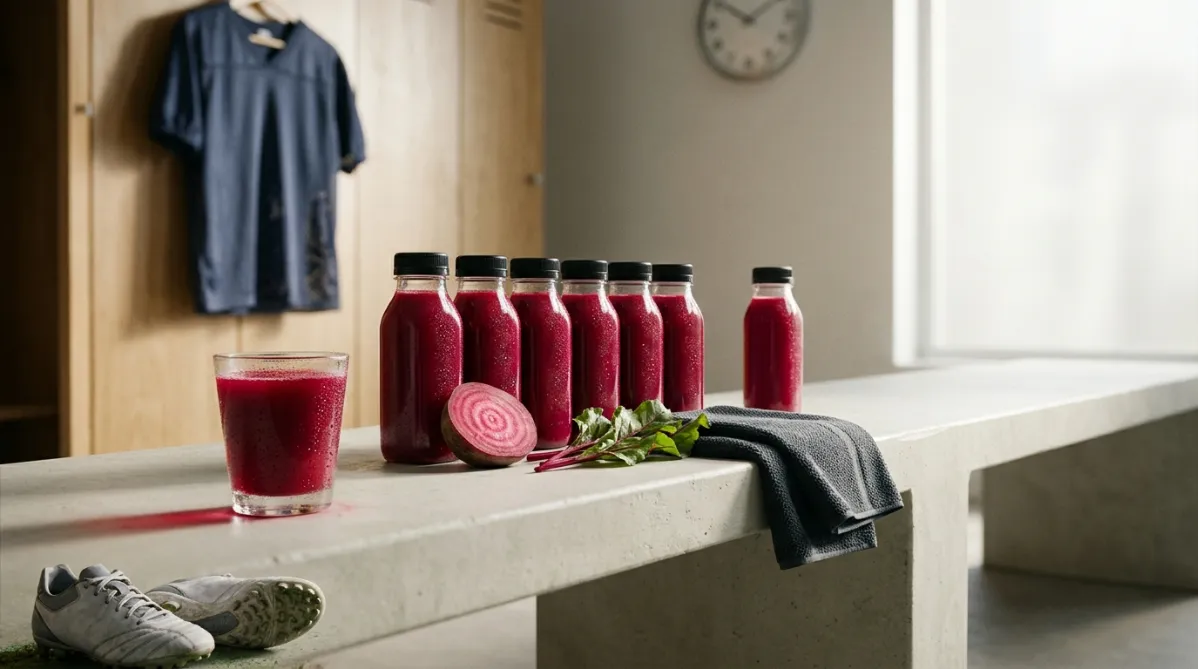
You've seen the little red shot bottles in the locker room. Here's the uncomfortable question: does chugging one right before kickoff do anything? A new meta-analysis of 24 trials in team sport athletes suggests the real action is in the days before game day, and even then the payoff is modest.
The Verdict in 30 Seconds
Researchers from the Poznan University of Physical Education pooled 24 randomized, placebo-controlled trials covering 365 athletes (277 males, 88 females). The paper was published in the Journal of the International Society of Sports Nutrition. The question was whether dietary nitrate, usually delivered as beetroot juice, improves performance in team sport athletes.
- Overall effect on performance: small but statistically significant (g = 0.075).
- Team sport-specific tasks: a bit larger, g = 0.143, with low heterogeneity and moderate certainty.
- Chronic (multi-day) protocols: a clear benefit (g = 0.145).
- Acute (single-dose) protocols: no clear effect.
The supplement worked, but only a little. And the pre-game shot on its own didn't show up as a winner.
What Counts as "Chronic" Here?
The definition matters. In this review, a chronic protocol meant nitrate for at least two days, with the final dose taken 2-3 hours before exercise. So these were not people drinking beetroot juice for months. They were loading for a few days and topping up before the session.
The authors flag a catch. Because chronic protocols also included a pre-exercise dose, the results shouldn't be read as proof of long-term physiological adaptation. You can't tell whether the benefit came from the days of loading, the final dose, or the combination. The protocol that worked is "load, then top up," and the data can't separate the two parts.
Does Chronic Really Beat Acute?
On paper, yes. The chronic-versus-acute contrast was statistically significant (g = 0.118). But that comparison did not hold up when the researchers used more conservative assumptions about how crossover trials correlate within the same athlete. That dropped the certainty of this contrast to very low.
So "daily loading beats a single shot" is a reasonable working hypothesis, not a settled fact. Chronic protocols clearly showed an effect and acute ones didn't, but the difference between them is shaky. A lack of clear evidence for acute dosing is not proof that it never works.
What Improved
The most consistent gains showed up in team sport-specific performance tests, the kind of tasks that mimic what players actually do. This is the finding with moderate certainty, and it is the strongest result in the paper.
The review also found hints in two areas, both rated very low certainty:
- Repeated high-intensity efforts
- Fatigue-sensitive neuromuscular performance
Treat those as leads for future research, not selling points. Nitrate also reliably raised circulating and salivary nitrate/nitrite, so the supplement did what it's supposed to do in the body.
What Didn't Improve
This part rarely makes it onto the bottle label.
- Single sprints: no consistent benefit. If your sport is a one-off burst, don't expect a boost.
- Most metabolic and biochemical markers: no consistent changes.
- Cardiorespiratory responses: largely unchanged.
That last point cuts against the usual pitch that nitrate lowers the oxygen cost of exercise. In these team-sport trials, the performance edge didn't come with a clear shift in the cardiorespiratory numbers.
What About Dosing?
The authors ran dose-response meta-regressions and found no consistent linear or non-linear trend. More nitrate wasn't reliably better. Evidence on whether sex or training status changes the response is suggestive but uncertain. The paper states the evidence is currently insufficient to support specific dosing recommendations. Anyone giving you an exact milligram number as "proven" for team sports is ahead of the data.
Practical Takeaways
- Don't rely on a lone pre-game shot. Single-dose trials showed no clear effect.
- If you try it, use the structure that worked: several days of consistent nitrate intake with a final dose 2-3 hours before training or competition.
- Test it in training first. Effects are small, so judge it on how you feel and perform in sport-specific drills, not on hype.
- Set realistic expectations. A pooled effect of g = 0.143 in team sport tasks is a marginal gain, not a transformation.
- Keep the basics first. Sleep, carbohydrate intake, and training quality are worth far more than a small effect size.
Who It's For
Beetroot juice or nitrate is most reasonable for competitive soccer, basketball, rugby, handball, and similar athletes who are already training and eating well and want a small, low-risk edge. It suits those who can plan ahead, such as before a tournament, a testing block, or a key match, and who are willing to follow a multi-day routine with a final pre-exercise dose. The evidence includes both male and female athletes, though women made up only about a quarter of the sample.
Who Should Skip It
Skip it if you're hoping a single shot before the whistle will carry you. That approach has no clear support here. It's also not worth it if your performance depends on isolated sprint efforts, since single-sprint outcomes showed no consistent benefit. Recreational players with the basics of sleep, fueling, and training still unsorted will get more from fixing those first. Anyone with a medical condition, such as kidney issues or blood pressure medication use, should check with a physician or sports dietitian before adding concentrated nitrate sources.
The Bottom Line
Nitrate isn't a miracle, and the headline number is small. But for team sport athletes who plan ahead, loading over several days and taking a final dose before exercise has the best support. The caveats are real: very low certainty on the chronic-versus-acute gap, no dosing guidance, and no evidence for long-term adaptation. Well-powered, sex-stratified trials will have to settle the rest.