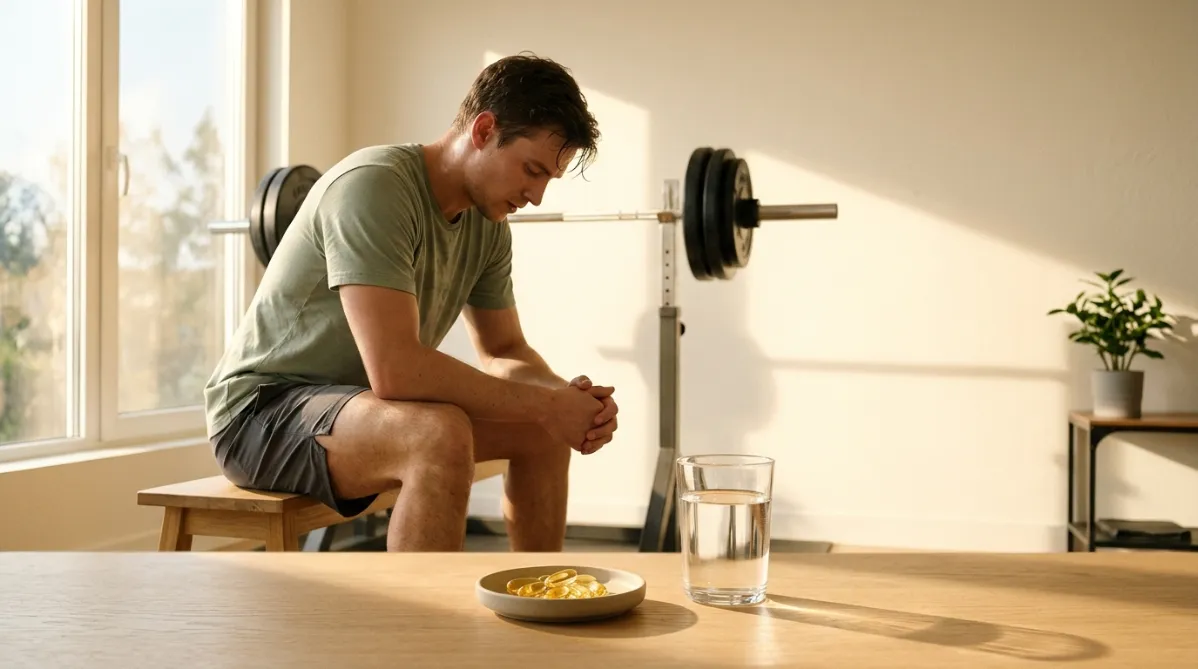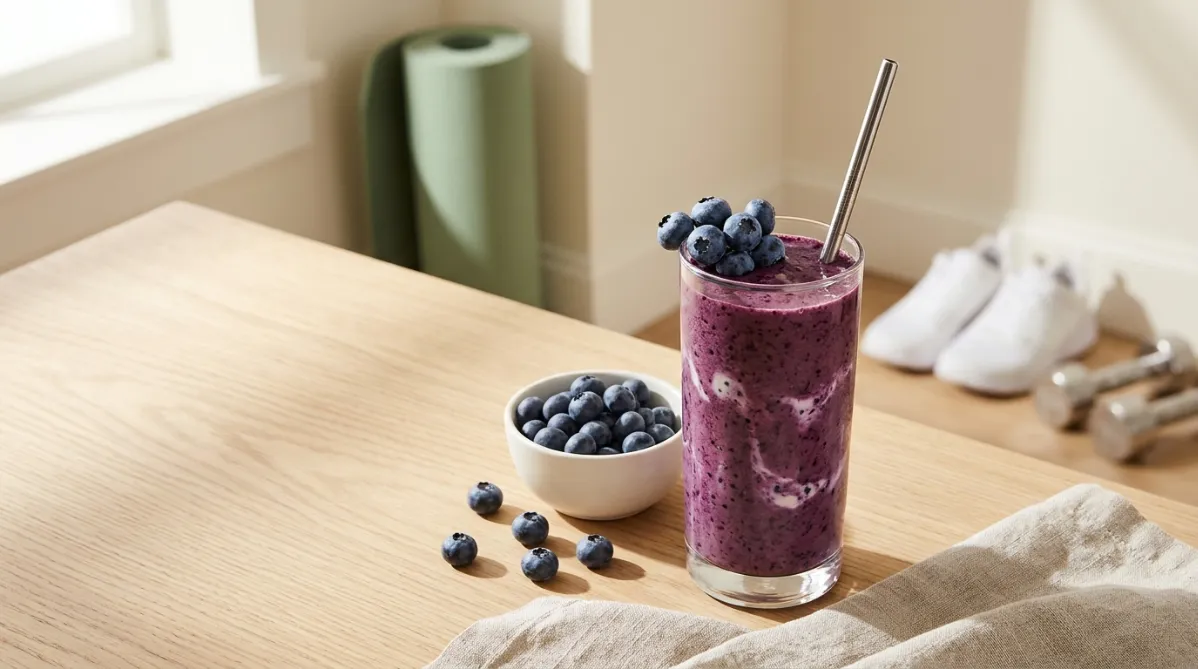
You know the feeling: two days after a brutal leg session, stairs become a negotiation. Muscle that should be strong feels weak, and the next workout gets pushed back. A small New Zealand trial tested a simple food-based fix, a blueberry smoothie, and found it sped up the return of one key strength measure. The result is real but modest, and the details matter.
The Study at a Glance
The research, published in the Journal of the International Society of Sports Nutrition in 2012, came from Massey University and the New Zealand Institute for Plant and Food Research. Here is the design:
- Design: randomized crossover. Each participant did both conditions, which makes the comparison tighter than a standard two-group trial.
- Participants: 10 women.
- Damage protocol: 300 strenuous eccentric contractions of the quadriceps, the lowering phase of a lift, which is notorious for causing soreness and temporary weakness.
- Intervention: a smoothie made with New Zealand blueberries versus a placebo smoothie with a similar antioxidant capacity.
- Timing: 5 and 10 hours before the exercise, then immediately after, and again 12 and 36 hours after.
- Monitoring: knee torque (concentric, isometric and eccentric) and blood markers of oxidative stress, antioxidant capacity and inflammation across a 60-hour recovery window.
The abstract does not report the exact amount of blueberries in each serving, so there is no verified gram figure to quote here.
The Headline Finding: Isometric Strength Bounced Back Faster
The damage protocol worked. Twelve hours after exercise, isometric, concentric and eccentric torque had all dropped significantly (p < 0.001) in both conditions. Everyone got weaker, and the smoothie did not prevent that.
The difference showed up in the recovery. Over the 60-hour period, peak isometric tension showed a significant interaction effect (p = 0.047), meaning strength recovered at a faster rate after the blueberry smoothie than after placebo. Concentric and eccentric strength showed a similar trend, but the abstract describes it only as a trend, not a significant result.
So one outcome crossed the significance line, and only just. It is a promising signal, not a slam dunk.
Why the Placebo Detail Matters
Many berry studies leave a lingering doubt: is it the fruit, or just antioxidants in general? Here the placebo smoothie was matched for antioxidant capacity, so the blueberry advantage can't be explained by a simple antioxidant headcount.
The authors reached the same conclusion. They argue the effect was independent of the drink's inherent antioxidant capacity. Their proposed explanation is that blueberries, combined with the eccentric exercise stimulus, appear to up-regulate adaptive processes, specifically the body's own endogenous antioxidant systems. This is a hypothesis drawn from the data, not a proven mechanism.
What the Blood Markers Showed
Both groups saw rises in oxidative stress and inflammatory biomarkers after the damaging exercise, as expected. The blueberry group's oxidative stress fell faster, but that difference only reached significance at 36 hours post-exercise. That timing coincided with a gradual rise in plasma antioxidant capacity.
Inflammation was a different story. Biomarkers were still elevated at 60 hours of recovery, so the smoothie did not obviously shut inflammation down in this window. The strength benefit appears to have come without a clear anti-inflammatory win.
What This Means for You
This is a single small trial, so treat these as practical ideas rather than prescriptions.
Timing: The protocol used multiple servings spread around the session: 10 and 5 hours before, immediately after, then 12 and 36 hours later. If you want to mirror it, the logic is to bracket a hard leg day rather than drink one smoothie afterward.
Dose: The abstract doesn't specify the blueberry amount, so no evidence-based quantity can be cited from it. A sensible approach is a normal fruit-smoothie serving made with real blueberries. Check the full text if you need the exact recipe.
Best use cases: Eccentric-heavy sessions are where this evidence applies: heavy negatives, downhill running, a new squat or lunge block, or a return after time off. These are the sessions most likely to leave you weak for days.
Who it's for: Recreational and trained lifters or athletes who want to be ready for the next session sooner and don't mind adding a food-based strategy.
Who might skip it:
- People managing blood sugar or total calories who would need to account for a fruit smoothie.
- Anyone with a fruit allergy or intolerance.
- Anyone who needs a guaranteed result. One outcome reached significance in 10 women, so it isn't a sure thing.
Caveats Worth Keeping in Mind
- Tiny sample: 10 women. The findings may not carry over to men or to other populations.
- One significant effect: isometric peak torque (p = 0.047). Concentric and eccentric strength only trended in the same direction.
- Short window: 60 hours of recovery, with no data on long-term training adaptations.
- Unspecified dose: the abstract gives no blueberry quantity.
- Not a cure for soreness: torque dropped significantly in both groups, and inflammation stayed elevated in both.
Bottom Line
A blueberry smoothie, taken around a punishing eccentric session, helped these 10 women recover isometric leg strength faster than a placebo matched for antioxidant capacity. The effect was modest and statistically borderline, and the mechanism is still a hypothesis. If you're already planning a hard leg block, adding blueberries around it is a low-risk experiment. Just don't expect a miracle from fruit alone.