Dr. Gymbro
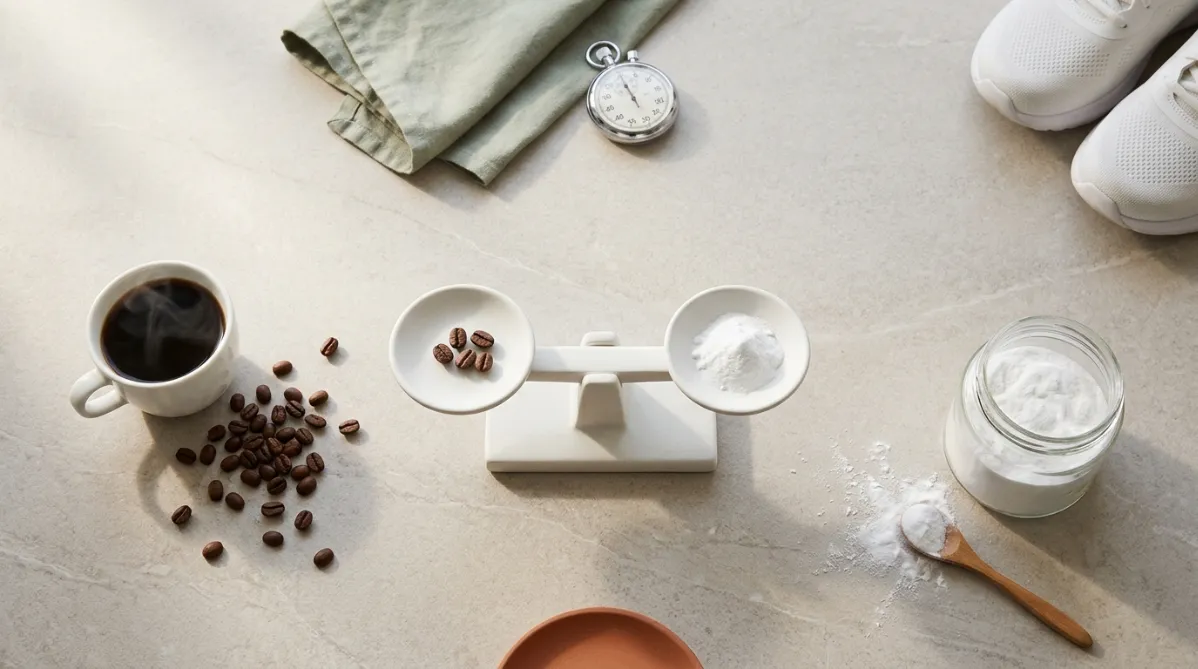
A calm, editorial-style flat lay photographed from above on a pale, warm-gray stone countertop in soft morning window light. On the left, a small white ceramic cup of black coffee with a delicate swirl of steam, beside a scattering of whole roasted coffee beans. On the right, a minimalist glass jar of fine white baking soda powder with a wooden spoon resting beside it, a few soft white grains dusted across the surface. In the center, a clean white scale-like balance made of matte ceramic with two small dishes: one holding a few coffee beans, the other a small mound of white powder, perfectly level to suggest the idea of equal outcomes. A folded sage-green linen napkin and a simple stainless steel stopwatch rest near the top edge, along with a pair of minimalist white running shoes partially visible in the corner. Subtle long shadows, gentle natural highlights, and a shallow depth of field give a tactile, premium feel. The color palette is muted and modern: cream, warm espresso brown, soft sage, and chalky white, with a single accent of pale terracotta in a small ceramic dish. Composition is balanced and uncluttered with generous negative space on the upper right for a title overlay. The overall mood is clean, contemporary, and quietly scientific, like a cover from a trendy health and performance journal. Wide landscape 16:9 framing, crisp detail, natural film-like grain.
Nutrition

Caffeine + Baking Soda Stack: Does It Beat Either Alone?

Dr. Gymbro · · 4 min read

You already know caffeine works. You may know baking soda works too. So taking both should work better, right? A 2026 systematic review and meta-analysis in Nutrients by Chen, Tu, and Wang tested that assumption, and the answer is more complicated than the supplement-stack hype suggests.

The Short Version

The researchers pooled 13 crossover trials comparing combined caffeine and sodium bicarbonate (CAF + SB) against placebo, and in some cases against either supplement alone. The headline numbers look decent at first glance:

  • Mean power: +8.43 W vs placebo (95% CI 1.85 to 15.00, p = 0.012)
  • Time-trial completion time: ratio of means 0.984, about a 1.6% reduction vs placebo (p = 0.022)

The catch is that both results were sensitive to leave-one-out analysis. When individual studies were dropped from the pool, statistical significance disappeared. That is a classic sign of a fragile finding. More importantly, CAF + SB did not significantly improve mean power compared with caffeine alone or sodium bicarbonate alone.

Why the Stack Looks Better Than It Is

The comparison against placebo is the easiest one to win. Caffeine alone beats placebo and so does bicarbonate alone, so a combination of the two beating placebo tells you little about whether the combination adds anything. The useful question is whether the stack beats its own ingredients, and the current evidence says it has not been shown to.

The physiology didn't settle it either. The stack raised blood bicarbonate (HCO3-) and post-exercise lactate versus placebo, though the bicarbonate evidence was limited by heterogeneity and a small number of studies. Higher blood buffering capacity is the expected result of taking bicarbonate. The authors point out that these physiological shifts do not, on their own, prove better performance. Ratings of perceived exertion also showed no consistent pattern.

What About Stomach Trouble?

This is the part many lifters and athletes care about most, and the answer is unsatisfying: GI tolerability remains uncertain. The review found no consistent effect on GI symptoms, but it handled them narratively because the studies measured and reported them in different ways. Bicarbonate is notorious for bloating, nausea, and urgent bathroom trips, and caffeine can add to gut irritation in some people. Whether the combination makes this worse hasn't been settled, so assume it might.

Typical Doses Used in the Literature

These are the ranges commonly seen in research, not personalized recommendations:

  • Caffeine: roughly 3 to 6 mg/kg body mass. For a 80 kg person, that is about 240 to 480 mg.
  • Sodium bicarbonate: commonly about 0.3 g/kg body mass. For the same person, that is about 24 g, a sizable sodium load.

Individual tolerance varies a lot, and people with high blood pressure, kidney issues, or sodium-restricted diets should talk to a clinician before using bicarbonate. Caffeine sensitivity is also highly individual, and the top of that range can cause jitters, anxiety, or poor sleep.

Timing and GI-Friendly Tactics

Studies vary in protocol, but these approaches are common in the broader bicarbonate and caffeine literature:

  • Caffeine is typically taken about 45 to 60 minutes before exercise.
  • Bicarbonate is often taken roughly 60 to 180 minutes before, since blood levels peak at different times for different people. Testing your own timing in training helps.
  • Split the bicarbonate dose into smaller servings over a period of time rather than taking it all at once.
  • Take it with fluid and a carbohydrate-containing meal or snack, which many athletes find reduces stomach upset.
  • Consider capsule forms, including delayed-release versions, if powder in water is rough on you.
  • Never debut it on race or competition day. Trial it in practice sessions first.

Who Might Bother With the Stack

If you do time trials, cycling efforts, rowing pieces, or other high-intensity work lasting from about one to ten minutes, the combination is at least a reasonable thing to experiment with. These are the situations where both caffeine and bicarbonate have the strongest rationale: caffeine for lowering perceived effort and boosting drive, and bicarbonate for buffering acid buildup.

Even then, the evidence behind a 1.6% gain is thin. For an elite athlete, 1.6% can matter. For a recreational lifter, it's likely lost in the noise of sleep, nutrition, and training consistency.

Who Should Just Pick One

For most people, picking one is the more rational move:

  • Pick caffeine if you want the simplest, cheapest, best-supported option with minimal GI risk.
  • Pick bicarbonate if your sport is dominated by high-intensity efforts, you've tolerated it before, and you're willing to deal with its logistics.
  • Skip the stack if you have a sensitive stomach, are sodium-sensitive, or have never tested either supplement alone.

Since the combination was not shown to beat either ingredient solo, using both adds complexity, cost, and potential GI risk without a proven payoff.

Bottom Line

The authors conclude that CAF + SB may produce modest improvements in selected outcomes compared with placebo, but those findings are not robust, and there is no established added benefit over either supplement alone. Until larger, better-controlled trials directly compare the stack with each ingredient and track GI symptoms consistently, treat it as an experiment, not an upgrade. Start with one supplement, test it in training, and add the second only if you have a specific reason and a stomach that cooperates.


Original study

Read the original research on pubmed.ncbi.nlm.nih.gov →

This article summarizes published research for general information. It is not medical advice.

DG

Written by

Dr. Gymbro

Dr. Gymbro writes for Dr. Gymbro: science-backed fitness, nutrition & performance.

Related Articles

A lone trail runner pauses on a high alpine ridge at dawn, holding a small enamel camp mug of steaming coffee, with thin ribbons of steam curling into crisp, cold air. She wears a fitted charcoal running vest and a muted sage windbreaker, and her breath is faintly visible. Behind her, layered mountain ranges fade into soft blue and lavender haze, and a sea of low clouds fills the valley below. Warm golden sunlight skims the ridgeline and rim-lights her profile, shoulders, and the rising steam. In the foreground, a scattering of dried alpine grasses and lichen-covered stones is in sharp focus, with a worn trail snaking toward the summit. Near the mug sits a small pair of trail running shoes with dusty soles and a simple analog wristwatch resting on a flat rock.

The composition follows a wide 16:9 editorial layout. The subject sits slightly right of center on the rule of thirds, leaving generous negative space in the pale peach-and-powder-blue sky on the left, where headline text could sit. The palette is restrained and modern: warm amber, soft cream, dusty sage, slate blue, and a touch of terracotta. The look is cinematic but natural, with shallow depth of field on the foreground details, gentle film grain, and a slightly matte finish. It evokes a high-end outdoor lifestyle magazine or a contemporary wellness journal. The mood is calm, focused, and quietly determined, capturing the contrast between thin, cold altitude air and the warmth of a coffee ritual. The image has no text, logos, or futuristic elements, and no gym equipment, only natural light, texture, and atmosphere.
nutrition

Caffeine in Thin Air: The Endurance Boost Hypoxia Can't Erase

BY DR. GYMBRO ·

Thin air wrecks endurance, but a new meta-analysis suggests caffeine can claw some of it back. Pooling nine placebo-controlled crossover studies (117 participants), researchers found a moderate-to-large performance boost in hypoxia (g = 0.76). The surprise is that oxygen saturation and perceived exertion didn't change, while heart rate, lactate, and ventilation went up. The evidence is rated low certainty and only 19 participants were women, so this is promising rather than proven. Here's who stands to benefit, who should skip it, and how to think about dose and timing.

nutrition

Caffeine Made Soccer Players Faster, But Not at Reacting

BY DR. GYMBRO ·

Everyone assumes caffeine makes athletes sharper all around, but a new double-blind trial in amateur soccer players tells a more nuanced story. A 300 mg dose (about 3.7 mg/kg) improved planned agility with an effect size of 0.62 and also boosted jump performance. But when players had to react to a light or a human opponent, the benefits were small or not statistically significant. Here is what the study found, how to read the results, and who might actually benefit.

A landscape editorial photograph in a bright, modern gym studio with soft natural light pouring through tall windows. In the foreground, a matte ceramic cup and a small glass jar of plain white powder sit on a light oak bench, with a wooden scoop resting beside them and a few loose grains dusted across the wood. The jar has no label, which hints at mystery without being heavy-handed. Slightly out of focus behind them, a female athlete in a sage green athletic set stands at a barbell, chalked hands gripping the bar, her expression calm and focused. A male cyclist on a stationary bike is blurred in the far background. The palette is warm neutrals: cream, soft sand, pale oak, muted sage, and a touch of terracotta, with gentle golden-hour highlights and soft shadows. The composition follows the rule of thirds, with the cup and jar in the lower left, the athlete on the right, and open negative space in the upper area for headline text. The depth of field is shallow, with a creamy bokeh background. The mood is contemplative, curious, and trendy, like a contemporary health and science magazine cover. Fine film grain, subtle matte finish, clean minimalist styling, and no text or logos.
science research

Fake Caffeine Still Made Athletes Stronger and Faster

BY DR. GYMBRO ·

What if part of your pre-workout kick is coming from your head and not the scoop? A 2026 meta-analysis of 17 studies found that a placebo athletes believed was caffeine still improved sport performance (d = 0.49), across bench press, cycling time-trials and repeated sprints. Effects were larger when researchers were blinded and in studies with more females, though the evidence is low certainty with high risk of bias. This is no reason to skip real caffeine at 3-6 mg/kg, but it is a reminder that expectation is a performance variable. Here's what the data say, and who should be cautious.

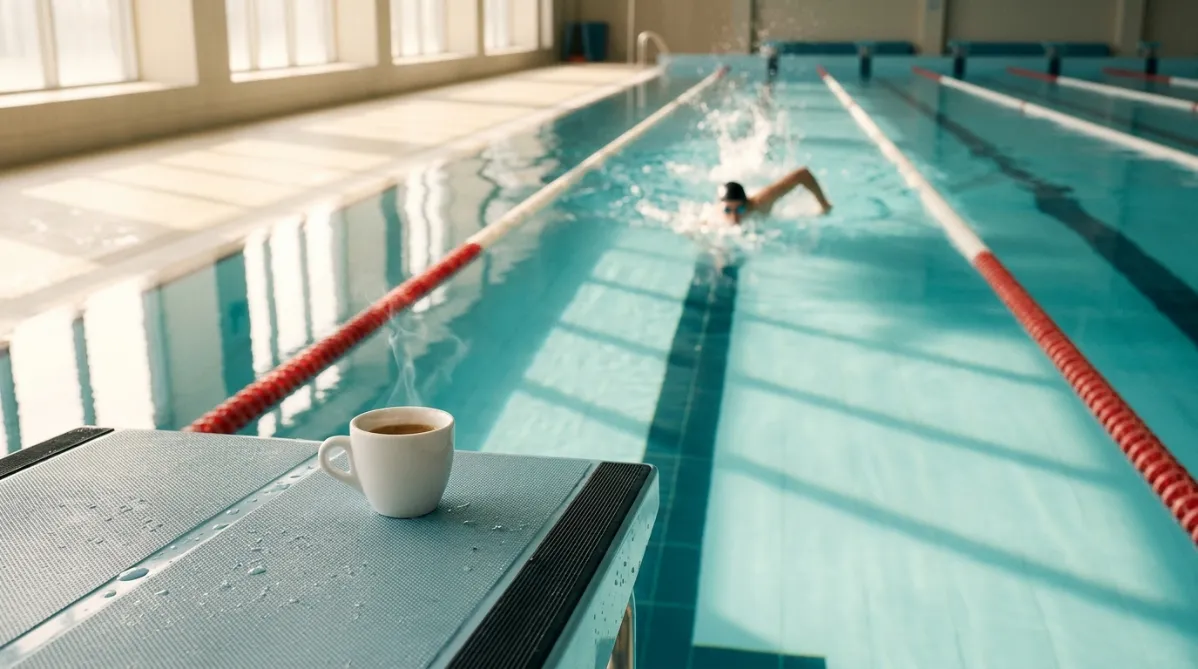
A wide, editorial-style photograph of a competition swimming pool lane seen from just above the water line at the starting end, in soft morning light. In the foreground, on the pool deck, a white ceramic espresso cup sits on the edge of a blue-gray starting block, a thin curl of steam rising from it. The cup is in crisp focus, with a few droplets of water on the textured non-slip deck around it. Behind it, the pool stretches into the distance as a series of calm lanes divided by red and white lane ropes. The turquoise water glints with gentle ripples and long, shimmering reflections. At the far end, a lone swimmer in a dark cap and goggles is mid-stroke, caught in a small burst of white splash, and slightly out of focus because of the shallow depth of field.

Large windows along the side wall let in pale golden sunlight, which throws soft diagonal light across the water and the deck. The palette is clean and modern: aqua, deep teal, warm cream and a small accent of coffee brown. The cup's warm tones stand out against the cool blues. The composition follows the rule of thirds, with the cup in the lower left third and open negative space of water and light on the right, leaving room for headline text. The look is minimal, airy and contemporary, like a high-end sports and science magazine, with subtle film grain, natural color grading, and a slightly desaturated, calm mood. Faint stopwatch-like details appear only as a thin black timing pad edge on the starting block, with no text or numbers visible. The overall feel is quiet anticipation just before a race, precise and fresh, with a sense of small margins and measured performance.
nutrition

Caffeine Makes Swimmers Faster, But by Less Than You'd Think

BY DR. GYMBRO ·

Swimmers have swigged coffee before races for years, but does it actually make them faster? A new multilevel meta-analysis of 13 crossover trials puts the gain at about 1.7%, a meaningful margin in a sport decided by hundredths of a second. The surprise is in the details: the clearest benefit appeared at 6 mg/kg or more, while lower doses did not show a convincing effect. Caffeine also raised post-race blood lactate, and results varied widely between studies. Here is what the evidence supports and what it leaves open.

This page is available in