Dr. Gymbro
A softly lit bedside table in a calm, modern bedroom at dusk, photographed in wide landscape format with shallow depth of field. In the foreground, a matte white shaker bottle sits beside a tall frosted glass of creamy, pale vanilla-colored protein shake, with a few condensation droplets catching warm light. Next to the glass rests a slim fitness band on a dark charcoal fabric strap, its small LED glowing a gentle green, lying casually on a light oak wooden surface. A small scoop of fine white protein powder rests on a ceramic dish nearby, with a light dusting of powder on the wood.

In the soft-focus background, a neatly made bed with oatmeal-colored linen bedding and a textured knit throw blanket. A sheer curtain filters the last peach and lavender light of evening from a large window. A small potted olive branch in a terracotta vase and a closed paperback book add a quiet editorial touch. A bedside lamp with a warm, cream-colored shade casts a golden glow across the scene and creates gentle highlights on the glass.

The palette is muted and harmonious: warm cream, soft sand, oatmeal beige, faint sage green accents, and touches of dusty lavender in the window light. The mood is peaceful, reassuring, and clean, like a contemporary wellness magazine or a trendy health journal feature. Lighting is natural and cinematic, with soft shadows and a subtle film-like grain. The composition follows the rule of thirds, with the shake and band on the left third and open negative space on the right for headline overlay. Minimalist, Scandinavian-inspired styling, high-end lifestyle photography, crisp details, and a tranquil, premium editorial feel.
Recovery

Casein Before Bed Won't Wreck Your Sleep, WHOOP Data Shows

Dr. Gymbro · · 4 min read

You've probably heard the warning: a heavy protein shake right before bed will keep you tossing, turning and under-recovered. A new randomized trial in elite female athletes put that idea to the test with WHOOP wearables. The result is more interesting than a simple yes or no. The shake didn't ruin sleep, but it didn't improve it either.

The Myth Under the Microscope

Pre-sleep feeding has become a popular recovery tactic. Slow-digesting proteins like casein are the usual choice, since they're meant to supply amino acids overnight. The worry is that late-night calories could disrupt sleep, raise heart rate, or blunt overnight recovery.

Researchers at Florida State University, with a collaborator at South Dakota State University, set out to check this. Their paper, published in the Journal of the International Society of Sports Nutrition (Paterson et al., 2026), notes that randomized, double-blind crossover trials comparing pre-sleep macronutrients in elite female athletes have been scarce.

How the Study Worked

Twenty-five NCAA Division I female athletes aged 18 to 25 were recruited, and 21 completed the trial. Each athlete went through four conditions in a randomized, double-blind, placebo-controlled crossover design:

  • 40 g casein (160 kcal)
  • 40 g alpha-lactalbumin, a whey-derived milk protein (160 kcal)
  • 40 g carbohydrate (160 kcal)
  • 40 g placebo (about 5 kcal)

Each condition lasted three consecutive nights, with at least a three-day washout between them. The full protocol ran 4 to 8 weeks. Athletes took the supplement about 2 hours after their last meal and roughly 30 minutes before bed. It was their last caloric intake of the day.

What Was Measured

Objective data came from a WHOOP 4.0 band: total sleep time, sleep onset latency, sleep efficiency, resting heart rate and heart rate variability (HRV). Each morning the athletes also filled out questionnaires on subjective sleep quality, how long it took them to fall asleep, and how recovered they felt. In a small subset of six athletes, blinded continuous glucose monitors tracked overnight glucose.

The Numbers: Basically a Wash

No significant treatment effects appeared for any objective sleep or recovery metric (all p > 0.05). Across the four conditions:

  • Total sleep time: 7.47 to 7.62 hours
  • Sleep efficiency: 91.5% to 92.0%
  • Resting heart rate: 53.5 to 54.1 bpm
  • HRV: 98.2 to 103.9 ms

The subjective data told the same story. Sleep quality scores ranged from 69% to 75%, self-reported time to fall asleep from 16 to 20 minutes, and perceived recovery from 61% to 66%. None of these differed significantly between treatments.

In the glucose sub-analysis, overnight glucose changed over time (p = 0.008), as you'd expect. But there was no difference between treatments (p = 0.187) and no treatment-by-time interaction (p = 0.550).

The authors concluded that three nights of casein, alpha-lactalbumin or carbohydrate before bed did not impair objective or subjective sleep or recovery compared with placebo.

The Plot Twist: It Didn't Help Sleep Either

This is not a "protein before bed improves sleep" story. None of the active conditions beat placebo on any sleep measure. If you want casein for muscle protein synthesis, adherence or hitting daily protein targets, this study suggests you probably don't need to worry about sleep. If you were hoping it would act as a sleep aid, this study doesn't support that.

The study also didn't measure muscle outcomes, performance or body composition. It can't say whether pre-sleep protein helps recovery in the muscle-building sense.

Limitations You Should Know

  • Short exposure: Each condition lasted only three nights. Longer-term effects remain unknown.
  • Wearable-based sleep data: WHOOP is convenient and practical, but it is not polysomnography, the lab gold standard for sleep staging.
  • Narrow population: All participants were young, elite female collegiate athletes who already slept well, at about 7.5 hours with efficiency above 91%. Results may not carry over to poor sleepers, older adults, males or non-athletes.
  • Tiny CGM subset: Only six athletes had glucose monitoring, so those findings are preliminary.
  • Sample size: 21 completers is modest for detecting small effects.
  • Disclosure: One author is a non-paid member of the International Protein Board.

Practical Takeaways

Dose: The study used 40 g of protein or carbohydrate (160 kcal). That's the amount with data behind it here.

Timing: Athletes took it about 30 minutes before bed, roughly 2 hours after their last meal, as the final calories of the day.

Who it's for: Athletes and active people who want to use pre-sleep feeding to help meet protein or energy needs. In this group of well-sleeping young female athletes, it didn't hurt sleep, HRV or resting heart rate.

Who should skip it or be cautious:

  • People with a milk allergy, or those who don't tolerate dairy proteins, since both proteins tested are milk-derived.
  • Anyone who personally notices that late eating disrupts their sleep. These are group averages, and individuals can differ.
  • People who don't need the extra calories or protein. The study found no sleep benefit, so there's no reason to add it for sleep alone.

Bottom line: The "bedtime protein shake ruins your sleep" claim doesn't hold up in this trial. Treat a pre-bed shake as a nutrition tool rather than a sleep hack, and check your own WHOOP or sleep data if you want to see how you respond.
Original study

Read the original research on pubmed.ncbi.nlm.nih.gov →

This article summarizes published research for general information. It is not medical advice.

DG

Written by

Dr. Gymbro

Dr. Gymbro writes for Dr. Gymbro: science-backed fitness, nutrition & performance.

Related Articles

A landscape editorial still life shot from slightly above on a pale oat-colored linen surface, lit by soft morning window light with gentle long shadows. On the left, in warm golden sunlight, sits a small ceramic bowl of dried ashwagandha root pieces and a scatter of fine tan powder. Beside it are a few rough, rosy-gold slices of Rhodiola rosea root and a sprig of tiny succulent-like green leaves with yellow blossoms. A matte sand-colored stoneware mug of steaming tea and a simple glass of water stand nearby. A small amber glass bottle with a minimal unbranded label tips out two capsules.

The right side of the frame is cooler and bluer, as if dusk is arriving. It holds a muted indigo ceramic dish with a few pale capsules, a small bundle of dried chamomile flowers (the source of apigenin), and a few green tea leaves. A slim, unlit beeswax candle and a folded charcoal wool blanket suggest evening. The warm and cool halves meet softly in the center, where a rumpled white cotton napkin sits beneath a small brass spoon.

In the background, out of focus, a wooden shelf holds a worn paperback, a small potted plant, and the edge of a kettlebell in matte black, hinting at an active lifestyle. Subtle film grain, shallow depth of field, and a muted palette of cream, terracotta, sage green, and deep indigo give it a clean, modern wellness-magazine feel. Leave generous negative space in the upper third for a headline overlay. No text, no logos, no people.
recovery

Ashwagandha + Rhodiola Worked. The Evening Sleep Stack Didn't.

BY DR. GYMBRO ·

A new four-arm trial throws a curveball at the supplement-stacking crowd. In 103 healthy, active adults, a morning combo of 600 mg ashwagandha and 300 mg Rhodiola rosea was linked to lower perceived stress, better sleep quality and improved mood. The popular evening stack of magnesium L-threonate, L-theanine and apigenin added nothing, and taking both looked worse on positive affect. Here's what the study found, why it needs caution (only two weeks, small groups), and how lifters might use it.

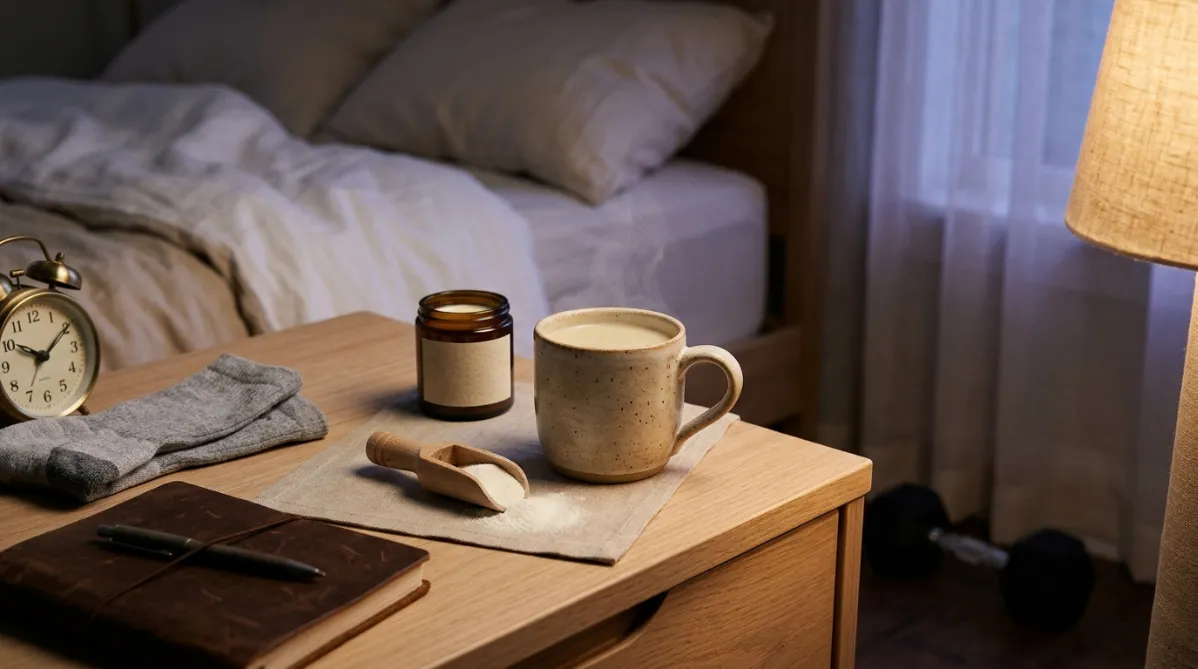
A softly lit bedroom nightstand scene in landscape format, photographed in a modern editorial lifestyle style. In the center of the frame sits a handmade ceramic mug in warm oatmeal tones, filled with a pale creamy drink. A thin wisp of steam rises from it. Beside the mug, a small wooden scoop rests on a matte linen-textured surface with a fine dusting of white collagen powder. A minimal amber glass jar with a cream label stands just behind, with no readable text. The nightstand is pale oak with subtle grain.

To the left, a neatly folded pair of gray cotton athletic socks and a worn leather-bound training journal with a pen on top hint at a lifter's routine. A small brass alarm clock reads about 9:30 and is slightly out of focus. On the right side, a sheer curtain filters the last blue-violet twilight from a window, while a warm bedside lamp with a linen shade casts a honey-colored glow across the scene. The glow contrasts gently with the cool dusk tones.

Behind the nightstand, the edge of a rumpled bed with soft white and sand-colored bedding is visible, with a dumbbell resting quietly on the floor in the soft-focus background to suggest recovery after training. The depth of field is shallow, with the mug and scoop in crisp focus and the background dissolving into creamy bokeh.

The palette is calm and earthy: warm beige, soft cream, muted terracotta, and dusk blue accents. The lighting is cinematic and low-key, with gentle highlights on the ceramic rim and a subtle rim light on the steam. The composition follows the rule of thirds, with the mug placed on the left third and generous negative space on the right for title overlay. The mood is serene, restorative, and quietly scientific without any clinical elements. The finish is clean, high-end, and magazine-worthy, with fine film grain and natural color grading, like a wellness feature in a contemporary online journal.
recovery

The 15 g Bedtime Collagen Trick That Cut Night Wake-Ups by 27%

BY DR. GYMBRO ·

Waking up repeatedly through the night can quietly sabotage your recovery, even when training and nutrition are dialed in. A small trial found that 15 g of collagen peptides taken an hour before bed cut polysomnography-recorded awakenings from 29.3 to 21.3, roughly 27% fewer. Participants also scored better on a morning Stroop test. But total sleep time, sleep latency and sleep efficiency didn't budge, and the study involved just 13 men over 7 nights with an industry-supplied product. Here's what the data really shows and how lifters might test it safely.

A quiet bedside scene at dusk, shot in soft natural light with a shallow depth of field. A tall frosted glass of creamy, pale-white shake sits on a light oak nightstand, with a thin film of condensation on the glass and a faint milky residue near the rim. Beside it, a matte ceramic scoop rests on a small linen coaster. A minimalist tub of unbranded protein powder in muted sage green sits slightly out of focus in the background.

To the left, a neatly made bed with oatmeal-colored linen sheets and a rumpled cream duvet. A pair of worn lifting gloves and a folded gray gym towel sit on the edge of the bed, suggesting an evening workout just finished. A small analog alarm clock reads about 10:30 PM, its soft face glowing faintly. A sprig of dried eucalyptus in a small stoneware bud vase adds an organic touch.

Through a large window on the right, deep indigo twilight fades into a warm amber horizon, and the last light spills across the wall in long, gentle gradients. A sheer curtain moves slightly. The palette is warm neutrals (cream, oak, sand, soft terracotta) with a few muted blue-violet accents from the evening sky.

The composition uses the rule of thirds, with the glass at the left-center foreground and generous negative space on the right, where headline text could sit. The mood is calm, restorative, and editorial, like a modern wellness and nutrition journal. The lighting is gentle and diffused, with subtle film grain and slightly lifted shadows. The textures of linen, wood, glass, and ceramic are crisp. The image is clean and uncluttered, with no text, logos, or people, and no futuristic or sci-fi elements.
nutrition

The 40 g Bedtime Shake: What Pre-Sleep Casein Does Overnight

BY DR. GYMBRO ·

Lift in the evening, then fast for eight hours: does that hurt recovery? A 2012 study gave 16 young men 40 g of casein 30 minutes before bed and tracked what happened overnight. The protein was digested and absorbed during sleep, whole-body protein synthesis jumped (311 vs 246 µmol/kg), and net protein balance flipped from negative to positive. Muscle protein synthesis was about 22% higher, though only borderline significant. Here is what the findings mean, what they don't, and how to use them.

A sunlit, minimalist home gym corner photographed in soft golden morning light, with a young athletic man seated on a wooden bench, leaning forward with his elbows resting on his knees, catching his breath after a hard leg session. He wears a muted sage-green t-shirt and charcoal shorts, his face turned slightly away from the camera, calm and focused. A matte ceramic dish in the foreground holds a few small, translucent golden softgel capsules, with a glass of water beside it catching the light and casting a soft caustic shadow across a pale oak floor. Behind him, a loaded barbell rests on a squat rack, slightly out of focus, and a tall window pours warm sunlight diagonally across the scene, creating long gentle shadows and a hazy glow. A small potted green plant sits on a shelf at the edge of the frame. The color palette is warm and editorial: cream, soft gold, sage green, pale wood, and charcoal accents. Shallow depth of field, with crisp focus on the capsules and glass in the lower third and a creamy bokeh background. The composition leaves generous negative space on the right side for a headline overlay. The mood is clean, modern, and aspirational, like a high-end wellness magazine or a trendy health journal feature. Shot on a 50mm lens, natural light, fine film grain, subtle matte finish, landscape 16:9 framing.
recovery

Vitamin D Sped Strength Recovery in Men Who Weren't Deficient

BY DR. GYMBRO ·

Men with perfectly normal vitamin D levels still recovered strength faster after a brutal leg workout when they took 4,000 IU daily. In this randomized, placebo-controlled trial of 28 active men, peak isometric force bounced back about 8% better at 24 hours. Muscle-damage markers ALT and AST also rose less. But there's a twist: soreness didn't improve at all. Here's what the study found, where it falls short, and who might actually care.

This page is available in