CBL-514 Fat-Loss Injections: The Phase 2 Trial Lifters Should Read
A placebo-controlled Phase 2 trial reported that injections of an investigational drug called CBL-514 removed a substantial amount of abdominal subcutaneous fat on ultrasound, while average body weight barely moved. For anyone deep in a cut, that combination sounds like a cheat code. It isn't one. The trial was single-blind, nearly half of treated participants didn't finish, follow-up was short, and the drug is still experimental. This hub breaks down what was actually tested, what was found, and what a lifter should take from it. This is not medical advice.
What CBL-514 Is (and Isn't)
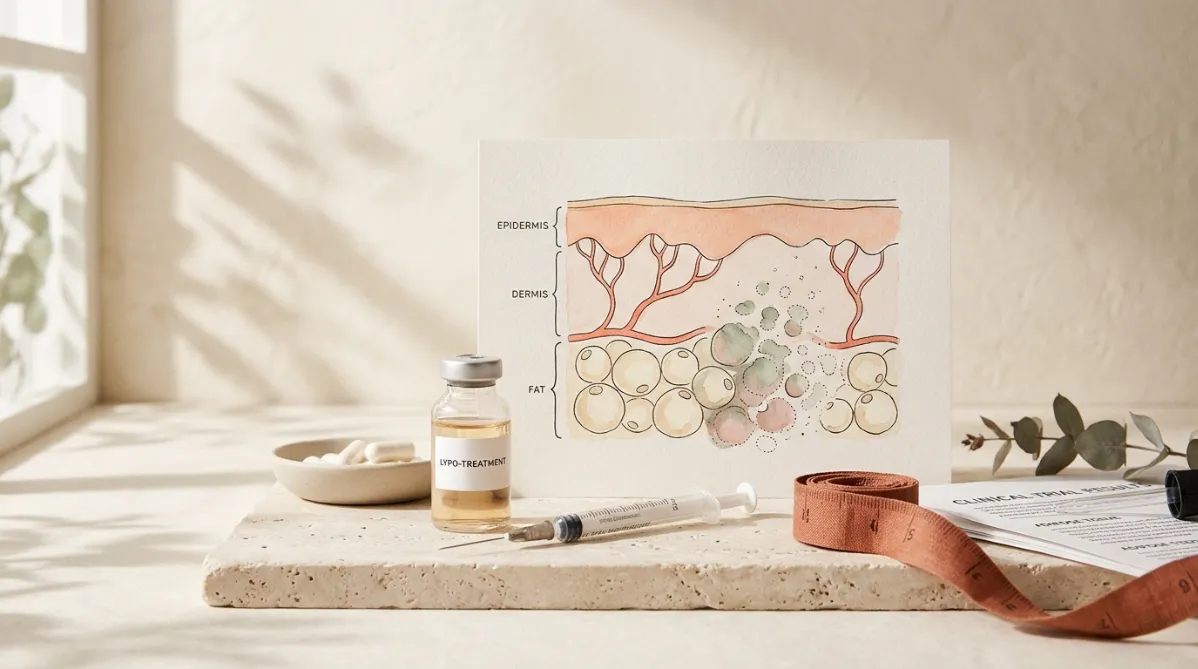
CBL-514 is an investigational small-molecule injection lipolysis agent from Caliway Biopharmaceuticals. It is not a fat-burner supplement, not a pill, and not an approved consumer product. It is injected under the skin of a treated area by trial investigators. In this study that area was the abdomen. Some people search for it as "CL-514", but the correct name is CBL-514.
The paper says CBL-514 promotes adipocyte (fat cell) apoptosis, meaning programmed cell death, in nonclinical studies. Earlier, smaller, open-label Phase 2a work cited unpublished company reports suggesting it inhibits the survival kinase DYRK1b and raises apoptosis mediators such as caspase 3 and Bax/Bcl-2. The chemical structure has not been disclosed. The idea is to destroy fat cells locally. It does not raise metabolic rate, burn calories, or cause whole-body weight loss. The only FDA-approved injectable for fat reduction mentioned in the paper is deoxycholic acid (Kybella), and only for under-chin fat.
The Phase 2 Design
The study is Gold et al., Aesthetic Surgery Journal 2025;45(6):611-620 (full paper here). It was a randomized, single-blind, placebo-controlled, parallel-group trial run at five centers in the US and Australia between February 2022 and March 2023. Seventy-six participants were randomized 2:1, with 50 getting CBL-514 and 26 getting placebo (saline). Most were women with an average BMI around 27 and a stable body weight.
The trial protocol called for up to four treatment sessions at four-week intervals, with follow-up at 4 and 8 weeks after the last one. Each session involved 25 to 50 injections. Each injection delivered 2.4 mL at 2 mg/cm², up to a maximum of 600 mg per session. That is the trial protocol, run by clinicians under supervision. It is not a dose anyone should try to replicate.
Fat volume was estimated by ultrasound at four abdominal points, using thickness multiplied by a 300 cm² treatment area. The primary endpoint was the share of participants losing at least 150 mL of fat.
The Headline Results
The authors say the study met its primary and all secondary endpoints. In the intention-to-treat analysis:
- ≥150 mL loss at 8 weeks: 69.6% (16/23) with CBL-514 vs 0.0% (0/16) with placebo, P < .001.
- ≥150 mL loss at 4 weeks: 63.9% (23/36) vs 17.4% (4/23).
- ≥200 mL loss at 8 weeks: 60.9% (14/23) vs 0.0% (0/16).
- Average change at 8 weeks: about −209 mL versus baseline in the CBL-514 group, and a between-group difference of about −216 mL.
- Largest single loss: more than 750 mL in one participant.
Look at the denominators, though. They shrink from 36 to 23 in the treated group and from 23 to 16 in placebo because of missing follow-up. The strongest-looking numbers come from the people who stuck around.
Body weight did not explain any of this. The treated group's weight changed by +0.45 kg at the 4-week visit and +0.02 kg at 8 weeks. Placebo changed by −0.76 kg and −0.26 kg. The authors also report local fat loss in some participants who gained more than 1 kg. This is a local fat-volume change, not "weight loss."
Safety and the Big Caveats
The study recorded treatment-emergent adverse events and injection-site reactions for every treatment session, along with labs, vitals, and ECGs. Local reactions at the injection site are the practical downside of a drug that works by destroying tissue under the skin. Four of the participants who did not complete the study left because of adverse events. Check the paper's safety tables for exact rates rather than relying on summaries.
The limitations matter just as much as the results:
- Single-blind only. Participants were blinded, but investigators, site staff, and the sponsor were not. This is not a double-blind trial.
- High dropout. Of 75 treated participants, 38 completed the study and 37 did not, a non-completion rate of 49.3%. Reasons included loss to follow-up, withdrawal, weight instability, schedule problems, and adverse events.
- ITT vs per-protocol gap. The per-protocol group was only 30 people. Its results look even better (average loss around −280 to −315 mL), but that is a small, filtered group.
- Sponsor involvement. Caliway was involved in design, data analysis, interpretation, and manuscript writing.
- Small, exploratory sample. There was no adjustment for multiple testing, and the group was mostly women, with 94% female in the treated arm.
- Short follow-up. Eight weeks after the last session says little about long-term durability.
- Indirect comparisons. The authors liken results to cryolipolysis and liposuction, but those are their interpretations. Methods differed, and there was no head-to-head trial.
- Ultrasound estimate. Volume came from a cuboid calculation, not a direct measurement. The authors' comment on little skin laxity was a visual impression rather than a formal endpoint.
What a Lifter on a Cut Should Take Away
First, this tells you nothing about getting leaner through training or diet. It addresses stubborn local fat in people with a stable weight, under clinical supervision, with an unapproved compound. Second, a scale that doesn't move can hide a real change in fat volume, a good reminder to track more than body weight. Third, ultrasound-measured subcutaneous fat does not replace a DEXA or a mirror, and it says nothing about visceral fat or health markers.
If you see CBL-514 sold online as a peptide or "research chemical," treat it with serious suspicion. It is not an approved product, there is no validated dose outside a trial, and the human data come from a controlled medical setting. Anyone curious should talk to a physician and look for registered trials (NCT04897412) rather than improvising.
Read the CBL-514 Series
Want more depth on each angle? These explainers go further:
- What is CBL-514? Does it burn fat?
- CBL-514 fat removal injections: What does the science say?
- How does CBL-514 work? Here's the science
- Does CBL-514 really burn fat? Here's what we know
- CBL-514 Dosages - what does science say?
This article is for education only and is not medical advice. CBL-514 is investigational and not approved.