Dr. Gymbro
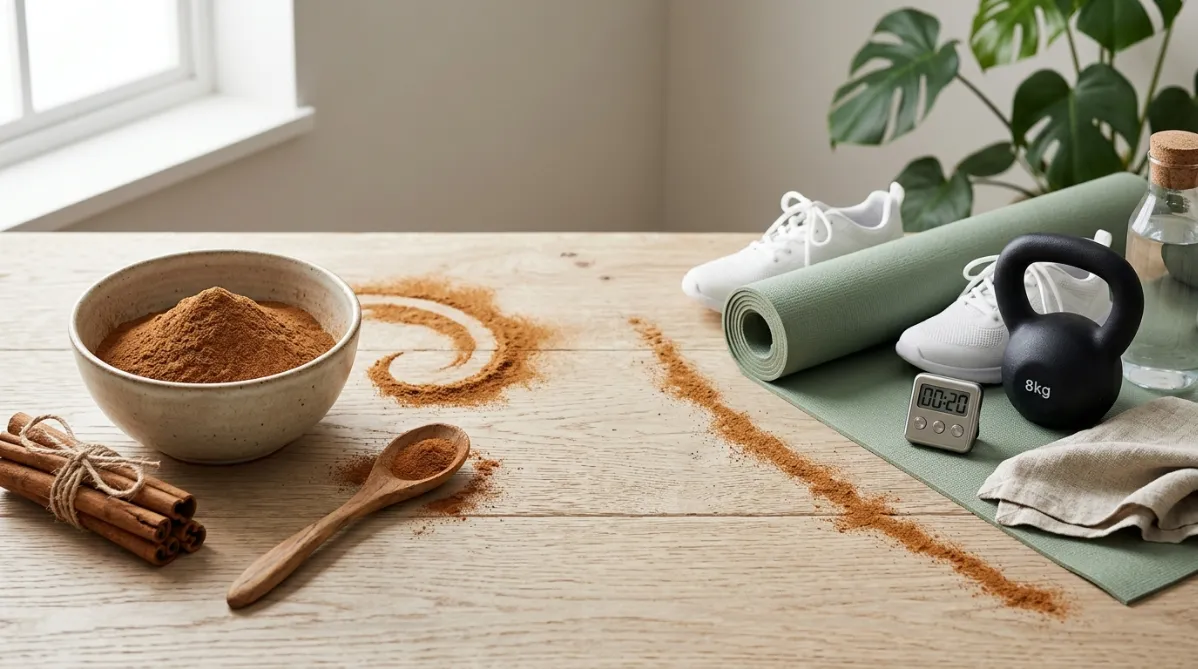
A wide, landscape editorial photograph shot from slightly above on a pale oak wooden surface, styled like a modern wellness magazine cover. On the left, a rustic ceramic bowl in matte oatmeal glaze holds ground cinnamon in a soft mound. Beside it sit several whole cinnamon sticks tied with natural twine, and a small wooden spoon dusted with warm reddish-brown powder. A loose cinnamon swirl spills across the surface in a graceful, organic arc. On the right, a minimalist fitness scene flows into the frame: a matte sage-green yoga mat partly unrolled, a stainless steel interval timer reading 00:20, a pair of clean white training sneakers, and a compact black kettlebell. A folded linen towel and a glass bottle of water add quiet, lifestyle-oriented detail. The two halves are linked by a thin line of scattered cinnamon powder that runs across the table like a brushstroke, joining the kitchen and the workout.

Soft morning window light enters from the upper left. It casts gentle, long diffused shadows and highlights the texture of the spice, the grain of the wood, and the curled bark of the sticks. The palette is warm and earthy: cinnamon brown, terracotta, cream, sage green, and soft charcoal, with one small accent of burnt orange. The background is a softly blurred neutral wall with a hint of a leafy plant in the top corner, giving shallow depth of field. The composition leaves generous negative space at the top and center-right for headline text. The mood is calm, fresh, health-forward, and trustworthy, with a subtle scientific-journal sophistication. Crisp focus on the cinnamon, creamy bokeh in the background, and a fine film-like grain. The image is realistic, tactile, and uncluttered, with no people, no text, no logos, and nothing futuristic.
Nutrition

Cinnamon + Tabata Beat Training Alone for Fat Loss in 8-Week Trial

Dr. Gymbro · · 4 min read

What if the edge in your fat-loss plan were already in your spice rack? A small 2025 trial in the Journal of the International Society of Sports Nutrition tested exactly that. Men who combined Tabata-style circuits with 1.5 g of cinnamon a day lost more body fat than men who trained alone. Before you buy a bulk bag of cinnamon, the details matter, and so do the caveats.

The Trial Setup

Iranian researchers recruited 40 overweight or obese male soldiers and split them into four groups of roughly ten:

  • Tabata only (T)
  • Tabata + cinnamon (T+S)
  • Cinnamon only (S)
  • Control (C)

The intervention ran for eight weeks with three sessions per week. The cinnamon groups took 500 mg capsules three times a day, which adds up to 1.5 g daily, or roughly half a teaspoon. The researchers measured body composition, strength-endurance performance (push-ups, squats, plank, vertical jump), blood sugar, insulin, liver enzymes and inflammatory markers.

The Tabata Circuit Used

The format was classic Tabata timing: 20 seconds of all-out work, 10 seconds of rest. The circuit rotated through eight exercises:

  1. Jump squats
  2. Back extensions
  3. Crunches
  4. Push-ups
  5. Triceps dips
  6. Side crunches
  7. Medicine-ball military press
  8. Chin-ups

A textbook Tabata block is eight rounds of 20/10, which takes four minutes. The summary available doesn't spell out how many rounds each exercise got, so treat "4-minute-style" as the spirit of the protocol rather than a verified session length.

The Results, in Numbers

Body mass, BMI and body fat percentage dropped significantly in every intervention group (p < 0.001), while controls didn't budge. The biggest fat loss came from the combination group: -7.86% body fat. That was significantly more than Tabata alone (p = 0.013).

Other findings:

  • Performance: Push-ups, squats, plank and jump all improved in both training groups, with no meaningful difference between Tabata and Tabata + cinnamon. Cinnamon did not make the men fitter.
  • Metabolic markers: Fasting glucose, insulin, HOMA-IR and liver enzymes (SGOT, SGPT, GGT) fell across the intervention groups, with the largest reductions in the combination group.
  • Inflammation and myokine signals: CRP and TNF-α declined, while adiponectin and irisin rose in all intervention groups. The combination group showed superior changes versus every other group (p < 0.05).

One secondary reading of the data tables, reported by Ergo-Log, suggests the scale told a different story. Training alone produced roughly 7 kg of weight loss and the combination about 6 kg. The combination group may nonetheless have lost more fat while holding on to or gaining lean mass. I haven't verified those figures against the full paper, so consider them provisional. If they hold up, they're a good reminder that body composition matters more than the number on the scale.

Why Cinnamon Might Help

The authors point toward inflammation and myokine signaling rather than a direct fat-burning effect. Chronic low-grade inflammation, including elevated TNF-α, is linked to insulin resistance and stubborn adiposity. Cinnamon's polyphenols are thought to dampen inflammatory signaling. Irisin, a hormone-like molecule released by muscle, is associated with browning of fat tissue and energy expenditure. Both moved in the right direction, and most strongly in the combination group.

Insulin is the usual headline mechanism for cinnamon, but it probably isn't the driver here. Glucose, insulin and HOMA-IR improved in all intervention groups, including training alone. That suggests exercise did most of the metabolic heavy lifting, and cinnamon's added benefit lay elsewhere. This is mechanistic speculation, since the study wasn't designed to prove the pathway.

Cinnamon Alone Is Not a Magic Fat Burner

The abstract's conclusion frames cinnamon as something that potentiated the effects of Tabata. It did not replace it. The control group changed nothing, the training groups improved fitness, and the cinnamon-only group did not match the combination. Treat this as "training plus cinnamon may outperform training alone," not "cinnamon melts fat."

Honest Limitations

  • Tiny sample: About ten men per group is too few for firm conclusions.
  • Soldiers only: A controlled, young, male population doesn't represent everyone.
  • Unclear blinding: If participants knew who got cinnamon, expectation effects could creep in.
  • Cinnamon type not emphasized: The product and any extract specifics matter for replication.
  • Single country, single trial: It needs independent replication.

Practical Takeaways

Dose: The trial used 500 mg with each meal, three times daily (1.5 g total). That's the only dosing this study supports, so there is no reason to go higher.

Ceylon vs. cassia: Most supermarket cinnamon is cassia, which contains meaningful amounts of coumarin, a compound that can stress the liver at high intake. European regulators set a tolerable daily intake of about 0.1 mg per kg of body weight, and cassia coumarin content varies widely between products. For daily use over weeks, Ceylon ("true") cinnamon, which contains only trace coumarin, is the safer choice. This is especially relevant if you have liver concerns.

Who it's for: Healthy adults already committed to structured, high-intensity training and looking for a low-cost add-on. It is not a shortcut for people who skip workouts.

Who should check first: If you take diabetes medication, blood thinners or have liver disease, talk to your doctor before supplementing. Beginners should also build a base before attempting all-out Tabata work.

The Bottom Line

The real story is the training. Eight weeks of Tabata circuits improved body composition, fitness, inflammation and liver markers. Cinnamon looks like a cheap, plausible booster that pushed fat loss further in this small trial. It's worth watching, but it's not yet proven.
Original study

Read the original research on pubmed.ncbi.nlm.nih.gov →

This article summarizes published research for general information. It is not medical advice.

DG

Written by

Dr. Gymbro

Dr. Gymbro writes for Dr. Gymbro: science-backed fitness, nutrition & performance.

Related Articles

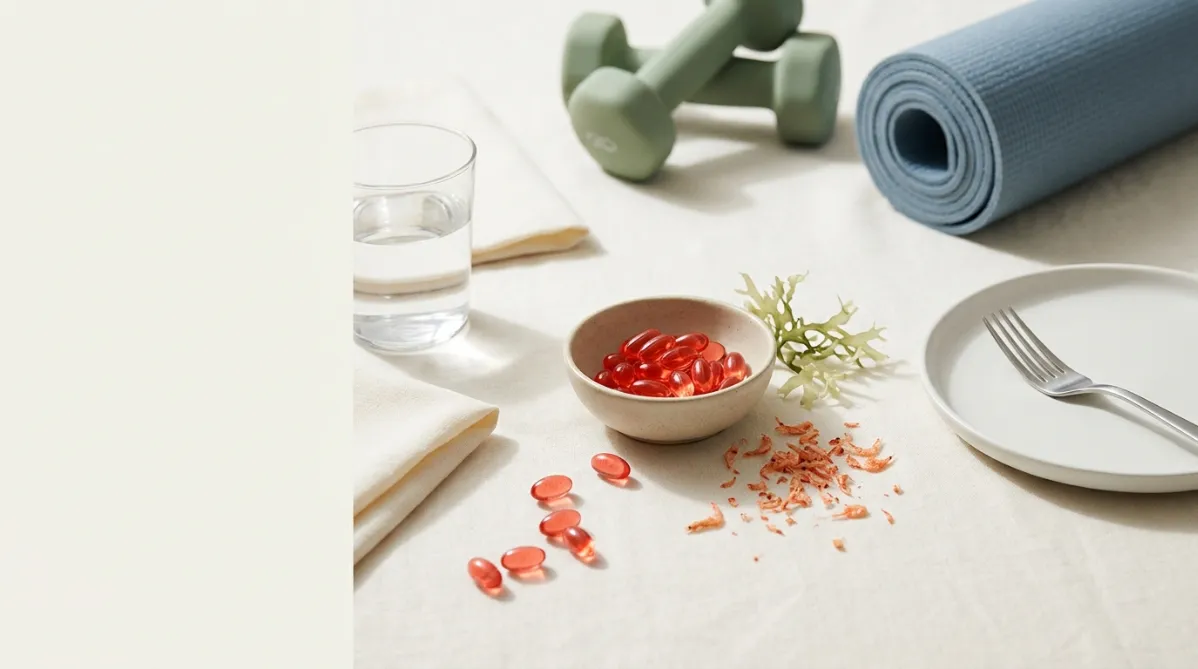
A bright, minimalist editorial still life on a soft warm-white linen surface, shot from a slightly elevated angle in natural morning window light. In the center, a small shallow ceramic bowl in matte oatmeal tones holds several glossy, translucent coral-red softgel capsules, with a few spilled onto the surface in a gentle arc. Beside the bowl, a single ripe peach-pink shrimp-like krill shape is absent; instead a delicate scatter of tiny coral-orange dried krill-pink petals and a sprig of pale green seaweed hint at the marine origin. To the left, an empty clear glass of water and a folded cream napkin suggest fasting. To the right, a simple matte white plate sits bare with a silver fork resting across it. In the soft-focus background, a pair of sage green hand weights and a neatly rolled yoga mat in dusty blue add a quiet nod to muscle and strength. Soft shadows fall diagonally across the scene, giving gentle depth. The palette is calm and modern: warm ivory, coral red, sage green, dusty blue, and soft beige. Shallow depth of field with crisp focus on the capsules, which catch small bright highlights. Clean negative space on the left third of the frame for headline text. The overall feel is a contemporary wellness magazine or health journal cover, airy, refined, and editorial, with subtle film-like grain and natural color grading. Landscape 16:9 composition.
nutrition

Krill Oil Cut Muscle Loss on a Fasting Diet by Up to 6x in a Trial

BY DR. GYMBRO ·

Dieting hard often means losing muscle along with fat, but a new randomized trial suggests one supplement may change that. In 41 adults doing 8 weeks of alternate-day fasting, krill oil and placebo groups lost the same body weight (about 4.6 vs 4.5 kg). Yet the krill group lost just 0.2 kg of fat-free mass versus 1.2 kg for placebo, and held onto handgrip strength too. Before you stock up, there are catches: the sample was small and the capsule also contained astaxanthin and choline. Here are the numbers, the dose and who should skip it.

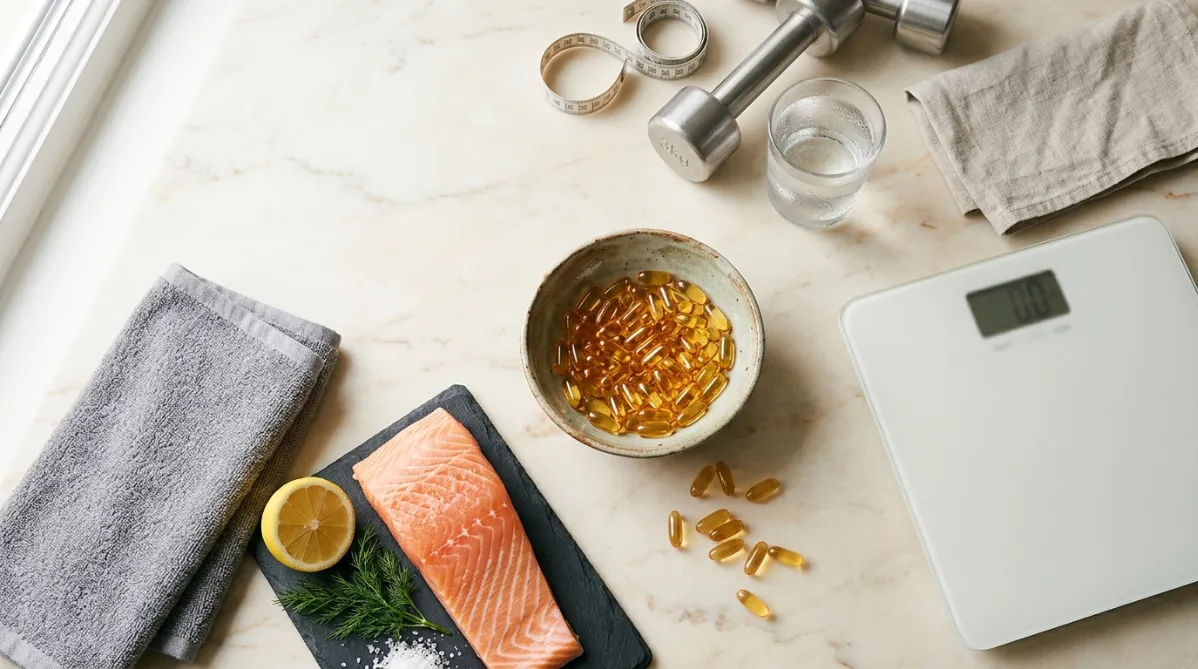
A wide, editorial-style flat lay photographed from above on a pale, warm-toned marble surface with soft natural window light coming from the left. At the center sits a shallow ceramic bowl filled with glistening golden-amber fish oil capsules, a few spilled casually onto the marble. Beside the bowl, a sleek minimalist bathroom scale in matte white sits at the right edge, its digital display blurred so it appears static. To the left, a neatly folded heather-gray athletic towel rests beside a small cluster of fresh ingredients: a halved lemon, a sprig of dill, and a fillet of raw salmon on a slate board, its coral-pink flesh with delicate white marbling catching the light. Near the top of the frame, a pair of brushed-steel dumbbells in a light finish and a soft tape measure curl loosely across the surface, suggesting body composition tracking without being clinical. A small glass of water with condensation and a linen napkin add quiet lifestyle detail. The color palette is calm and modern: cream, soft sage green, warm gold, coral, and muted gray. Shadows are soft and diffused, with gentle highlights on the capsules making them glow like tiny amber beads. The composition has generous negative space on the upper left for headline text, with a shallow depth of field that keeps the capsules and salmon crisp while the edges fall softly out of focus. The overall mood is clean, health-conscious, and contemporary, like a high-end wellness magazine or science journal cover, with a subtle film-like grain and natural, true-to-life tones. No people, no text, no futuristic elements.
nutrition

Fish Oil Swapped Fat for Muscle in 6 Weeks. Scale Didn't Budge.

BY DR. GYMBRO ·

What if the scale doesn't move, but your body quietly trades fat for muscle? A double-blind trial of 44 healthy adults found that 6 weeks of fish oil (about 2.4 g EPA+DHA daily) shifted body composition by roughly half a kilo each way, with body weight unchanged. A drop in salivary cortisol tracked with the changes, though that link is only correlational. Resting metabolic rate didn't budge, and the sample was small. Here's what the numbers really show, and how to use them sensibly.

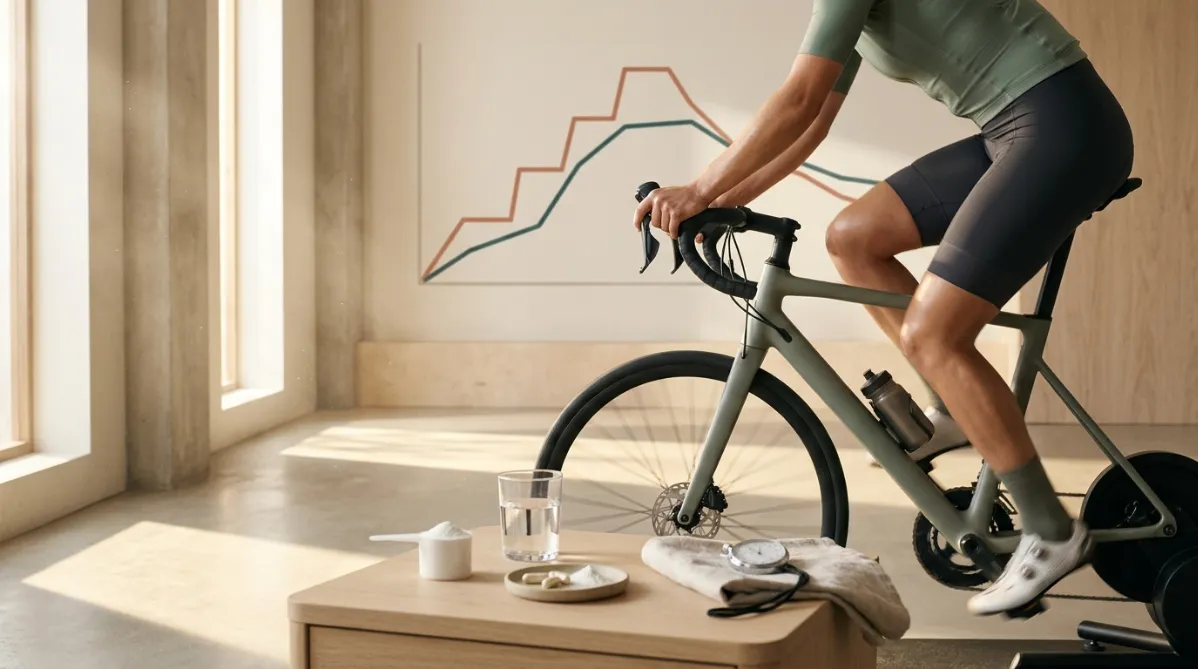
A wide, editorial-style photograph of a lone cyclist's legs and torso mid-sprint on a stationary indoor bike in a bright, minimalist performance studio. The scene is shot from a low three-quarter angle with shallow depth of field. The cyclist wears matte charcoal shorts and a fitted sage-green top, with a subtle sheen of sweat catching soft window light. Their hands grip the handlebars and the pedals are caught in a slight motion blur, which conveys explosive effort.

In the foreground, slightly out of focus on a pale oak side table, sit a small matte white scoop and a clear glass of water. Next to them is a little ceramic dish holding a few off-white capsules and a pinch of fine white powder. A folded linen towel and a slim stopwatch rest nearby. The stopwatch face is softly legible, hinting at timed sprint intervals.

The background is warm cream concrete and pale wood, with tall windows casting long diagonal shafts of golden morning light across the floor. Faint dust motes drift in the light. On the wall behind, a clean, abstract line graph is painted in muted terracotta and deep teal. It shows one line rising in steps like five sprint bouts and another line gently falling, a subtle visual nod to power up and lactate down. The graph is minimal and stylized, with no readable numbers or text.

The color palette is earthy and modern: sage green, terracotta, warm cream, soft charcoal, and touches of natural wood. The lighting is soft and directional with gentle highlights and natural shadows. The overall look is calm, refined, and contemporary, like a premium wellness and sports science magazine cover. The composition follows the rule of thirds, with the cyclist on the right and open negative space on the left for a headline. The image is crisp, grainy in a subtle film-like way, and free of any futuristic or sci-fi elements.
science research

This Carnitine Form Lifted Sprint Power Up to 15% and Cut Lactate

BY DR. GYMBRO ·

A 2009 crossover study found that a single 4.5 g dose of glycine propionyl-L-carnitine (GPLC) lifted peak and mean sprint power by 2.6% to 15% across five all-out cycling bouts. Blood lactate was also 16.2% lower 14 minutes after exercise. But the "15%" is the top of a range, not an average, and the study involved just 24 men in one lab. This article breaks down how GPLC differs from regular L-carnitine and ALCAR, where the nitric oxide theory fits, and who might actually benefit. It also covers dose, timing and the limits of the evidence.

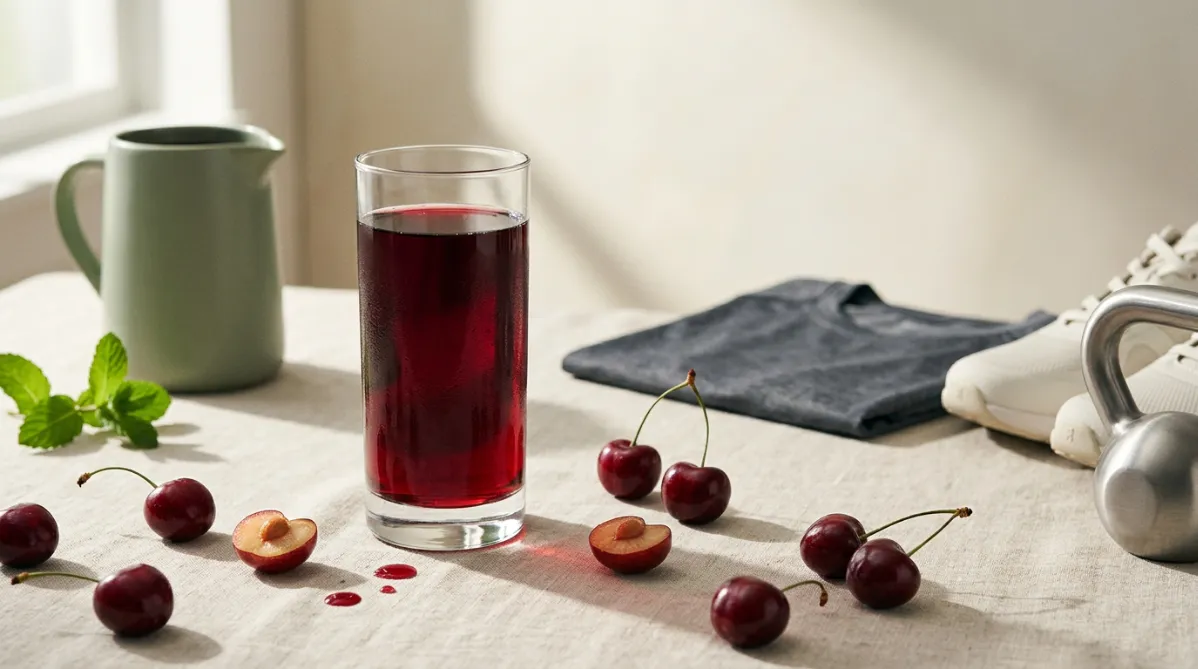
A wide, softly lit editorial still life on a pale oatmeal linen surface. In the center sits a tall, clear glass filled with deep garnet-red tart cherry juice, with condensation beading on the outside and a faint ruby glow where light passes through it. Around it are a scattering of fresh Montmorency cherries, some with stems and some halved to show pale amber flesh and a single pit. A few drops of juice have splashed onto the linen, leaving small crimson stains. To the right, slightly out of focus, lies a folded charcoal-gray running shirt, a pair of minimalist off-white running shoes, and a small brushed-steel kettlebell, suggesting both endurance and strength training without a gym in view. On the left, a ceramic pitcher in matte sage green holds more juice, and a sprig of fresh mint adds a small contrast.

Window light comes from the upper left, casting long, gentle shadows and creating a warm morning feel. The palette is restrained and modern: deep burgundy, cream, sage, and soft slate, with plenty of negative space in the upper right for headline text. The camera angle is a shallow three-quarter view from slightly above, with a shallow depth of field. The foreground cherries are razor sharp and the background melts into a creamy blur. Subtle film grain, natural color grading, and a clean, minimalist composition give it the polished feel of a contemporary health and science magazine. No text, no logos, no people, and no futuristic elements. The overall mood is calm, fresh, and restorative, hinting at recovery and balance.
recovery

Tart Cherry Juice Trick: Faster Strength Recovery, Lower IL-6

BY DR. GYMBRO ·

Marathoners and lifters swear by tart cherry juice for recovery, and this placebo-controlled study put it to the test. In 20 runners, isometric strength recovered significantly faster (P=0.024), while IL-6, CRP and uric acid all dropped and antioxidant status was about 10% higher. But creatine kinase, LDH and muscle soreness were not significantly different, so the picture is more nuanced than the hype. Here's what the study did, what it found, and who might actually benefit.

This page is available in