Dr. Gymbro
A wide, editorial-style landscape photograph of a calm, sunlit studio scene. In the center-left, a young man's bare lower leg and ankle are planted on a matte sand-colored yoga mat, heel slightly lifted in a mid calf-raise. The Achilles tendon and calf muscle are defined by soft, directional window light, with gentle shadows that emphasize natural contours. On a pale oak wooden surface at the right of the frame sits a minimalist glass of water beside a small ceramic bowl of fine white collagen peptide powder, with a wooden scoop resting on the rim. A few loose grains of powder catch the light. Beside them is a muted sage-green matte canister with no legible text or branding.

In the soft-focus background, a clean off-white wall and a tall linen curtain diffuse warm morning light. A slim notebook with a pencil and a small analog stopwatch lie on the wood, hinting at measured testing. The palette is restrained and modern: warm cream, sand, soft sage, pale oak, and subtle terracotta accents. Shallow depth of field with a creamy bokeh background, crisp focus on the ankle and tendon. The mood is quiet, thoughtful, and scientific without being clinical, like a contemporary wellness and science journal cover. Natural film-like grain, balanced negative space on the upper right for headline placement, and a soft, high-end magazine aesthetic. No text, no logos, no futuristic elements.
Nutrition

Collagen Peptides Stiffened Tendons and Boosted Explosive Strength

Dr. Gymbro · · 4 min read

Collagen has spent years marketed as a beauty supplement. A new randomized trial suggests it may also change how your muscles and tendons behave mechanically, and that could matter if your sport depends on speed. The catch is that the same study found no gain in max strength and no gain in muscle size.

What the Researchers Actually Tested

The study appeared in Medicine & Science in Sports & Exercise in 2025. It was a double-blind, randomized, placebo-controlled trial of 50 healthy, young, sedentary men. Half (n = 25) drank a beverage with 10 g of collagen peptides (CP) daily for 16 weeks. The other half (n = 25) drank a placebo.

The researchers used MRI to measure the cross-sectional area of the medial gastrocnemius (a calf muscle) and the Achilles tendon. They used ultrasound shear wave elastography to measure stiffness in both tissues. They also tested ankle plantar flexion strength: maximal voluntary isometric contraction (MVIC) torque, and rate of torque development (RTD), which is how quickly you can ramp up force.

The intervention was the supplement itself. The abstract does not describe a training program, so this is a test of collagen alone in people who weren't training.

The Headline Finding: Stiffer Muscle, Stiffer Tendon

The collagen group showed significant increases in both tissues, and the placebo group showed no significant change:

  • Medial gastrocnemius stiffness: P < 0.001, Cohen's d = 0.594
  • Achilles tendon stiffness: P < 0.001, Cohen's d = 0.378
  • Normalized rate of torque development: P < 0.001, Cohen's d = 0.525

Those effect sizes are small to moderate. Calling them "game-changing" would go beyond the data. They are still consistent, and they appeared in a controlled design.

Stiffness matters because a stiffer muscle-tendon unit can transmit force more efficiently. In movements where you need to produce force quickly, such as jumping, sprinting and rapid change of direction, how fast force rises often matters more than how much total force you can eventually produce.

What Did NOT Change

The abstract reports no significant changes in medial gastrocnemius or Achilles tendon cross-sectional area, or in MVIC torque, in either group. So collagen did not make the muscle bigger, and it did not raise peak force output in this trial.

That makes the finding more specific. Collagen peptides were linked to a change in tissue quality and the speed of force production, not to bulk or maximal strength. If you hoped collagen would replace creatine or progressive overload for building size, this study gives no support for that.

Does Stiffness Explain the Speed Gains?

The authors found positive correlations between medial gastrocnemius stiffness and normalized RTD, both before and after the intervention, in both groups (P ≤ 0.033, r ≥ 0.427). Muscles that were stiffer tended to produce force faster.

The authors conclude that the increase in muscle stiffness appears to contribute to the improved explosive strength. That is a reasonable interpretation, but correlation is not proof of mechanism. The correlations also existed in the placebo group, so they show a general relationship between stiffness and explosiveness, not that collagen caused the RTD gain through stiffness.

Read This Before You Buy a Tub

Several caveats apply:

  • Industry-linked authors. Most of the authors are affiliated with the Health Science Research Center at Morinaga & Co., Ltd., a supplement and food company. That doesn't invalidate the work, which was peer reviewed and used a double-blind, placebo-controlled design, but independent replication would strengthen it.
  • Narrow population. The participants were young, healthy, sedentary men. The results may not apply to trained athletes, women, older adults or people with tendon injuries.
  • One muscle group. Measurements focused on the calf and Achilles tendon.
  • Modest sample. Fifty participants is enough to detect these effects but not enough to settle the question.
  • Performance is inferred. The authors say collagen may enhance athletic performance in activities needing rapid force production. They tested an isometric strength measure, not jumps, sprints or competition results.

This is a human randomized trial, not an animal or cell study, but it is a single trial and should be treated as promising rather than definitive.

Practical Takeaways

Dose: The study used 10 g of collagen peptides per day, in a beverage.

Duration: Participants took it daily for 16 weeks. The effects came from sustained use, so a few weeks is not a fair test.

Timing: The abstract doesn't say when during the day participants drank it or how timing relates to training, so there is no evidence-based timing rule here. Consistency is the only protocol the data support.

Who might care most:

  • Jumpers and sprinters, because rate of force development is central to their events.
  • Anyone focused on tendon health, since Achilles stiffness increased. The study does not show that collagen prevents or heals tendon injuries, so don't treat it as rehab.
  • Lifters chasing size or max strength should keep expectations low, since neither changed.

Also keep in mind that stiffer is not automatically better. In sport, the best level of tendon stiffness depends on the movement and the athlete, and this study did not examine injury risk.

The Bottom Line

In 50 sedentary young men, 10 g of daily collagen peptides for 16 weeks increased calf muscle and Achilles tendon stiffness and improved how quickly the calf muscles could generate force, with small-to-moderate effect sizes. Muscle size and maximal strength didn't change. The work comes from authors affiliated with a supplement company and needs independent replication, particularly in trained athletes and with performance outcomes like jump height and sprint time. Until then, collagen looks like a plausible, low-risk experiment for explosive athletes, not a proven performance booster.
Original study

Read the original research on pubmed.ncbi.nlm.nih.gov →

This article summarizes published research for general information. It is not medical advice.

DG

Written by

Dr. Gymbro

Dr. Gymbro writes for Dr. Gymbro: science-backed fitness, nutrition & performance.

Related Articles

A calm, modern editorial still life shot from a slightly elevated angle on a pale oak wooden table, bathed in soft morning window light with gentle diffused shadows. In the center-left, a small matte ceramic bowl in warm oatmeal tone holds a measured heap of fine, creamy-white collagen peptide powder, with a minimalist wooden scoop resting beside it. Next to it sits a clear glass of water with delicate condensation. On the right side of the frame, a rolled-up sage green yoga mat leans against a light plaster wall, and a pair of clean, minimalist white running sneakers sits slightly off-center, one tilted to show the heel and the back of the ankle area. A thick, natural-fiber resistance band in muted terracotta is coiled loosely in the foreground. In the background, a wooden step or low plyometric box suggests calf-raise exercise, softly out of focus. A small linen notebook lies open with a handwritten simple line graph showing two rising lines, one steeper than the other, with a thin pencil beside it, and no legible text. A sprig of dried eucalyptus in a slim bud vase adds an organic touch. The palette is warm neutrals: cream, oat, sand, soft terracotta, sage, with a subtle pop of muted coral. The mood is thoughtful, health-conscious, and reassuring, like a premium wellness and sports science magazine. Shallow depth of field, crisp texture on the powder and wood grain, subtle film-like grain, generous negative space on the upper left of the frame for headline overlay. Landscape 16:9 composition, clean, uncluttered, airy, and contemporary.
nutrition

The 5-Gram Achilles Hack: Why Collagen Peptides Made Early Rehab Gains Jump Past the Clinical Threshold

BY DR. GYMBRO ·

Stalled Achilles rehab is frustrating, and a small pilot study suggests a 5 g/day collagen peptide supplement might help early progress. Over the first 3 months, the collagen group's VISA-A score rose 12.6 points versus 5.3 on placebo, with a clinically meaningful threshold of about 6.5. Everyone, however, was doing the same bi-daily calf-strengthening program, so exercise remains the backbone. Here's the protocol, the numbers, who it applies to, and why the 20-patient sample means we should stay cautious.

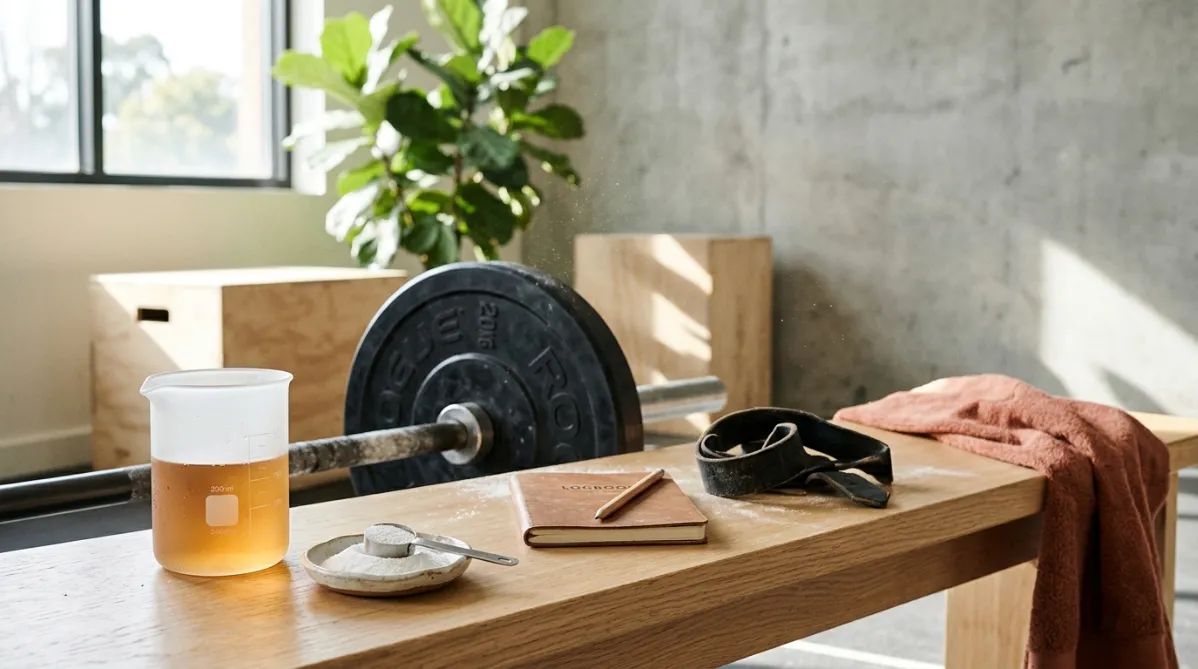
A wide, editorial-style still life shot from a slightly elevated three-quarter angle on a pale oak gym bench, lit by soft morning window light. In the foreground sits a minimalist matte-white glass beaker of clear, faintly amber liquid, with a few condensation droplets on its surface. Beside it rests a small ceramic dish of white crystalline powder and a stainless steel scoop. In the middle ground, a chalk-dusted steel barbell with black bumper plates rests on the bench's edge. A pair of worn leather lifting straps and a small notebook with a pencil lie nearby, suggesting data logging. Behind them, softly blurred, is a bright, airy studio with concrete walls, a wooden plyo box, and a tall leafy plant catching the light.

The palette is warm and muted: cream, sand, soft sage green, and charcoal, with one small accent of burnt orange in the amber liquid and a terracotta towel draped over the bench. Fine chalk dust floats in sunbeams that cut diagonally across the frame. The shallow depth of field keeps the beaker and barbell sharp while the background melts into creamy bokeh. Composition follows the rule of thirds, with the beaker on the left third and generous negative space on the right for headline text. The mood is calm, premium, and contemporary, like a high-end wellness and sports-science magazine photograph with subtle film grain, natural shadows, and realistic textures.
nutrition

Ketones Kept Force Output 8% Higher, But Jumps Didn't Budge

BY DR. GYMBRO ·

Fifty grams of a ketone precursor kept rate of force development 8% higher an hour later in a new Ohio State study, yet it did nothing for countermovement jumps. The randomized crossover trial of 20 active men and women found blood ketones peaking around 2.2 mM at 120 minutes. It also found a 24% drop in blood glucose and a 13 bpm rise in heart rate. That makes it intriguing for lifters doing repeated max-strength efforts, but this was a small, acute study. Here is what the data show, who might care, and who should hold off.

A landscape editorial still life in soft natural window light, set on a pale oak tabletop with a matte warm-white wall behind it. In the center-left, a few glossy strands of dark olive-brown kelp (Ecklonia cava) drape in an elegant curve over a shallow ceramic bowl in muted sage green. Next to the bowl, a small pile of fine, dry brown seaweed powder sits beside a minimalist wooden scoop. On the right, an unbranded matte-white supplement tub and a few loose cream-colored capsules are spilled neatly across the surface. A brushed steel cycling water bottle stands slightly out of focus in the background, with a folded gray cycling cap beside it. In the foreground, a clean white notebook with a thin pencil rests next to a simple analog stopwatch, hinting at a performance trial without any text or numbers visible.

The palette is earthy and calm: sage, olive, warm sand, cream and soft charcoal, with one subtle terracotta accent from a small ceramic dish. Long soft shadows fall diagonally across the table, and a gentle highlight catches the wet sheen of the seaweed. Shallow depth of field, with a creamy blurred background and crisp detail on the seaweed texture and capsules. The composition leaves generous negative space on the upper right for a headline overlay. Shot as if with a 50mm lens at f/2.8, top-down angle tilted about 30 degrees, in a modern wellness-magazine style that is minimalist, tactile and refined, with a subtle film-like grain and natural color grading.
nutrition

Does Brown Seaweed in Your Pre-Workout Actually Do Anything?

BY DR. GYMBRO ·

Brown seaweed extract *Ecklonia cava* shows up in pre-workouts and fat burners, but does it actually help you perform? A randomised, double-blind crossover trial gave 12 trained cyclists 263 mg or a placebo before an hour of riding and a set of maximal sprints. Blood glucose rose slightly, but lactate, oxygen uptake, fat-versus-carb use and sprint power did not change. The sample is small, so the study can't rule out tiny effects, but it offers no support for an acute performance boost. Here's what was tested, what it means and where your money may be better spent.

A wide, landscape editorial photograph of a clean, sunlit kitchen countertop in soft morning light. Two matching matte ceramic bowls sit side by side on a pale oak wood surface. One holds fine, bright white creatine powder, the other holds an almost identical powder, with a small stainless steel scoop resting in each. Between them sits a simple glass of water with gentle ripples and a thin wooden stirring spoon. In the soft-focus background, a minimalist amber glass supplement jar with a plain cream label and a sleek matte-white tub with a pastel sage-green lid stand slightly out of focus, suggesting a budget option and a premium option without any readable branding. A small, neatly folded linen napkin in warm oatmeal tones and a sprig of eucalyptus in a tiny stoneware vase add a calm, modern touch.

A few grains of powder are scattered naturally across the wood, catching the light. The color palette is warm neutrals with soft sage green, cream, and muted terracotta accents. The composition uses a shallow depth of field, a slightly elevated three-quarter angle, and generous negative space on the right side for title overlay. The lighting is natural window light from the left, creating long, gentle shadows and a subtle glow on the powder. The overall mood is calm, trustworthy, and thoughtful, like a contemporary health and wellness magazine or a minimalist lifestyle journal. High-resolution, crisp textures, film-like color grading, subtle grain, and a balanced, symmetrical sense of comparison between the two bowls.
nutrition

This 'Better-Absorbed' Creatine Just Matched Plain Monohydrate

BY DR. GYMBRO ·

The premium creatine market is built on promises of better absorption and a gentler stomach, but plain monohydrate has the research record and the low price. A new randomized, double-blind crossover trial tested a newer product, OptiCreatine, against monohydrate in 17 healthy young adults. After a single 5 g dose, blood creatine curves, peak levels, timing and GI symptoms were statistically similar. Here is what that means in plain words, what the study can't tell you, and how to shop smartly.

This page is available in