Dr. Gymbro
A wide, editorial-style flat lay photographed from above on a pale warm-gray concrete surface, lit by soft natural window light with gentle shadows. On the left, three small matte ceramic bowls in sage green, soft terracotta, and cream, each holding a different white crystalline powder. The textures vary subtly: fine and powdery, slightly granular, and glittery with tiny crystalline flecks. Beside them rest three minimalist wooden scoops, a few scattered grains catching the light. In the center-right, a worn classic black-and-white soccer ball sits slightly off-frame, partially cropped by the edge, with a pair of muted navy cleats resting nearby, laces loosely draped. A small stopwatch with a brushed-steel finish and a folded sheet of graph paper with a hand-drawn bar chart in soft coral and teal pencil add a subtle sense of data and measurement. A few blades of fresh-cut grass and a sprig of eucalyptus add organic accents. The palette is calm and modern: warm neutrals, sage, terracotta, and muted navy, with one pop of coral. The composition leaves generous negative space in the upper right for headline text. The mood is clean, curious, and trustworthy, like a contemporary health and science journal. Shallow depth of field, crisp focus on the powders, with the soccer elements slightly softer. High-end editorial photography, 16:9 landscape.
Science & Research

Creatine HCl Beat Monohydrate in Soccer Players—Don't Toss Yours Yet

Dr. Gymbro · · 4 min read

The cheap tub of creatine monohydrate in your cupboard just lost a head-to-head trial to its pricier, trendier cousins. But before you reorder, read the fine print: this study has real limits, and the result runs against earlier research.

What the researchers actually tested

A team from the Sports Science Department at Wenzhou Medical University in China, led by Duan, published a randomized, placebo-controlled trial in the Journal of the International Society of Sports Nutrition in 2026. They recruited 40 male collegiate soccer players and split them into four parallel groups of 10:

  • Creatine monohydrate (Cr-Mon)
  • Creatine ethyl ester (Cr-Ee)
  • Creatine hydrochloride (Cr-HCl)
  • Placebo

Everyone completed the same 4-week preparatory phase of repeated sprint training, three sessions a week for 12 sessions in total. Before and after, the players were tested on countermovement vertical jump (CMVJ), 20-m sprint, an L-run agility test, a Wingate anaerobic power test (peak power, mean power and fatigue index) and an incremental test for VO2max.

The headline result: the "fancy" forms pulled ahead

First, the unsurprising part. Every group improved, including placebo, which is what you would expect from a month of structured sprint work. The creatine groups, however, improved significantly more than placebo in physical performance, peak power output and fatigue index (reported at p = 0.001).

Then came the twist. According to the abstract, the ethyl ester and HCl forms produced superior gains (p < 0.05) in physical performance and peak power compared with monohydrate. The authors specifically highlight the CMVJ, 20-m sprint, L-run and peak power as the areas where Cr-Ee and Cr-HCl added the extra edge.

So in this trial, the premium-priced and heavily marketed forms did not just match monohydrate. They beat it on the explosive, short-burst measures that matter most for soccer.

Where the forms did NOT differ

Not everything split along formulation lines. The abstract reports no significant differences among the groups for mean power output or VO2max. That fits the usual picture of creatine as a short-burst, high-intensity aid. It supports phosphocreatine-dependent efforts like sprints and jumps, rather than aerobic capacity.

Why you shouldn't ditch monohydrate yet

This is where an honest read matters more than a clickable one.

The groups were tiny. With only 10 athletes per arm, a few unusually responsive players could swing the group averages. Small trials are good at generating hypotheses and poor at settling debates.

Four weeks is short. Nothing here speaks to longer-term performance, health markers or how the forms compare over a full season.

The sample is narrow. All participants were young, male, collegiate soccer players. The results may not carry over to women, older adults, other sports or people who do not train.

The abstract does not report muscle creatine. Without direct measures of muscle creatine content, we cannot tell whether the newer forms actually raised creatine stores more or whether something else explains the gap. The abstract also does not give the dose used for each form, so we cannot say whether the groups were matched by creatine content, and we should not assume they were.

It contradicts earlier work. A well-known 2009 study by Spillane and colleagues found that creatine ethyl ester was no better than monohydrate for body composition and performance, and that it was associated with higher serum creatinine. One new trial does not erase that, and the two findings are hard to reconcile without more data.

Monohydrate still has the evidence advantage. It is the most researched creatine form, widely available and typically the cheapest. A form can beat it in one small trial and still not be the better buy.

The authors report no conflicts of interest, which is reassuring, but it does not fix the design constraints.

Practical takeaways

Dose: The abstract does not state the dose for each form, so do not copy a protocol from this paper. If you use monohydrate, follow the dosing on a reputable product label or the guidance of a qualified sports dietitian. If you try HCl, follow that product's label.

Timing: The study design was daily supplementation across a 4-week training block alongside repeated sprint training, three sessions a week. The abstract does not say when during the day it was taken, and creatine's effect depends more on consistent use than on a precise hour.

Who it may suit: Field and court athletes building sprint, jump and agility capacity, especially in a preseason block. Those who find monohydrate hard on the stomach might reasonably explore HCl, though this study did not test tolerability, so that is a practical consideration rather than a finding.

Who should be cautious or skip it: People with kidney disease or other medical conditions, those taking medications, and anyone under 18 should speak with a doctor first. Ethyl ester deserves extra caution given the earlier creatinine finding. Anyone who is happy and getting results on monohydrate has no strong reason to switch on this evidence alone.

Bottom line

This trial is a genuinely interesting signal that creatine HCl and ethyl ester may offer an edge for jumps, sprints, agility and peak power over a short training block. But 40 athletes, 4 weeks and a missing dose breakdown make it a prompt for further research, not a reason to bin your monohydrate. Until larger, longer trials with muscle creatine measurements confirm it, monohydrate remains the proven, affordable default, and HCl is the intriguing challenger to watch.
Original study

Read the original research on pubmed.ncbi.nlm.nih.gov →

This article summarizes published research for general information. It is not medical advice.

DG

Written by

Dr. Gymbro

Dr. Gymbro writes for Dr. Gymbro: science-backed fitness, nutrition & performance.

Related Articles

A modern editorial still life photographed from a slightly elevated angle on a pale, matte stone surface in soft natural window light. On the left, a heaping mound of fine white creatine monohydrate powder spills from a matte ceramic scoop, with a few crisp grains scattered across the surface. In the center, a small, minimalist amber glass capsule bottle sits tipped on its side, with a handful of off-white capsules spilling out. The label is blank and clean. On the right, a neat row of three clear glass lab-style vials rests on a slim oak tray. The vials hold different amounts of white powder: the first nearly empty, the second slightly fuller, the third filled almost to the brim. This quietly suggests the difference in dose and result. Beside the tray lies a simple stainless steel measuring spoon and a folded sheet of cream paper with soft, abstract bar-chart lines in muted sage green and terracotta. The lines are hand-drawn and unlabeled.

Behind the objects, slightly out of focus, a lean athletic forearm in a gray linen sleeve rests on the edge of the surface, one hand loosely holding a matte shaker bottle. This hints at a training context without showing a face. A single sprig of eucalyptus in the corner adds a soft organic touch.

The palette is warm neutral: bone white, oatmeal, soft sage, muted terracotta, and touches of amber. Shadows are gentle and long, with a shallow depth of field that gives creamy bokeh in the background. The mood is calm, clean, and trustworthy, like a premium health and science journal's feature spread, with generous negative space at the top and right for headline overlay. The composition is wide, balanced, and uncluttered, with subtle film-like grain and a natural, true-to-life color grade. No text, no logos, no futuristic elements.
nutrition

Kre-Alkalyn's Label Dose Didn't Lift Muscle Creatine, Biopsies Show

BY DR. GYMBRO ·

Buffered creatine like Kre-Alkalyn promises better absorption, lower doses and less bloating. A double-blind Texas A&M trial put that to the test with actual muscle biopsies in 36 trained lifters over 28 days. At the label dose of 1.5 g/day, muscle creatine barely moved, while monohydrate raised it clearly more. Strength, body composition and side effects showed no advantage for the buffered product. Here is what the numbers show and how to dose creatine instead.

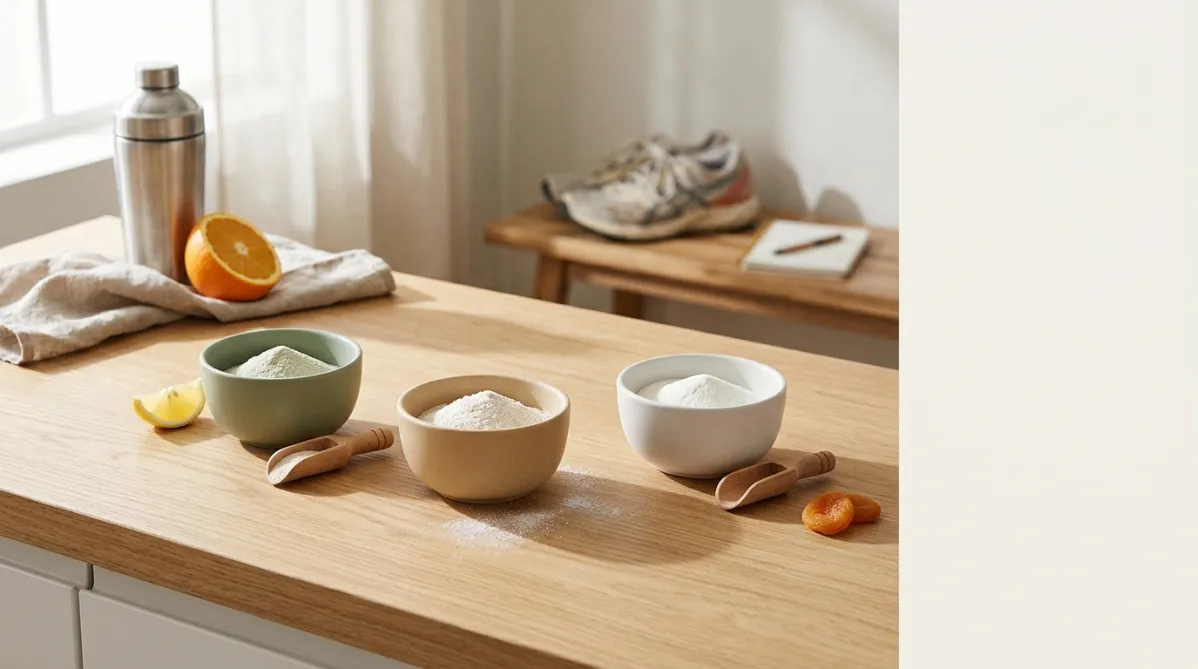
A landscape editorial photograph of a clean, sunlit kitchen-counter or light oak table, shot from slightly above at a gentle angle. Three small matte ceramic bowls in muted sage green, warm sand, and soft white sit in a loose row. Each holds a different fine white powder, and each has a small wooden scoop resting beside it. The middle bowl is slightly closer to the camera and sharper in focus, with a faint dusting of powder spilling onto the surface. In the soft-focus background, a stainless steel shaker bottle and a half-peeled orange sit beside a folded linen napkin, suggesting citrus without being literal. A single lemon wedge sits near the left bowl, and a small dried apricot sits near the right, a subtle visual nod to citrate and pyruvate.

In the background, a blurred athletic scene: a running shoe resting on a wooden bench and a small notebook with a pen, suggesting a training log. Soft diffused morning light enters from the left through a window and casts long, gentle shadows. The palette is warm neutrals, creamy whites, soft greens, and a hint of terracotta orange. The look is a modern wellness magazine with a shallow depth of field, a fine-grain film feel, and generous negative space on the right third of the frame for title text. The mood is calm, trustworthy, and scientific yet approachable, with no text, labels, or logos.
nutrition

Creatine Pyruvate vs Citrate: One Form Kept Force Up Longer

BY DR. GYMBRO ·

Two fancy creatine forms beat placebo in a 28-day trial, but one kept muscle force elevated through all ten all-out intervals while the other faded. Creatine pyruvate raised force in every interval (p < 0.001), whereas creatine citrate's benefit disappeared by the sixth interval. Only pyruvate also improved relaxation velocity and resting oxygen consumption. Before you ditch your tub, there's a major catch: the study had no creatine monohydrate group. Here's what the numbers show, what they can't, and how to choose.

A wide, landscape editorial photograph of a clean, sunlit kitchen counter or pale stone tabletop, styled like a modern wellness magazine spread. Two scoops sit side by side on a matte ceramic surface. The left one is a plain, humble wooden scoop heaped with fine white creatine powder. The right is a glossy, ornate brushed-gold scoop holding the same white powder, which hints at "premium" branding. Behind each scoop stands a tub. The left tub is minimal, matte, and cream-colored with simple sans-serif lettering and no readable words. The right tub is sleek black with metallic gold accents and an overly polished look. A few fine grains of powder are scattered across the surface, catching the light.

The composition uses a shallow depth of field. The foreground scoops are crisp, and the background softly blurs into a warm neutral palette of oatmeal, soft sage green, and muted terracotta. Soft morning window light comes in from the left, casting long, gentle shadows and a subtle highlight along the scoops' edges. A small price tag shape, blank and unmarked, sits near the gold scoop, with a slightly crumpled paper texture to suggest the "pricey" angle without any text. A glass of water with condensation and a folded linen napkin sit at the edge of the frame. A single green sprig or eucalyptus stem adds a natural accent.

The overall mood is calm, intelligent, and quietly skeptical, with the plain option feeling confident and the flashy one a bit overdressed. The color grading is soft and slightly desaturated with creamy highlights, and there is fine film grain. The layout leaves generous negative space on the right third for a headline overlay. It looks like a high-end lifestyle and science journal cover, with a minimalist, tactile, trendy feel and no futuristic or sci-fi elements.
science research

Creatine Ethyl Ester vs Monohydrate: The Pricey Form Lost

BY DR. GYMBRO ·

Supplement makers love to sell "advanced" creatine as better absorbed than the old standby. A 2009 double-blind trial tested creatine ethyl ester against monohydrate and placebo in 30 untrained men over seven weeks of heavy training. CEE produced lower serum creatine and sharply higher serum creatinine, a pattern consistent with it breaking down into waste. Muscle creatine rose in both creatine groups, but strength, power, and body composition did not differ between any groups. The takeaway: skip the premium form and keep it simple.

A wide, editorial-style still life photographed from slightly above on a pale oat-colored linen surface, lit by soft morning window light from the left. In the center sits a small matte ceramic bowl holding a mound of fine white powder, with a minimalist wooden scoop resting beside it. Next to the bowl is an open amber glass supplement jar with a plain cream label, and a few white capsules spill across the linen in a loose arc.

To the right, a neatly arranged cluster of analog "study" objects suggests careful measurement: a vintage stopwatch with a clean white face, a slim notebook with a sage-green cover open to a hand-drawn bar chart (blurred, no legible text), and a mechanical pencil lying across the page. A small row of six identical ceramic dishes, each holding a pinch of powder, is lined up along the top edge of the frame to hint at the six-week trial. One dish is slightly out of alignment, a subtle visual cue for ambiguity.

A shallow glass of water and a single sprig of green eucalyptus add a calm, organic note in the foreground. Soft, long shadows fall across the textured linen, and the palette stays restrained: warm cream, soft sage, muted terracotta, pale gray, and touches of amber from the glass jar. A few translucent paper cutouts in two tones (sage and blush) overlap in the upper right corner as a modern graphic accent, evoking overlapping data points without showing any numbers.

Depth of field is shallow, with the bowl and stopwatch in crisp focus and the edges gently softened. The composition leaves generous negative space on the left third for title text overlay. The overall mood is thoughtful, balanced, and quietly skeptical, in the style of a contemporary wellness and science magazine: clean, tactile, minimal, with a subtle film-like grain and natural color grading. No people, no futuristic or sci-fi elements, no readable text or logos.
nutrition

GAA Brain Booster? The 6-Week Trial Result Is Complicated

BY DR. GYMBRO ·

GAA, the creatine precursor sold as a brain booster, just got its first serious human test. In a six-week, double-blind trial of 58 healthy adults, it produced some faster reaction times and a scattering of mood and stress signals. Most cognitive tests, however, showed nothing, and many of the headline results were only trends. Safety markers looked fine, but the study was small, exploratory, and had no creatine-only comparison group. Here is what it really shows, who it might suit, and why the verdict is mixed.

This page is available in