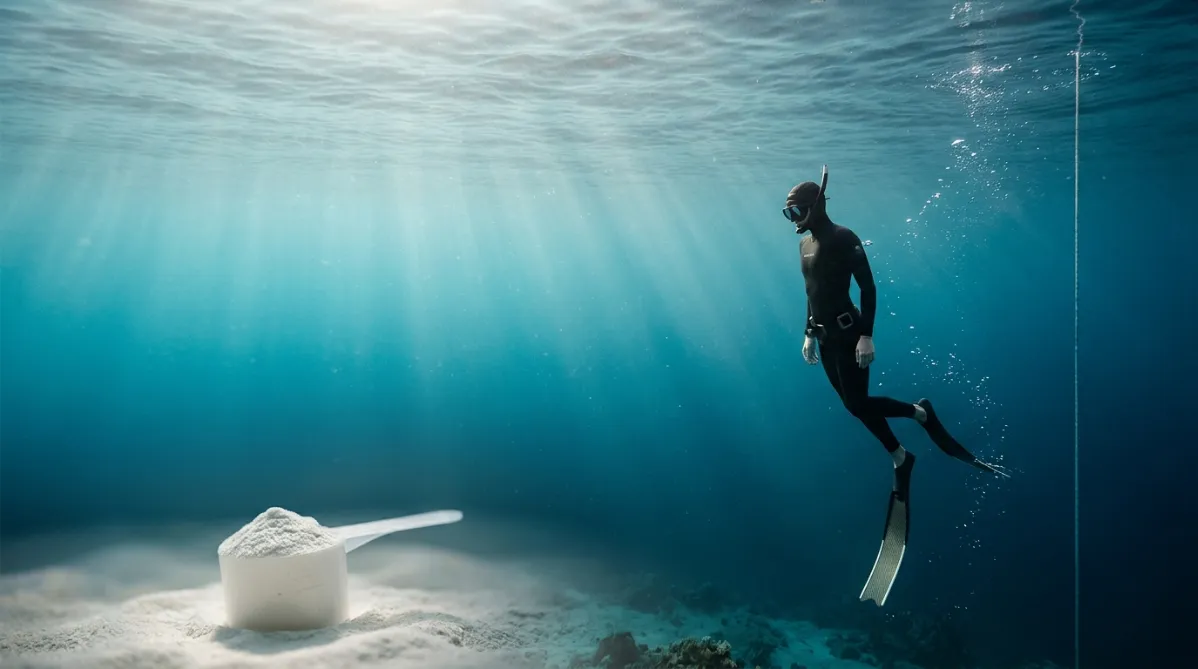
What happens to your muscles when you ask them to work flat out and give them no new oxygen? A new randomized trial in freedivers suggests that creatine, the most studied supplement in sports nutrition, may help in exactly that situation.
The Big Finding: More Work, Lower Lactate
Researchers led by Kurmazovic tested a standard creatine monohydrate loading protocol in trained breath-hold divers. Participants cycled on an ergometer on a single breath, trying to cover as much distance as they could. After one week of creatine, they produced more total work and lasted longer before exhaustion than the placebo group.
The lactate result is the most surprising part. Blood lactate was lower in the creatine group than in the placebo group, even though the creatine group performed better. Pushing harder usually means more lactate, so this runs against what you would expect. The paper reports a significant Time × Group interaction for lactate (p = 0.003).
How the Study Worked
This was a double-blind, randomized, placebo-controlled trial published in the Journal of the International Society of Sports Nutrition in 2026. It enrolled 20 trained breath-hold divers (18 men, 2 women, mean age about 41.6 years).
- Test: A brief warm-up, then a maximal cycling effort on one breath, aiming for the greatest possible distance.
- Protocol: Pre-supplementation testing, then random assignment to creatine monohydrate (20 g/day for 7 days) or placebo, then retesting.
- Measures: Total work, time to exhaustion, blood lactate, exhaled pCO₂ after the effort, perceived exertion for breath-hold and for muscle fatigue, and body composition by DXA scan.
- Registration: ClinicalTrials.gov NCT07233707.
Why Creatine Might Matter When You Hold Your Breath
The authors' reasoning is straightforward. Creatine is known to support anaerobic energy availability and buffering capacity. During a breath-hold effort, muscles lean more heavily on anaerobic ATP production, so phosphocreatine-derived ATP could be especially valuable. Until now, nobody had tested whether that benefit shows up under voluntary apnea.
The results are consistent with that idea. Total work (p = 0.011) and time to exhaustion (p = 0.028) both improved more with creatine than with placebo. The paper does not directly prove the mechanism, so treat the explanation as a plausible one rather than a settled fact.
Other Results
- Fat-free mass rose more with creatine (p = 0.017). Creatine is often linked to water retention, and this study did not separate the cause, so be cautious about reading it as pure muscle gain.
- Perceived breath-hold exertion did not differ between groups. Creatine improved performance without making the breath-hold feel harder.
- Muscle fatigue ratings showed a slight increase in the creatine group. The authors flag this themselves.
- Exhaled pCO₂, fat mass and total body mass showed no significant between-group differences.
Practical Takeaways
Dose: The study used 20 g/day of creatine monohydrate for 7 days. This is the classic loading protocol. The abstract does not say how the daily dose was divided. Many athletes split loading doses into several smaller servings across the day, which is common practice but not something this paper tested.
Timing: The paper does not test timing relative to training or competition, so there is no evidence-based answer here. The finding is about a week of loading, not a pre-dive dose.
Who it might help:
- Freedivers and spearfishers: This is the group actually studied, so the evidence is most direct for them.
- Combat and swim athletes: Breath-hold or restricted-breathing efforts and repeated anaerobic bursts are common in these sports. This is an extrapolation, and the study did not test them.
- Anyone doing high-intensity anaerobic work: Creatine already has a long track record here. This trial adds a new context in which it appeared to work.
Limitations
This is promising work, but it should not be oversold.
- Small sample. With only 20 participants, the results are preliminary. Small trials can overestimate effects and need replication.
- Narrow population. The group was trained breath-hold divers, mostly men around 41. Only two women took part, so the findings say little about sex differences.
- Lab cycling is not diving. A maximal cycling test on one breath is not the same as a deep dive, a static apnea hold or a competition. The authors describe creatine as a potentially effective strategy for breath-hold sports, which is not proof of better real-world diving performance.
- Safety. Freediving carries serious risks, including blackout. Nothing in this study makes extended breath-holding safer, and creatine is no reason to push limits. Never train apnea alone.
- Unexplained lactate result. Lower lactate alongside greater work is interesting, but the abstract does not explain why, so avoid over-reading it.
- Muscle fatigue ratings. The slight rise in perceived muscle fatigue means the benefit was not entirely free of trade-offs.
Bottom Line
The study found that a week of creatine monohydrate loading improved work output and time to exhaustion in breath-hold cycling among trained divers, with lower lactate than placebo. Because the sample was small, it is a strong signal rather than a final verdict. If you do breath-hold or anaerobic sport and already consider creatine, this adds support. Talk to a qualified professional first if you have kidney issues or other health conditions.
Source: Kurmazovic et al. Load and breath-hold: impact of 7-day creatine monohydrate loading on breath-hold exercise performance – a double-blind randomized controlled trial. J Int Soc Sports Nutr, 2026. DOI: https://doi.org/10.1080/15502783.2026.2732743 | PubMed 42868132