Dr. Gymbro
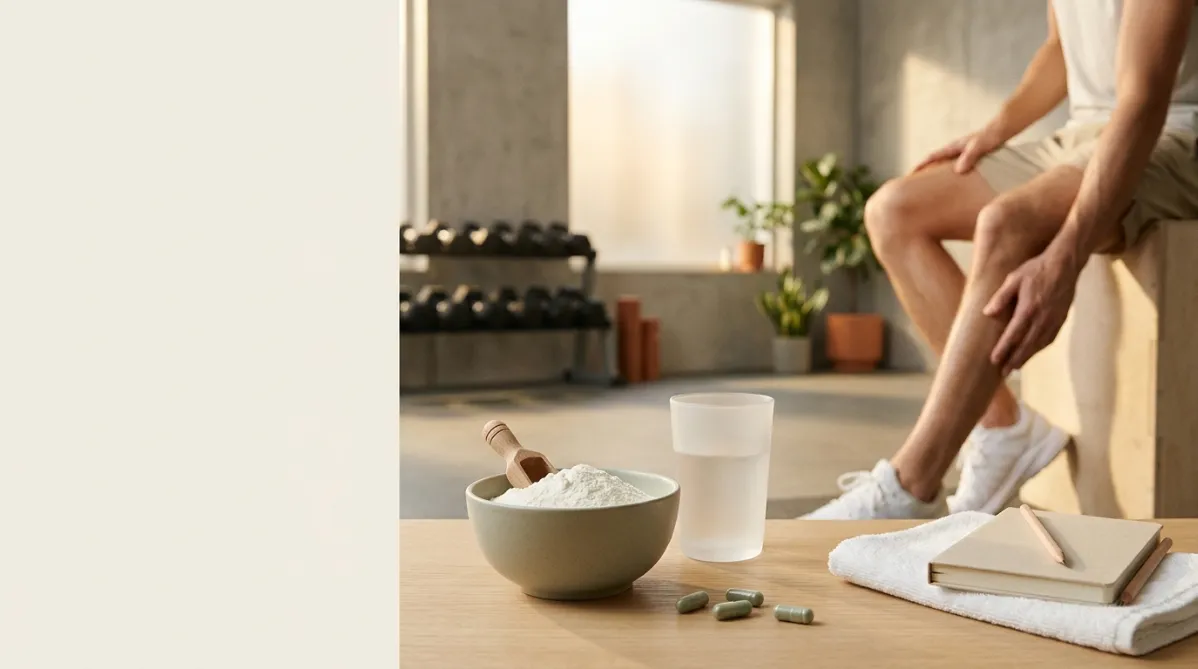
A landscape editorial photograph with a clean, modern wellness-journal look, shot in soft natural morning light. In the foreground, a matte ceramic bowl of white powder sits on a pale oak surface with a wooden scoop beside it. A frosted glass tumbler of water stands next to it, and a few loose capsules in muted sage green are scattered nearby. Behind them, slightly out of focus, a lean athlete's lower legs and calves are visible as he sits on the edge of a plyo box, one hand resting on his calf. He wears neutral clothing, with sand-colored shorts and white training shoes. The setting is a minimalist, airy gym studio with concrete walls, a large window casting diffused golden light, and a rack of dumbbells softly blurred in the background. The palette is warm cream, soft sage, pale wood, and muted terracotta accents. The composition uses generous negative space on the left third for headline overlay, shallow depth of field, and subtle film grain. A folded white towel and a small notebook with a pencil rest on the surface, hinting at a research and tracking theme. The mood is calm, credible, and contemporary, like a premium health and fitness magazine cover, with crisp detail on the textures of powder, ceramic, glass, and skin.
Recovery

10 g of EAAs Cleared Calf Swelling by 72 Hours—Placebo Didn't

Dr. Gymbro · · 4 min read

Your calves are wrecked, the stairs look like a threat, and a scoop of powder might help. A new randomized controlled trial tested that idea, with a twist: the swelling in the calves of the people who took essential amino acids (EAAs) went back to baseline within 72 hours, while the placebo group's didn't. The study also found something EAAs did not do, and the details matter before you buy a tub.

What the researchers actually did

A team from the University of Tampa, with collaborators at the University of Central Florida and Nova Southeastern University, published the trial in the Journal of the International Society of Sports Nutrition (2026). They recruited 36 recreationally active young men (average age 21.2 ± 2.7 years) and randomly assigned them to one of three groups:

  • EAA group: 10 g of essential amino acids
  • Placebo group: 10 g of maltodextrin
  • Control group: no supplement

Every participant did a punishing eccentric calf (plantar flexor) protocol: 4 sets of 50 repetitions, then one more set to failure. Supplements were taken 30 minutes before exercise, immediately afterward, and throughout the 72-hour recovery window. The researchers measured soreness (a numeric pain scale), pressure pain threshold, calf muscle thickness and Achilles tendon thickness by ultrasound, and calf circumference. Measurements were taken before exercise, right after, and at 24, 48, and 72 hours.

The headline results

The workout did its job. Soreness, calf muscle thickness, and circumference all rose significantly (p < 0.001), and pressure pain threshold dropped (p = 0.018). That is the expected signature of exercise-induced muscle damage.

Soreness at 24 hours was lower with EAAs than with placebo. The authors call the effect modest, and the abstract does not give effect sizes, so don't expect miracle relief.

Swelling is the more striking result. Calf muscle thickness rose in both supplemented groups after exercise. By 72 hours it had returned to baseline in the EAA group but was still elevated in the placebo group (condition × time interaction, p < 0.001). The abstract reports this comparison between EAA and placebo. It does not say how the no-supplement control group compared on this measure.

The plot twist: the Achilles tendon didn't care

Achilles tendon thickness dropped right after exercise (p = 0.005), but supplementation had no influence on it. The authors conclude that EAAs did not affect tendon morphology within 72 hours. So if you hoped amino acids would speed up tendon recovery, this study gives no support. The benefit, such as it was, showed up in the muscle.

How to read it (and where to be skeptical)

This is a small, short, single-site trial. Keep these limits in mind:

  • Sample size: 36 men split across three groups means small cells. The abstract doesn't give per-group numbers.
  • Who was studied: Only young, recreationally active males. Women, older adults, and trained athletes weren't tested.
  • Indirect markers: Soreness, swelling, and ultrasound thickness are proxies for damage. The abstract reports no direct blood markers or performance outcomes, so "faster recovery" here means faster swelling resolution, not proven faster return to full strength.
  • Short window: Everything was tracked for 72 hours. Longer-term effects are unknown.
  • Soreness effect was limited: It reached significance at 24 hours versus placebo, and the authors themselves describe it as modest.
  • Background diet: The abstract doesn't describe how participants' normal protein intake was handled, which matters for interpreting who might benefit.

Funding and conflicts: The abstract lists no funding source. It does disclose that first author Ecaterina Vasenina serves as a scientific advisor for Legion Athletics, a supplement company. The statement says this relationship had no role in the study's design, execution, analysis, or interpretation, and the other authors declared no conflicts. That's worth knowing, but it isn't evidence of bias.

Practical takeaways

The following is practical interpretation, not something the trial tested directly.

Dose and timing used in the study: 10 g of EAAs, 30 minutes before the damaging session, immediately after, and during the 72-hour recovery period. The abstract doesn't specify the exact dosing schedule during recovery, so there's no precise protocol to copy beyond the pre- and post-workout doses.

Who might benefit:

  • People who regularly fall short of their daily protein target
  • Those training fasted or going long stretches without a protein-rich meal around a hard session
  • Anyone returning to a very high-volume eccentric block who wants to test whether it eases the worst of the swelling and soreness

Who can probably skip it:

  • People who already eat plenty of protein spread across the day. Extra amino acids on top of an adequate diet may add little, though this study did not test that.
  • Anyone hoping to speed tendon recovery. The Achilles data show no effect.
  • Anyone expecting dramatic pain relief. The soreness benefit was modest.

A reasonable approach is to fix your whole-food protein intake first. If you still want to experiment, a 10 g EAA dose around brutal eccentric sessions is the amount with trial data behind it, but that data comes from 36 young men over three days.

Bottom line

In this trial, 10 g of EAAs reduced 24-hour soreness compared with placebo and was associated with calf swelling returning to baseline by 72 hours, while the placebo group stayed swollen. Tendon thickness was unaffected. It's an encouraging but early result that needs larger, longer, more diverse replication before anyone calls EAAs a recovery essential.
Original study

Read the original research on pubmed.ncbi.nlm.nih.gov →

This article summarizes published research for general information. It is not medical advice.

DG

Written by

Dr. Gymbro

Dr. Gymbro writes for Dr. Gymbro: science-backed fitness, nutrition & performance.

Related Articles

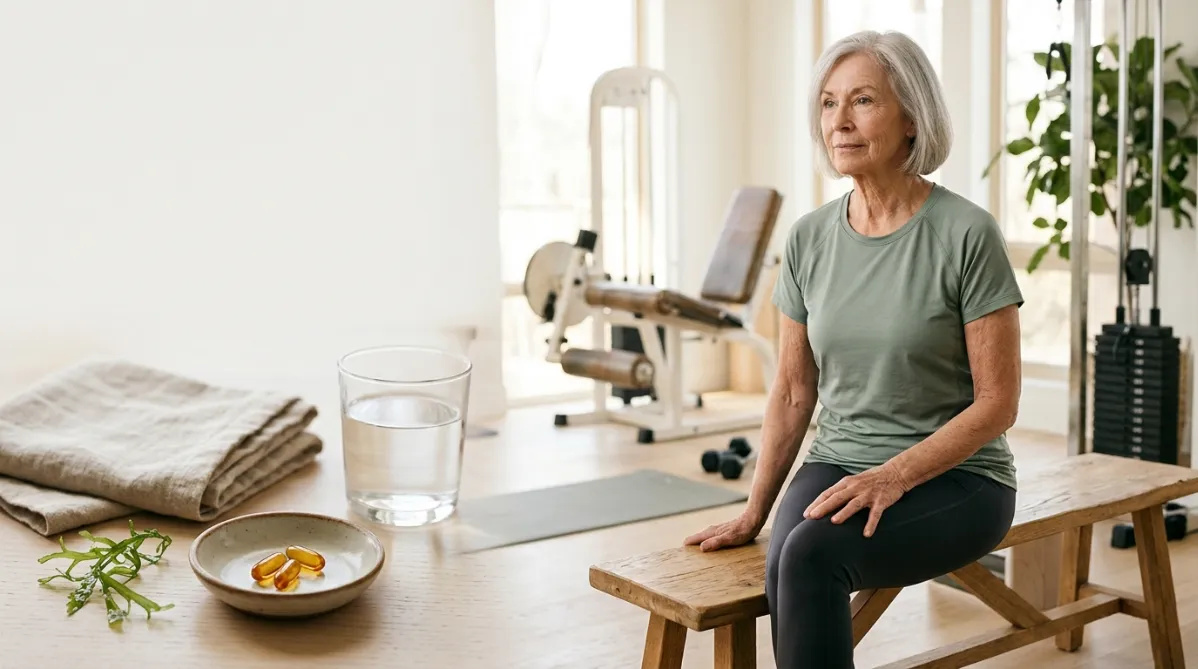
A warm, softly lit editorial scene of an older woman in her early seventies, with short silver hair and a calm, focused expression. She sits on the edge of a light oak bench in a bright, airy home gym, one hand resting on her thigh as she pauses between sets. She wears a muted sage-green athletic top and charcoal leggings. A well-worn leg extension machine sits blurred in the background, and a tall window floods the room with golden morning light.

In the foreground, slightly out of focus, a small ceramic dish on a pale wooden surface holds two translucent amber softgel capsules. Next to it sit a glass of water and a folded linen towel in warm cream. A single sprig of green algae-like seaweed rests beside the dish as a quiet nod to the algae-oil source. The sprig is delicate and natural, with no laboratory elements.

The color palette is earthy and modern: sage green, warm amber, oatmeal beige, and soft terracotta accents, with gentle highlights on the capsules. The composition follows the rule of thirds. The woman sits on the right, and the capsules and water fill the lower left. Negative space in the upper left keeps the layout clean for a headline overlay.

The photographic style is contemporary lifestyle editorial, shot on a 50mm lens at f/2, with shallow depth of field, soft natural grain, and subtle film-like tones. The mood is thoughtful, reassuring, and quietly skeptical. The scene suggests curiosity about whether a popular supplement delivers, with no drama and no clinical coldness. The image should look like the cover of a trendy health and wellness journal: clean, minimal, human, and sophisticated, with realistic textures in the skin, fabric, wood, and glass.
nutrition

Omega-3 for Sore Legs After 65? The Trial Had a Twist

BY DR. GYMBRO ·

Omega-3 supplements are often marketed as a way to ease muscle soreness and speed recovery. A new randomised, placebo-controlled trial put that claim to the test in 43 healthy adults aged 65 to 85 after a demanding eccentric leg-extension session. After eight weeks on 2 g of algae-oil omega-3, functional recovery was no better than placebo, and strength was lower at 24 and 72 hours. The biochemical response did look different, but different is not the same as better. Here is exactly what changed, what didn't, and what older lifters should take from it.

A calm, editorial still life photographed from a slightly elevated angle on a pale oak table in soft morning window light. On the left, a sleek matte-black single-serve ketone drink bottle with a minimal label stands next to a small frosted glass filled with a pale amber liquid, with a few condensation droplets on its surface. A modest scatter of small unmarked white sachets lies beside it, hinting at a pricey supplement habit. On the right, a thoughtfully arranged group of simple, proven recovery staples: a ceramic bowl of oatmeal topped with sliced banana and blueberries, a tall glass of water with a lemon slice, a boiled egg halved on a small plate, and a folded soft gray linen towel. A pair of well-worn running shoes rests casually at the edge of the frame, with a neatly rolled yoga mat leaning against the wall behind them. In the background, a softly blurred sunlit corner of a modern apartment shows a green potted plant and a cream wall. A few coins and a crisp folded receipt sit near the ketone bottle, a subtle nod to the cost question.

The palette is muted and earthy, with warm creams, sage green, soft charcoal, and touches of amber and berry blue. The light is diffused and natural, with gentle long shadows and shallow depth of field that keeps the foreground objects crisp. The composition is balanced with generous negative space across the top third for headline overlay, and the mood is thoughtful, grounded, and quietly skeptical. The look is a modern lifestyle magazine photograph, clean and minimal, with fine film-like grain and a trendy wellness-journal feel. Landscape 16:9 format.
recovery

Are Ketone Drinks Worth It for Recovery? The Data Says Probably Not

BY DR. GYMBRO ·

Ketone drinks are marketed as a recovery shortcut, but a new systematic review and exploratory meta-analysis found little to back that up. Compared with control, exogenous ketones showed no significant benefit for muscle soreness, glycogen resynthesis, creatine kinase or physical performance. Post-exercise lactate even slightly favored the control condition, and reaction-time improvements were isolated. The evidence comes mostly from active men, so there are caveats. Here's what the data mean for your wallet and what to prioritize instead.

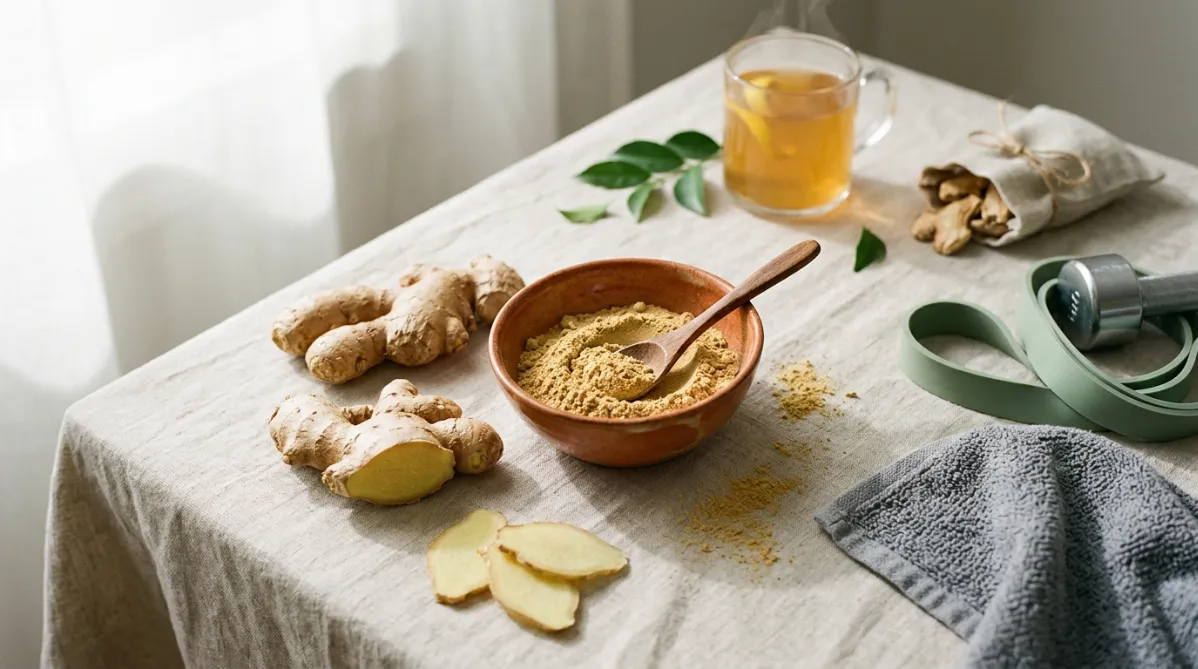
A wide, editorial-style still life photographed from slightly above on a pale oat-colored linen surface, lit by soft natural window light from the left. At the center sits a rustic ceramic bowl of finely ground golden-tan ginger powder, with a small wooden spoon resting in it and a light dusting of spice across the cloth. Beside it lie several whole ginger rhizomes, knobby and honey-brown. One is sliced open to show its pale yellow, fibrous interior, and a few paper-thin slices fan out in the foreground. On the right, a folded heather-gray gym towel, a matte sage-green resistance band coiled loosely, and a single brushed-steel dumbbell sit just inside the frame, softly out of focus. A glass of warm amber ginger tea steams faintly near the upper right, with a thin curl of lemon peel inside. A few fresh green leaves and a small linen pouch of dried ginger add texture. The palette is warm and muted: cream, soft gold, sage, terracotta, and charcoal accents. The shallow depth of field keeps the ginger bowl and sliced root crisp while the gym elements melt into a gentle blur. Shadows are long and soft, and the negative space on the upper left leaves room for a headline. The mood is calm, clean, and modern, like a contemporary wellness or science journal cover. It is a natural, tactile, high-resolution photograph with subtle film grain and no text, no people, and no futuristic elements.
recovery

2 Grams of Ginger Cut Next-Day Muscle Pain by ~25% in Two Trials

BY DR. GYMBRO ·

A common kitchen spice just went head-to-head with one of the gym's most universal complaints: next-day muscle soreness. In two double-blind trials, people who took 2 grams of ginger daily for 11 days reported roughly 25% less pain 24 hours after punishing eccentric exercise. But ginger didn't clearly improve strength or swelling, and nobody tested it against ibuprofen. Here is what the research shows, why it might work, where the evidence falls short, and who should consider trying it.

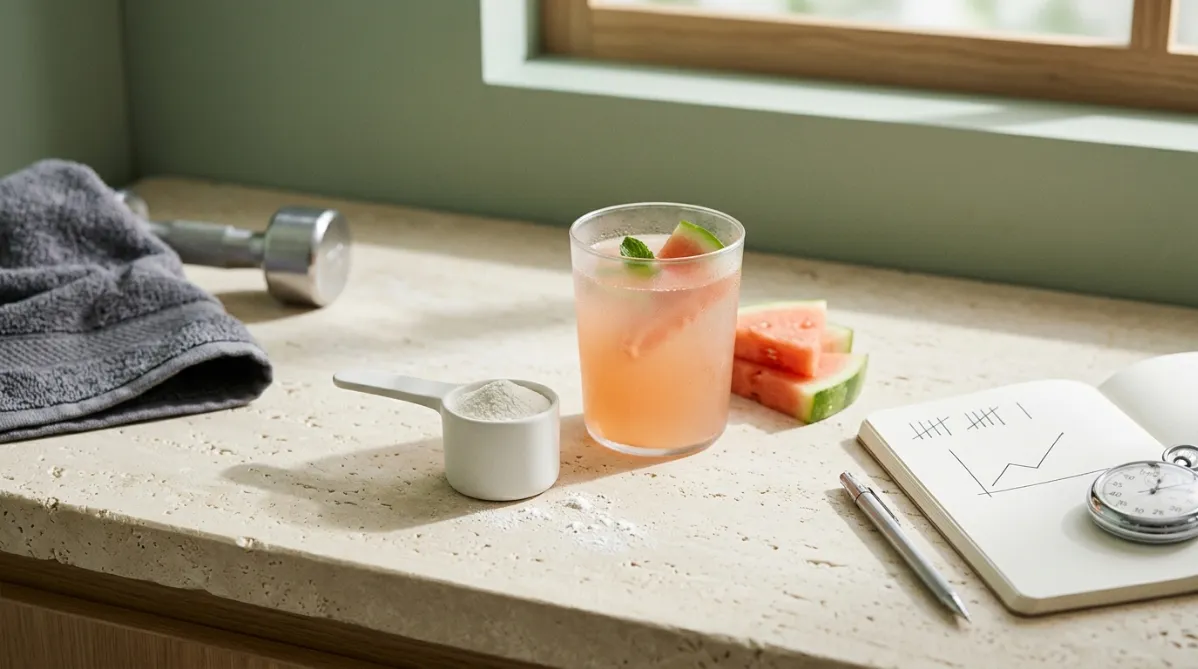
A wide, editorial-style still life photographed on a pale limestone countertop in soft morning window light. At the center sits a matte white scoop of fine white powder resting beside a frosted glass tumbler of cloudy, pale pink-orange water, with a few watermelon slices and a halved wedge showing glossy coral flesh and thin green rind, a nod to citrulline's natural source. To the left, a neatly folded charcoal gym towel and a brushed steel dumbbell rest at the edge of the frame, slightly out of focus. To the right, a minimalist open notebook with a few hand-drawn tally marks and a simple line graph sketched in black ink rises toward the right edge, next to a slim mechanical pencil and a small analog stopwatch with a clean white face. A few loose grains of powder are scattered across the stone, catching the light. Soft diagonal shadows fall across the surface from a nearby window, and a gentle sage-green wall in the background adds calm contrast. The palette is warm cream, watermelon coral, sage green, and soft graphite gray, with plenty of negative space on the upper left for headline overlay. Shallow depth of field, crisp focus on the powder scoop and watermelon, subtle film grain, natural tones, and a clean, modern wellness-journal aesthetic. Shot at eye level with a slight downward angle, like a contemporary health and science magazine cover. No text, no logos, no people.
nutrition

8 g Citrulline Malate = 53% More Reps and 40% Less Soreness? What the Study Shows

BY DR. GYMBRO ·

A 2010 crossover trial found that 8 g of citrulline malate was linked to about 53% more bench press reps in the final evaluated set and roughly 40% less soreness at 24 and 48 hours. The catch is that the biggest rep gain showed up late in the session, once fatigue had built up. Here is what the study actually tested, how to apply the dose and timing sensibly, who stands to benefit, and why the 14.63% rate of stomach discomfort and the study's limits deserve attention.

This page is available in