Dr. Gymbro
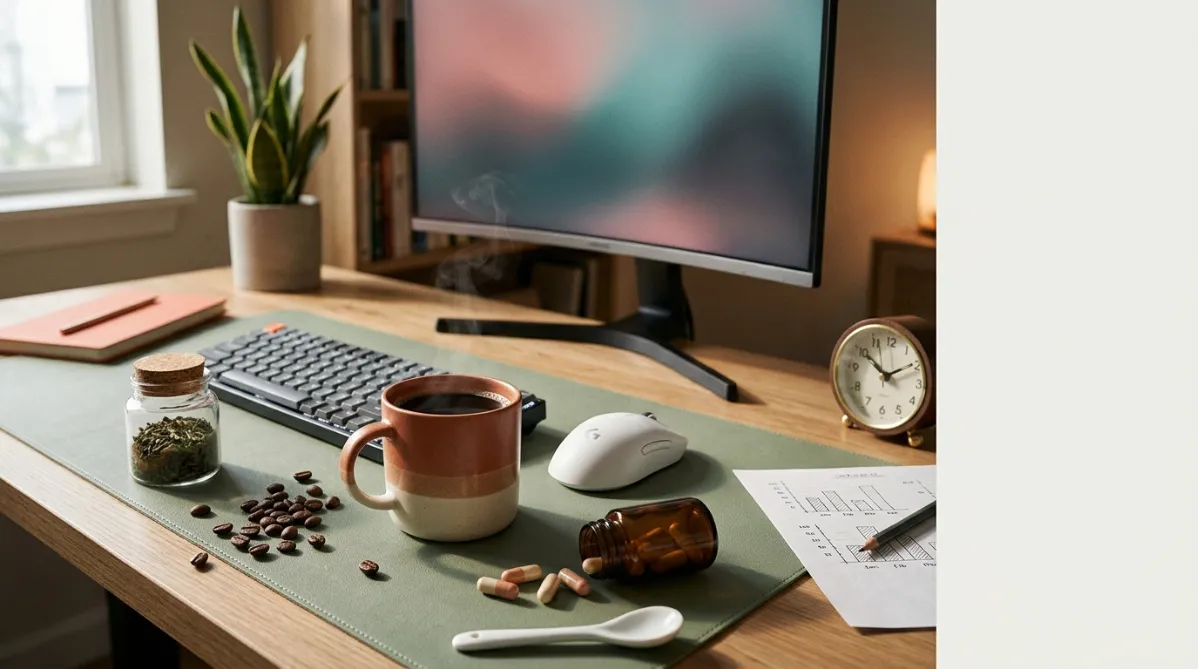
A landscape editorial still life on a softly lit desk, shot from a slightly elevated three-quarter angle with shallow depth of field. In the center sits a ceramic cup of black coffee with a thin curl of steam, on a matte sage-green desk mat. Beside it, a sleek white wireless gaming mouse and a minimal, low-profile keyboard are partly in focus. Scattered in the foreground are a few whole roasted coffee beans and a small glass jar of loose green tea leaves, as a quiet nod to caffeine sources. To the left, a few unlabeled supplement capsules in muted peach and cream spill from a small amber glass bottle onto the mat. Their blurred, ordinary look hints that they are less important than the coffee. In the background, a monitor glows with a soft, abstract, out-of-focus gradient of dusty rose and teal, with no readable game interface. A small analog alarm clock sits at the edge of the frame, its hands near late evening, suggesting sleep concerns. A sheet of paper with simple hand-drawn bar charts and a pencil rests near the cup, hinting at research and data without any legible text.

The palette is warm and modern: cream, sage, terracotta, charcoal, with a single accent of coral. Soft window light comes from the left, casting gentle long shadows and a subtle film-like grain. The composition is clean and uncluttered, with generous negative space on the right third for a title overlay. The look is contemporary and trendy, like a lifestyle-science magazine cover, calm, tactile, and sophisticated, with no sci-fi or neon cyberpunk elements.
supplements

The Gaming Supplement With Real Evidence Isn't What Ads Sell

Dr. Gymbro · · 4 min read

Walk through any gaming expo or scroll any streamer's sponsor list and you'll find neon-colored powders promising "laser focus," "zero tilt," and "pro-level reflexes." Now a systematic review has checked what the research behind those claims actually shows. The answer is less glamorous than the marketing: one old, cheap, widely available compound dominates the evidence, and most of the exotic blends barely appear in it.

What the Review Looked At

Researchers from Jiangxi University of Technology and Jiangxi Normal University searched PubMed, Scopus, Web of Science, and Embase through June 17, 2025. They looked for randomized controlled trials and randomized crossover trials testing nutritional supplements on cognition, mood, or in-game performance in esports players. Thirteen studies made the cut: ten crossover designs and three parallel RCTs, covering 466 participants in total. The review was published in the Journal of the International Society of Sports Nutrition.

Across those trials, the authors identified 18 supplement protocols. Fourteen of them involved pure caffeine or a caffeine-containing product. The remaining protocols tested inositol-enhanced arginine silicate (ASI + I), gamma-aminobutyric acid (GABA), and microalgae extracts. In other words, the "gaming supplement" with a real research footprint is essentially caffeine. Most of the novel stacks have only a handful of studies behind them, or none.

What Actually Improved

The authors grouped the positive findings into three areas that matter to competitive players.

  • Attention and executive function: Players showed significant gains in the mental skills tied closely to gameplay, such as sustaining focus, switching tasks, and making decisions under pressure.
  • Mood and vitality: Some supplements were associated with higher vitality and lower fatigue and negative emotions, which matters during long practice blocks and tournament days.
  • Shooting performance: The in-game gains clustered in aiming tasks, with higher shooting scores, better accuracy, and faster reaction times.

The pattern fits what we know about stimulants and arousal. Tasks built around fast reactions and sustained visual attention, like aim trainers and tactical shooters, are exactly where a small boost in alertness is easiest to measure. The review doesn't show that any supplement makes someone a better strategist, shot-caller, or teammate.

The Limits You Shouldn't Skip

The authors call their findings preliminary. The studies were heterogeneous, using different supplements, doses, timing, and outcome measures, so pooling them into one verdict isn't straightforward. More than half the included research raised concerns about overall risk of bias, even though PEDro quality scores of 6 to 10 were rated good to excellent. Sample sizes were small, and most participants were amateur players, so it's unclear whether results carry over to professionals who already train, sleep, and eat on strict schedules.

The authors call for standardized protocols, dosing, and measurement methods in future trials. Until that happens, treat the results as a promising signal rather than a guarantee. That applies even more to the non-caffeine ingredients, where the evidence is thinner still.

Side Effects Worth Knowing

Stimulants carry trade-offs, and trials in this area have flagged several. Reported or discussed effects include elevated cortisol, increased anxiety or jitteriness, and headaches. These matter for gamers in particular. A player who is already nervous before a ranked match or a bracket may find that extra stimulation sharpens reactions but also worsens tension and decision-making. Individual sensitivity to caffeine varies a lot, so a dose that feels fine for one person can feel miserable for another.

Practical Takeaways for Players

This is general information, not medical advice, and anyone with a heart condition, anxiety disorder, pregnancy, or medication concerns should check with a clinician first.

  1. Start with the cheap option. Coffee, tea, or plain caffeine has far more evidence than most proprietary blends.
  2. Think in body-weight terms. A commonly cited range in sports nutrition is around 3 mg/kg of body weight, used here as general guidance only. For a 70 kg player, that's roughly 210 mg, or about two cups of brewed coffee. Many people do fine, or better, with less.
  3. Time it. Taking caffeine about 30 to 60 minutes before play lines up with when blood levels typically peak.
  4. Test it in practice, not in finals. Trial your dose in scrims so you know how it affects your aim, nerves, and stomach before it matters.
  5. Protect your sleep. Caffeine has a long half-life, so late-night sessions fueled by energy drinks can wreck sleep. Poor sleep hurts reaction time, memory, and mood far more than a supplement can repair.
  6. Be skeptical of labels. Proprietary blends that bury caffeine doses or pile on unproven ingredients make it hard to know what you're taking.

The Bottom Line

The strongest evidence for gaming supplements points to caffeine, and it suggests modest benefits for attention, mood, and shooting-type tasks. The research base is still small, mostly amateur, and prone to bias, so no supplement replaces sleep, hydration, regular meals, and deliberate practice. If you're going to use something, use the one with data behind it, keep the dose reasonable, and don't let it cost you a night's sleep.

Original study

Read the original research on pubmed.ncbi.nlm.nih.gov →

This article summarizes published research for general information. It is not medical advice.

DG

Written by

Dr. Gymbro

Dr. Gymbro writes for Dr. Gymbro: science-backed fitness, nutrition & performance.

Related Articles

A wide, editorial-style still life photographed from slightly above on a pale oat-colored linen surface, lit by soft morning window light from the left. In the center sits a small matte ceramic bowl holding a mound of fine white powder, with a minimalist wooden scoop resting beside it. Next to the bowl is an open amber glass supplement jar with a plain cream label, and a few white capsules spill across the linen in a loose arc.

To the right, a neatly arranged cluster of analog "study" objects suggests careful measurement: a vintage stopwatch with a clean white face, a slim notebook with a sage-green cover open to a hand-drawn bar chart (blurred, no legible text), and a mechanical pencil lying across the page. A small row of six identical ceramic dishes, each holding a pinch of powder, is lined up along the top edge of the frame to hint at the six-week trial. One dish is slightly out of alignment, a subtle visual cue for ambiguity.

A shallow glass of water and a single sprig of green eucalyptus add a calm, organic note in the foreground. Soft, long shadows fall across the textured linen, and the palette stays restrained: warm cream, soft sage, muted terracotta, pale gray, and touches of amber from the glass jar. A few translucent paper cutouts in two tones (sage and blush) overlap in the upper right corner as a modern graphic accent, evoking overlapping data points without showing any numbers.

Depth of field is shallow, with the bowl and stopwatch in crisp focus and the edges gently softened. The composition leaves generous negative space on the left third for title text overlay. The overall mood is thoughtful, balanced, and quietly skeptical, in the style of a contemporary wellness and science magazine: clean, tactile, minimal, with a subtle film-like grain and natural color grading. No people, no futuristic or sci-fi elements, no readable text or logos.
nutrition

GAA Brain Booster? The 6-Week Trial Result Is Complicated

BY DR. GYMBRO ·

GAA, the creatine precursor sold as a brain booster, just got its first serious human test. In a six-week, double-blind trial of 58 healthy adults, it produced some faster reaction times and a scattering of mood and stress signals. Most cognitive tests, however, showed nothing, and many of the headline results were only trends. Safety markers looked fine, but the study was small, exploratory, and had no creatine-only comparison group. Here is what it really shows, who it might suit, and why the verdict is mixed.

nutrition

Caffeine Made Soccer Players Faster, But Not at Reacting

BY DR. GYMBRO ·

Everyone assumes caffeine makes athletes sharper all around, but a new double-blind trial in amateur soccer players tells a more nuanced story. A 300 mg dose (about 3.7 mg/kg) improved planned agility with an effect size of 0.62 and also boosted jump performance. But when players had to react to a light or a human opponent, the benefits were small or not statistically significant. Here is what the study found, how to read the results, and who might actually benefit.

A lone trail runner pauses on a high alpine ridge at dawn, holding a small enamel camp mug of steaming coffee, with thin ribbons of steam curling into crisp, cold air. She wears a fitted charcoal running vest and a muted sage windbreaker, and her breath is faintly visible. Behind her, layered mountain ranges fade into soft blue and lavender haze, and a sea of low clouds fills the valley below. Warm golden sunlight skims the ridgeline and rim-lights her profile, shoulders, and the rising steam. In the foreground, a scattering of dried alpine grasses and lichen-covered stones is in sharp focus, with a worn trail snaking toward the summit. Near the mug sits a small pair of trail running shoes with dusty soles and a simple analog wristwatch resting on a flat rock.

The composition follows a wide 16:9 editorial layout. The subject sits slightly right of center on the rule of thirds, leaving generous negative space in the pale peach-and-powder-blue sky on the left, where headline text could sit. The palette is restrained and modern: warm amber, soft cream, dusty sage, slate blue, and a touch of terracotta. The look is cinematic but natural, with shallow depth of field on the foreground details, gentle film grain, and a slightly matte finish. It evokes a high-end outdoor lifestyle magazine or a contemporary wellness journal. The mood is calm, focused, and quietly determined, capturing the contrast between thin, cold altitude air and the warmth of a coffee ritual. The image has no text, logos, or futuristic elements, and no gym equipment, only natural light, texture, and atmosphere.
nutrition

Caffeine in Thin Air: The Endurance Boost Hypoxia Can't Erase

BY DR. GYMBRO ·

Thin air wrecks endurance, but a new meta-analysis suggests caffeine can claw some of it back. Pooling nine placebo-controlled crossover studies (117 participants), researchers found a moderate-to-large performance boost in hypoxia (g = 0.76). The surprise is that oxygen saturation and perceived exertion didn't change, while heart rate, lactate, and ventilation went up. The evidence is rated low certainty and only 19 participants were women, so this is promising rather than proven. Here's who stands to benefit, who should skip it, and how to think about dose and timing.

A wide, editorial-style photograph of a professional soccer pitch at golden hour, shot from a low angle at the edge of the grass. In the foreground, slightly off-center to the left, a pair of worn leather cleats sits beside a scatter of three small matte ceramic dishes. One holds fine white taurine powder, one holds dark roasted coffee beans, and one holds pale cream-colored softgel capsules. Soft warm light catches the textures: the grain of the beans, the powder's fine crystalline sheen, the glossy curve of the capsules. A clean white sports towel and a brushed-steel water bottle rest nearby, with a small stopwatch lying on the turf, its face softly glowing.

Behind them, the field stretches into a gentle blur. A lone player in a muted navy training kit mid-sprint leaves a faint streak of motion across the frame, with painterly bokeh from stadium floodlights and distant stands. The grass is a rich, deep green with crisp white line markings curving across the midground and leading the eye toward the athlete. Long amber shadows stretch across the pitch, and a hazy peach and pale blue sky fills the upper right, leaving open negative space for a title overlay.

The palette is restrained and modern: deep green, warm cream, soft amber, charcoal, and a touch of muted coral. The depth of field is shallow, with sharp detail on the supplements and cleats. The mood is calm, premium, and scientific without feeling clinical, like a contemporary sports-science magazine or wellness journal cover. The lighting is natural and cinematic, with gentle film grain and a subtle vignette. The composition follows the rule of thirds, with clean lines and no text, logos, or clutter.
nutrition

Taurine, Caffeine + PS Stack Gave Pro Soccer Players an Edge. The Catch?

BY DR. GYMBRO ·

Pro footballers who took taurine, caffeine and phosphatidylserine for 14 days showed more favorable 30 m sprint results, reaction times and mental fatigue scores than placebo in a 97-player randomized trial. But doubling the PS dose from 300 to 600 mg made only a modest, inconsistent difference. The authors also say the data do not prove better fatigue resistance, and PS was never tested on its own. Here is what the stack was, what it did and what it cannot tell you.

This page is available in