Dr. Gymbro
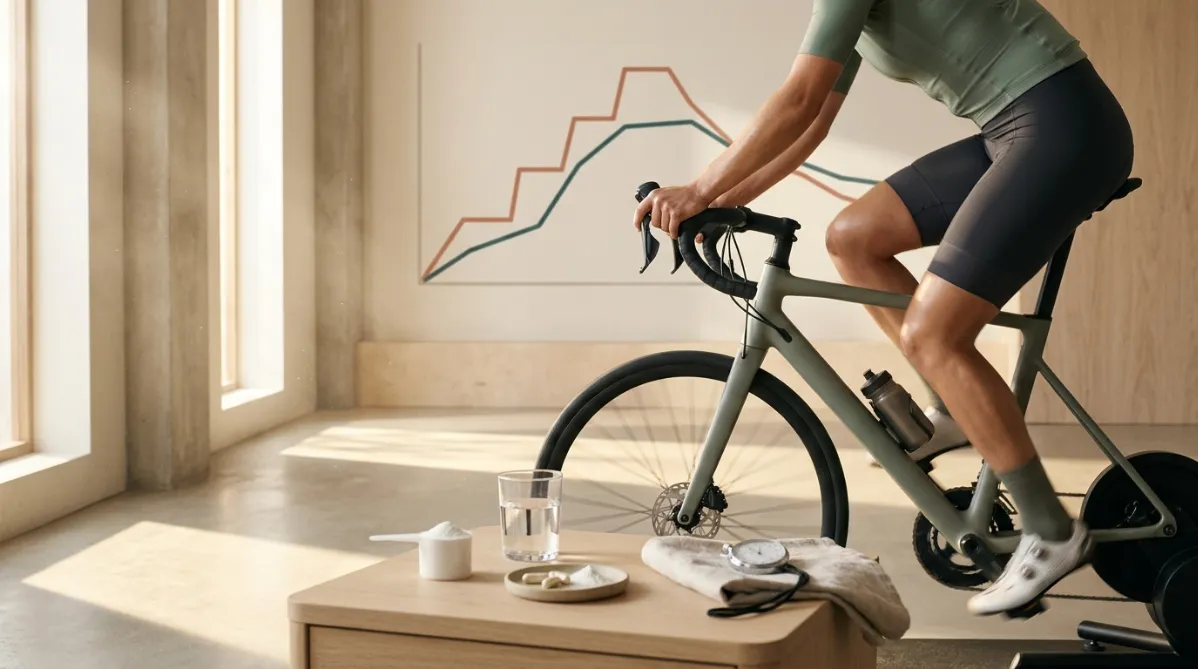
A wide, editorial-style photograph of a lone cyclist's legs and torso mid-sprint on a stationary indoor bike in a bright, minimalist performance studio. The scene is shot from a low three-quarter angle with shallow depth of field. The cyclist wears matte charcoal shorts and a fitted sage-green top, with a subtle sheen of sweat catching soft window light. Their hands grip the handlebars and the pedals are caught in a slight motion blur, which conveys explosive effort.

In the foreground, slightly out of focus on a pale oak side table, sit a small matte white scoop and a clear glass of water. Next to them is a little ceramic dish holding a few off-white capsules and a pinch of fine white powder. A folded linen towel and a slim stopwatch rest nearby. The stopwatch face is softly legible, hinting at timed sprint intervals.

The background is warm cream concrete and pale wood, with tall windows casting long diagonal shafts of golden morning light across the floor. Faint dust motes drift in the light. On the wall behind, a clean, abstract line graph is painted in muted terracotta and deep teal. It shows one line rising in steps like five sprint bouts and another line gently falling, a subtle visual nod to power up and lactate down. The graph is minimal and stylized, with no readable numbers or text.

The color palette is earthy and modern: sage green, terracotta, warm cream, soft charcoal, and touches of natural wood. The lighting is soft and directional with gentle highlights and natural shadows. The overall look is calm, refined, and contemporary, like a premium wellness and sports science magazine cover. The composition follows the rule of thirds, with the cyclist on the right and open negative space on the left for a headline. The image is crisp, grainy in a subtle film-like way, and free of any futuristic or sci-fi elements.
Science & Research

This Carnitine Form Lifted Sprint Power Up to 15% and Cut Lactate

Dr. Gymbro · · 4 min read

Most carnitine supplements promise fat loss and deliver very little. A 2009 study in the Journal of the International Society of Sports Nutrition tested a different form, glycine propionyl-L-carnitine (GPLC), on something more relevant to lifters and field athletes: repeated all-out sprints. The result was higher power output and lower blood lactate. The headline number is real, but it needs context.

The Study: What Was Actually Done

Researchers at Florida Atlantic University, led by Jacobs, ran a double-blind, placebo-controlled, crossover trial in 24 resistance-trained men (average age 25.2 ± 3.6 years). Each man completed two test sessions one week apart. Ninety minutes before each session, he took either 4.5 g of GPLC or 4.5 g of cellulose as a placebo, in randomized order.

The test was brutal. Each session used five 10-second Wingate cycle sprints separated by 1-minute active recovery periods. The team tracked peak power, mean power, percent power decrement, heart rate and blood lactate before, during and after the sprints. Power was standardized to body mass.

The Numbers: Where the "15%" Comes From

With GPLC, peak and mean power were 2.6% to 15% greater across the five sprint bouts (significant main effect of condition, p < 0.05). That range matters. The 15% figure is the top of the range, not the average boost in every sprint. The researchers also found significant interactions between bout order and condition for both peak and mean power (p < 0.05). So the size of the benefit changed from sprint to sprint.

The abstract does not say which bouts showed the largest and smallest gains. Check the full paper before assuming GPLC mostly helps late fatigued sprints, or early ones.

Lactate told a similar story, with one caveat:

  • 4 minutes post-exercise: lactate was 15.7% lower with GPLC, but the abstract lists p = 0.09. That is not statistically significant by the usual p < 0.05 cutoff.
  • 14 minutes post-exercise: lactate was 16.2% lower with GPLC (p < 0.05).

The paper reports a significant main effect of condition for lactate overall, but the cleanest individual result is the 14-minute value.

GPLC vs. Regular L-Carnitine vs. ALCAR

All three are built around carnitine, the compound that helps shuttle fatty acids into mitochondria. They differ in what is attached:

  • L-carnitine is the plain form, usually sold for fat metabolism and general support.
  • Acetyl-L-carnitine (ALCAR) has an acetyl group and is mostly marketed for cognitive and nervous system support.
  • GPLC is propionyl-L-carnitine bound to glycine. Propionyl-L-carnitine has been studied in vascular contexts, which brings us to nitric oxide.

The study's background notes that earlier research found short-term GPLC raised nitric oxide metabolites at rest and in response to reactive hyperaemia (the blood-flow surge after temporary restriction). Nitric oxide widens blood vessels, so the idea is that better blood flow could help delivery and clearance during repeated efforts. That is a plausible hypothesis, but this study did not measure nitric oxide or blood flow. It shows performance and lactate changed, not why. Treat the mechanism as a theory.

Limits You Should Know About

This is promising, not settled.

  • Small sample: 24 young, resistance-trained men. Results may not carry over to women, older adults, endurance athletes or beginners.
  • One acute dose: this tested a single 4.5 g dose, not weeks of daily supplementation.
  • One exercise mode: stationary cycle Wingate sprints. Whether it helps barbell work, running sprints or team sports is unknown.
  • Single lab, limited replication: one research group produced these results, and independent replication is thin. Check the full paper's funding and conflict-of-interest disclosures, as you should with any supplement study.
  • A mixed lactate signal: one of the two lactate comparisons missed significance.
  • Lower lactate is not automatically better performance. It may reflect less glycolytic stress or faster clearance. The study can't say which.

What This Means for You

Dose and timing (as tested): 4.5 g taken about 90 minutes before training. That is the only protocol with data here. Don't assume smaller doses or different timing give the same effect.

Who it might suit:

  • Athletes doing HIIT, sprint intervals or repeated-effort sessions with short rests
  • Resistance-trained people who want to experiment with a pre-workout aid for conditioning days
  • Anyone who accepts the evidence is early and wants to test it carefully

Who should probably skip it:

  • Anyone hoping for a fat-loss or general-health fix. This study doesn't address that.
  • People with kidney disease, thyroid conditions, seizure disorders or on prescription medication, who should talk to a clinician before taking any carnitine product
  • Anyone who is pregnant or nursing
  • Budget-conscious lifters. A 4.5 g dose is large compared with typical serving sizes on many carnitine products, so costs add up. Compare per-gram prices and confirm the label actually lists GPLC content.

A sensible way to test it: try it on a hard interval day and track repeat sprint output and perceived recovery against a comparable session without it. Keep everything else, including food, caffeine and sleep, constant. A personal trial is anecdotal, but it beats guessing.

Bottom Line

In this crossover trial, a single 4.5 g dose of GPLC raised sprint power by 2.6% to 15% across five bouts and lowered lactate 14 minutes after exercise by 16.2%. That is interesting for sprint and interval athletes. But it is one small, acute, single-lab study on cycling, and the nitric oxide explanation is untested here. GPLC deserves more research, not blind faith.
Original study

Read the original research on pubmed.ncbi.nlm.nih.gov →

This article summarizes published research for general information. It is not medical advice.

DG

Written by

Dr. Gymbro

Dr. Gymbro writes for Dr. Gymbro: science-backed fitness, nutrition & performance.

Related Articles

A landscape editorial still life on a soft, warm oat-colored linen surface, lit by diffused natural window light from the left. In the center sits a shallow matte ceramic bowl in muted sage green holding a small mound of fine white arginine powder. Beside it rests a wooden scoop dusted with powder. To the left, a loose arrangement of dried Astragalus root slices, pale golden and delicate, fans out in a graceful curve. To the right, a few whole Panax notoginseng roots, knobbly and earthy brown, sit next to a small pile of finely ground tan powder on a folded cream paper. A single sprig of fresh green leaf adds a gentle accent in the background.

In the foreground, a minimalist glass beaker with clear water and a thin linen-wrapped glass dropper sit slightly out of focus. Behind the objects, a softly blurred backdrop in pale blush and sand tones carries a faint, abstract pattern of soft circular shapes, like ripples or molecular dots drawn in subtle terracotta ink. A thin hand-drawn line graph in dusty coral rises gently across the upper right of the background, as if sketched on textured paper, with no readable text.

The composition uses generous negative space on the upper left, which leaves room for a headline overlay. The palette is earthy and calm: sage, cream, terracotta, honey gold, and soft blush. The shallow depth of field gives creamy bokeh. Gentle shadows fall to the right. The overall feel is clean and contemporary, like a wellness and science journal cover, with subtle film grain, high-end editorial photography, and tactile natural textures.
nutrition

The Add-On That Boosted Arginine Absorption 17% in a Small Trial

BY DR. GYMBRO ·

A 2023 crossover trial found that pairing 5 g of arginine with Astragalus and Panax notoginseng saponins raised arginine absorption by 17.3% and lifted the arginine-to-ADMA ratio by 167.1%. Urinary nitrate and cGMP, two nitric oxide markers, also rose. But only 24 people were analysed after six were excluded for large individual differences, and nobody measured workout performance. Here's what the data show, what they don't, and who should think twice.

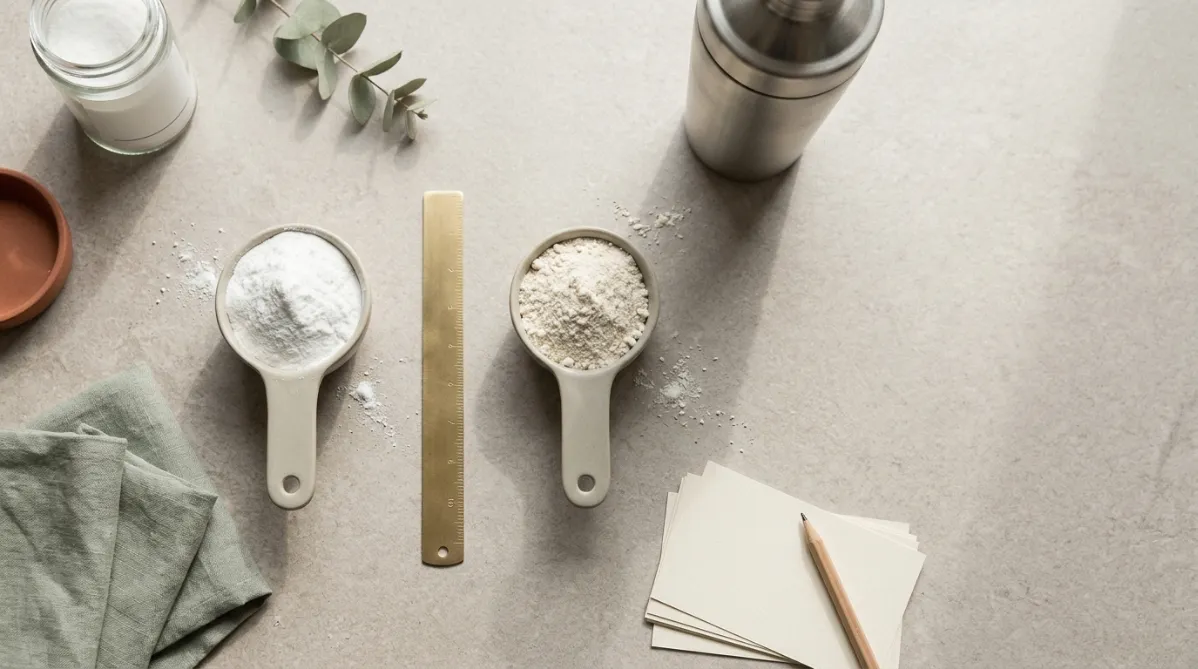
A bright, minimalist flat-lay photograph of two supplement scoops on a pale warm-gray stone surface, shot from directly above in soft natural window light. On the left, a matte ceramic scoop holds fine white creatine monohydrate powder, heaped in a clean mound. On the right, a second scoop of the same shape holds slightly coarser off-white beta-alanine powder, with a small, deliberate gap between the two. Each scoop sits in its own soft shadow, which suggests separation rather than combination. Between them, a thin brushed-brass ruler or a single slim line of fine powder runs across the surface and subtly divides the composition.

Around the scoops, a few restrained props in a muted editorial palette of sage green, cream, terracotta, and soft charcoal: a small glass jar with a minimalist label that has no readable text, a folded linen napkin, a single sprig of eucalyptus, and a stainless-steel shaker bottle softly out of focus in the upper corner. A few loose powder grains are scattered naturally across the stone. A small stack of blank cream index cards with a pencil rests in the lower right, hinting at research and note-taking without any legible writing.

The composition follows a clean rule-of-thirds layout, with generous negative space on the right third for headline overlay. The lighting is gentle and diffused, with long, soft shadows falling to the lower left. The color grading is calm and slightly desaturated, with creamy highlights and a subtle film-like grain. The overall look is a modern wellness and science journal cover, with an airy, trustworthy, contemporary editorial feel, shallow depth of field, and crisp detail on the powders.
nutrition

Creatine + Beta-Alanine: The Stack Bonus Researchers Couldn't Find

BY DR. GYMBRO ·

The creatine plus beta-alanine stack is marketed as a performance power couple, but a new network meta-analysis of 52 randomized trials found no synergy between them. Creatine alone significantly improved sprint, jump, repeated-sprint and upper-body endurance outcomes versus placebo. Beta-alanine's effects were non-significant or context-specific, and the combo added nothing beyond creatine. Here's what the study did, where it falls short, and what it means for your supplement budget.

A wide, cinematic landscape photograph of a freediver suspended mid-water in a calm, sunlit turquoise sea, shot from slightly below so the surface glimmers above like rippling silver glass. The diver wears a sleek matte black wetsuit and a long, elegant pair of carbon fins. Their body is streamlined, arms relaxed at their sides, head tilted slightly down in a state of serene focus. Shafts of soft golden sunlight pierce the water diagonally and illuminate fine floating particles and a trail of tiny bubbles rising from the diver's fins. A single thin dive line descends vertically into deeper blue at the right of the frame, adding a graphic compositional element.

In the lower left foreground, slightly out of focus, a minimalist still-life element rests on a pale sandy seabed: a small, clean white scoop with a mound of fine white powder, casually echoing creatine without any text or labels. The scoop is softly lit and has a shallow depth of field blur, creating a gentle visual link between supplement and sport.

The color palette is refined and modern: deep teal, aquamarine, soft cerulean, warm cream highlights, and touches of sunlit gold. The water gradients smoothly from bright, luminous turquoise near the top to a rich inky navy at the bottom, giving depth and a sense of quiet intensity. Leave generous negative space on the left third of the image for headline placement, with the diver positioned on the right third following the rule of thirds.

The mood is calm, athletic, and contemplative, like an editorial image from a premium health and science magazine. Style: high-end editorial photography, natural light, subtle film grain, soft contrast, crisp detail on the diver and gentle bokeh in the background. No text, no logos, no futuristic or sci-fi elements, no graphics overlays.
nutrition

Creatine Works Even When You Can't Breathe: Freediver Trial Shows

BY DR. GYMBRO ·

Creatine is famous for helping you lift heavier and sprint harder, but can it help when you are not breathing at all? A new double-blind trial in trained freedivers found that a 7-day loading phase of 20 g/day boosted total work and time to exhaustion on a breath-hold cycling test. Strangely, blood lactate ended up lower in the creatine group than in placebo despite the better performance. Here is what the study did, who might benefit, and why a sample of just 20 divers means you should keep your expectations in check.

A wide, editorial-style flat lay photographed from above on a pale warm-gray stone countertop in soft morning window light. On the left, a small matte white ceramic bowl holds fine white arginine powder, with a wooden scoop resting beside it. At the center, two halved oranges and one whole lemon in saturated citrus tones, with a few glossy droplets of water on the cut surfaces, to suggest vitamin C. On the right, three slim amber glass capsule bottles with minimal cream labels and no legible text stand in a loose row, with a few white capsules spilling out. A single chrome dumbbell handle enters the frame from the upper right corner, partly cropped, its cool metallic sheen contrasting with the warm fruit. A sprig of green rosemary and a folded linen napkin in oatmeal beige add texture. Long soft shadows fall to the left. The palette is warm cream, sunny orange, soft yellow, and muted sage, with a few crisp accents of steel gray. The composition is airy and uncluttered, with generous negative space in the upper left for a title overlay. It has a shallow depth of field, a crisp foreground, and a faintly blurred background. The look is clean, contemporary, and wellness-magazine, like a premium health and fitness journal cover, with natural grain, high-end product photography quality, and a calm, fresh, trustworthy mood.
science research

3 g Arginine + 500 mg Vitamin C: Testosterone Up 26% in Lifters

BY DR. GYMBRO ·

Arginine has long been written off as an overhyped nitric oxide booster, but a new randomized trial adds a twist: pair it with vitamin C. In 50 male bodybuilders, 3 g of arginine (split into three doses) plus 500 mg of vitamin C for 45 days significantly raised testosterone and VO2max versus placebo, and body fat dropped. Growth hormone, cortisol and nitrogen balance did not significantly differ between groups. It's a cheap stack worth watching, but it comes from one small trial, and higher testosterone doesn't guarantee more muscle.

This page is available in