Dr. Gymbro
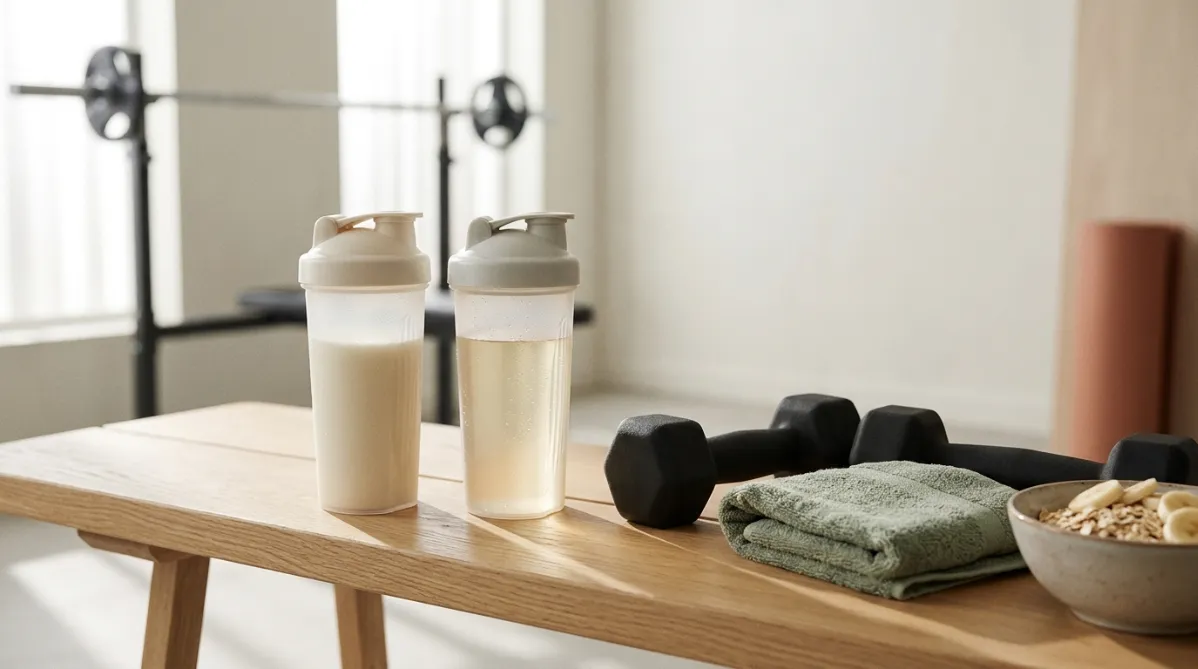
A wide, softly lit editorial still life on a clean, light oak gym bench in a bright, minimalist training studio. In the foreground, two matching frosted translucent shaker bottles stand side by side. One holds a pale, creamy white drink and the other a clear, faintly golden carbohydrate drink. Condensation beads on both. Beside them rest a pair of matte black hex dumbbells and a folded sage-green towel. A small ceramic bowl of rolled oats and a sliced banana sit at the edge of the frame, hinting at a balanced daily meal. In the soft-focus background, tall windows let in diffused morning light, and a barbell rack is blurred into gentle geometric lines. The palette is muted and modern: warm cream, sage green, charcoal, and soft terracotta accents. Light falls from the left in long, gentle shadows across the bench. The composition is airy, with generous negative space on the right third for the headline. The mood is calm, credible, and contemporary, like a premium health and science journal feature. Shallow depth of field, crisp textures on the wood grain and glass, and a subtle film-like grain. No people, no text, no futuristic elements.
Nutrition

Intra-Workout Protein Shake: 8-Week Biopsy Trial Found No Extra Muscle

Dr. Gymbro · · 4 min read

You've seen the tubs, the neon shakers, and the gym-floor gospel: sip protein during your session or leave gains on the table. A new randomized controlled trial from Umeå University in Sweden put that idea under the microscope, literally, with muscle biopsies. The result? Adding protein to an intra-workout carb drink did not produce measurable extra muscle fibre growth over 8 weeks. The training itself, however, worked beautifully.

What the Researchers Actually Tested

Most protein-timing research is done in fasted lifters, yet most people train after a meal or snack. The Swedish team wanted to know whether intra-workout protein still matters in that more realistic, non-fasted setting. Seventeen physically active young men completed an 8-week supervised resistance training programme. One group (n = 8) drank a carbohydrate-plus-protein beverage during sessions, while the other (n = 9) drank an isocaloric, carbohydrate-only drink.

Because calories were matched, any difference could be pinned on the protein itself rather than on extra energy. Researchers assessed body composition, physical performance, blood markers, and, crucially, muscle biopsies taken before and after the intervention. They then analysed fibre cross-sectional area (fCSA) by fibre type and across the full distribution of fibre sizes.

The Headline Result: No Between-Group Difference

For every outcome measured, there were no significant differences between the protein-carb group and the carb-only group (all p > 0.05). Fibre growth, lean mass, strength, aerobic capacity, and fat oxidation all looked statistically similar regardless of which drink the men sipped mid-session.

In plain terms: if you had already eaten before training, swapping a carb-only drink for a carb-plus-protein drink did not detectably boost hypertrophy. That is a useful reality check for a product category built on the promise of an "anabolic window" that opens mid-workout.

Training Still Delivered, Big Time

Don't mistake a null result for a failed programme. Resistance training produced significant improvements in lean mass, muscle strength, VO2max, fat oxidation capacity, and fibre size (all p < 0.05) across both groups. Median type IIA fibre area rose from 5,232 μm² to 5,925 μm².

The distributional analysis was especially interesting. Type IIA fibres grew across the entire percentile range, from smaller to larger fibres, signalling a broad hypertrophic response rather than growth in only a few fibres. Type I fibres changed more modestly and less uniformly.

The Disappearing Type IIX Fibres

The biopsies also revealed a dramatic fibre-type shift. Pure type IIX fibres fell from a median of about 1.2% to roughly 0.0%, while IIA/IIX hybrid fibres dropped from about 8.9% to 4.4%. In practice, the muscle shifted toward the more fatigue-resistant, trainable type IIA phenotype. Eight weeks of lifting essentially reorganised the muscle's makeup, no special drink required.

The IGF-1 Curveball (Handle With Care)

The researchers also explored whether baseline hormones and fitness markers predicted growth. Baseline IGF-1 showed an association with increases in fCSA (p = 0.04), whereas testosterone, capillary density, and VO2max did not. This was an exploratory finding in a very small sample, and the authors explicitly caution that it needs confirmation in larger studies. Do not read it as a reason to chase IGF-1 levels or buy anything marketed to raise them. It is a hypothesis, not a prescription.

Fair Caveats: Small and Exploratory

Honesty matters here. With 8 versus 9 participants, this study is underpowered, and the authors label their analyses exploratory. "No detectable difference" is not the same as "proven zero difference." Modest effects of intra-workout protein cannot be excluded, and individual responses varied. The participants were also young, active men, so the results may not transfer neatly to women, older adults, or elite athletes training with very high volumes. Still, the biopsy-level data adds a rare, direct look at what happens inside the muscle.

Practical Takeaways for Peri-Workout Nutrition

  • Training is the main driver. Progressive, consistent resistance training produced robust hypertrophy and fibre adaptations on its own.
  • Prioritise total daily protein. Hitting your overall daily intake, spread across meals, is a far better use of effort than obsessing over sipping during sets.
  • If you eat before you train, intra-workout protein is optional. Having a meal beforehand likely covers your bases.
  • Carbs may help sessions feel better. Both groups got carbohydrate; fuel for long or intense sessions can still be useful if you enjoy it.
  • Don't overpay for hype. Save your money for whole foods, a basic protein powder, or a decent coach.

The Bottom Line

The intra-workout protein shake is not a magic ingredient. In this small but carefully controlled biopsy trial, men who trained in a fed state grew just as much muscle with a carb-only drink as with carbs plus protein. Lift hard, progress your loads, eat enough protein across the day, and treat mid-session protein as a convenience rather than a requirement. Larger trials may refine the picture, but for now the evidence says your training and your daily diet do the heavy lifting.

Original study

Read the original research on pubmed.ncbi.nlm.nih.gov →

This article summarizes published research for general information. It is not medical advice.

DG

Written by

Dr. Gymbro

Dr. Gymbro writes for Dr. Gymbro: science-backed fitness, nutrition & performance.

Related Articles

nutrition

Does Sipping 60 g of Carbs Mid-Workout Make You Stronger? Not Quite

BY DR. GYMBRO ·

Intra-workout carb drinks are everywhere, but do they actually make you stronger? A new randomised, placebo-controlled crossover pilot of 15 resistance-trained adults tested 60 g of maltodextrin during a workload-matched lifting session. Blood glucose rose by about 19 mg/dL, yet lactate, reactive strength and grip strength showed no clear change. Knee-extension reps to failure were roughly 2.5 higher with carbs, but that signal came from just 10 people and wasn't significant after adjustment. Here's what the trial really shows, who might still benefit, and why it's a hypothesis-generator rather than a green light.

A wide, editorial-style still life photographed in soft natural window light on a pale oak gym bench. In the foreground, a small rustic ceramic bowl in warm sand tones holds a mound of fine golden-beige ashwagandha root powder, with a few dried gnarled ashwagandha roots and a sprig of green leaves with tiny orange-red berries resting beside it. A wooden scoop dusted with powder lies at an angle. Just behind, a matte black barbell with a single chalk-dusted steel plate sits slightly out of focus, a light haze of white chalk hanging in the air and catching the sunlight.

On the left side, a neat stack of printed research papers with a sharp black pen and a few muted sage-green sticky tabs. One page shows a simple, abstract forest-plot-style line graph with small squares and horizontal lines, subtly out of focus, hinting at statistics without legible text. A pair of minimal round reading glasses rests on the pages. A small linen gym towel is folded near the edge of the bench.

The palette is restrained and modern: warm cream, soft sage green, muted terracotta, charcoal black, and brushed steel highlights. The background is a softly blurred minimalist studio space with a pale plaster wall and a long soft shadow cast by a window frame, giving a calm, contemplative mood. Shallow depth of field, crisp detail on the powder and roots, gentle film-like grain, and generous negative space on the right third of the frame for a headline overlay. The overall look is a clean, trendy health-and-science journal cover, thoughtful and skeptical rather than promotional, balancing the natural herbal element against the discipline of strength training.
nutrition

Ashwagandha for Lifters: Strength Boost or Statistical Mirage?

BY DR. GYMBRO ·

Ashwagandha is sold to lifters as a strength and size booster, and a new meta-analysis of resistance-training RCTs found bench and squat 1RM gains that look impressive on paper. But only three trials with 161 participants could be pooled. Both strength results lost significance under stricter HKSJ testing, and each leaned on a single influential trial. GRADE rated the evidence low to very low, and there was no dependable effect on body fat. Here is what the review actually shows, and who might still want to try it.

A wide, softly lit editorial photograph of a minimalist home gym corner with pale oak flooring and a warm off-white wall. In the foreground on a light wooden bench sits a matte ceramic scoop resting beside a simple frosted glass shaker bottle, with a delicate dusting of fine cream-colored protein powder spilled across the wood in a natural, casual arc. In the soft-focus midground, a loaded barbell rests on a squat rack with brushed steel plates, and a neatly folded charcoal towel hangs over the rack's upright. To the right, a small open notebook with a pencil lies on the bench, suggesting tracked training logs, with no legible text. Morning sunlight streams diagonally through a large window on the left, casting long gentle shadows and a warm golden glow across the scene, with subtle dust motes floating in the light. The color palette is muted and modern: sage green, warm sand, soft terracotta, and cream, with a single accent of deep forest green from a potted plant in the background corner. Shallow depth of field, crisp detail on the powder and scoop, creamy bokeh on the barbell. Shot as if with a 50mm lens at f/2, natural film-like grain, clean negative space on the upper right for headline overlay. The mood is calm, thoughtful, and science-minded, with a contemporary wellness magazine aesthetic, realistic and tactile, with no people, no logos, and no text.
nutrition

Does Protein Powder Add Strength? 23 Trials Reveal the Catch

BY DR. GYMBRO ·

Does adding protein powder to your training actually make you stronger? A 2026 meta-analysis of 23 randomized trials and 611 young adults found an average edge of 7.4 kg on the squat and 2.6 kg on the bench press. The squat benefit clustered in programs of 12 weeks or less and in trials where protein was taken around workouts and before sleep. But the timing signal was only borderline, no optimal dose was established, and the authors stress the benefit is conditional, not universal. Here is what the data support and what they don't.

supplements

Ecdysterone for Fat Loss? 30 mg Cut Arm Fat More Than Placebo

BY DR. GYMBRO ·

Ecdysterone is known as a natural anabolic, but a 12-week trial put it up against fat and blood sugar instead. Men taking 30 mg/day of asparagus-derived 20E while lifting three times a week lost more arm fat than those on placebo, and their fat oxidation, fasting insulin and insulin sensitivity moved in the right direction. The catch is a tiny sample of 10 per group, with most changes appearing only within the supplement group. Here's what held up against placebo, what didn't, and how to avoid underdosed products if you're tempted to try it.

This page is available in