Knee pain ends training careers quietly. It shortens your squat depth, kills your running volume, and eventually makes the stairs a negotiation. Now a randomised trial suggests a cheap, boring powder from chicory root might take the edge off. Over six weeks, 20 g/day of inulin cut knee pain by 1.11 points on a 0-10 scale compared with placebo. It also improved grip strength, and the researchers think the gut may be the reason.
Before you clear the supplement shelf, read the fine print. This was not a trial of young lifters, and the result is not a miracle.
What the study did
The trial, from the University of Nottingham's INSPIRE programme, was published by Kouraki A, Franks S, Vijay A, Kurien T, Taylor MA, Smith SL, Smith B, Kelly A and Valdes AM in Nutrients (2026; 18(5):714). It was a 2 × 2 factorial randomised controlled trial in 117 community-dwelling adults with knee osteoarthritis (OA).
Participants got one of four things for six weeks:
- 20 g/day inulin, a prebiotic fibre
- Digital physiotherapy-supported exercise (PSE) via the Joint Academy app
- Inulin plus PSE
- Placebo: 10 g/day maltodextrin
The primary outcome was pain on a Numerical Rating Scale. Secondary outcomes were the 30-second chair stand test, timed up and go (TUG), grip strength and quantitative sensory testing. The team also measured blood levels of short-chain fatty acids (SCFAs) and the gut hormone GLP-1.
The results: the numbers that matter
Compared with placebo, inulin reduced pain by a baseline-adjusted 1.11 points (95% CI -2.18 to -0.04, p = 0.045). That clears the commonly cited 1-point threshold for a clinically meaningful change. The confidence interval runs close to zero, though, so this is a promising signal, not an airtight one.
Other findings:
- Grip strength improved with inulin versus placebo (p = 0.002).
- Pain sensitivity improved. Pressure pain thresholds (p = 0.009) and temporal summation (p = 0.025) both moved in the right direction. Temporal summation is a marker of how readily the nervous system amplifies repeated pain signals.
- Butyrate, an SCFA, rose only in the inulin groups (p = 0.0248), and so did GLP-1 (p = 0.0109).
- Dropout was 3.6% with inulin versus 21% with digital physiotherapy (p < 0.01).
The paper reports a figure of 1.67 points for the combined inulin-plus-PSE arm. It found no synergy between the two, though the trial was not powered to detect one.
Why might a fibre help a joint?
The idea is a gut-joint-muscle axis. Inulin is fermented by gut bacteria, which produce SCFAs such as butyrate. The researchers cite emerging evidence linking the gut microbiome to how the body processes chronic pain.
The grip-strength result adds a muscle angle. Higher GLP-1 was associated with improved grip strength, which the authors read as a possible gut-muscle link. This is an association, not proof of mechanism. The trial shows that inulin raised butyrate and GLP-1 and that pain and grip strength improved. It does not prove that those hormones caused the improvements.
The honest limitations
This is where the clickbait ends.
- Not athletes. Participants had a mean age of 67.5 (±9.4), a BMI of 29.5 and knee OA. Baseline pain averaged 3.96 out of 10. Whether younger lifters with overuse knee pain would respond the same way is unknown.
- Physio did more for pain. Physiotherapy-supported exercise reduced pain by 1.55 points (p = 0.002), more than inulin. It also improved TUG (p = 0.02) and the 30-second chair stand (p = 0.0004), which inulin did not.
- Six weeks only. We don't know about long-term effects or durability.
- Modest sample, borderline significance. The inulin pain result sat at p = 0.045.
- No synergy shown. The study wasn't powered to test for interaction, so "stack them for extra benefit" remains unproven.
- Conflicts of interest. Two authors sit on scientific advisory boards of nutrition and beverage companies. The paper states these are unrelated to the study and had no role in it.
The retention numbers are worth noting. Digital physiotherapy lost 21% of participants, inulin just 3.6%. The paper reports minor gastrointestinal effects, but no withdrawals because of them.
Practical takeaways
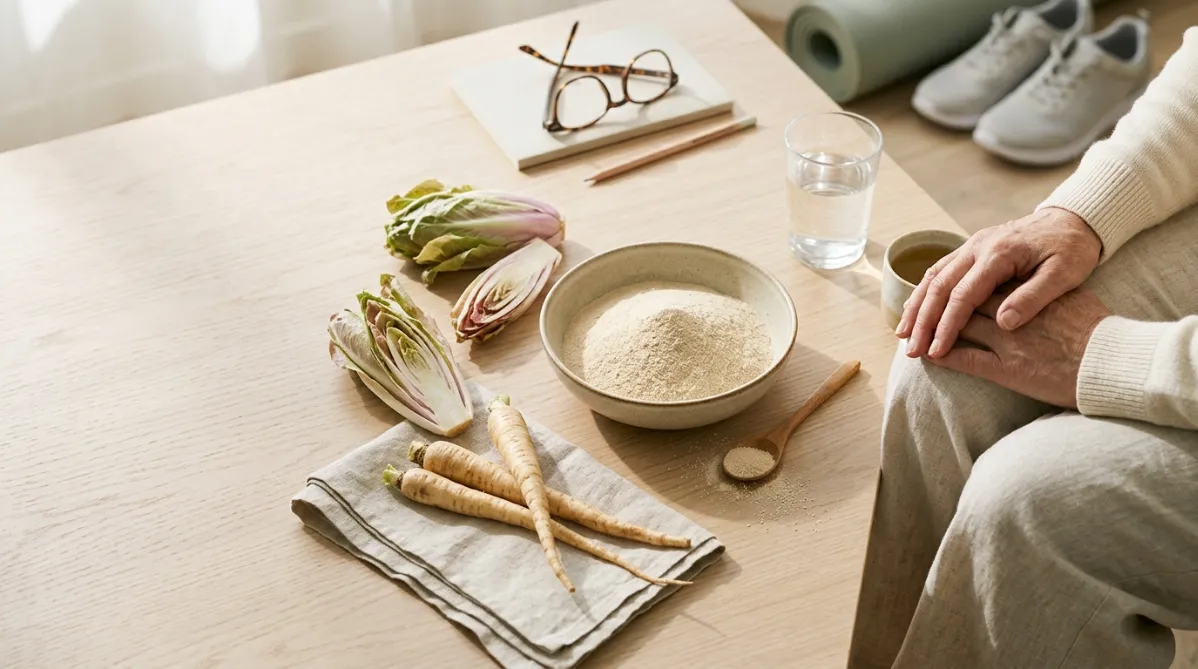
What the trial used: 20 g/day of inulin, a chicory-root-type prebiotic fibre, mixed into a drink or food, for six weeks.
Dose and ramp-up: The trial dose was 20 g/day. Starting lower and building up is a sensible way to limit gas and bloating. That ramp-up is general advice, not something this trial tested. The source material doesn't specify timing, so there's no evidence-backed "best time of day."
Who it might suit:
- Older or overweight trainees with knee OA who want a low-cost add-on
- People who struggle to stick with structured exercise programmes
- Anyone whose doctor is happy for them to try more fibre
Who should skip it or check first:
- Anyone who reacts badly to high-fibre foods or has a sensitive gut
- People with undiagnosed knee pain, which needs a proper assessment first
- Anyone hoping inulin will replace rehab. In this trial, exercise-based physio did more for pain and was the only arm to improve the function tests.
The smart play: Keep training and keep your physio. Inulin is a possible extra, not a substitute. Pain was reduced in every active arm, and the exercise arm improved the mobility measures.
Bottom line
A cheap fibre beat placebo on knee pain, nudged grip strength upward, and raised butyrate and GLP-1, all in a small six-week trial of older adults. The pain effect is real enough to be interesting and modest enough to stay humble about. For lifters nursing grumpy knees, it's a reason to watch this space, and maybe to talk to your clinician. It's not a reason to skip the rehab work.
Source: Kouraki A, Franks S, Vijay A, et al. Effect of Prebiotic Supplementation With and Without Physiotherapy on Pain and Pain Sensitivity in People with Knee Osteoarthritis. Nutrients. 2026;18(5):714. doi:10.3390/nu18050714. PubMed record.