Dr. Gymbro
A wide, editorial-style photograph of a runner's morning ritual on a quiet paved path at the edge of a park, shot in soft golden-hour light with a shallow depth of field. In the foreground, a small frosted glass bottle of pale amber liquid sits on a weathered wooden bench, beside a sleek analog stopwatch and a folded linen towel. Condensation beads on the glass and catches warm sunlight. The background melts into a creamy blur of a lone runner in a muted sage-green jacket and charcoal tights, mid-stride, heading away along a tree-lined track, with soft mist hovering above the grass.

The color palette is calm and modern: warm honey and amber tones, soft sage green, off-white, and touches of deep navy in the shadows. Subtle film grain and gentle natural contrast give it a contemporary lifestyle-magazine feel. Long, delicate shadows stretch across the path.

On the bench, a small open notebook with a loose hand-drawn sketch of a head profile and a simple line graph sits next to a pencil, hinting at cognition and measurement without any text legible. A few fallen autumn leaves add texture. The composition follows the rule of thirds, with the bottle and stopwatch on the left third, negative space on the right for headline overlay, and the runner small in the distance to suggest that speed is not the story.

The mood is thoughtful, clean, and quietly intelligent, evoking wellness science journalism: minimal, airy, organic, and refined. No futuristic elements, no neon, no digital effects, just natural light, tactile materials, and a considered, understated aesthetic.
supplements

Ketone Ester Didn't Make Runners Faster—But Sharpened Their Minds

Dr. Gymbro · · 4 min read

Ketone ester drinks are sold on the promise of faster legs. A new 31-day trial in recreational runners found no faster 5 km. It did find something nobody put on the label: quicker responses on classic executive-function tests.

The Short Version

The study, published in the Journal of the American Nutrition Association (Prins, Koutnik and colleagues, 2026), gave runners a ketone monoester (KME) three times a day for a month. It did not change 5-km time-trial performance. It did speed responses on two cognitive tasks, lower glycemia by 15%, and was linked to higher oxygen uptake in a graded exercise test done after supplementation ended.

The catch is the size. This was a very small trial, and every result needs to be read with that in mind.

How the Study Worked

The researchers recruited 18 recreational runners and randomized them into two groups of nine. One group drank (R)-3-hydroxybutyl (R)-3-hydroxybutyrate, the ketone monoester, at 30 g per dose. The other drank an isocaloric, flavor-matched placebo at the same volume. Both groups dosed three times daily for 31 days, so the KME group took 90 g/day.

The design was single-blind, so participants didn't know what they were drinking but the researchers presumably did. Outcomes included a 5-km time trial, cognitive testing, mood, body composition, blood pressure and tolerability. Metabolism and substrate oxidation, at rest and during graded exercise, were measured after the 31 days were completed. That timing matters because it tests what happens after repeated ketone exposure, not just right after a drink.

Finding #1: No Faster 5K

The headline for performance-minded athletes is a null result. A month of high-dose KME did not change 5-km time-trial performance. Blood ketones did rise as expected, with post-ingestion R-BHB around 3.0 mM (p < 0.001), so the supplement was doing its biochemical job. Elevated ketones simply didn't translate into a quicker run.

Finding #2: Sharper Stroop and Task-Switching Scores

The KME group responded faster on the Stroop Incongruent task (p = 0.015) and on the Switching task (p = 0.038). Both tap executive function, meaning the ability to override automatic responses and shift between rules. Mood and quality-of-life scores did not change, so the benefit appeared in measured cognitive speed, not in how participants said they felt.

These are two p-values just under 0.05 in a group of nine per arm. They are interesting, not proof.

Finding #3: Glucose Down 15%, VO2 Preserved

KME lowered glycemia by 15% (p < 0.001). After supplementation stopped, the KME group also preserved mean absolute VO2 during graded exercise testing (p = 0.029). The authors say oxygen uptake was higher in the KME group even after dosing ended, but it came without any improvement in running performance. A physiological difference that doesn't show up on the stopwatch is hard to call a performance benefit.

Funding, Conflicts and Limitations

The abstract does not include funding or conflict-of-interest statements. Author affiliations include several academic departments and the Institute for Human and Machine Cognition. Anyone weighing the findings should check the full paper's disclosures, since ketone research often involves people with ties to the field.

The limitations are plain:

  • Tiny sample: 18 runners total, nine per group.
  • Single-blind: Researcher bias is possible, and ketone drinks have a distinctive taste that may weaken blinding.
  • Recreational runners only: The results don't speak to elites or other populations.
  • Many outcomes, few hits: With this many measures, a few modest p-values can occur by chance.
  • Tolerability: It was an outcome, but the abstract doesn't report the results, so I can't say how well the dose was tolerated.

Practical Takeaways

Dose: The trial used 30 g three times daily (90 g/day) for 31 days. That is a high dose, and ketone esters are expensive, so a month at this level is a real financial commitment. The abstract doesn't give cost figures, so treat that as a general observation.

Timing: The abstract specifies three daily doses but not their timing relative to training, so I can't tell you when to drink them. Don't assume pre-run dosing was the protocol.

Who it might interest: People curious about cognitive effects or metabolic research, and those who accept that this is early, small-sample evidence. It is not a case for buying ketone esters to run faster.

Who should skip it:

  • Runners chasing a quicker 5K. This trial showed no time-trial gain.
  • Anyone on a tight budget. Ninety grams a day adds up.
  • People managing blood glucose or taking glucose-lowering medication. Glycemia fell 15% in this study, so talk to a clinician first. This is my caution, not a finding from the paper.
  • Anyone with a medical condition or who is pregnant. Get medical advice before using high-dose supplements.

Bottom Line

This small trial gives ketone esters a more nuanced story than the marketing. The stopwatch didn't move, but cognitive speed, glucose and post-supplement VO2 did. Those signals are worth testing in bigger, double-blind studies with transparent disclosures. Until then, they are hypotheses, not a reason to spend on a 90 g/day habit.

Original study

Read the original research on pubmed.ncbi.nlm.nih.gov →

This article summarizes published research for general information. It is not medical advice.

DG

Written by

Dr. Gymbro

Dr. Gymbro writes for Dr. Gymbro: science-backed fitness, nutrition & performance.

Related Articles

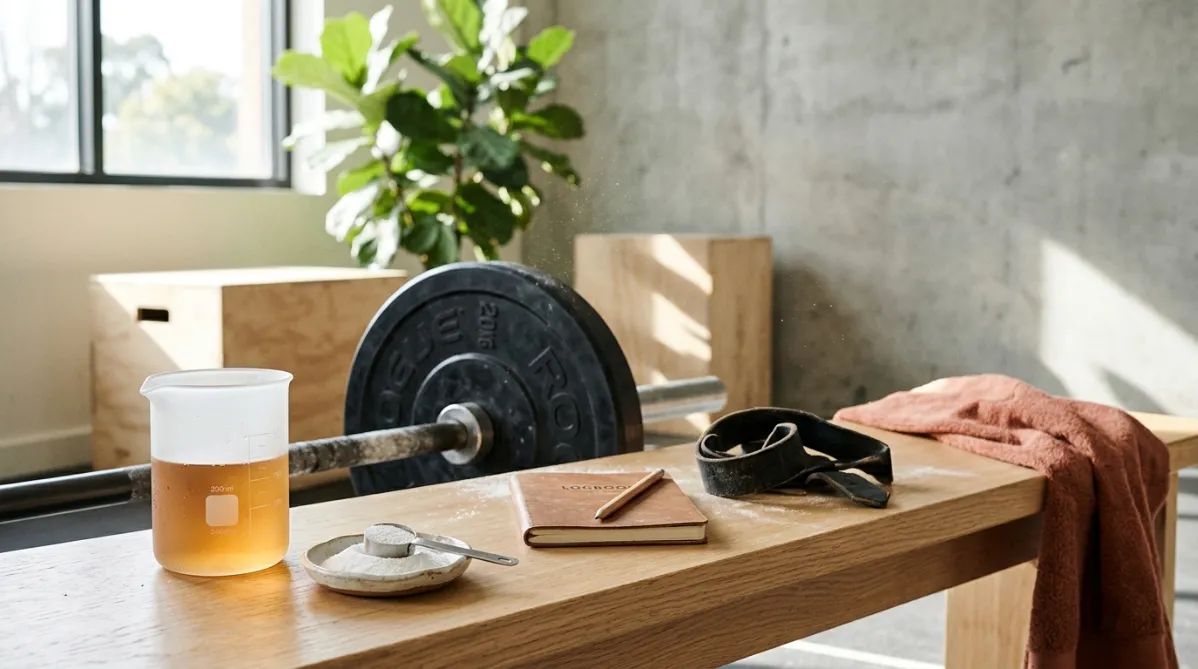
A wide, editorial-style still life shot from a slightly elevated three-quarter angle on a pale oak gym bench, lit by soft morning window light. In the foreground sits a minimalist matte-white glass beaker of clear, faintly amber liquid, with a few condensation droplets on its surface. Beside it rests a small ceramic dish of white crystalline powder and a stainless steel scoop. In the middle ground, a chalk-dusted steel barbell with black bumper plates rests on the bench's edge. A pair of worn leather lifting straps and a small notebook with a pencil lie nearby, suggesting data logging. Behind them, softly blurred, is a bright, airy studio with concrete walls, a wooden plyo box, and a tall leafy plant catching the light.

The palette is warm and muted: cream, sand, soft sage green, and charcoal, with one small accent of burnt orange in the amber liquid and a terracotta towel draped over the bench. Fine chalk dust floats in sunbeams that cut diagonally across the frame. The shallow depth of field keeps the beaker and barbell sharp while the background melts into creamy bokeh. Composition follows the rule of thirds, with the beaker on the left third and generous negative space on the right for headline text. The mood is calm, premium, and contemporary, like a high-end wellness and sports-science magazine photograph with subtle film grain, natural shadows, and realistic textures.
nutrition

Ketones Kept Force Output 8% Higher, But Jumps Didn't Budge

BY DR. GYMBRO ·

Fifty grams of a ketone precursor kept rate of force development 8% higher an hour later in a new Ohio State study, yet it did nothing for countermovement jumps. The randomized crossover trial of 20 active men and women found blood ketones peaking around 2.2 mM at 120 minutes. It also found a 24% drop in blood glucose and a 13 bpm rise in heart rate. That makes it intriguing for lifters doing repeated max-strength efforts, but this was a small, acute study. Here is what the data show, who might care, and who should hold off.

A wide, softly lit editorial still life photographed on a pale oak desk at the blue hour just before dawn. In the center-left foreground, a clear glass of water sits beside a small ceramic dish holding a mound of fine white powder, with a matte wooden scoop resting beside it, a light dusting of powder scattered across the wood grain. Behind them, a minimalist analog alarm clock in muted sage green reads close to 4:00. Next to it is an open linen-bound notebook with a pencil and a few abstract handwritten lines, plus a ceramic mug of black coffee with a thin trail of steam. To the right, a slim laptop is open to a blurred, softly glowing screen with no legible text. A window in the background shows a deep indigo sky turning peach at the horizon, with soft city silhouettes out of focus. Warm light from a small brass desk lamp creates a gentle pool of amber on the desk, contrasting with the cool blue ambient light from the window. The palette is muted and modern: dusty blue, warm cream, soft sage, and a touch of apricot. Shallow depth of field, fine film grain, and generous negative space on the right third for title overlay. The mood is calm, focused, and slightly weary but hopeful, like a contemporary health and science magazine cover. Clean composition, natural textures, subtle shadows, and a high-end lifestyle photography aesthetic.
nutrition

Creatine Before an All-Nighter? A Lower Dose Still Cut the Brain Crash

BY DR. GYMBRO ·

What if one big scoop of creatine could soften the brain fog of an all-nighter? A new study in Nutrients found that a single 0.2 g/kg dose, roughly 14-16 g for most adults, reduced the decline in logic, numerical, language-speed and vigilance tasks during 21 hours awake, with improvements of up to 12%. Women appeared to benefit more. But only 29 people took part, the dose is several times the normal daily amount, and the effect was smaller than with the same group's earlier 0.35 g/kg trial. Here's what the data show, and what they don't.

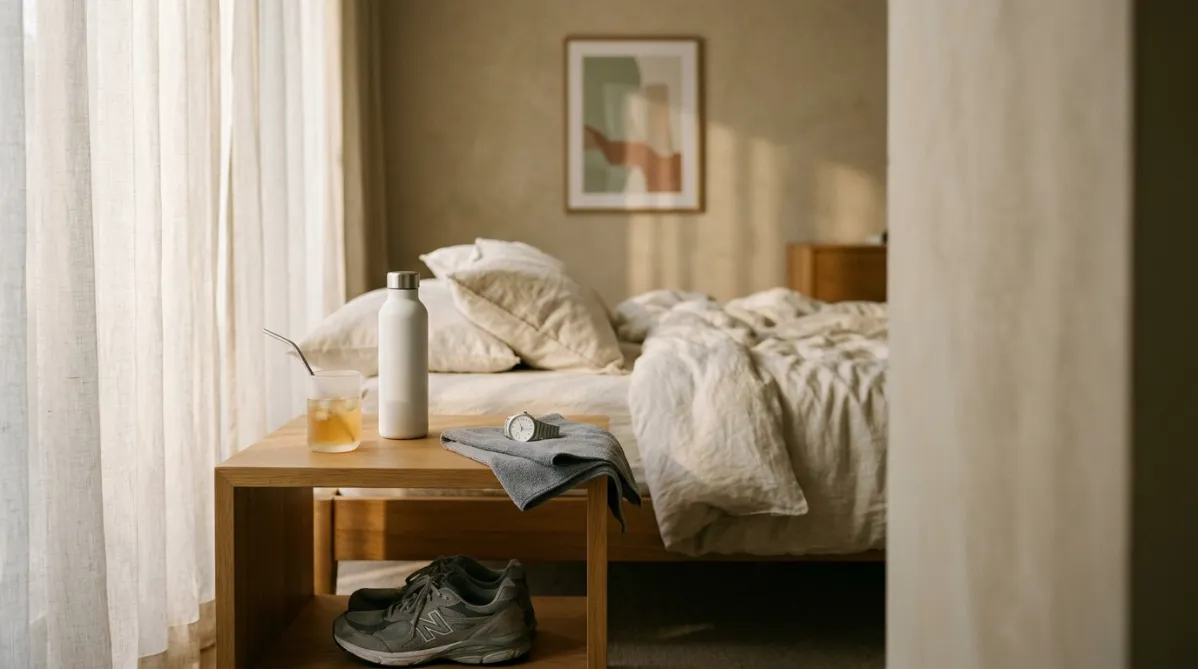
A calm, editorial-style landscape photograph of an athlete's bedroom at dawn, shot with soft natural light. In the foreground, a minimalist wooden bedside table holds a small frosted glass of pale amber drink beside a slim matte-white bottle with no label, a worn pair of running shoes tucked just beneath it. Soft morning light filters through sheer linen curtains, casting long, gentle gold and peach gradients across rumpled off-white bedding in the background, slightly out of focus. A folded gray training towel and a simple analog wristwatch rest on the table edge. On the wall above, a single abstract print in muted sage and terracotta tones adds a trendy, curated feel. The color palette is warm neutrals, oat, soft sage green, and dusty amber, with gentle shadows and a shallow depth of field. The composition uses generous negative space on the right third, ideal for headline overlay. The mood is quiet, restorative, and contemporary, like a lifestyle and wellness magazine cover. Fine film grain, natural textures of linen, oak, and glass, crisp but soft focus, high-end editorial photography.
recovery

Hard Training Quietly Cuts REM Sleep. A Ketone Drink Blocked It

BY DR. GYMBRO ·

Seven weeks of progressively harder training lowered REM sleep in trained athletes who drank a control beverage, while those on a ketone ester drink actually gained REM. The double-blind trial used polysomnography to track sleep at the start, middle and end of the block. Ketone ester did not boost the early sleep gains, and perceived sleep quality and stress-recovery scores did not clearly benefit. Here is the dose, the timing, who it may suit, and the limits you should know before getting excited.

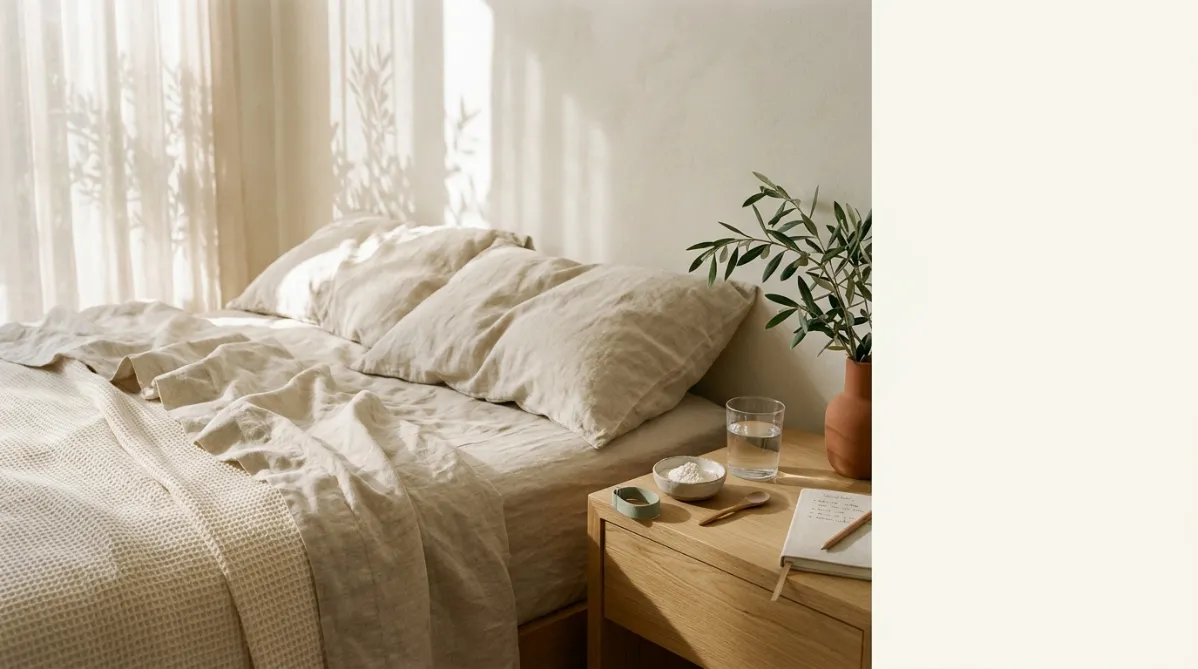
A calm, sunlit bedroom scene in soft editorial photography style, shot in landscape format. In the foreground, a rumpled bed with crisp oatmeal-colored linen sheets and a cream waffle-knit blanket, morning light spilling across it through sheer curtains. On a light oak nightstand sits a clear glass of water beside a small ceramic bowl holding a loose scoop of fine white powder, a wooden spoon resting next to it. A minimalist fabric wristband in muted sage green lies casually on the nightstand, suggesting sleep tracking without any screens or glowing displays. A slim open notebook with a pencil rests beside it, hinting at research and reflection. A potted olive branch in a terracotta vase adds an organic touch. The wall behind is warm off-white plaster with soft, gently shifting shadows of leaves. Color palette: warm sand, muted sage, soft blush, creamy white, and touches of terracotta. The mood is quiet, restorative, and thoughtful, like a modern wellness journal feature. Shallow depth of field, a soft film-like grain, natural diffused light, and generous negative space on the right side of the frame for title overlay. The composition is balanced and uncluttered, with a gentle golden-hour glow. The style is contemporary lifestyle editorial, tactile and understated, with no text, no people's faces, and no futuristic elements.
science research

Creatine Didn't Speed Up Perimenopausal Brains. Sleep Is Another Story

BY DR. GYMBRO ·

Creatine was supposed to sharpen perimenopausal brains, but the main thinking-speed test showed no creatine advantage. Instead, a small exploratory trial of 51 women found higher prefrontal oxygenation, a 7.4-point sleep consistency edge at week 6 and fewer temperature-sensitivity days. Everyone, including placebo, got faster on the Stroop task. The study design, dosing, limits and the authors' creatine and WHOOP ties are all laid out here, so you can judge how much weight the findings deserve.

This page is available in