Dr. Gymbro
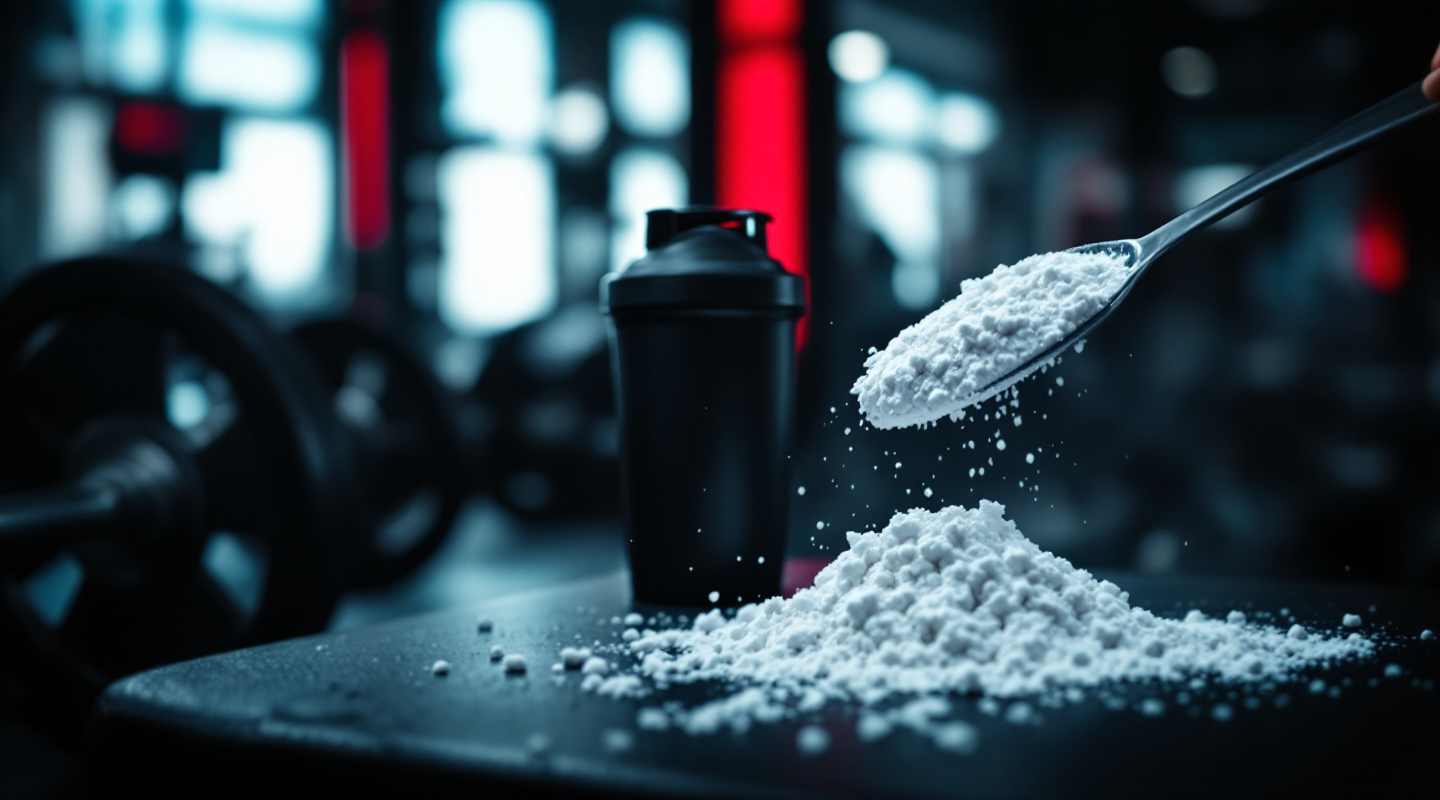
A wide, editorial-style still life shot from a slightly elevated three-quarter angle on a pale oak gym bench, lit by soft morning window light. In the foreground sits a minimalist matte-white glass beaker of clear, faintly amber liquid, with a few condensation droplets on its surface. Beside it rests a small ceramic dish of white crystalline powder and a stainless steel scoop. In the middle ground, a chalk-dusted steel barbell with black bumper plates rests on the bench's edge. A pair of worn leather lifting straps and a small notebook with a pencil lie nearby, suggesting data logging. Behind them, softly blurred, is a bright, airy studio with concrete walls, a wooden plyo box, and a tall leafy plant catching the light.

The palette is warm and muted: cream, sand, soft sage green, and charcoal, with one small accent of burnt orange in the amber liquid and a terracotta towel draped over the bench. Fine chalk dust floats in sunbeams that cut diagonally across the frame. The shallow depth of field keeps the beaker and barbell sharp while the background melts into creamy bokeh. Composition follows the rule of thirds, with the beaker on the left third and generous negative space on the right for headline text. The mood is calm, premium, and contemporary, like a high-end wellness and sports-science magazine photograph with subtle film grain, natural shadows, and realistic textures.
Nutrition

Ketones Kept Force Output 8% Higher, But Jumps Didn't Budge

Dr. Gymbro · · 4 min read

You can take a supplement, wait an hour, and have it help one test of explosiveness while doing nothing for another. That is what a new Ohio State study found with exogenous ketones. It makes the result more interesting, and it also tells you where to be cautious.

The Headline Finding

Researchers from the lab of Jeff Volek tested 50 g of a ketone precursor, bis-octanoyl (R)-1,3-butanediol (BO-BD), against a flavor-matched, isocaloric placebo. Their question was whether it could improve maximal strength and explosive power. Few studies have looked at ketones in anaerobic, neuromuscular performance, so this is relatively new territory.

The key result is that BO-BD preserved rate of force development (RFD) in the isometric mid-thigh pull (IMTP). At 60 minutes after ingestion, RFD was 8% higher than with placebo (p = 0.022). RFD is how quickly you can build force, and it matters for any lift where you have to produce force fast.

The authors describe this as a "preservation" effect. The ketones did not clearly make people better than their baseline. They seemed to keep RFD from sliding between sets of repeated, high-intensity efforts. That suggests a possible delay of fatigue rather than a boost to peak output.

The Plot Twist: Jumps Didn't Care

The same participants also did countermovement jumps (CMJ), and neither condition changed CMJ performance. The abstract reports no ketone effect on the jump measures, which covered power and jump height.

The authors don't explain why the two tests diverged, so any reason is speculation. The tests do differ, though. The IMTP is a maximal isometric effort, while the CMJ is a fast, dynamic movement that uses the stretch-shortening cycle. Ketones may matter more for one demand than the other, but this study can't say.

How the Study Worked

  • Participants: 20 college-aged, active adults (10 men, 10 women).
  • Design: Randomized, counterbalanced crossover. Each person tried both conditions, with a 3 to 7 day washout between visits.
  • Dose: 50 g of BO-BD or placebo.
  • Testing: 3 sets of 3 CMJ and IMTP repetitions at baseline, 60 minutes, and 120 minutes.
  • Monitoring: Capillary R-BHB, blood glucose, and heart rate every 30 minutes.

The crossover design is a strength, because each person serves as their own control. The sample is small, though, and the study covers a single acute dose.

Timing: When Do Ketones Actually Show Up?

Blood R-BHB climbed steadily after ingestion and peaked at 120 minutes, averaging 2.2 ± 0.7 mM with BO-BD versus 0.3 ± 0.1 mM with placebo (p < 0.001). That is a clear rise in ketone levels, in the range often called nutritional ketosis.

The interesting part is that the strength effect showed up at 60 minutes, before ketones peaked. So the benefit did not need peak blood levels. The abstract does not say why, and the study cannot separate timing effects from other mechanisms. Someone planning around this would reasonably aim for a window of roughly an hour after dosing, but that is an inference from one study, not a protocol.

The Side Notes You Should Know

The supplement had measurable physiological effects beyond ketone levels:

  • Blood glucose: Fell 24% with BO-BD versus 3% with placebo (p < 0.001), coinciding with the R-BHB peak.
  • Heart rate: Rose 13.3 bpm versus 3.6 bpm with placebo (p < 0.001).

A lower glucose reading and a faster resting pulse are not trivial. Some people may feel off, jittery, or simply uncomfortable. The abstract does not report gastrointestinal effects or how participants felt, so it can't tell you about tolerability.

Who Might Care

The finding fits athletes who do repeated maximal-strength efforts and care about holding force production across sets. Examples include:

  • Lifters working heavy singles, doubles, and triples.
  • Strength testing sessions with multiple attempts.
  • Anyone whose performance depends on maintaining rate of force development late in a session.

The authors suggest nutritional ketosis may delay fatigue during repeated, high-intensity strength bouts. That is a reasonable hypothesis to test further, not a proven effect.

Who Should Skip (or Wait)

If your sport depends mainly on jumping, this study offers no reason to expect a benefit, since CMJ was unaffected. People who are sensitive to stimulants or heart rate changes, or who have glucose-related medical issues, should be careful and talk to a clinician. The lower glucose and higher heart rate are exactly the kind of effects that matter for those groups. Anyone drug-tested should also check product ingredients and the rules of their governing body.

Reality Check

This is a small study of 20 young, active adults, and it measured acute effects after a single dose. It does not show what happens with repeated use, in trained strength athletes, in older adults, or over weeks of training. Only the RFD result is highlighted in the abstract, and a 60-minute effect in one test does not make ketones a proven performance aid.

Bottom Line

A 50 g dose of BO-BD raised blood ketones to about 2.2 mM, and it preserved RFD about 8% better than placebo at 60 minutes in the mid-thigh pull. It did nothing for countermovement jumps, and it came with lower glucose and a higher heart rate. The result is promising for repeated max-strength work, but it needs replication in larger and more specific groups before anyone should treat it as a strategy rather than an experiment.

Original study

Read the original research on pubmed.ncbi.nlm.nih.gov →

This article summarizes published research for general information. It is not medical advice.

DG

Written by

Dr. Gymbro

Dr. Gymbro writes for Dr. Gymbro: science-backed fitness, nutrition & performance.

Related Articles

A wide, editorial-style photograph of a runner's morning ritual on a quiet paved path at the edge of a park, shot in soft golden-hour light with a shallow depth of field. In the foreground, a small frosted glass bottle of pale amber liquid sits on a weathered wooden bench, beside a sleek analog stopwatch and a folded linen towel. Condensation beads on the glass and catches warm sunlight. The background melts into a creamy blur of a lone runner in a muted sage-green jacket and charcoal tights, mid-stride, heading away along a tree-lined track, with soft mist hovering above the grass.

The color palette is calm and modern: warm honey and amber tones, soft sage green, off-white, and touches of deep navy in the shadows. Subtle film grain and gentle natural contrast give it a contemporary lifestyle-magazine feel. Long, delicate shadows stretch across the path.

On the bench, a small open notebook with a loose hand-drawn sketch of a head profile and a simple line graph sits next to a pencil, hinting at cognition and measurement without any text legible. A few fallen autumn leaves add texture. The composition follows the rule of thirds, with the bottle and stopwatch on the left third, negative space on the right for headline overlay, and the runner small in the distance to suggest that speed is not the story.

The mood is thoughtful, clean, and quietly intelligent, evoking wellness science journalism: minimal, airy, organic, and refined. No futuristic elements, no neon, no digital effects, just natural light, tactile materials, and a considered, understated aesthetic.
supplements

Ketone Ester Didn't Make Runners Faster—But Sharpened Their Minds

BY DR. GYMBRO ·

Ketone ester drinks are marketed as a shortcut to faster running, but a 31-day trial found no 5-km improvement. What did change was striking: faster Stroop and task-switching responses, glycemia down 15%, and higher VO2 in a graded test even after dosing stopped. The catch is the size, with just 18 recreational runners in a single-blind design. Here's what the data show, what they don't, and who should skip a 90 g/day regimen.

A modern editorial still life photographed from a slightly elevated angle on a pale, matte stone surface in soft natural window light. On the left, a heaping mound of fine white creatine monohydrate powder spills from a matte ceramic scoop, with a few crisp grains scattered across the surface. In the center, a small, minimalist amber glass capsule bottle sits tipped on its side, with a handful of off-white capsules spilling out. The label is blank and clean. On the right, a neat row of three clear glass lab-style vials rests on a slim oak tray. The vials hold different amounts of white powder: the first nearly empty, the second slightly fuller, the third filled almost to the brim. This quietly suggests the difference in dose and result. Beside the tray lies a simple stainless steel measuring spoon and a folded sheet of cream paper with soft, abstract bar-chart lines in muted sage green and terracotta. The lines are hand-drawn and unlabeled.

Behind the objects, slightly out of focus, a lean athletic forearm in a gray linen sleeve rests on the edge of the surface, one hand loosely holding a matte shaker bottle. This hints at a training context without showing a face. A single sprig of eucalyptus in the corner adds a soft organic touch.

The palette is warm neutral: bone white, oatmeal, soft sage, muted terracotta, and touches of amber. Shadows are gentle and long, with a shallow depth of field that gives creamy bokeh in the background. The mood is calm, clean, and trustworthy, like a premium health and science journal's feature spread, with generous negative space at the top and right for headline overlay. The composition is wide, balanced, and uncluttered, with subtle film-like grain and a natural, true-to-life color grade. No text, no logos, no futuristic elements.
nutrition

Kre-Alkalyn's Label Dose Didn't Lift Muscle Creatine, Biopsies Show

BY DR. GYMBRO ·

Buffered creatine like Kre-Alkalyn promises better absorption, lower doses and less bloating. A double-blind Texas A&M trial put that to the test with actual muscle biopsies in 36 trained lifters over 28 days. At the label dose of 1.5 g/day, muscle creatine barely moved, while monohydrate raised it clearly more. Strength, body composition and side effects showed no advantage for the buffered product. Here is what the numbers show and how to dose creatine instead.

Creatine Before or After Your Workout? A Small Study Gives Post-Workout the Edge
nutrition

Creatine Before or After Your Workout? A Small Study Gives Post-Workout the Edge

BY DR. GYMBRO ·

Should you take creatine before or after you lift? A 2013 study of 19 male bodybuilders found that post-workout dosing edged out pre-workout on lean mass, fat mass and bench press. But the formal statistical test showed no significant difference between the groups, and the authors relied on a cautious "possibly more beneficial" inference. Here is what the data actually say, why the sample size matters, and how to apply the findings with a simple 5 g daily routine.

A landscape, editorial-style flat lay photographed from above on a pale oak gym bench or a matte light-gray concrete surface. On the left side, a clear glass of water sits next to a small matte white ceramic bowl of fine white creatine powder, with a wooden scoop resting beside it and a few loose grains scattered naturally on the surface. In the center, a modern analog wall-style clock face is replaced by a simple minimalist stopwatch in brushed steel, its hands paused, subtly suggesting timing without any text or numbers emphasized. On the right, a neatly folded charcoal gym towel and a single chalk-dusted dumbbell handle enter the frame at the edge, with a faint dusting of white chalk on the wood. A small linen notebook with a pencil rests slightly off-center, its pages blank, hinting at data and study without any readable writing.

The color palette is soft and restrained: warm cream, oatmeal, sage green, and muted slate, with one accent of terracotta orange in the pencil or a small ceramic dish. Light comes from a large window at the upper left, casting long, gentle diagonal shadows and a soft highlight across the glass of water, creating delicate caustic reflections on the surface. The depth of field is shallow, with the creatine bowl and scoop in crisp focus and the edges softly blurred. The composition leaves generous negative space on the upper right for a headline overlay. The overall feel is calm, clean, and contemporary, like a wellness and science journal's cover image, with natural textures, subtle film grain, and a refined, premium magazine look. No people, no logos, no text, and no futuristic elements.
nutrition

Creatine Before or After Your Workout? A Small Study Gives Post-Workout the Edge

BY DR. GYMBRO ·

Should you take creatine before or after you lift? A 2013 study of 19 male bodybuilders found that post-workout dosing edged out pre-workout on lean mass, fat mass and bench press. But the formal statistical test showed no significant difference between the groups, and the authors relied on a cautious "possibly more beneficial" inference. Here is what the data actually say, why the sample size matters, and how to apply the findings with a simple 5 g daily routine.

This page is available in