Cutting weight fast usually costs you some muscle along the way. A new randomized trial in Obesity suggests that a krill oil capsule might blunt that loss. Both groups lost the same amount of body weight, but the krill oil group kept almost all of its fat-free mass. The placebo group did not.
The result is promising, but the study is small and the capsule contained more than one active ingredient. Here is what the researchers found and what it means for your own cut.
The Study at a Glance
Researchers at the University of Glasgow ran a randomized, placebo-controlled trial (ClinicalTrials.gov NCT06001632) in adults with overweight or obesity. All participants followed 8 weeks of alternate-day fasting (ADF). They were assigned to take four capsules a day of either krill oil or a vegetable-oil placebo.
- Completers: 41 participants (25 women, 16 men)
- Age: 39 ± 10 years
- BMI: 31.1 ± 4.2 kg/m²
- Measured: body mass, fat-free mass (FFM) and handgrip strength (HGS), before and after the intervention
The trial was published in 2025 by Alblaji, Gray, Almesbehi, Morrison and Malkova. The authors declared no conflicts of interest.
What Was in the Capsules
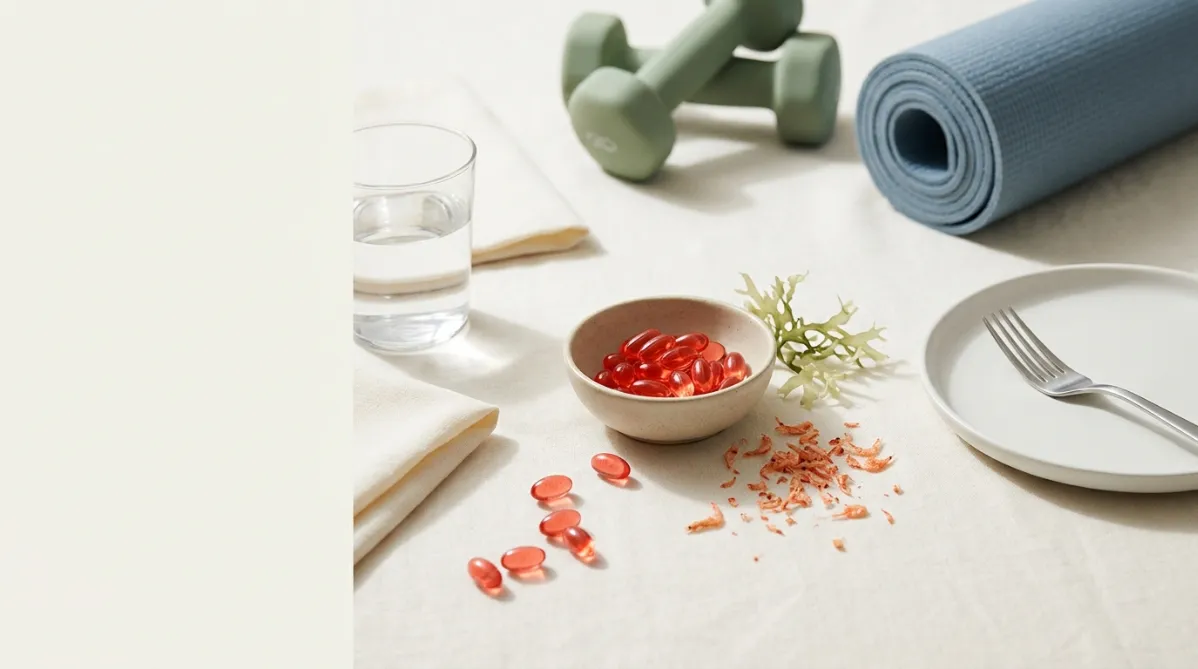
Each krill oil capsule contained 191 mg EPA, 94 mg DHA, 78 mg choline and 100 mcg astaxanthin. At four capsules a day, the daily dose came to:
- EPA: 764 mg
- DHA: 376 mg
- Choline: 312 mg
- Astaxanthin: 400 mcg
This matters for interpretation. Krill oil is a package: omega-3s bound in phospholipids, plus choline and the antioxidant astaxanthin. The study cannot say which component, or which combination, did the work. "Omega-3" is a convenient shorthand, but the trial tested the whole capsule.
The Numbers: Same Scale Loss, Very Different Muscle Outcome
Body weight loss was virtually identical. The krill oil group lost 4.6 ± 1.4 kg and the placebo group lost 4.5 ± 1.9 kg, with no significant difference between them.
Fat-free mass told a different story:
- Krill oil: -0.2 ± 0.9 kg, not a statistically significant change
- Placebo: -1.2 ± 2.0 kg, a significant reduction (p < 0.05)
That is about a 1 kg difference in lean tissue. On average, the placebo group lost roughly five to six times more fat-free mass than the krill oil group. The between-group difference was statistically significant.
Handgrip strength followed the same pattern:
- Krill oil: -0.2 ± 0.5 kg, no significant change
- Placebo: -0.9 ± 0.7 kg, a significant decline
The between-group difference was again significant (p < 0.05). Handgrip is a simple proxy for muscle function, not a measure of squat or bench performance, but it is a useful signal.
Did Fat Loss Stay the Same?
The abstract reports total body weight loss, not fat mass directly. Since total loss was equal and the krill group lost less fat-free mass, the arithmetic implies the krill group lost at least as much fat. That is an inference, not a headline result, and the measurement method for FFM matters for how precise it is. Read the "same fat loss" claim as "same scale loss, with more of it coming from non-lean tissue."
Caveats Worth Taking Seriously
- Small sample. Forty-one completers is modest. The placebo FFM change had a large spread (±2.0 kg), so individual responses varied widely.
- Short duration. Eight weeks says nothing about long-term maintenance of muscle or strength.
- Bundled ingredients. Astaxanthin and choline were in the capsule alongside EPA and DHA, so the effect cannot be pinned on omega-3 alone.
- Healthy adults with overweight. The results may not apply to lean athletes, older adults or people with medical conditions.
- One trial. Replication, ideally with larger samples and resistance training controlled, is needed.
What This Means for You
Who it may be for
- People on aggressive calorie deficits who are worried about losing lean mass
- People doing alternate-day fasting or other intermittent fasting protocols, the setting in which this trial was run
Dose used in the study
Four capsules daily, delivering about 764 mg EPA, 376 mg DHA, 312 mg choline and 400 mcg astaxanthin, for 8 weeks. Check your product label, because krill oil capsules vary widely in strength. Matching the trial's daily totals matters more than matching the number of capsules.
Timing
The abstract does not specify when during the day capsules were taken or whether they were taken on fasting days. As general practice, fat-soluble supplements are often taken with a meal, which on ADF would mean your eating day. That is a practical suggestion, not a finding of this study.
Who should be cautious or skip it
- Shellfish allergy: krill is a crustacean, so avoid it.
- Blood thinners or bleeding disorders: high-dose omega-3s can affect clotting, so talk to your doctor first.
- Pregnancy, breastfeeding or chronic illness: get medical advice before supplementing.
- Anyone expecting a shortcut: this is not a substitute for adequate protein, resistance training or a sensible deficit.
The Bottom Line
In this 8-week randomized trial, krill oil did not change how much weight people lost on alternate-day fasting. It did appear to protect lean mass (-0.2 kg vs -1.2 kg) and handgrip strength (-0.2 kg vs -0.9 kg). That is an intriguing result for anyone cutting hard. But with only 41 completers and a multi-ingredient capsule, treat it as a promising lead rather than settled science. If you try it, keep protein intake and lifting in place, since those remain the best-established defenses against muscle loss on a diet.