Caffeine made trained men run farther. That part is not surprising. The twist in a new crossover trial is that only the melatonin-at-night, caffeine-in-the-morning stack also pushed muscle-damage and inflammation markers down. Caffeine alone did not. Melatonin alone did not. And the sleep benefit that melatonin is famous for? The researchers did not detect one.
The stack in one line
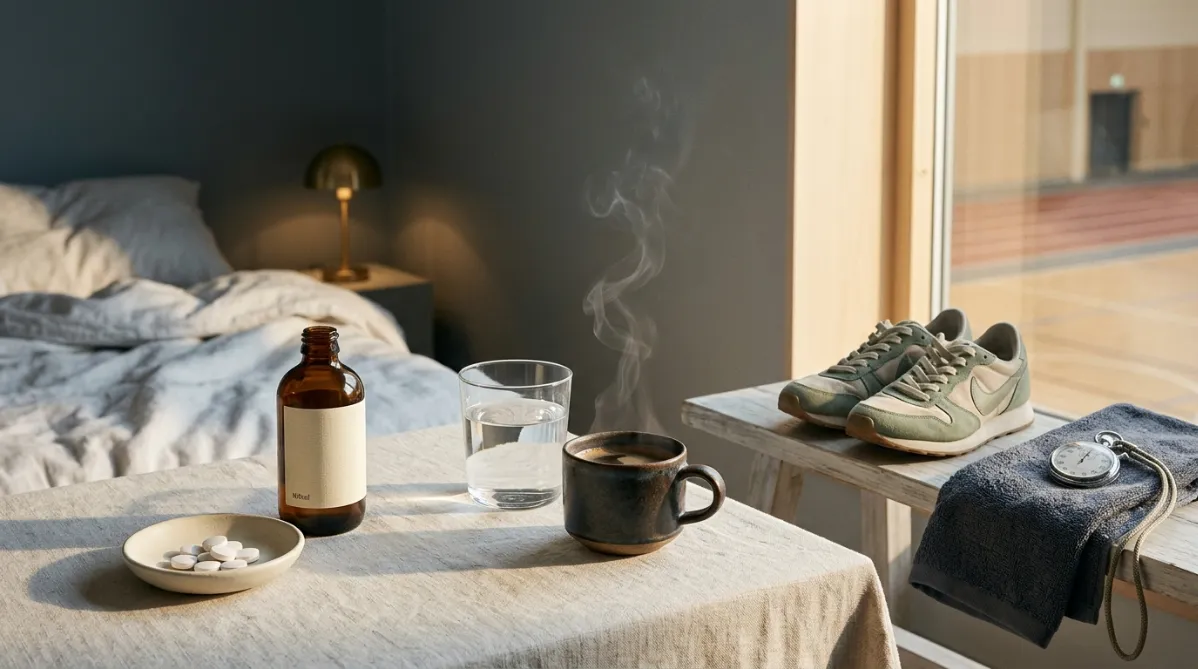
The protocol was simple: 6 mg of melatonin before bed, then 3 mg/kg of caffeine the next morning, with a 5 m shuttle run test one hour after the caffeine dose. The study, published in Nutrients in 2026 by a Tunisian, Spanish and Norwegian team, set out to look at an interaction athletes may already be creating by accident. Many use melatonin to wind down and caffeine to wake up, yet few studies have tested the two together.
How the study worked
Fourteen trained males (average age 22.4 ± 2.9 years) completed four conditions in a randomized, double-blind, placebo-controlled crossover design:
- PLA + PLA: placebo at night, placebo in the morning
- PLA + CAF: placebo at night, 3 mg/kg caffeine in the morning
- MEL + PLA: 6 mg melatonin at night, placebo in the morning
- MEL + CAF: melatonin at night, caffeine in the morning
Blood was drawn before and after exercise to track creatine kinase, lactate dehydrogenase, aspartate aminotransferase and alanine aminotransferase (muscle-damage markers), plus C-reactive protein (an inflammation marker). Peak heart rate and rating of perceived exertion were also recorded during the test. Sleep was assessed only on the night after melatonin or placebo was taken.
Finding 1: Caffeine boosted distance, with or without melatonin
Total distance in the shuttle run test rose in both the MEL + CAF and PLA + CAF conditions compared with double placebo. Melatonin alone was not reported to raise distance. In practical terms, the performance gain looks like a caffeine effect. The 3 mg/kg dose is a moderate, widely studied amount, and this result fits the long record of caffeine helping repeated high-intensity efforts.
Finding 2: Only the combo lowered damage and inflammation markers
This is the headline. MEL + CAF reduced muscle-damage and inflammation markers compared with all three other conditions (PLA + PLA, MEL + PLA and PLA + CAF), with p < 0.05. Neither compound produced that drop on its own. That pattern suggests an interaction, though this study cannot say why. Melatonin has antioxidant and anti-inflammatory properties, and the authors framed the two substances as complementary, one supporting recovery and one supporting performance. That is a hypothesis, not something this trial proved.
Finding 3: No sleep change
Melatonin is usually sold as a sleep aid, so this may surprise you. No differences in sleep parameters were observed between conditions (p > 0.05). Healthy, trained young men may simply have little room to improve. Sleep was also only assessed for the night after the evening dose. So if you were hoping for deeper sleep, this study gives you no evidence of it. Any benefit seen here is not explained by better measured sleep.
Practical protocol (based on what was tested)
- Evening: 6 mg melatonin before bed
- Morning: caffeine at 3 mg/kg body weight. A 70 kg athlete would take about 210 mg.
- Timing: the exercise test began one hour after the caffeine dose
- Who it might suit: athletes who train or compete in the morning, and team-sport players whose sessions involve repeated shuttle-style sprints, since that is what the 5 m shuttle run test resembles
Those are the conditions the study actually used. Other doses, timings or athlete types are untested here. Caffeine tolerance is also individual, and people sensitive to it may not respond the same way. Melatonin and caffeine are supplements with their own considerations, so anyone with a medical condition or on medication should check with a professional first.
The caveats you should not skip
- Small sample. Fourteen trained young men is a small group, and the results may not carry over to women, older adults or elite athletes.
- Single test. Performance was measured with one test, the 5 m shuttle run. The authors' own conclusion is cautious: improvements in certain high-intensity outcomes.
- Blood markers are not performance. Lower creatine kinase or C-reactive protein after exercise is intriguing, but it does not prove faster recovery, fewer injuries or better training adaptation. The study did not follow athletes over days or weeks.
- No added performance edge from melatonin. On distance, the combination did not clearly beat caffeine alone based on the reported results.
- Mechanism unknown. The trial shows an association within one session, not why it happens.
Bottom line
If you already use caffeine before morning sessions, this study offers no reason to expect melatonin to add to the distance you cover. It does hint that the pair may shift muscle-damage and inflammation markers in a way neither does alone. That is worth replicating in larger groups, over longer periods, and with recovery outcomes athletes actually feel. For now, treat the stack as an interesting lead rather than a proven recovery hack.