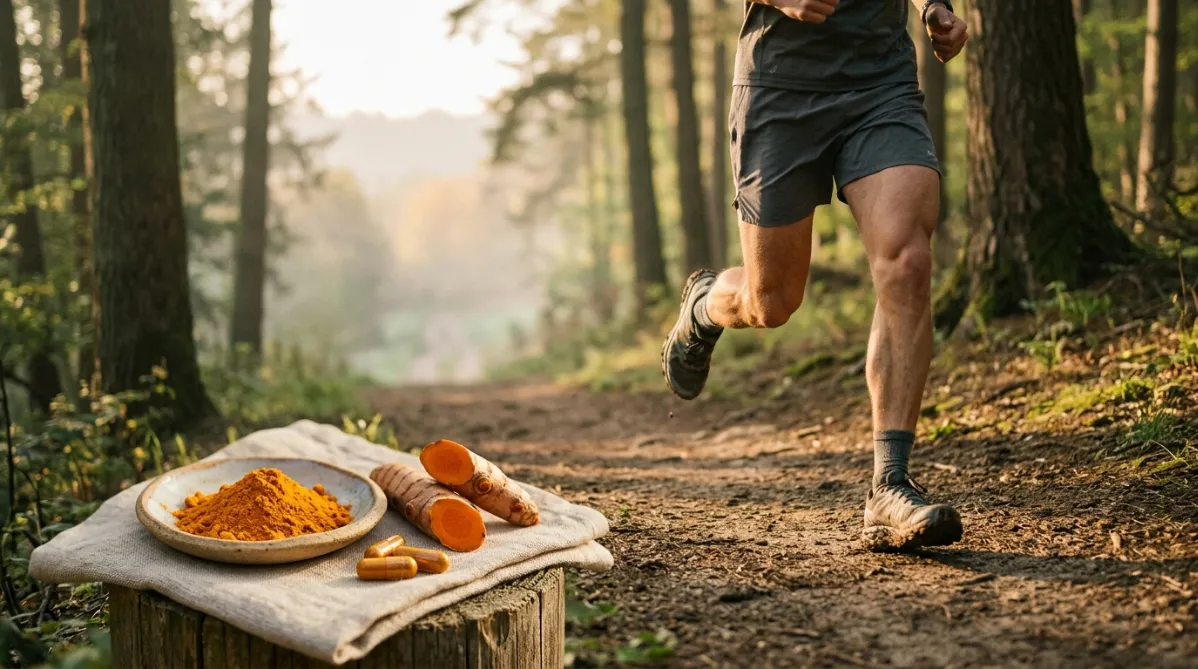
The Hook: Fewer Damaged Muscles on MRI
Downhill running wrecks quads and hamstrings. Every stride is an eccentric contraction, which is why a steep descent can leave you walking down stairs backwards for days. A 2014 randomized trial in the Journal of the International Society of Sports Nutrition tested whether a bioavailable curcumin could blunt that damage. The headline result is that fewer curcumin takers showed MRI-visible muscle injury in the posterior and medial compartments of both thighs than placebo takers.
The study is small and has caveats, covered below. But the imaging result is the most interesting part, and it is worth a close look.
What the Researchers Did
Drobnic and colleagues recruited 20 healthy, moderately active men and randomized them to curcumin or a matching placebo. The design was a single-blind pilot trial, so participants did not know which product they got, but the researchers presumably did.
Both groups then did a downhill running test to induce eccentric muscle damage. Forty-eight hours later the team measured damage three ways:
- MRI of the thigh muscles
- Blood markers of muscle damage and inflammation
- Muscle biopsy histology
Participants also reported pain intensity.
The Dose and Timing
The protocol is easy to copy on paper:
- Product: Meriva, a curcumin-lecithin Phytosome delivery system
- Dose: 1 g twice daily, which is 2 g of Meriva per day
- Actual curcumin: about 200 mg per dose, so roughly 400 mg curcumin per day
- Start: 48 hours before the downhill run
- Finish: 24 hours after the run
- Total duration: 4 days
The "2 g" figure refers to the whole Meriva complex, not pure curcumin. Many people mix those up when comparing labels, so check how much curcumin your product actually contains per serving.
What Worked
The strongest finding was on imaging. Significantly fewer subjects in the curcumin group had MRI evidence of muscle injury in the posterior or medial compartment of both thighs. MRI is more objective than a pain scale, which makes this result more convincing than self-reports alone.
Blood markers of muscle damage and inflammation tended to be lower with curcumin. Only one reached statistical significance: interleukin-8 at 2 hours after exercise.
What Didn't: Pain and Mechanism
The pain result is weaker than the headlines suggest. Curcumin takers reported less pain in the lower limb overall, but significant differences appeared only in the right and left anterior thighs. It was not a blanket reduction in soreness.
Two other readouts showed nothing:
- Oxidative stress markers: no differences
- Muscle histology: no differences
That matters because the study's rationale was that curcumin would blunt oxidative stress. If oxidative markers didn't move, the mechanism is unclear. The authors say as much, calling for larger studies to "further clarify the mechanism of action."
Flag: Industry Ties and the Bioavailability Form
Meriva is a branded product made by Indena SpA of Milan, and the abstract names the company. Studies of proprietary ingredients often involve people connected to the manufacturer. Before treating this as neutral evidence, read the full paper's competing-interests statement.
The delivery form is also central. Standard curcumin is poorly absorbed. Meriva binds curcumin to lecithin to improve bioavailability. These results apply to that formulation, not to kitchen turmeric or any generic curcumin capsule. Don't assume a cheap powder would do the same.
Limitations
- Only 20 participants, so it is underpowered and exploratory.
- Single-blind, which leaves room for bias.
- Healthy, moderately active men only. Results may not carry over to women, older adults, or elite athletes.
- Mixed secondary outcomes, with one significant blood marker out of several.
- No performance data. Less MRI damage doesn't prove faster recovery or better training output.
The authors conclude that curcumin "has the potential" to prevent DOMS. That is a careful phrase, and it fits the data better than any claim that it "prevents" or "cures" soreness.
How to Use This Practically
If you want to try the protocol, the study offers a template:
- Pick a bioavailable form, ideally the lecithin-based Phytosome used here.
- Match the dose: 2 g of the complex per day, split into two 1 g doses.
- Start two days before a known muscle-damaging event, such as a downhill race, a new eccentric-heavy block, or a hard hiking trip.
- Continue for 24 hours afterward.
- Keep expectations modest. You may see less damage, but the pain benefit was limited.
This is not medical advice. Curcumin products can interact with blood thinners and may not suit people with gallbladder issues, so check with a clinician first if that applies to you.
Bottom Line
This pilot gives a promising but preliminary signal. The MRI finding is the standout, the pain benefit is regional, and the biochemical evidence is thin. A larger, double-blind, independently funded replication would settle whether Meriva curcumin deserves a spot in a recovery stack.