If you're vegan, lactose intolerant, or just tired of dairy bloat, you've probably wondered whether plant protein can really build muscle. A 12-week, double-blind trial of 161 men put pea protein head-to-head with whey and a placebo. The headline result is striking, but the fine print matters just as much.
What They Actually Tested
The study, published in the Journal of the International Society of Sports Nutrition in 2015 by Babault and colleagues, was a randomized, double-blind, placebo-controlled trial. It enrolled 161 men aged 18 to 35 and split them into three groups:
- Pea protein (NUTRALYS brand), n = 53
- Whey protein, n = 54
- Placebo, n = 54
Everyone followed 12 weeks of resistance training focused on the upper limbs. Each participant took 25 g of protein or placebo twice a day, about 50 g daily. Researchers measured biceps brachii thickness by ultrasound and strength on an isokinetic dynamometer at baseline, day 42, and day 84.
The Results: Everyone Grew, but Groups Barely Separated
Across all participants, biceps thickness rose from 24.9 mm to 26.9 mm at the midpoint and 27.3 mm at the end. That time effect was highly significant (P < 0.0001), so the training worked.
The difference between the groups was only a trend (P = 0.09), which falls short of statistical significance. Strength also improved over time, with no significant difference between pea, whey, and placebo.
So in the full group, you can't say pea beat anything. It's a modest start for a headline, which is why the next part matters.
The Beginner Twist
The researchers then ran a sensitivity analysis on the weakest participants, defined by strength at the start of the study. This is a reasonable proxy for people new to lifting or returning after a break. In this subgroup the groups did separate (P < 0.05):
- Pea protein: +20.2% biceps thickness
- Whey protein: +15.6%
- Placebo: +8.6%
Pea's gain was significantly greater than placebo's. Whey landed in between and was not statistically different from either pea or placebo. Pea did not beat whey. Both protein groups simply moved in the same direction, with pea clearing the statistical bar against placebo.
The authors concluded that pea protein promoted greater thickness gains than placebo, especially in people starting or returning to strength training. Since the two proteins didn't differ, they proposed pea as an alternative to whey-based products.
The Fine Print You Shouldn't Skip
This is where a good headline needs honest caveats:
- The main comparison was a trend. The overall group difference (P = 0.09) wasn't significant.
- The positive finding is from a subgroup. Sensitivity analyses can generate useful hypotheses, but they're more vulnerable to chance than a primary result.
- Industry ties. Several authors are affiliated with Roquette, the company that makes NUTRALYS. That doesn't invalidate the work, and the trial was registered (NCT02128516), but it's context worth having.
- Narrow population. Participants were young men, and only the upper body was trained, specifically the biceps. The results don't automatically carry over to women, older adults, or leg training.
- No whey win or loss. Whey's 15.6% gain wasn't statistically different from pea or placebo, so this trial can't rank them.
The fair reading is that pea protein appears to be a viable option when training is hard enough and total intake is adequate. It's not proof that pea is superior, or even fully equivalent in every context.
Practical Takeaways
Dose. The trial used 25 g twice daily, roughly 50 g of supplemental protein per day. That's a solid, realistic target for many lifters, though your total daily protein from food matters too.
Timing. The paper didn't test timing as a variable. Splitting protein into two servings, with one around your workout, is a practical way to mirror the study. Consistency across the 12 weeks likely mattered more than the exact minute.
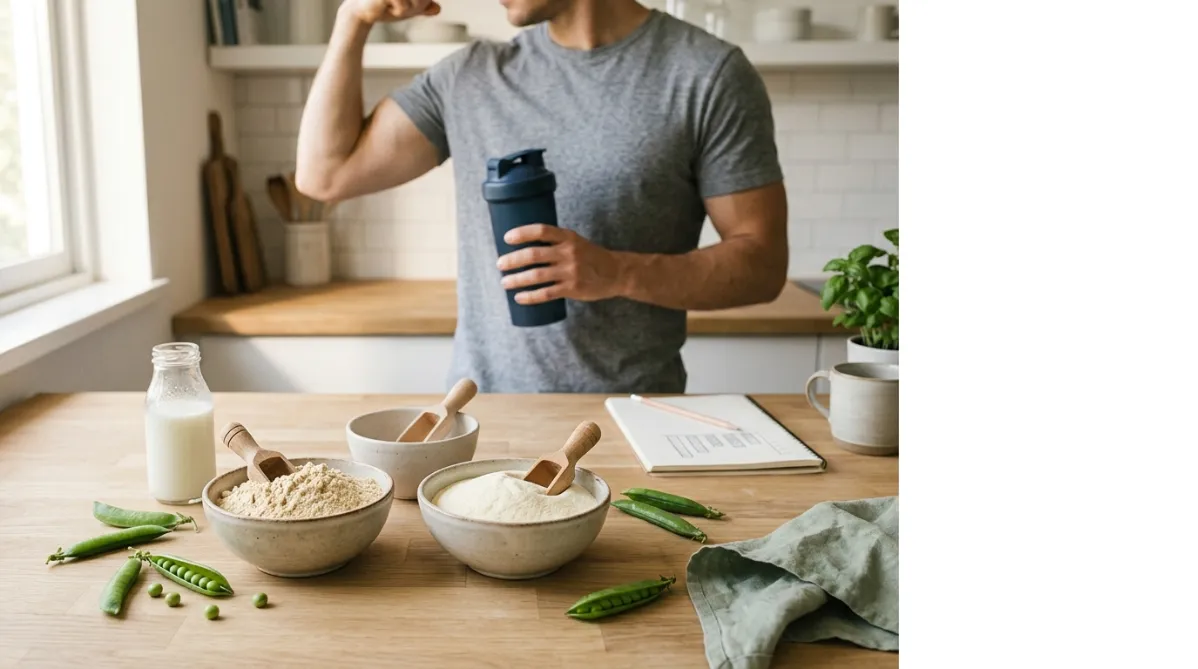
Who it's for. Pea protein is a sensible choice for vegans, people with lactose intolerance or dairy sensitivity, and anyone who prefers plant-based products. The strongest signal here is in newer or returning lifters, who tend to respond quickly to any decent protein plus training stimulus.
How to choose a pea protein.
- Look for a clear protein-per-serving number, ideally 20 to 25 g.
- Choose products with short ingredient lists and minimal fillers.
- Check for third-party testing, such as NSF or Informed Choice, for quality and contaminants.
- Remember that the study used one specific branded isolate. Other products may differ in processing and amino acid profile.
- Compare cost per gram of protein, not just per tub.
The Bottom Line
The pea protein vs whey question doesn't have a knockout answer here. In 161 men, pea protein supported muscle growth alongside training, and in the weakest participants it produced a 20.2% gain in biceps thickness versus 8.6% for placebo. Whey did similarly well, and nothing in the data says one beat the other. If you avoid dairy, this trial gives you a reasonable, evidence-backed reason to use pea protein, as long as you keep expectations realistic and the training consistent.