Dr. Gymbro
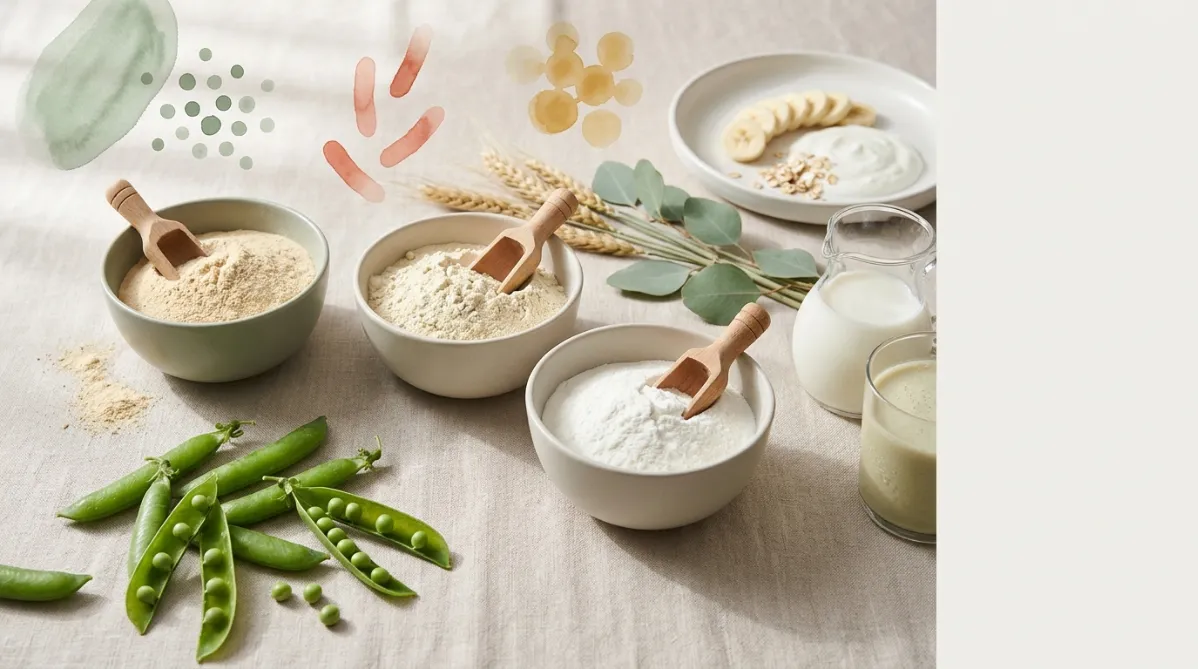
A wide, softly lit editorial flat-lay on a pale oat-colored linen surface, shot from slightly above. Three matte ceramic bowls sit in a loose diagonal across the frame. One holds fine, creamy beige pea protein concentrate, another holds paler, powdery pea protein isolate, and the third holds bright white whey protein isolate. Each bowl has a small wooden scoop resting beside it, with a few fine dustings of powder on the linen. Fresh green pea pods, split open to show round peas, spill naturally in the left foreground. A small glass pitcher of milk sits near the right edge, next to a half-full glass of a smooth, pale green-beige shake with condensation on the surface.

Behind the bowls, a few sprigs of dried wheat and soft eucalyptus leaves add organic texture. In the upper right, a shallow white ceramic plate holds a small arrangement of gut-friendly foods: sliced banana, a spoonful of plain yogurt, and a few oats. Delicate watercolor-style abstract shapes in sage green, warm coral, and soft mustard float subtly in the background. They suggest microscopic organisms, like loose dots, rods, and clustered circles, but stay painterly and minimal, not scientific or futuristic.

Natural window light enters from the left, casting long, gentle shadows and a warm, airy glow. The palette is muted and modern: sage green, cream, warm beige, blush, and touches of terracotta. The composition leaves generous clean negative space on the right third for a headline overlay. The depth of field is shallow, with the nearest pea pods and the front bowl crisp and the background softly blurred. The style is high-end wellness magazine photography with a subtle tactile, handmade feel, calm, fresh, and contemporary, in a 16:9 landscape format.
Science & Research

Which Protein Powder Reshapes Your Gut? Pea Did It in 4 Weeks

Dr. Gymbro · · 4 min read

Your protein shake may be doing more than feeding your muscles. A new Swedish randomised trial suggests the type of protein powder you pick can shift the bacteria living in your gut within just four weeks. Two forms of pea protein did it, and each one favoured different microbes.

The Study: Three Powders, One Dose, Four Weeks

Researchers at Örebro University published a randomised, double-blind, 3-arm parallel trial in the European Journal of Nutrition. Healthy adults took one of three supplements: pea protein concentrate (PPC), pea protein isolate (PPI), or whey protein isolate (WPI). The dose was 0.5 g of protein per kg of body mass per day for four weeks.

Gut microbiota composition was the main outcome. The team collected faecal samples and lifestyle questionnaires weekly. They also took fasting blood and 24-hour urine samples at baseline, mid-intervention and post-intervention to track metabolic markers. This is human research, not a mouse or petri-dish study. The trial was registered as NCT05611138.

The researchers made two comparisons: PPC versus PPI, and PPI versus WPI. That let them look at plant versus animal protein, and at two plant proteins with different food matrices.

The Headline Finding: Pea Protein Changed Diversity

Both pea protein powders produced a measurable shift. Supplementing with PPC and PPI significantly reduced α-diversity (the variety of species within a person's gut) and increased β-diversity (how different the community looks from one sample to another). The authors note these effects were partly modulated by BMI.

A drop in α-diversity can sound alarming, since higher diversity is often treated as a marker of a healthy gut. The abstract doesn't say whether this change is good, bad or neutral here. The authors say only that compositional changes still need to be linked to function, so don't read it as a verdict either way.

The Bacteria That Rose

The species-level results are where the two pea powders split:

  • Pea protein concentrate (PPC): Anaerobutyricum hallii and Bifidobacterium longum increased significantly.
  • Pea protein isolate (PPI): Lactobacillus crispatus and Limosilactobacillus frumenti increased significantly.

The authors describe these as beneficial species, and their conclusion is that different dietary proteins selectively modulate them. The abstract does not report which species changed in the whey group, so we can't say from this source how whey compared at the species level. The PPI-versus-WPI contrast was built into the design, but the abstract gives no details on it.

What This Does Not Show

A few caveats before you swap your tub:

  • Healthy adults only. The results don't tell us what happens in people with digestive conditions.
  • Composition, not function. The authors state that further studies are needed to verify how these changes translate into microbial functionality.
  • Metabolic markers aren't in the abstract. Blood and urine were collected, but the abstract reports no results from them.
  • Individual responses matter. The authors stress investigating individual responses, and BMI partly modulated the diversity effects.
  • Four weeks is short. We don't know whether the shifts persist, grow or fade.

Practical Takeaways: Choosing Your Powder

Dose. The trial used 0.5 g/kg body mass per day. For an 80 kg person, that is 40 g of protein daily from the supplement. The abstract doesn't specify timing, such as pre-workout, post-workout or with meals, so there is no evidence-based timing advice from this study.

Pea protein concentrate. In this trial, PPC was linked to rises in B. longum and A. hallii. If your goal is a plant-based powder and you're curious about gut effects, this is one to consider. Concentrates are generally less processed than isolates, but the abstract doesn't test that explanation.

Pea protein isolate. PPI was linked to increases in L. crispatus and L. frumenti. It is the more purified form, which many lifters prefer for protein density.

Whey protein isolate. WPI was the animal-based comparator. Nothing in this abstract suggests whey is harmful. It simply doesn't report whey-specific bacterial gains, so you can't claim a gut advantage for it from this paper.

Who Should Pay Attention

Plant-based lifters get the most direct value. If you rely on pea protein to hit your daily target, this study suggests it isn't gut-neutral. It appears to shift specific bacterial species, and the form you choose may matter.

People with GI issues should be careful. The participants were healthy, so these findings can't be applied to conditions like IBS or IBD. If your gut is already sensitive, trial any new powder gradually, and talk to a clinician or dietitian before making changes.

The Bottom Line

Four weeks of pea protein, in either form, reshaped the gut microbial community of healthy adults. Concentrate and isolate nudged different beneficial species upward. The big unanswered question is what those shifts mean for your health, and this study leaves that open. For now, treat protein powder choice as one more input into your gut ecosystem, not just your macros.
Original study

Read the original research on pubmed.ncbi.nlm.nih.gov →

This article summarizes published research for general information. It is not medical advice.

DG

Written by

Dr. Gymbro

Dr. Gymbro writes for Dr. Gymbro: science-backed fitness, nutrition & performance.

Related Articles

A bright, airy, minimalist kitchen counter in soft morning light, shot from a slightly elevated three-quarter angle in a wide landscape composition. Two matching ceramic bowls sit side by side on a pale oak butcher-block surface. The left bowl holds fine, creamy-beige pea protein powder with a small wooden scoop resting in it. The right bowl holds smooth, ivory-white whey powder with an identical scoop. Between and slightly behind them sits a third, smaller empty bowl with a plain scoop, hinting at the placebo. Scattered around the bowls are fresh green pea pods, some split open to reveal bright, round peas, and a small glass bottle of milk with delicate condensation. A sage-green linen napkin is folded loosely at the edge of the frame.

In the soft-focus background, a young man in a fitted heather-gray t-shirt is seen from the shoulders down, casually flexing one arm while holding a matte shaker bottle, the biceps subtly defined and the pose relaxed and natural. A minimalist notebook with a pencil and a simple hand-drawn bar chart lies open on the counter, suggesting analysis without legible text. A small potted herb plant and a ceramic mug add warmth.

The color palette is muted and editorial: warm cream, sage green, soft terracotta, pale wood, and touches of charcoal. Light streams in from a window on the left, casting gentle long shadows and a subtle golden glow across the powders so their textures look fine and tactile. Shallow depth of field keeps the bowls crisp while the background melts into a creamy blur. The look is modern lifestyle-magazine photography, clean and uncluttered, with generous negative space on the right third of the frame for headline overlay. It is natural, appetizing, and trustworthy, in the style of a contemporary wellness and nutrition journal.
nutrition

Pea Protein vs Whey: The Beginner Result Nobody Expected

BY DR. GYMBRO ·

Can plant protein really build muscle like whey? A 12-week trial of 161 men put pea protein, whey, and placebo head-to-head, and the beginner results turned heads: +20.2% biceps thickness for pea versus +8.6% for placebo. But the full-group difference was only a trend, and the standout finding came from a subgroup analysis. Here's what the study found, what it didn't prove, and how vegan or lactose-intolerant lifters can use it.

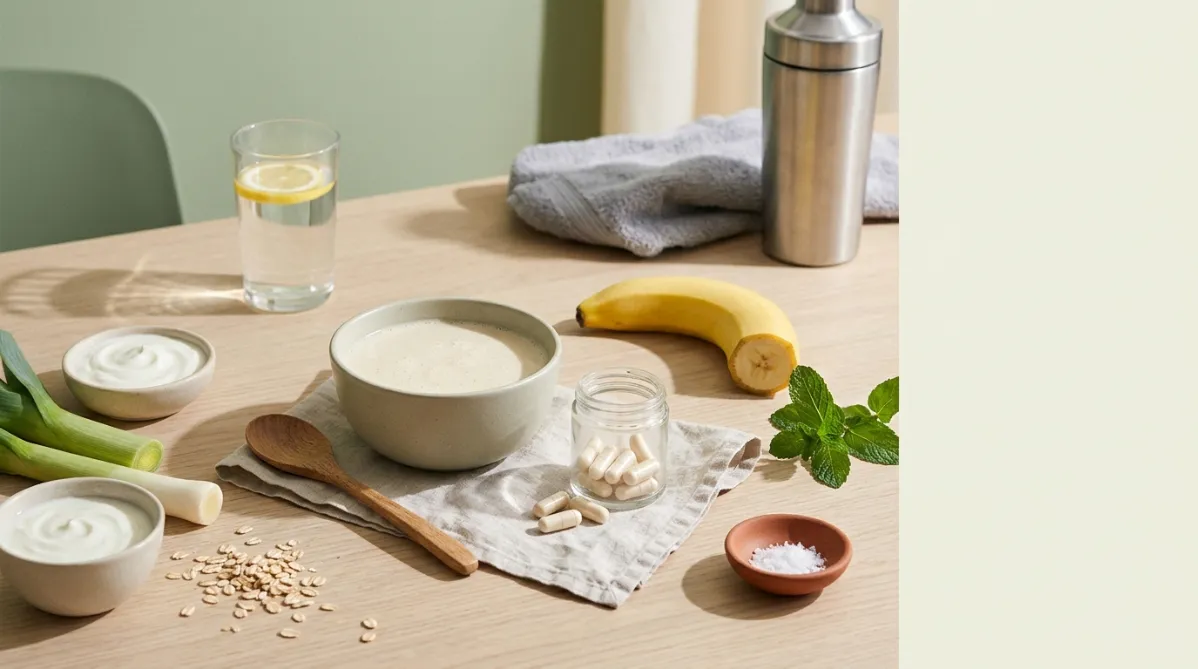
A bright, minimalist still life on a soft sage-green and warm cream backdrop, shot from a slightly elevated angle in natural morning window light. In the center sits a matte ceramic bowl of creamy vanilla protein shake with a wooden spoon resting beside it. Next to it, a small glass jar with a few off-white probiotic capsules spilling onto a pale linen napkin. Around them are fresh, gut-friendly foods arranged with editorial restraint: a halved ripe banana, a small bowl of plain yogurt with a swirl on top, a few stalks of leeks, a handful of oats scattered on the surface, and a sprig of fresh mint. A tall glass of water with a lemon slice catches the light and casts a delicate caustic shadow across the table.

In the background, slightly out of focus, a folded gray gym towel and a sleek stainless steel shaker bottle hint at an athletic lifestyle without dominating the scene. The surface is a pale oak tabletop with subtle grain. A soft diffused shadow falls to the left, giving gentle depth.

The palette is calm and modern: sage green, oatmeal, warm white, soft butter yellow, and touches of terracotta from a small clay dish holding a pinch of sea salt. The composition leaves generous negative space on the right third for headline overlay. The mood is clean, wellness-focused, and quietly editorial, like a feature in a contemporary health and science journal. Shallow depth of field, crisp focus on the capsules and bowl, subtle film grain, and natural color grading. No people, no text, no logos, no futuristic elements.
nutrition

Protein Farts? Probiotic BB536 Cut Odor, But Only in Some Guts

BY DR. GYMBRO ·

Gassy, smelly gut trouble from all that whey? A new trial tested the probiotic Bifidobacterium longum BB536 in athletes on high-protein diets and spotted drops in odor compounds like methyl mercaptan and ammonia. The catch: the overall group showed no significant difference from placebo, and the promising results came from post hoc subgroups. The study was small, exploratory, and tied to the probiotic's maker. Here's what BB536 is, why your baseline microbiome may decide who benefits, and the cheaper fixes to try first.

A bright, minimalist editorial still life on a pale oat-colored linen surface, shot from a slightly elevated three-quarter angle in soft natural window light. On the left, a matte ceramic bowl of fine white collagen powder with a wooden scoop resting beside it, a light dusting of powder spilling across the linen. On the right, a matching bowl of creamy off-white whey powder with a brushed-steel scoop. Between them sits a small, neatly balanced stack of simple geometric wooden blocks and a single smooth gray stone, hinting at a scale or comparison without showing a literal scale. Behind them, a lightly blurred row of three clean amber glass supplement jars with plain cream labels, unbranded. A single rolled yoga towel and a pair of small chrome dumbbells sit softly out of focus in the background on a pale plaster shelf. Accents of muted sage green and warm terracotta appear in a ceramic cup and a folded napkin, giving the palette a calm, contemporary wellness-magazine feel. A thin, elegant sprig of dried eucalyptus lies at the edge of the frame. Shadows are long, gentle, and slightly cool, with a creamy shallow depth of field and fine grain. The composition leaves generous negative space across the upper third for title overlay, with a subtle gradient from warm ivory to pale gray-blue in the background wall. The styling is clean and modern like a trendy health journal website, with a refined, tactile, editorial photography look, balanced symmetry, and no text, no people, no futuristic or laboratory elements.
nutrition

Collagen Beat Whey for Muscle in a 78-Trial Analysis?

BY DR. GYMBRO ·

A 2026 network meta-analysis of 78 randomized trials and 4,755 people ranked collagen first for strength and fat-free mass gains with resistance training, ahead of whey. Stranger still, no other protein supplement beat placebo. But collagen is an incomplete, low-leucine protein, and the confidence intervals are wide. Here is what the numbers actually show, why the result needs head-to-head confirmation, and what to do with your supplement stack in the meantime.

A wide, softly lit editorial still life on a pale oat-colored linen surface, shot from a slightly elevated three-quarter angle. On the left, a matte ceramic bowl in warm cream holds fine, pale golden-beige yeast protein powder, with a small wooden scoop resting beside it and a few loose dusty swirls on the linen. In the center, two tall frosted glass tumblers stand side by side. One holds a creamy, light tan shake with a delicate froth, and the other holds clear water with a faint ripple, creating a quiet visual contrast. On the right, a loosely folded charcoal gym towel, a brushed-steel shaker bottle, and a single small kettlebell in muted sage green sit slightly out of focus.

A few elements hint at the science without looking clinical. A minimalist matte-white notebook lies open with soft, blurred handwriting and a hand-drawn bar chart in thin pencil. Beside it rests a slim brass pen. A single sprig of dried wheat and a small dish of baker's yeast granules on a wooden board nod to the ingredient's fermentation origin.

Natural morning window light enters from the upper left, casting long, gentle shadows and a warm highlight along the glass rims. The palette is earthy and calm: oat, cream, soft terracotta, sage, and warm gray, with a subtle peachy glow in the background. The backdrop is a smooth plaster wall in muted putty tone, with a faint shadow of a window frame across it.

The composition leaves generous negative space in the upper third for a title overlay. Shallow depth of field keeps the glasses and bowl crisp while the gym props melt softly into the background. The overall mood is modern, wholesome, and trustworthy, with the feel of a contemporary health and nutrition magazine. The photograph has fine film-like grain and natural texture, and no text, logos, or labels appear anywhere.
recovery

Yeast Protein Blend Rivals Whey for Soreness and CK—With a Catch

BY DR. GYMBRO ·

Yeast protein is showing up in protein powders as a whey alternative, and a new randomized trial in well-trained athletes put a yeast-whey blend to the test after a punishing eccentric workout. Versus water, the blend lowered creatine kinase and, in men, soreness, while behaving much like plain whey. But the control was water only, not calorie-matched, and many findings were exploratory after multiple-comparison correction. Here's what the data show, what they don't, and who might want to try it.

This page is available in