Dr. Gymbro
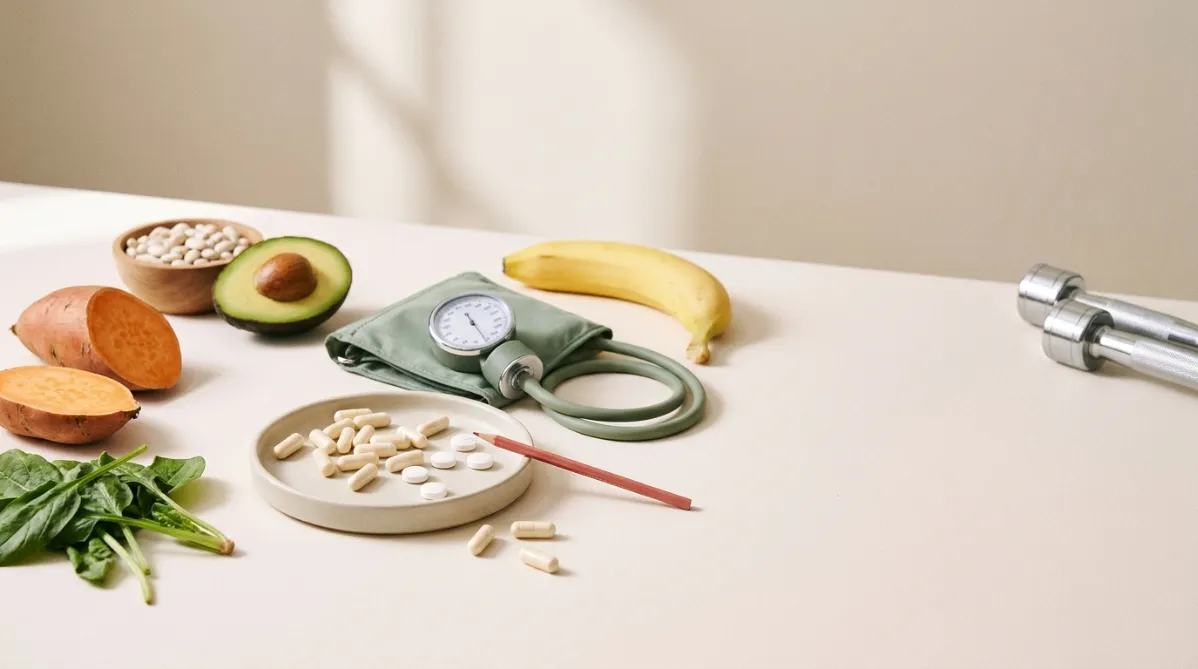
A bright, minimalist editorial still life on a soft warm-white surface, shot from a slightly elevated angle in natural morning light. In the center-left, a small matte ceramic dish holds a handful of pale cream capsules and tablets, a few spilling casually onto the surface. Beside it sits a sleek analog blood pressure cuff, softly coiled, in muted sage green fabric. Fresh potassium-rich foods are arranged in a loose, balanced composition around the pills: a halved ripe avocado with its pit, a peeled banana, a cut sweet potato with glowing orange flesh, a few leafy spinach stems, and a small cluster of white beans in a wooden bowl. A single slim pair of chrome dumbbell handles or a small chalked kettlebell rests discreetly at the right edge, hinting at the lifter audience without dominating the frame.

The palette is soft and modern: warm cream, sage green, terracotta orange, and buttery yellow, with subtle blush-pink shadows. The background is a smooth, out-of-focus pale oatmeal wall with a gentle diagonal shadow from a window, creating a calm, airy mood. The right third of the frame has generous negative space for headline text. A faint, delicate line of hand-drawn-style red accent, such as a small red ribbon or a thin red pencil resting near the pills, adds a quiet "caution" note without feeling alarming.

The overall look is clean, contemporary health-journal photography with shallow depth of field, crisp focus on the pills and produce, soft diffused highlights, and fine natural texture in the ceramic, linen, and food surfaces. Subtle film-like grain, editorial styling, and a calm, trustworthy, slightly cautionary tone. 16:9 landscape composition.
Science & Research

Potassium Pills Cut BP 5 Points in 4 Weeks, But There's a Catch

Dr. Gymbro · · 4 min read

You can drop your systolic blood pressure by about 5 mmHg in roughly a month with a pill. That sounds like a bargain until you read the fine print: the people taking it reported side effects about four times as often as the people who weren't. A new meta-analysis in the Journal of the American Heart Association (2026) puts oral potassium supplements under the microscope, and the results are encouraging, messy, and a little risky all at once.

The Headline Number: About 5 mmHg in About 4 Weeks

Researchers from Universidad Peruana Cayetano Heredia in Lima pooled data from 19 randomized trials covering 803 adults with untreated primary hypertension. Fourteen of the trials were crossover designs and five were parallel designs. The median duration was just 4 weeks. Participants took oral potassium and were compared with placebo, sodium chloride, or no treatment.

In clinic readings, potassium lowered systolic blood pressure by 5.3 mmHg (95% CI, 4.4-6.3) and diastolic pressure by 4.5 mmHg (95% CI, 3.9-5.1). For a nutrient intervention, that is a meaningful shift. The review was prospectively registered in PROSPERO and used standard tools such as Cochrane Risk of Bias 2 and GRADE to assess quality and certainty.

The Plot Twist: 24-Hour Readings Told a Quieter Story

Clinic blood pressure is a snapshot taken in a medical setting. Ambulatory monitoring tracks pressure across a full 24 hours and is often considered a better picture of real-life exposure. Here the effects were smaller: 2.8 mmHg systolic (95% CI, 1.3-4.3) and 3.2 mmHg diastolic (95% CI, 2.2-4.2).

The authors also note that the ambulatory evidence was limited. So the flashy 5 mmHg figure is real, but it describes clinic readings, and the around-the-clock benefit appears more modest. The authors characterize the overall effect as a modest reduction.

The Catch: Side Effects Were Roughly 4x More Common

Adverse events occurred in 12.8% of people on potassium versus 3.2% in comparison groups. That is about a fourfold difference. On the reassuring side, withdrawals and withdrawals due to adverse events were uncommon, which suggests most participants tolerated the supplements well enough to continue. But the data on safety were limited, and the trials were short.

The abstract does not break down which specific side effects drove that gap, so we shouldn't guess at it here. The point stands: more side effects with potassium is a signal to take seriously, not wave away.

Why You Should Read the Fine Print

  • This is for untreated high blood pressure. The trials enrolled adults with untreated primary hypertension. The results don't automatically apply to people with normal blood pressure or those already on medications.
  • Heterogeneity was substantial. Results varied considerably across trials, so the average masks a lot of spread.
  • Follow-up was short. A median of 4 weeks tells us little about long-term effects or long-term safety.
  • Ambulatory data were thin. The smaller 24-hour effect deserves as much attention as the bigger clinic number.

The authors themselves call for cautious interpretation, and that's the right takeaway.

Practical Takeaways

Food First, Pills Second

This meta-analysis tested oral potassium supplementation, not diet. Still, the sensible starting point for most people is potassium-rich whole foods such as fruits, vegetables, beans, and potatoes. Food also brings fiber and other nutrients, and it's much harder to overdo than a concentrated pill. Supplements are a medical decision, not a casual add-on.

Who Must Talk to a Doctor First

Potassium supplements can be dangerous for some people. The main concern is excess potassium in the blood, which can disrupt heart rhythm. Check with a doctor before using them if you:

  • Have kidney disease, since impaired kidneys may not clear potassium effectively.
  • Take ACE inhibitors or ARBs, which can raise potassium levels.
  • Take potassium-sparing diuretics, which also cause the body to retain potassium.

The review didn't test these combinations, so don't treat its findings as a green light. Dosing and monitoring belong with a clinician.

What It Means for Lifters

Many lifters eat plenty of protein but few fruits and vegetables, especially during a cut or a rigid meal-prep routine. If that's you, the practical move is to look at your plate before reaching for a bottle. Adding produce, potatoes, and legumes can improve potassium intake while supporting the rest of your nutrition. If your blood pressure runs high, get it measured and discussed with a doctor rather than self-treating with supplements. Heavy training doesn't make you immune to hypertension.

The Bottom Line

Potassium supplementation lowered clinic systolic pressure by about 5 mmHg in around four weeks in people with untreated primary hypertension, an encouraging result. But 24-hour reductions were smaller, side effects were more frequent (12.8% vs 3.2%), and the evidence base is short-term and variable. Treat potassium as a topic for your doctor's office, not a shortcut from the supplement aisle.

Original study

Read the original research on pubmed.ncbi.nlm.nih.gov →

This article summarizes published research for general information. It is not medical advice.

DG

Written by

Dr. Gymbro

Dr. Gymbro writes for Dr. Gymbro: science-backed fitness, nutrition & performance.

Related Articles

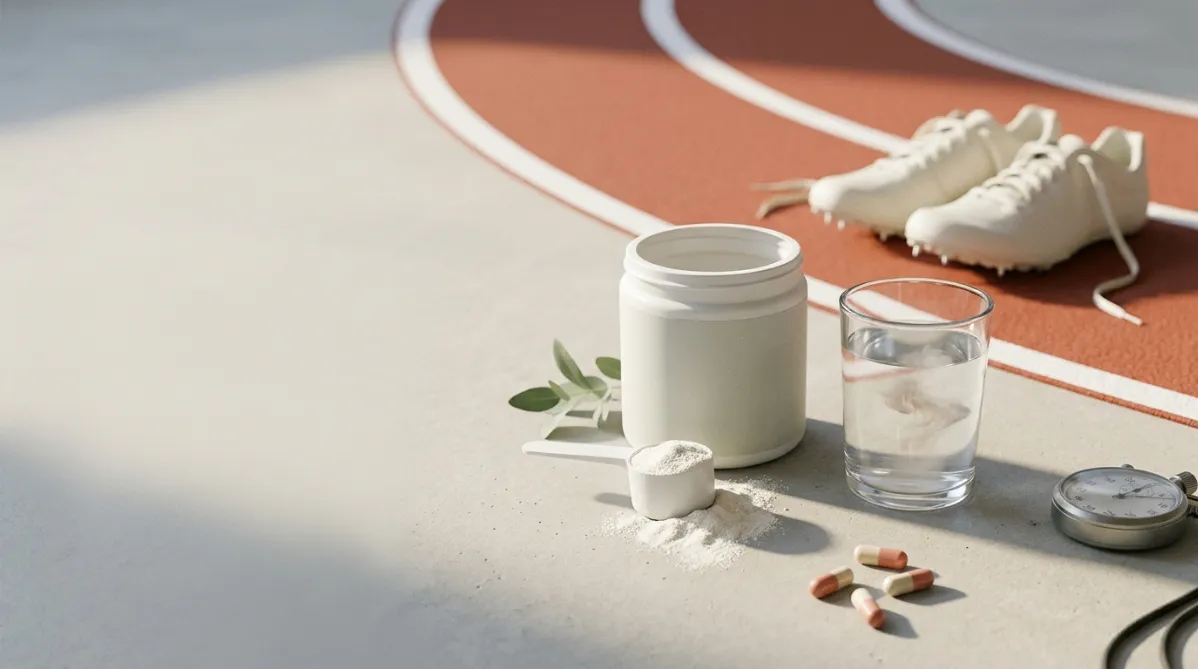
A wide, editorial-style still life photographed on a pale warm-gray concrete surface in soft morning window light. In the center sits an open, matte white supplement tub with a scoop resting beside it, a small mound of fine white powder spilling onto the surface. Next to it is a clear glass of water with a faint cloudy swirl of dissolved powder. A few loose capsules in muted coral and cream tones are scattered casually in the foreground. Behind them, slightly out of focus, is a clean running track lane in terracotta red with crisp white lines curving across the background. A pair of minimalist off-white sprint spikes rests on the edge of the track, laces loosely undone. A stopwatch with a brushed metal casing lies partially in frame at the right, its face reading a blurred, indistinct time.

The composition uses generous negative space on the left third, leaving a calm area of soft gray and cream for headline text. Shadows are long, gentle, and slightly cool, contrasting with the warm terracotta of the track. The palette is restrained: terracotta, bone white, soft sage green accents from a small leaf sprig tucked near the tub, and charcoal gray details. Shallow depth of field with a crisp focus on the scoop and powder, creamy bokeh behind. The mood is thoughtful, skeptical, and calm, like a modern wellness or science journal cover. Subtle film grain, natural color grading, and a tactile, tangible feel, with no text, no logos, and no futuristic elements.
nutrition

Beta-Alanine Is in Every Pre-Workout. Sprint Data Says It May Not Work

BY DR. GYMBRO ·

Beta-alanine is in almost every pre-workout, and the tingles make it feel like it's working. A 2026 multilevel meta-analysis of 17 randomized controlled trials found no benefit for repeated sprint ability, whether measured by mean performance, peak performance or fatigue decrement. Dose, duration and training status didn't change the picture. The authors suggest repeated sprints are limited by phosphocreatine recovery rather than acidosis, which is what beta-alanine targets. Here's who may still benefit, who can skip it, and what the study can't tell us.

A wide, editorial-style still life photographed in soft natural window light on a pale oak gym bench. In the foreground, a small rustic ceramic bowl in warm sand tones holds a mound of fine golden-beige ashwagandha root powder, with a few dried gnarled ashwagandha roots and a sprig of green leaves with tiny orange-red berries resting beside it. A wooden scoop dusted with powder lies at an angle. Just behind, a matte black barbell with a single chalk-dusted steel plate sits slightly out of focus, a light haze of white chalk hanging in the air and catching the sunlight.

On the left side, a neat stack of printed research papers with a sharp black pen and a few muted sage-green sticky tabs. One page shows a simple, abstract forest-plot-style line graph with small squares and horizontal lines, subtly out of focus, hinting at statistics without legible text. A pair of minimal round reading glasses rests on the pages. A small linen gym towel is folded near the edge of the bench.

The palette is restrained and modern: warm cream, soft sage green, muted terracotta, charcoal black, and brushed steel highlights. The background is a softly blurred minimalist studio space with a pale plaster wall and a long soft shadow cast by a window frame, giving a calm, contemplative mood. Shallow depth of field, crisp detail on the powder and roots, gentle film-like grain, and generous negative space on the right third of the frame for a headline overlay. The overall look is a clean, trendy health-and-science journal cover, thoughtful and skeptical rather than promotional, balancing the natural herbal element against the discipline of strength training.
nutrition

Ashwagandha for Lifters: Strength Boost or Statistical Mirage?

BY DR. GYMBRO ·

Ashwagandha is sold to lifters as a strength and size booster, and a new meta-analysis of resistance-training RCTs found bench and squat 1RM gains that look impressive on paper. But only three trials with 161 participants could be pooled. Both strength results lost significance under stricter HKSJ testing, and each leaned on a single influential trial. GRADE rated the evidence low to very low, and there was no dependable effect on body fat. Here is what the review actually shows, and who might still want to try it.

A lone trail runner pauses on a high alpine ridge at dawn, holding a small enamel camp mug of steaming coffee, with thin ribbons of steam curling into crisp, cold air. She wears a fitted charcoal running vest and a muted sage windbreaker, and her breath is faintly visible. Behind her, layered mountain ranges fade into soft blue and lavender haze, and a sea of low clouds fills the valley below. Warm golden sunlight skims the ridgeline and rim-lights her profile, shoulders, and the rising steam. In the foreground, a scattering of dried alpine grasses and lichen-covered stones is in sharp focus, with a worn trail snaking toward the summit. Near the mug sits a small pair of trail running shoes with dusty soles and a simple analog wristwatch resting on a flat rock.

The composition follows a wide 16:9 editorial layout. The subject sits slightly right of center on the rule of thirds, leaving generous negative space in the pale peach-and-powder-blue sky on the left, where headline text could sit. The palette is restrained and modern: warm amber, soft cream, dusty sage, slate blue, and a touch of terracotta. The look is cinematic but natural, with shallow depth of field on the foreground details, gentle film grain, and a slightly matte finish. It evokes a high-end outdoor lifestyle magazine or a contemporary wellness journal. The mood is calm, focused, and quietly determined, capturing the contrast between thin, cold altitude air and the warmth of a coffee ritual. The image has no text, logos, or futuristic elements, and no gym equipment, only natural light, texture, and atmosphere.
nutrition

Caffeine in Thin Air: The Endurance Boost Hypoxia Can't Erase

BY DR. GYMBRO ·

Thin air wrecks endurance, but a new meta-analysis suggests caffeine can claw some of it back. Pooling nine placebo-controlled crossover studies (117 participants), researchers found a moderate-to-large performance boost in hypoxia (g = 0.76). The surprise is that oxygen saturation and perceived exertion didn't change, while heart rate, lactate, and ventilation went up. The evidence is rated low certainty and only 19 participants were women, so this is promising rather than proven. Here's who stands to benefit, who should skip it, and how to think about dose and timing.

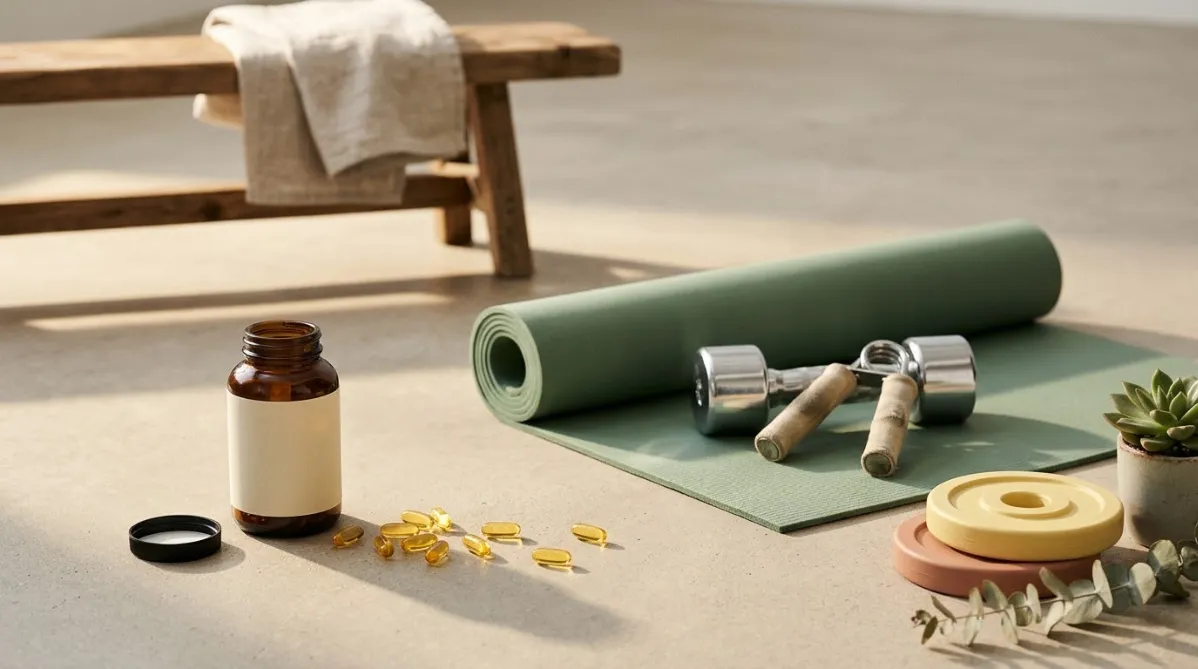
A soft-lit editorial still life on a pale warm-gray concrete surface, shot from a slightly elevated three-quarter angle in a wide landscape frame. On the left, a single amber glass supplement bottle with a minimalist cream label, its lid set beside it. A few golden-yellow softgel capsules are scattered in a loose arc across the surface, catching the light like small drops of honey. At the center-right, a matte sage-green yoga mat is partly unrolled, with a polished chrome dumbbell resting on it. Next to the dumbbell sits a worn canvas hand gripper, a nod to the handgrip finding. Behind them, a wooden gym bench is slightly out of focus, and a folded linen towel sits on top of it.

Warm morning sunlight enters from the upper left through a large window. It casts long, gentle diagonal shadows and a faint golden glow across the scene, a quiet reference to vitamin D and sunshine. A sprig of dried eucalyptus or a small potted succulent adds an organic touch near the bottom right. A small, neatly stacked pile of two or three matte pastel-toned weight plates in butter yellow and dusty terracotta adds color blocking.

The palette is muted and modern: butter yellow, sage, warm sand, soft terracotta, and off-white, with a single strong amber accent from the bottle. The depth of field is shallow, with crisp focus on the capsules and bottle and a creamy blur falling off toward the background. The negative space on the upper right is clean and uncluttered, which leaves room for a headline overlay. The overall feel is calm, minimalist, and contemporary, like a premium health and wellness magazine or a trendy online journal. The grain is subtle, the contrast gentle, and the textures tactile: brushed metal, frosted glass, linen, and concrete. There are no people, no text, and no futuristic elements.
science research

Vitamin D Won't Shred You or Build Muscle, With One Exception

BY DR. GYMBRO ·

A new dose-response meta-analysis of 28 randomized trials and 1,675 adults asked whether adding vitamin D to exercise beats exercise alone. Blood vitamin D levels jumped by about 34 nmol/L, but body weight, BMI, fat mass, body fat percentage, and fat-free mass didn't improve beyond training alone. Leg press strength didn't either. The exception: modest knee extension gains (+4.36 kg) and handgrip improvements in older adults and at higher doses. Here's who might benefit and what to do before you buy another bottle.

This page is available in