Dr. Gymbro
A wide, editorial-style still life photographed in soft natural window light on a pale oak table, styled like a modern wellness journal cover. In the foreground, a pair of worn white boxing hand wraps lies loosely coiled beside a small amber glass jar of probiotic capsules, its lid set to the side and a few cream-colored capsules spilled onto the wood. Next to them sits a tall glass of water with a thin slice of lemon, condensation beading on the surface. A neat bundle of fresh gut-friendly foods is arranged in the midground: a small bowl of plain yogurt with a drizzle of honey, sliced green banana, a few sprigs of fresh herbs, and a halved kiwi with glistening seeds. Behind them, slightly out of focus, a compact digital kitchen scale shows a lowered weight on its display, and a folded gray athletic towel rests beside a pair of black boxing gloves hanging from a hook against a muted sage-green plaster wall. The color palette is calm and sophisticated: sage green, warm oatmeal, soft cream, faint amber highlights, and touches of charcoal. Light streams in from the left, casting long, gentle shadows and a subtle golden glow across the textures of linen, wood, and glass. Shallow depth of field with a creamy bokeh background, crisp detail on the capsules and the hand wraps. Clean negative space on the right third of the frame leaves room for a headline overlay. The mood is fresh, restorative, and athletic, with a minimalist and refined composition, shot as if on a full-frame camera with an 50mm lens, high-end lifestyle magazine photography.
Nutrition

Cutting Weight Wrecks Your Gut. A Probiotic Cut Leaky-Gut Markers

Dr. Gymbro · · 4 min read

Anyone who has cut weight for a fight knows the routine: restricted food, manipulated fluids, brutal training, and a stomach that rebels at the worst moment. A new randomized trial in Frontiers in Nutrition (Wang et al., 2026) suggests a probiotic may help protect the gut during that process. The results are promising, but the study is small and has clear limits.

What the study tested

The researchers recruited 24 elite male combat athletes who were undergoing rapid weight loss ahead of competition. They were randomized to one of two groups:

  • Probiotic group: a complex sports probiotic at 1.5 × 10^10 CFU, taken twice daily
  • Placebo group: an inactive comparator

The intervention lasted 4 weeks. The trial was registered (ChiCTR2400079908), which is a point in its favor for transparency.

Why weight cutting hurts the gut

Rapid weight loss stacks several stressors on the digestive tract: low energy availability, dehydration, altered diet composition, high training stress, and psychological pressure. Together they can weaken the intestinal barrier, the thin lining that keeps gut contents from leaking into circulation. When that barrier loosens, you can get bloating, cramping, nausea, diarrhea, and a low-grade inflammatory response. For an athlete trying to make weight and then perform, that is a poor combination.

What the probiotic changed

According to the abstract, the probiotic group did better than placebo on several fronts.

Symptoms

  • Gastrointestinal symptoms were significantly reduced.

Gut permeability markers

  • Zonulin, a protein linked to tight-junction regulation, was lower.
  • Intestinal fatty acid-binding protein (I-FABP), a marker of intestinal cell damage, was lower.
  • D-lactate, a bacterial metabolite that can leak across a compromised barrier, was lower.

Immune and inflammatory markers

  • Secretory immunoglobulin A (SIgA), a key mucosal defense antibody, was higher.
  • Systemic inflammation was attenuated relative to placebo.

Microbiome shifts

  • Butyrate-producing bacteria, including Blautia and Latilactobacillus, were enriched.
  • Potentially pathogenic Streptococcus was suppressed.

Butyrate is a short-chain fatty acid that fuels the cells lining the colon and supports barrier integrity, so the microbiome changes fit the other findings.

Why the pattern is convincing

The strength of this study is that the outcomes line up. Symptoms improved, three different permeability and damage markers moved in the right direction, immune defense rose, inflammation fell, and the microbiome shifted in a plausible direction. That coherence is more persuasive than one isolated biomarker changing.

The honest caveats

This is not a green light to treat probiotics as a guaranteed fix. Keep these limits in mind:

  • Small sample. With 24 athletes, the results need replication in larger groups.
  • Male-only, elite-only. The findings may not carry over to women, amateurs, or athletes in other weight-class sports.
  • Multi-strain product. The abstract describes a complex sports probiotic and does not name the individual strains. The genera that increased in the gut (Blautia, Latilactobacillus) are changes in the microbiome, not a list of what was in the capsule. You cannot assume another product will behave the same way.
  • No performance outcome. The abstract reports gut and immune measures, not fight results, power output, or weigh-in success. Better gut markers do not automatically mean better performance.
  • Surrogate markers. Zonulin and similar measures are useful indicators, but they are not the same as proven clinical benefit.

The authors' conclusion that the approach is a "safe, effective nutritional strategy" is reasonable for this population and window, but it is a conclusion from one small trial.

Practical application

If you are a fighter or weight-class athlete, here is how to think about this:

  • Dose studied: 1.5 × 10^10 CFU, twice daily. The abstract does not make clear whether that figure is per dose or per day, so check the label of any product you consider.
  • Timing: The trial ran 4 weeks during pre-competition weight loss, so starting roughly 4 weeks before the cut is the closest match to the evidence. Starting on cut week is not what was tested.
  • Who it may suit: Combat athletes (boxing, MMA, wrestling, judo, and similar) and other weight-class athletes who already get GI trouble during cuts.
  • Who should check first: Anyone who is immunocompromised, has a medical GI condition, or is under a team physician's care should talk with a clinician or sports dietitian first.
  • Trial it early. Never introduce a new supplement in fight week. Test it in a training camp so you know how you tolerate it.

Takeaways

  • A 4-week multi-strain probiotic reduced GI symptoms and leaky-gut markers in elite combat athletes during rapid weight loss.
  • It also raised SIgA, lowered inflammation, and favored butyrate-producing bacteria.
  • The trial was small (n=24), all male, and did not report performance outcomes.
  • Strain-specific effects are unknown from the abstract, so the result applies to this product type, not every probiotic.
  • A probiotic is a possible add-on, not a substitute for a sensible, well-planned weight cut with adequate fuel and hydration.

For athletes who regularly pay for weight cuts with their gut, this is a credible, low-risk strategy worth discussing with a sports nutrition professional. Larger trials that include performance outcomes and named strains would make the case much stronger.
Original study

Read the original research on pubmed.ncbi.nlm.nih.gov →

This article summarizes published research for general information. It is not medical advice.

DG

Written by

Dr. Gymbro

Dr. Gymbro writes for Dr. Gymbro: science-backed fitness, nutrition & performance.

Related Articles

A wide, editorial-style flat lay photographed from above on a pale, warm-gray stone surface lit by soft natural window light. On the left, a matte white supplement sachet and a small frosted glass jar of off-white probiotic powder sit beside a wooden scoop dusted with fine granules. In the center, a modern minimalist stopwatch with a brushed silver case and crisp white face rests on a folded slate-blue running towel, its hands frozen just past the half-minute mark. On the right, a pair of sleek running shoes in cream and sage green are angled diagonally, with a few strands of laces trailing across the surface. Scattered around the arrangement are fresh, natural gut-health cues: a halved kefir-colored ceramic bowl of creamy yogurt with a drizzle of honey, a few sprigs of fresh mint, sliced green apple, and a handful of raw oats. A small glass of water with delicate condensation catches a soft highlight in the background. The color palette is calm and refined: sage green, cream, soft slate blue, and touches of warm honey gold against the neutral stone. Shadows are long and gentle, creating depth and a quiet, premium wellness-journal mood. The shallow depth of field softly blurs the edges, leaving the stopwatch and probiotic jar in crisp focus. Negative space on the upper right of the composition leaves room for a headline overlay. The overall feel is clean, modern, and trendy, like a contemporary health and sports science magazine cover, with realistic textures, natural tones, and no futuristic or digital elements.
nutrition

SLAB51 Probiotic: One Week Added 33 Seconds for Elite Athletes

BY DR. GYMBRO ·

One week of the multi-strain probiotic SLAB51 helped elite athletes last about 33 seconds longer on a treadmill test, but a single dose did nothing and VO2max didn't change. The randomized, double-blind crossover trial also found higher levels of the antioxidant enzyme SOD before exercise. So what is SLAB51, and why might gut bacteria influence endurance at all? This article breaks down the study design, the numbers, and what athletes can realistically take from them. It also covers the limits: a small sample of elite men and a very short intervention.

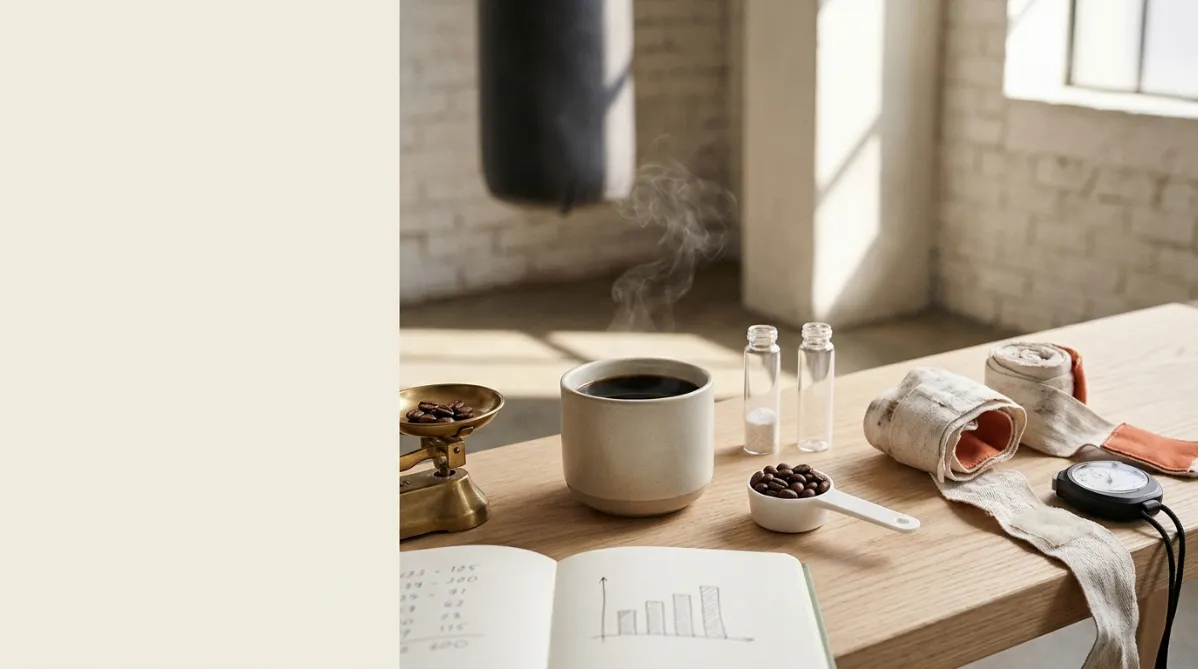
A wide, editorial-style still life shot from a slightly elevated angle on a pale oak gym bench, bathed in soft morning window light. In the center sits a matte ceramic cup of black coffee with delicate steam curling upward, flanked by a small white scoop of coffee beans and two identical glass vials, one filled with a few grains of fine powder and one empty, hinting at dose comparison. Next to the cup rests a pair of worn white boxing hand wraps, loosely coiled, and a slim black stopwatch with its face softly visible. In the foreground, a minimalist notebook lies open with blurred handwritten numbers and a simple pen sketch of a bar graph with bars of equal height, subtle and unreadable, suggesting a null result without any legible text. A small brass kitchen scale sits to the side with a few coffee beans on its tray.

In the soft-focus background, a boxing gym interior is visible: a hanging heavy bag in muted charcoal, exposed brick wall painted off-white, and tall windows casting long diagonal light across the floor. The color palette is warm and restrained: cream, sand, espresso brown, soft charcoal, with a single accent of muted terracotta orange in the hand wraps and a faint sage green in the notebook cover. Shallow depth of field with creamy bokeh, fine film grain, and gentle shadows give it a contemporary lifestyle-magazine and wellness-journal feel. The composition leaves generous negative space on the left third for headline overlay. Clean, calm, trendy, and tactile, with natural textures like wood grain, ceramic glaze, and cotton fabric. No people, no text, no futuristic elements.
science research

Low-Dose Caffeine Coffee Gave Elite Fighters Zero Sprint Boost

BY DR. GYMBRO ·

Think your pre-workout coffee is supercharging your sprints? A new randomized, double-blind crossover trial in 15 national-level combat athletes found no performance benefit from caffeine doses of 1.5 and 3 mg/kg, about 100 and 200 mg for a 68 kg athlete. Peak power, mean power, fatigue index and even estimated energy system contributions did not differ from decaf. But this is a small null result, not proof that caffeine fails, and most positive studies use capsules at 3–6 mg/kg. Here is the dose math, the caveats and what to actually do before your next hard session.

A clean, modern editorial flat-lay on a pale oat-colored linen surface, shot from slightly above in soft diffused natural window light. At the center sits an amber glass supplement bottle with a minimalist cream label, unbranded, with a few capsules spilling onto the fabric in soft greens and ivory tones. Around it are fresh botanical elements: a sprig of green tea leaves, sliced ginger root, a small bundle of dried hibiscus petals, and a few pale green pineapple and papaya slices hinting at digestive enzymes. A small ceramic bowl of creamy plain yogurt with a wooden spoon suggests probiotics. To the left, a flexible tailor's measuring tape in soft blush pink loosely curls across the linen, with a slim brushed-brass scale partly visible at the frame edge. On the right, a minimalist white notebook lies open with a hand-drawn simple line chart showing two diverging lines, one trending downward and one flat, with no readable text. A pair of reading glasses with thin gold frames rests beside it, and a tiny pair of balanced brass scales sits in the background, subtly suggesting weighing evidence and caution.

The palette is muted sage green, warm cream, soft terracotta, and touches of blush and brass. Shadows are gentle and long, the depth of field is shallow with a creamy blurred background, and the negative space on the left third of the frame leaves room for a headline overlay. The overall feel is a contemporary health and science journal, calm, trustworthy, and slightly skeptical, in the style of a premium wellness magazine photographed with a 50mm lens, with crisp texture on linen, glass, and botanicals.
nutrition

SlimSEB Probiotic-Enzyme Blend Beat Placebo—But There's a Catch

BY DR. GYMBRO ·

A probiotic, enzyme and botanical blend called SlimSEB beat placebo in a 12-week randomized trial of 87 adults at risk of type 2 diabetes. Obese participants lost 4.5 kg more than placebo and trimmed their waists by 11 cm, while cholesterol and insulin resistance also improved. But the product was supplied by its maker, the trial was small and short, and the multi-ingredient formula means no single component can take credit. Here is what the data show, how they compare with GLP-1 drugs, and who should think twice.

A wide editorial still life on a pale, warm-toned concrete surface in soft morning window light. In the center-left, a shallow matte ceramic bowl holds a small pile of bright red coffee cherries with glossy skins, a few sliced open to reveal pale mucilage and paired green-tan beans. Beside it, a small glass dish of fine, golden-brown powdered extract with a tiny wooden scoop resting on its edge. A sprig of coffee plant leaves, deep green and waxy, arcs across the foreground.

On the right side, slightly out of focus, a sleek road cyclist's handlebar and a matte black water bottle lean against a light plaster wall, suggesting athletic training without showing a person. A minimalist analog stopwatch with a clean white face and thin black hands sits in the mid-ground, angled toward the camera, its hands paused near the fifteen-minute mark. A folded linen cloth in oatmeal beige and a single small espresso cup with a thin crema ring add quiet texture.

The color palette is restrained and modern: cherry red, sage green, cream, soft terracotta, and charcoal accents. Light comes from the left, casting long, gentle shadows with a subtle warm glow and a hint of dust in the air. Shallow depth of field with crisp focus on the cherries and stopwatch, creamy bokeh in the background. Composition leaves open negative space in the upper right for a headline overlay. The overall feel is a clean, trendy health-and-science magazine cover: tactile, natural, minimal, and calm, shot in a 16:9 landscape frame with fine film-like grain and true-to-life tones.
nutrition

Coffee Cherry Extract: 200 mg Caffeine Lifted Cycling Output 4.6%

BY DR. GYMBRO ·

A low 200 mg caffeine dose from whole coffee cherry extract helped trained cyclists produce 4.6% more work in a 15-minute time trial. But the popular idea that it speeds up glycogen refuelling didn't hold up. This randomized, double-blind crossover trial involved just 12 cyclists and was industry-funded, with no plain-caffeine comparison group. Here's what the data show, what they don't, and who might want to try it.

This page is available in