Dr. Gymbro
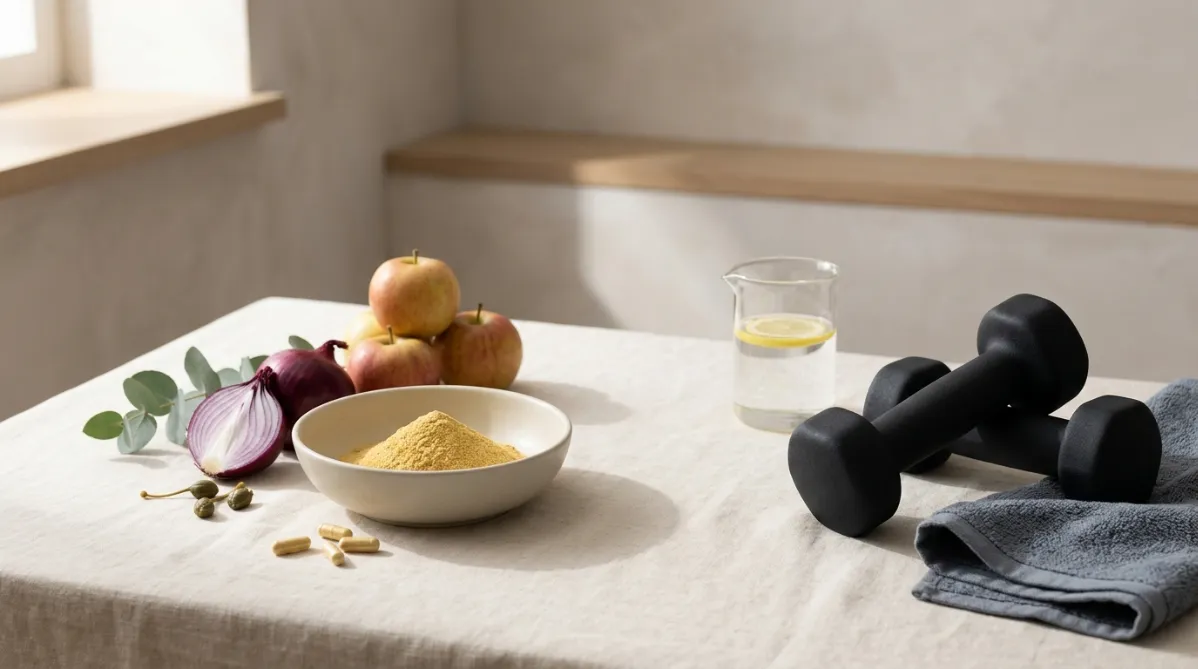
A wide, softly lit editorial still life on a warm off-white linen surface. At the center-left, a matte ceramic bowl holds a small mound of fine golden-yellow quercetin powder, with a few scattered capsules beside it. Next to the bowl sit fresh red onions (one halved to show its translucent purple layers), a few capers, and a small cluster of ripe apples with the skin on, all natural quercetin sources. On the right side of the frame, a sleek matte-black dumbbell rests at an angle beside a folded slate-gray gym towel. A minimalist glass beaker of water with a thin lemon slice sits just behind it.

Soft diffused morning window light enters from the upper left, casting gentle long shadows and subtle highlights on the powder and glossy onion skin. The color palette is muted and sophisticated: butter yellow, deep plum, warm cream, charcoal, with small touches of sage green from a single eucalyptus sprig. A subtle, out-of-focus background of pale plaster wall and a wooden shelf adds depth.

Shallow depth of field, shot from a slightly elevated three-quarter angle with a 50mm lens feel. Generous negative space in the upper right for a title overlay. The mood is clean, calm, and modern, like a premium wellness and science journal feature: tactile textures, natural materials, restrained composition, high-end editorial photography, and no text or logos.
Science & Research

1 g/Day Quercetin Before Eccentric Curls: The IGF Twist

Dr. Gymbro · · 3 min read

The Hook: A Plant Flavonoid Changed the Recovery Curve

You know the soreness that follows a brutal eccentric session. Your arms feel like wet cement, and the next workout slips a few days. A small 2021 crossover study in Frontiers in Endocrinology tested whether a common plant flavonoid, quercetin at 1 g/day for 14 days, could change what happens in the blood after eccentric muscle damage.

The headline findings: lower muscle-damage markers, lower IL-6, and a different timing and size of the IGF-I and IGF-II response. It is intriguing, but it is also a small study, so read the details before you buy a bottle.

What the Researchers Actually Did

Sgrò and colleagues ran a randomized, double-blind, placebo-controlled crossover trial with twelve young men. Each participant took either 1 g/day of quercetin or a placebo for 14 days. Then they performed an eccentric-induced muscle damage (EIMD) protocol. The crossover design means each person served as their own comparison, which helps in a small sample.

Blood was drawn before exercise and at several points during recovery, from 24 hours up to 7 days afterward. The team measured:

  • Creatine kinase (CK), lactate dehydrogenase (LDH) and myoglobin (Mb), the standard blood markers of muscle cell damage
  • Interleukin-6 (IL-6), an inflammation-related signal
  • IGF-I and IGF-II, anabolic growth factors involved in muscle repair and adaptation

Result #1: Damage Markers Dropped

Compared with placebo, quercetin significantly reduced plasma markers of cell damage during recovery:

  • CK: p<0.005
  • LDH: p<0.001
  • Myoglobin: p<0.05
  • IL-6: p<0.05

These markers leak into the bloodstream when muscle membranes are stressed or damaged. Lower levels suggest less disruption or a faster resolution. That is not the same as proving that muscle fibers were better protected, or that your performance bounced back sooner. Blood markers are indirect, and this abstract does not report strength or soreness outcomes.

Result #2: The IGF Timing Twist

This is the curiosity-gap part. In the placebo condition, the sequence was orderly: IGF-I rose at 72 hours, and IGF-II rose later, at 7 days.

After quercetin, two things changed:

  1. IGF-I rose more markedly than in placebo.
  2. The IGF-II peak arrived earlier, at 72 hours, the same time as IGF-I.

So quercetin did not simply nudge one number up. It appeared to compress and amplify the growth-factor response during recovery. The authors read this as a sign of a faster, more anabolic recovery environment.

Why This Is Interesting, and Why You Should Stay Skeptical

IGF-I and IGF-II are tied to muscle repair, satellite cell activity and tissue remodeling. A higher, earlier circulating signal fits a story where the muscle is being prompted to repair sooner. That is a plausible hypothesis, but it is still a hypothesis.

The limits matter:

  • Twelve young men is a very small sample, and the results may not apply to women, older adults or trained athletes.
  • Circulating IGF levels are not the same as muscle growth. This study reports no hypertrophy or strength outcomes.
  • The authors call the data "encouraging," not conclusive.
  • It tested a single dose and duration (1 g/day for 14 days) before one damaging protocol.

In short, this is a promising signal for recovery biology, not proof of bigger biceps.

Practical Takeaways

What you can reasonably take from this:

  • If you are curious about quercetin, the dose studied was 1 g/day for 14 days before the damaging session. It was a pre-loading strategy, not a post-workout fix.
  • The most defensible expected benefit is lower blood markers of damage and inflammation, not guaranteed less soreness or more muscle.
  • It may be most relevant before unaccustomed eccentric work, such as a new program with heavy negatives, downhill running or a high-volume block.

What not to conclude:

  • Do not assume quercetin will boost muscle growth.
  • Do not assume more IGF automatically means better recovery in your body.
  • Do not treat a 12-person trial as a universal recommendation.

Smart next steps:

  • Talk to a doctor or dietitian before taking high-dose supplements, especially if you take medications or have health conditions.
  • Prioritize the basics first: progressive loading, adequate protein, sleep and total calories.
  • Look for larger replications that measure strength, soreness and actual muscle adaptation.

The Bottom Line

A 14-day, 1 g/day quercetin load was linked to lower CK, LDH, myoglobin and IL-6 after eccentric damage, plus a stronger IGF-I response and an earlier IGF-II peak. It is a neat, early-stage finding, and it raises a good question about whether flavonoids can shape the recovery timeline. Until bigger trials link these blood changes to real-world performance and muscle outcomes, treat quercetin as an interesting experiment, not a proven shortcut.
Original study

Read the original research on pubmed.ncbi.nlm.nih.gov →

This article summarizes published research for general information. It is not medical advice.

DG

Written by

Dr. Gymbro

Dr. Gymbro writes for Dr. Gymbro: science-backed fitness, nutrition & performance.

Related Articles

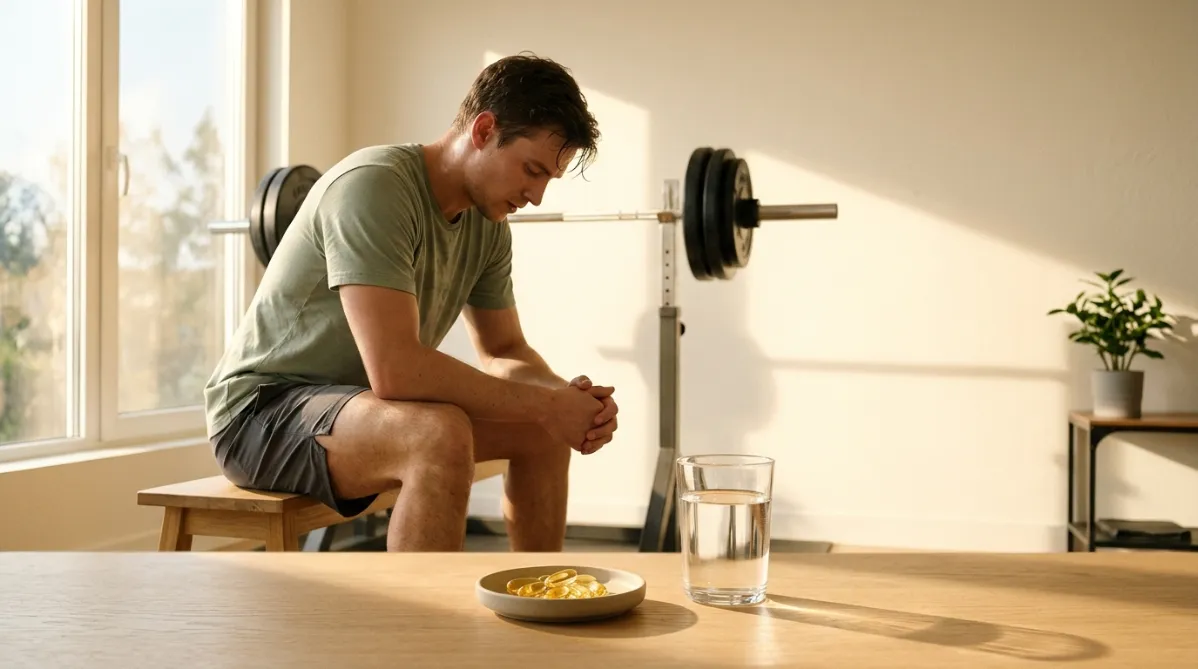
A sunlit, minimalist home gym corner photographed in soft golden morning light, with a young athletic man seated on a wooden bench, leaning forward with his elbows resting on his knees, catching his breath after a hard leg session. He wears a muted sage-green t-shirt and charcoal shorts, his face turned slightly away from the camera, calm and focused. A matte ceramic dish in the foreground holds a few small, translucent golden softgel capsules, with a glass of water beside it catching the light and casting a soft caustic shadow across a pale oak floor. Behind him, a loaded barbell rests on a squat rack, slightly out of focus, and a tall window pours warm sunlight diagonally across the scene, creating long gentle shadows and a hazy glow. A small potted green plant sits on a shelf at the edge of the frame. The color palette is warm and editorial: cream, soft gold, sage green, pale wood, and charcoal accents. Shallow depth of field, with crisp focus on the capsules and glass in the lower third and a creamy bokeh background. The composition leaves generous negative space on the right side for a headline overlay. The mood is clean, modern, and aspirational, like a high-end wellness magazine or a trendy health journal feature. Shot on a 50mm lens, natural light, fine film grain, subtle matte finish, landscape 16:9 framing.
recovery

Vitamin D Sped Strength Recovery in Men Who Weren't Deficient

BY DR. GYMBRO ·

Men with perfectly normal vitamin D levels still recovered strength faster after a brutal leg workout when they took 4,000 IU daily. In this randomized, placebo-controlled trial of 28 active men, peak isometric force bounced back about 8% better at 24 hours. Muscle-damage markers ALT and AST also rose less. But there's a twist: soreness didn't improve at all. Here's what the study found, where it falls short, and who might actually care.

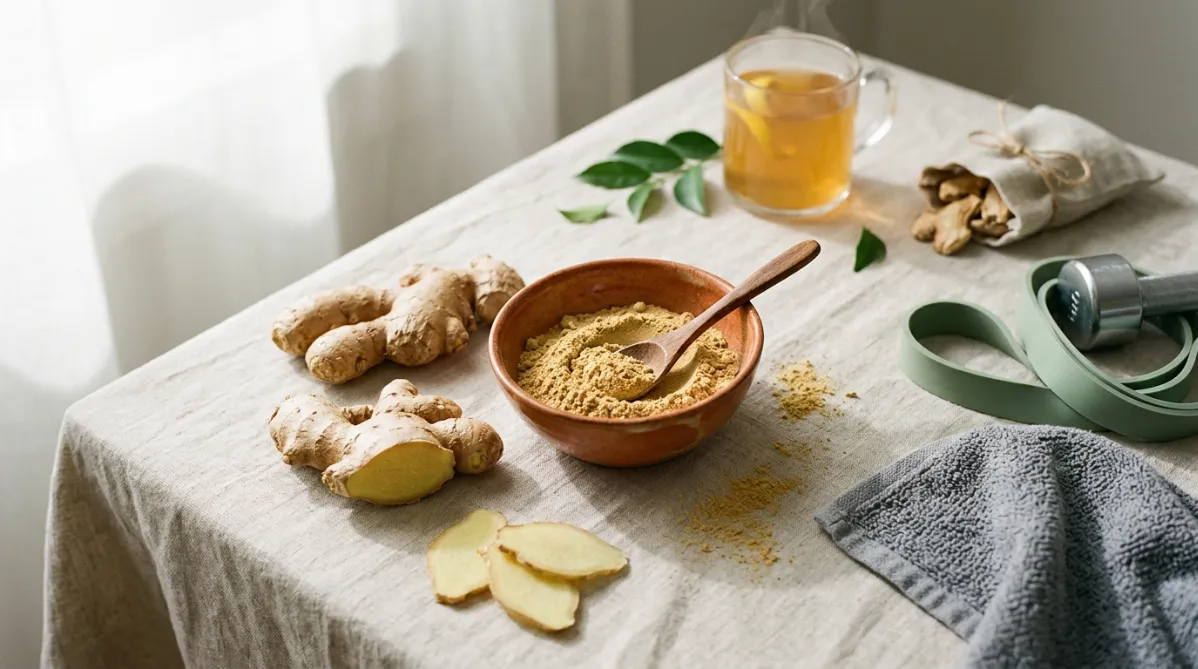
A wide, editorial-style still life photographed from slightly above on a pale oat-colored linen surface, lit by soft natural window light from the left. At the center sits a rustic ceramic bowl of finely ground golden-tan ginger powder, with a small wooden spoon resting in it and a light dusting of spice across the cloth. Beside it lie several whole ginger rhizomes, knobby and honey-brown. One is sliced open to show its pale yellow, fibrous interior, and a few paper-thin slices fan out in the foreground. On the right, a folded heather-gray gym towel, a matte sage-green resistance band coiled loosely, and a single brushed-steel dumbbell sit just inside the frame, softly out of focus. A glass of warm amber ginger tea steams faintly near the upper right, with a thin curl of lemon peel inside. A few fresh green leaves and a small linen pouch of dried ginger add texture. The palette is warm and muted: cream, soft gold, sage, terracotta, and charcoal accents. The shallow depth of field keeps the ginger bowl and sliced root crisp while the gym elements melt into a gentle blur. Shadows are long and soft, and the negative space on the upper left leaves room for a headline. The mood is calm, clean, and modern, like a contemporary wellness or science journal cover. It is a natural, tactile, high-resolution photograph with subtle film grain and no text, no people, and no futuristic elements.
recovery

2 Grams of Ginger Cut Next-Day Muscle Pain by ~25% in Two Trials

BY DR. GYMBRO ·

A common kitchen spice just went head-to-head with one of the gym's most universal complaints: next-day muscle soreness. In two double-blind trials, people who took 2 grams of ginger daily for 11 days reported roughly 25% less pain 24 hours after punishing eccentric exercise. But ginger didn't clearly improve strength or swelling, and nobody tested it against ibuprofen. Here is what the research shows, why it might work, where the evidence falls short, and who should consider trying it.

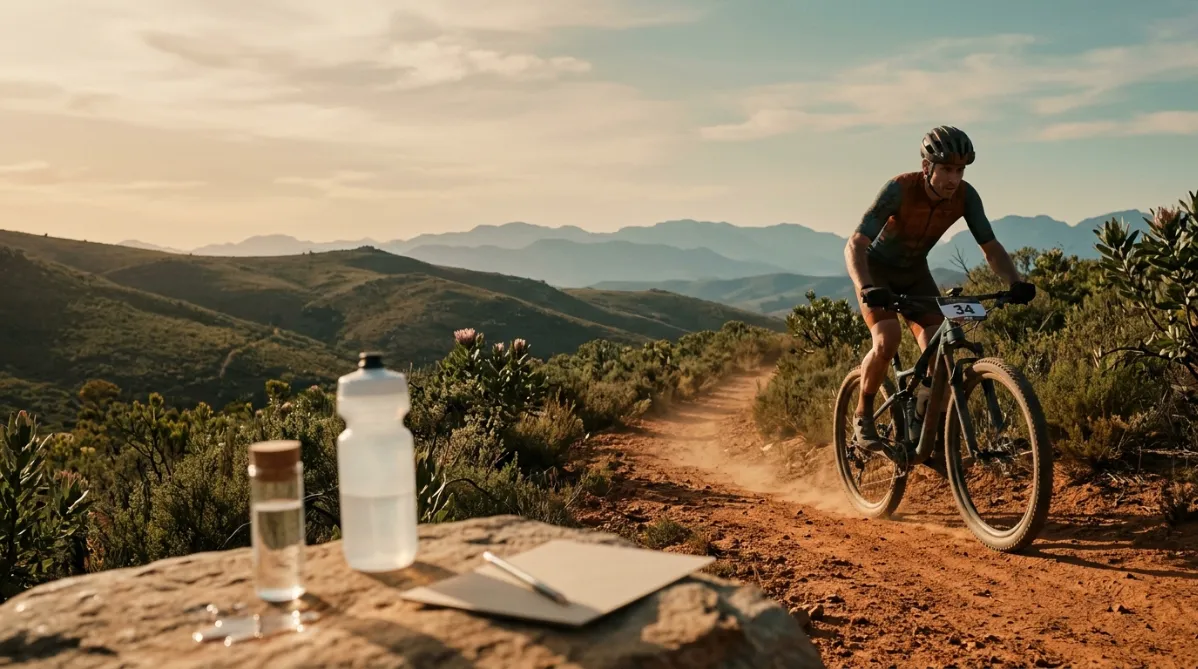
Wide landscape editorial photograph of a mountain biker mid-ride on a dusty red-orange singletrack trail in the South African Western Cape, golden hour light raking across the scene. The rider is in sharp focus on the right third of the frame, wearing a weathered cycling kit with a race number plate on the handlebars, dust kicking up from the rear tire. Behind them, rolling hills covered in fynbos shrubland and silhouetted protea plants fade into soft, hazy blue mountains. Warm amber sunlight creates long shadows and a soft rim light around the rider and bike.

In the lower left foreground, slightly out of focus, a small minimalist glass vial and a clear water bottle sit on a flat sun-bleached rock, with a few drops of liquid catching the light. Next to them, a simple matte paper notecard and a pencil suggest data collection, with no legible text. The vial and bottle are clean, understated, and modern, with no branding.

The color palette is earthy and refined: terracotta, ochre, sage green, dusty teal sky, and cream highlights. The composition uses shallow depth of field, a generous negative space in the upper left sky for headline overlay, and subtle film grain. The mood is contemplative, skeptical, and quietly sophisticated, like a feature photograph from a high-end outdoor sports and science magazine. Natural, candid, cinematic, shot on a 50mm lens with soft contrast and muted saturation. No futuristic elements, no glowing effects, no molecular graphics, no text.
science research

Ketone IQ Raised Ketones at Cape Epic, But Did Nothing Else

BY DR. GYMBRO ·

Riders at the 8-day Cape Epic drank Ketone IQ twice a day and hit about 1 mM blood ketones, yet their fatigue, heart rate, reaction time and recovery looked the same as placebo riders. The double-blind trial tested R-1,3-butanediol in real racing conditions rather than a lab. The authors say the modest ketosis was not effective, and that butanediol should not be confused with ketone esters. With only 18 riders, the study has real limits, but it is a sobering data point for anyone considering a pricey ketone drink for recovery.

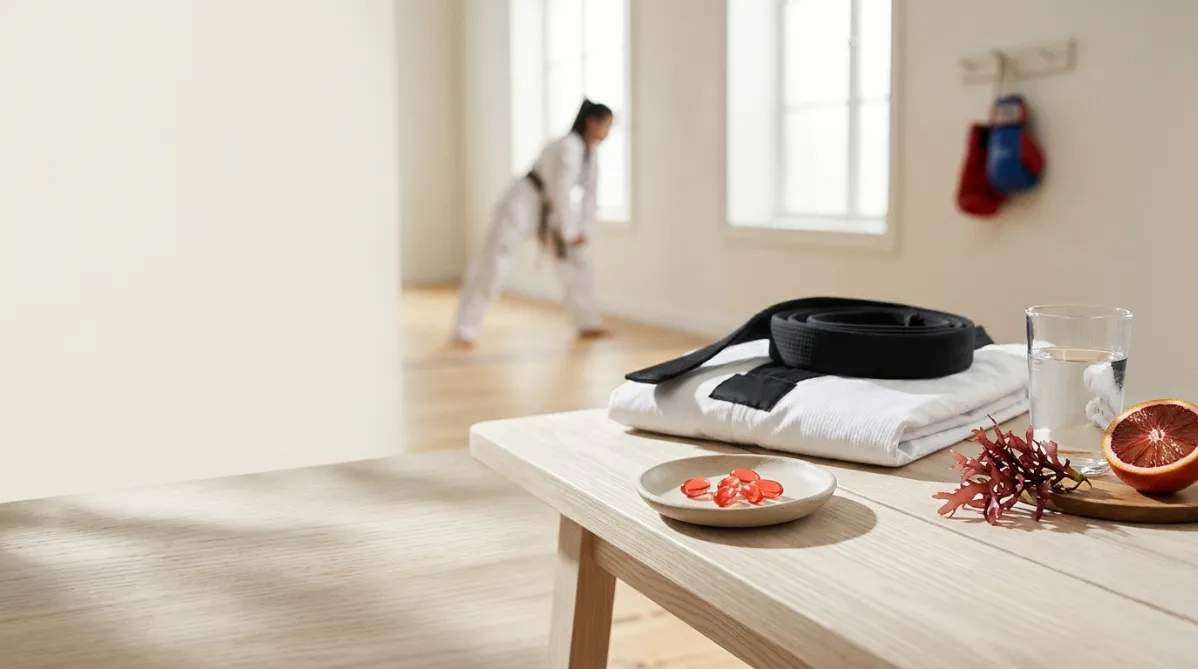
A wide editorial still life shot from a slightly elevated angle on a pale ash-wood bench in a bright, airy training hall. In the center sits a small matte ceramic dish holding a few translucent coral-red softgel capsules, their glossy surfaces catching soft window light. Beside the dish rests a folded white taekwondo dobok with a black belt loosely coiled on top. A sprig of fresh red microalgae-toned seaweed and a halved blood orange add natural color accents. A clean glass of water with subtle condensation stands to one side.

In the softly blurred background, the silhouette of a martial artist in a white uniform stretches near tall windows, with diffused morning light streaming across a sprung wooden floor. A pair of red and blue sparring gloves hangs on a minimal wall hook. Thin, elegant shadows stretch across the bench.

The palette is restrained and modern: warm off-white, soft sand, muted charcoal, with a vivid coral-red accent pulled from the capsules. Shallow depth of field, crisp focus on the capsules and dish, creamy bokeh behind. Natural, gentle lighting with a subtle film-like grain, reminiscent of a contemporary wellness and science magazine cover. Generous negative space on the left third of the frame for headline text. Calm, precise, and quietly athletic in mood, with no text, logos, or futuristic elements.
science research

12 mg Astaxanthin for 28 Days: Muscle Damage and Burnout in Fighters

BY DR. GYMBRO ·

A new randomized trial put 12 mg of daily astaxanthin to the test in young male taekwondo athletes. After 28 days, the supplement group showed a significantly different creatine kinase trajectory than placebo, plus higher SOD and exploratory signs of lower MDA and less emotional and physical exhaustion. But the burnout findings were exploratory, with no group × time interaction on any subscale. The trial was small and measured biomarkers, not performance. Here's what the data show, what they don't, and who might want to pay attention.

This page is available in