Dr. Gymbro
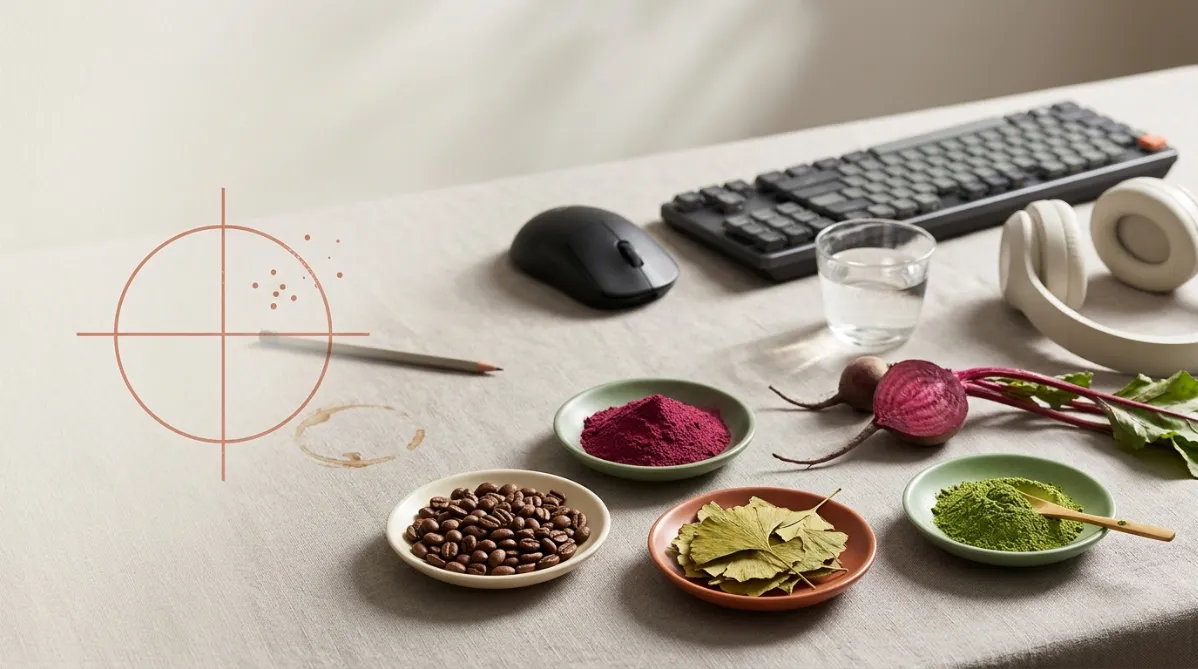
A landscape editorial still life on a softly textured warm-gray linen surface, shot from a slightly elevated three-quarter angle in diffused natural window light. In the foreground, four small ceramic dishes are arranged in a gentle arc. One holds roasted coffee beans, one holds deep magenta beetroot powder, one holds dried golden-green Ginkgo biloba leaves, and one holds bright jade matcha-style green tea powder with a tiny bamboo scoop. Each dish has a distinct, saturated color that stands out against the muted backdrop. Behind them, slightly out of focus, sits a minimalist matte-black gaming mouse beside a sleek, low-profile mechanical keyboard. A pair of matte off-white headphones rests on the right. A single fresh beetroot with its leafy stem and a halved beet showing concentric magenta rings lie casually near the dishes. A small glass of water catches the light, casting soft refracted highlights across the linen.

On the left, a clean, graphic crosshair motif is rendered as a thin circle and cross lines in soft terracotta ink, as if stamped on the paper surface, with a few tiny scattered dots clustered just off-center to hint at drifting aim. A subtle ring of coffee residue and a pencil lie near it, suggesting a researcher's desk. The color palette is warm and earthy: cream, sage green, terracotta, deep beet magenta, charcoal black, and touches of gold. The shallow depth of field gives creamy bokeh in the background, with soft shadows falling to the left. The mood is calm, modern, and intelligent, like a premium health and performance magazine cover, with generous negative space on the upper left for headline text. The composition is balanced and uncluttered, with crisp detail on the ingredients, fine natural textures like leaf veins and powder grain, and a refined, trendy editorial feel. There are no people, no text, and no futuristic elements.
Nutrition

Fried Brain, Lost Aim: Which Supplement Actually Restores It?

Dr. Gymbro · · 4 min read

You've been grinding ranked for three hours. Your crosshair feels heavy, your flicks land a few pixels off, and your tracking has gone shaky. That isn't a mechanical problem. It's a mental fatigue problem, and a new crossover trial from Wuhan Sports University suggests a few supplements might help you recover. It also suggests that some of what you hope they'll fix isn't fixable with a capsule.

What the researchers actually did

The study, published in the Journal of the International Society of Sports Nutrition, recruited 20 high-level first-person shooter athletes. Each player did a Stroop task, a classic cognitive test that induces mental fatigue by forcing you to override automatic responses. They then took one of five conditions: caffeine, nitrate (the beetroot compound), Ginkgo biloba extract, green tea catechins, or placebo. After 60 minutes of rest, they were tested on the KovaaK's aim trainer for shooting accuracy, shooting stability, spatial localization and multitasking. Heart rate variability (HRV) was recorded throughout.

The randomized crossover design is a strength. Every player acted as their own control across conditions, which cuts out much of the noise from individual differences in skill and baseline focus.

The head-to-head results

Shooting accuracy: All four supplements beat placebo after mental fatigue (all p < 0.05). There was no significant difference among them. Caffeine did not out-perform beetroot, and ginkgo did not lag behind green tea.

Shooting stability: Caffeine, nitrate and catechins produced significant recovery compared with placebo, again with no meaningful differences between them. Ginkgo was the odd one out here and did not restore stability.

Spatial localization and multitasking: None of the four supplements helped beyond placebo. Players improved on both after the rest period, but the authors attribute that to natural recovery. Sixty minutes of downtime did the work, not the supplement.

HRV: Indices such as RMSSD and SDNN shifted under some supplement conditions. The authors say this may reflect changes in autonomic regulation during recovery, but they stop short of firm conclusions.

What this means: the scoreboard is basically a tie

The headline is that there is no clear winner. If you're choosing purely on the evidence here, the question is not which supplement is best but which one fits your tolerance, schedule and rules. Caffeine, nitrate and catechins form a tier of three that helped both accuracy and stability. Ginkgo helped accuracy only.

The lack of difference between groups also doesn't prove the supplements are equal. With 20 players, the study may simply lack the statistical power to detect modest gaps between active compounds. "No significant difference" is not the same as "identical."

Practical takeaways for gamers and skill-sport athletes

The abstract doesn't report the exact doses used, so the ranges below come from the wider supplement literature, not from this trial. Treat them as general starting points, and check with a clinician if you have a medical condition or take medication.

  • Caffeine: Typically 3-6 mg/kg in sport research, though many people do well at the low end, and less if you're sensitive. Jitters can hurt fine motor control, so test it in practice, not in a tournament.
  • Nitrate (beetroot): Studies commonly use roughly 400-800 mg of nitrate, about a concentrated beetroot shot or two. It's a solid caffeine-free option, though some people get stomach upset, and it can temporarily tint urine pink.
  • Green tea catechins: Extracts providing a few hundred milligrams of EGCG are typical. Check whether the product contains caffeine, and avoid very high doses of concentrated extracts, which have been linked to liver concerns.
  • Ginkgo biloba: Around 120-240 mg of standardized extract is common. It may interact with blood thinners, so it needs more caution. Given that it was the weakest performer here, it's the lowest priority.

Timing: The protocol had players rest for 60 minutes after ingestion, so taking your chosen supplement about an hour before you need to perform is a sensible approach. Don't expect an instant boost.

Caffeine-free alternatives: If you're sensitive to stimulants, play in late-night sessions, or compete under restrictive rules, nitrate and decaffeinated catechins are the evidence-backed options here, since both improved accuracy and stability.

What no supplement will fix

The spatial localization and multitasking results are a useful reality check. Those abilities recovered with rest regardless of what players took. If your game sense, map awareness and ability to juggle information are fried, the data suggest that a break, not a capsule, is the main tool. Sleep, breaks between sessions and sensible scheduling remain the foundation.

Honest limitations

This is a small trial of 20 players, tested on one aim-trainer platform with one fatigue protocol. A Stroop task is a laboratory stand-in for the fatigue of a real tournament day, which involves stress, long hours, sleep loss and social pressure. Aim trainer scores don't necessarily translate to match performance. The HRV findings are exploratory, and the authors themselves call for further research. It's also worth noting that all four supplements beating placebo in a small sample could partly reflect expectation effects, even in a placebo-controlled design, if players could guess which pill they'd taken, as is plausible with caffeine.

Bottom line

If your aim falls apart when your brain is spent, caffeine, nitrate and green tea catechins all showed signs of restoring both accuracy and stability, with ginkgo helping accuracy only. None of them beat the others, and none rescued spatial awareness or multitasking beyond what rest already did. Pick based on your tolerance, test it in practice, take it about an hour ahead, and treat the results as promising but preliminary.
Original study

Read the original research on pubmed.ncbi.nlm.nih.gov →

This article summarizes published research for general information. It is not medical advice.

DG

Written by

Dr. Gymbro

Dr. Gymbro writes for Dr. Gymbro: science-backed fitness, nutrition & performance.

Related Articles

A wide, editorial-style photograph of a professional soccer pitch at golden hour, shot from a low angle at the edge of the grass. In the foreground, slightly off-center to the left, a pair of worn leather cleats sits beside a scatter of three small matte ceramic dishes. One holds fine white taurine powder, one holds dark roasted coffee beans, and one holds pale cream-colored softgel capsules. Soft warm light catches the textures: the grain of the beans, the powder's fine crystalline sheen, the glossy curve of the capsules. A clean white sports towel and a brushed-steel water bottle rest nearby, with a small stopwatch lying on the turf, its face softly glowing.

Behind them, the field stretches into a gentle blur. A lone player in a muted navy training kit mid-sprint leaves a faint streak of motion across the frame, with painterly bokeh from stadium floodlights and distant stands. The grass is a rich, deep green with crisp white line markings curving across the midground and leading the eye toward the athlete. Long amber shadows stretch across the pitch, and a hazy peach and pale blue sky fills the upper right, leaving open negative space for a title overlay.

The palette is restrained and modern: deep green, warm cream, soft amber, charcoal, and a touch of muted coral. The depth of field is shallow, with sharp detail on the supplements and cleats. The mood is calm, premium, and scientific without feeling clinical, like a contemporary sports-science magazine or wellness journal cover. The lighting is natural and cinematic, with gentle film grain and a subtle vignette. The composition follows the rule of thirds, with clean lines and no text, logos, or clutter.
nutrition

Taurine, Caffeine + PS Stack Gave Pro Soccer Players an Edge. The Catch?

BY DR. GYMBRO ·

Pro footballers who took taurine, caffeine and phosphatidylserine for 14 days showed more favorable 30 m sprint results, reaction times and mental fatigue scores than placebo in a 97-player randomized trial. But doubling the PS dose from 300 to 600 mg made only a modest, inconsistent difference. The authors also say the data do not prove better fatigue resistance, and PS was never tested on its own. Here is what the stack was, what it did and what it cannot tell you.

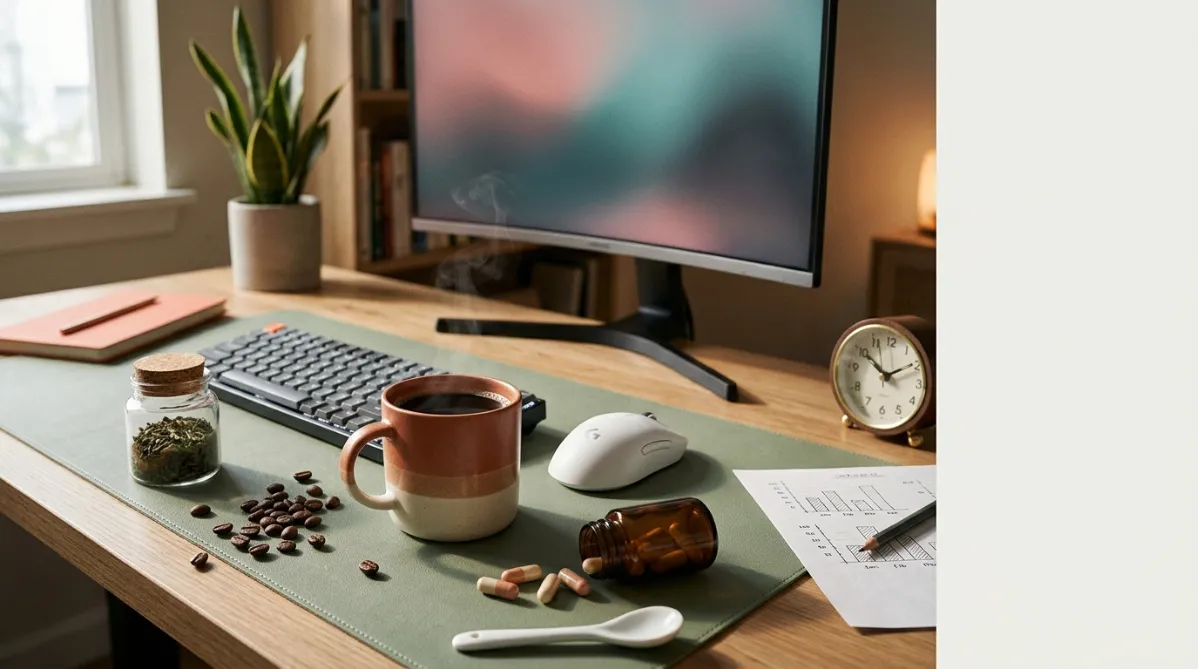
A landscape editorial still life on a softly lit desk, shot from a slightly elevated three-quarter angle with shallow depth of field. In the center sits a ceramic cup of black coffee with a thin curl of steam, on a matte sage-green desk mat. Beside it, a sleek white wireless gaming mouse and a minimal, low-profile keyboard are partly in focus. Scattered in the foreground are a few whole roasted coffee beans and a small glass jar of loose green tea leaves, as a quiet nod to caffeine sources. To the left, a few unlabeled supplement capsules in muted peach and cream spill from a small amber glass bottle onto the mat. Their blurred, ordinary look hints that they are less important than the coffee. In the background, a monitor glows with a soft, abstract, out-of-focus gradient of dusty rose and teal, with no readable game interface. A small analog alarm clock sits at the edge of the frame, its hands near late evening, suggesting sleep concerns. A sheet of paper with simple hand-drawn bar charts and a pencil rests near the cup, hinting at research and data without any legible text.

The palette is warm and modern: cream, sage, terracotta, charcoal, with a single accent of coral. Soft window light comes from the left, casting gentle long shadows and a subtle film-like grain. The composition is clean and uncluttered, with generous negative space on the right third for a title overlay. The look is contemporary and trendy, like a lifestyle-science magazine cover, calm, tactile, and sophisticated, with no sci-fi or neon cyberpunk elements.
supplements

The Gaming Supplement With Real Evidence Isn't What Ads Sell

BY DR. GYMBRO ·

Gaming supplement ads promise laser focus and lightning reflexes, but a new systematic review of 13 randomized trials (466 players) shows the evidence is mostly about one ingredient: caffeine. It appeared in 14 of 18 tested protocols and was linked to better attention, executive function, mood, and shooting accuracy and reaction time. Inositol-enhanced arginine silicate, GABA, and microalgae were also tested, but with far less backing. The authors warn that small samples, amateur players, and bias risk make the findings preliminary. Here's what the research shows, what side effects to watch for, and how to use caffeine sensibly without sacrificing sleep.

A bright, editorial flat-lay photograph shot from slightly above on a pale oat-colored linen surface in soft natural window light. At the center, a small white ceramic cup of black coffee sits on a matte saucer, with a delicate curl of steam. To its left, a shallow wooden bowl holds glossy red coffee cherries, the fruit of the coffee plant, with a few scattered on the linen and one sliced open to show the pale seed inside. To the right, three identical small amber glass vials with minimalist cream labels stand in a row, and a few loose beige capsules and a small pile of fine tan powder rest on a speckled stone dish beside them. A few roasted coffee beans are scattered casually across the composition. A thin sprig of green coffee leaves with waxy, dark foliage arcs in from the top edge. A brass measuring spoon and a folded cream notepad with a pencil sit near the lower right, hinting at a lab-style comparison without any clinical equipment. The palette is warm and restrained: terracotta red, cream, espresso brown, soft sage green, and touches of amber and brushed brass. Shadows are gentle and diffuse, with shallow depth of field that softens the background edges. The composition leaves generous negative space on the left third for title text, and the whole scene feels calm, modern, and curated, like a lifestyle and wellness magazine cover. Fine film-like grain, true-to-life color, and crisp textures in the linen weave, the glossy cherry skins, and the glass vials. No text, no logos, no people, wide 16:9 landscape framing.
science research

Coffee Fruit Extract Flopped Against 75 mg of Caffeine in a New Trial

BY DR. GYMBRO ·

Coffee fruit extract is pitched as a smarter, gentler energy boost, but a new double-blind crossover trial tested it against plain caffeine and found a surprising gap. In 28 adults, neither 100 mg nor 300 mg of coffeeberry extract shifted alertness, mental energy, mental fatigue, or cycling performance. A modest 75 mg dose of caffeine did improve alertness and mental energy for a short time. This was one acute study of single doses, so it is not the final word. Here is what the trial found, what it can't tell us, and how to read supplement labels.

A sunlit outdoor running track in late afternoon, shot from a low angle with shallow depth of field. In the foreground, a matte black bottle with a minimal off-white label sits on the edge of a warm terracotta-colored track lane, beside a folded white towel and a small glass of amber liquid catching golden light. Condensation beads on the bottle. A faint heat shimmer rises from the track surface and softens the background.

In the midground, slightly out of focus, a lean athlete in a sage-green tank top and charcoal shorts runs on a treadmill-like stretch of track, a thin sheen of sweat on their shoulders, their expression focused and calm. Their motion is gently blurred, suggesting endurance and rhythm. Long soft shadows stretch across the lane lines.

The background fades into hazy peach, apricot, and pale yellow tones, with the suggestion of tall trees and a distant stadium wall. Warm sun flare enters from the upper right, creating a subtle glow and a few soft light streaks across the frame.

Subtle editorial touches: a small notebook with a pencil and a stopwatch rest beside the bottle, hinting at data and timing without any text legible. The color palette is warm and muted, with terracotta, cream, sage, and charcoal accents, and a fine film-like grain. The composition leaves open negative space on the left third for a headline overlay. The overall mood is clean, modern, and health-journal inspired, natural and aspirational, with a calm scientific curiosity rather than hype.
nutrition

Ketone Drinks in the Heat: Longer Endurance and Sharper Memory?

BY DR. GYMBRO ·

Ketone drinks are supposed to be for fat-burning biohackers, but a new heat-stress trial suggests they might also help you finish stronger. In 17 trained men, ketone monoester plus caffeine extended time to exhaustion to 8.9 minutes versus 7.0 with carbs plus caffeine, after 90 minutes of loaded treadmill work at 34 °C. Working-memory accuracy on the 1-back task improved too, while heart rate and core temperature didn't differ meaningfully. But 2-back, reaction time and the hit-and-avoid task showed no benefit, and the study was small, male-only and single-session. Here's what the data show, and what they don't.

This page is available in