Dr. Gymbro
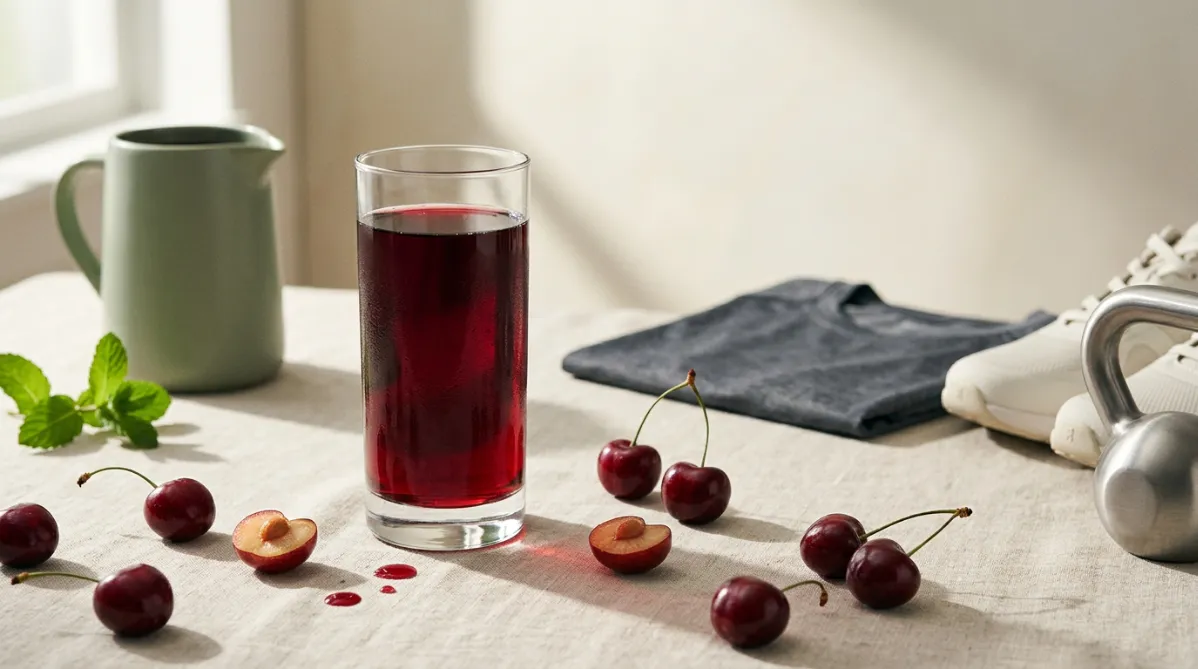
A wide, softly lit editorial still life on a pale oatmeal linen surface. In the center sits a tall, clear glass filled with deep garnet-red tart cherry juice, with condensation beading on the outside and a faint ruby glow where light passes through it. Around it are a scattering of fresh Montmorency cherries, some with stems and some halved to show pale amber flesh and a single pit. A few drops of juice have splashed onto the linen, leaving small crimson stains. To the right, slightly out of focus, lies a folded charcoal-gray running shirt, a pair of minimalist off-white running shoes, and a small brushed-steel kettlebell, suggesting both endurance and strength training without a gym in view. On the left, a ceramic pitcher in matte sage green holds more juice, and a sprig of fresh mint adds a small contrast.

Window light comes from the upper left, casting long, gentle shadows and creating a warm morning feel. The palette is restrained and modern: deep burgundy, cream, sage, and soft slate, with plenty of negative space in the upper right for headline text. The camera angle is a shallow three-quarter view from slightly above, with a shallow depth of field. The foreground cherries are razor sharp and the background melts into a creamy blur. Subtle film grain, natural color grading, and a clean, minimalist composition give it the polished feel of a contemporary health and science magazine. No text, no logos, no people, and no futuristic elements. The overall mood is calm, fresh, and restorative, hinting at recovery and balance.
Recovery

Tart Cherry Juice Trick: Faster Strength Recovery, Lower IL-6

Dr. Gymbro · · 4 min read

Marathoners swear by it, and plenty of lifters have started copying them: a couple of bottles of tart cherry juice around a brutal event. A 2010 study in the Scandinavian Journal of Medicine & Science in Sports put the habit to a placebo-controlled test. The results were mixed. Strength came back faster and key inflammation markers dropped, but some of the markers you'd most expect to move did not.

What the Study Did

The paper is "Influence of tart cherry juice on indices of recovery following marathon running" by Howatson G, McHugh MP, Hill JA, Brouner J, Jewell AP, van Someren KA, Shave RE and Howatson SA (Scand J Med Sci Sports, 2010;20(6):843-52). You can find the PubMed record here.

Twenty recreational marathon runners were assigned to either cherry juice or a placebo. The cherry group drank two 8 fl oz (~240 mL) bottles a day of a Montmorency tart cherry juice blend (Cherrypharm), one in the morning and one in the afternoon. They did this for 5 days before the marathon, on race day, and for 48 hours afterward. The placebo was a fruit-flavoured concentrate mixed with water.

Each bottle contained the juice of roughly 50-60 cherries, at least 600 mg of phenolic compounds, at least 40 mg of anthocyanins, and 32 g of carbohydrate. The researchers measured markers of muscle damage, inflammation, antioxidant status and oxidative stress before and after the race.

The Results, With the Real Numbers

Strength came back faster. Isometric strength recovered significantly faster in the cherry juice group (P=0.024). For anyone who trains again within days of a hard effort, this is the headline result.

Inflammation markers were lower. The cherry group showed reduced levels of:

  • IL-6 (P<0.001)
  • C-reactive protein, CRP (P<0.01)
  • Uric acid (P<0.05)

Antioxidant status was higher. Total antioxidant status (TAS) was about 10% greater in the cherry group than in the placebo group at all post-supplementation measurements (P<0.05).

Lipid peroxidation was lower at 48 hours. TBARS, a marker of oxidative stress, was lower in the cherry group at 48 h (P<0.05).

What Did NOT Change

The cherry story is less tidy than the marketing suggests. According to the paper, no other muscle damage indices differed significantly between groups. That means:

  • Creatine kinase was not significantly different.
  • Lactate dehydrogenase was not significantly different.
  • Muscle soreness was not significantly different.
  • Protein carbonyls, another oxidative stress marker, were not different either.

So cherry juice did not make runners less sore, and it did not reduce the usual blood markers of muscle damage. Strength recovered faster and inflammatory markers fell, but the "less damage" and "less soreness" claims are not supported by this trial.

Why It Might Work

The authors conclude that tart cherry juice appears to be a viable way to aid recovery after strenuous exercise. Their proposed route is increased total antioxidative capacity, plus reduced inflammation and lipid peroxidation, which in turn helps restore muscle function. Tart cherries are rich in phenolic compounds and anthocyanins, and each bottle in this trial carried at least 600 mg of the former and at least 40 mg of the latter.

The data fit that story: higher TAS, lower IL-6, CRP and uric acid, lower TBARS at 48 h, and faster strength return. The study can't prove that one caused the other, though. It shows a pattern, not a proven mechanism.

Limitations You Should Know

  • Small sample. Only 20 runners were studied, so the results should be treated cautiously until replicated.
  • Runners, not lifters. The participants were recreational marathoners. Whether the effects carry over to heavy resistance training is an extrapolation, not something this paper tested.
  • One product, one protocol. The results apply to a specific Montmorency blend at a specific dose and schedule.
  • Mixed outcomes. Soreness, CK and LDH didn't budge, so "faster recovery" here mainly means strength and inflammatory markers.
  • Sugar comes along for the ride. Each bottle has 32 g of carbohydrate, which matters if you're tracking intake.

A Caution on Blunting Inflammation

This is a debate in the field, not a finding of this paper. Some researchers argue that inflammation and oxidative stress are part of the signalling that drives training adaptation. On that view, constantly dampening them during regular training blocks may not be desirable. This study didn't test long-term adaptation, so it can't settle the question. A reasonable reading is that cherry juice may suit one-off, high-stress events better than daily use in every training phase.

Practical Takeaways

Dose: The study used two 8 fl oz (~240 mL) bottles per day, one in the morning and one in the afternoon.

Timing: Start about 5 days before a hard event, keep going on the day itself, and continue for 48 hours afterward.

Carbs: Each bottle has 32 g of carbohydrate, so two bottles add up. Factor that into your daily intake.

Who it may suit: Endurance athletes and lifters facing a single punishing event, such as a race, a meet, or a brutal block of sessions. They may value quicker strength return and lower inflammation markers.

Who might skip it: Anyone expecting less soreness, because the study found no significant difference there. Also anyone watching sugar or carbs closely, and anyone who prefers not to blunt inflammation during regular training phases. If you have a medical condition, check with a professional first.

Bottom Line

The cherry juice trick has real data behind it, but the data is narrower than the hype. In 20 marathoners, tart cherry juice led to faster isometric strength recovery (P=0.024), lower IL-6 (P<0.001), CRP (P<0.01) and uric acid (P<0.05), and about 10% higher antioxidant status. It did not significantly change CK, LDH or soreness. It's a promising, event-focused tool, not a magic bullet.

Source: Howatson G, et al. Scand J Med Sci Sports. 2010;20(6):843-52. PubMed | DOI
Original study

Read the original research on pubmed.ncbi.nlm.nih.gov →

This article summarizes published research for general information. It is not medical advice.

DG

Written by

Dr. Gymbro

Dr. Gymbro writes for Dr. Gymbro: science-backed fitness, nutrition & performance.

Related Articles

A sunlit, minimalist home gym corner photographed in soft golden morning light, with a young athletic man seated on a wooden bench, leaning forward with his elbows resting on his knees, catching his breath after a hard leg session. He wears a muted sage-green t-shirt and charcoal shorts, his face turned slightly away from the camera, calm and focused. A matte ceramic dish in the foreground holds a few small, translucent golden softgel capsules, with a glass of water beside it catching the light and casting a soft caustic shadow across a pale oak floor. Behind him, a loaded barbell rests on a squat rack, slightly out of focus, and a tall window pours warm sunlight diagonally across the scene, creating long gentle shadows and a hazy glow. A small potted green plant sits on a shelf at the edge of the frame. The color palette is warm and editorial: cream, soft gold, sage green, pale wood, and charcoal accents. Shallow depth of field, with crisp focus on the capsules and glass in the lower third and a creamy bokeh background. The composition leaves generous negative space on the right side for a headline overlay. The mood is clean, modern, and aspirational, like a high-end wellness magazine or a trendy health journal feature. Shot on a 50mm lens, natural light, fine film grain, subtle matte finish, landscape 16:9 framing.
recovery

Vitamin D Sped Strength Recovery in Men Who Weren't Deficient

BY DR. GYMBRO ·

Men with perfectly normal vitamin D levels still recovered strength faster after a brutal leg workout when they took 4,000 IU daily. In this randomized, placebo-controlled trial of 28 active men, peak isometric force bounced back about 8% better at 24 hours. Muscle-damage markers ALT and AST also rose less. But there's a twist: soreness didn't improve at all. Here's what the study found, where it falls short, and who might actually care.

Wide landscape editorial photograph of a mountain biker mid-ride on a dusty red-orange singletrack trail in the South African Western Cape, golden hour light raking across the scene. The rider is in sharp focus on the right third of the frame, wearing a weathered cycling kit with a race number plate on the handlebars, dust kicking up from the rear tire. Behind them, rolling hills covered in fynbos shrubland and silhouetted protea plants fade into soft, hazy blue mountains. Warm amber sunlight creates long shadows and a soft rim light around the rider and bike.

In the lower left foreground, slightly out of focus, a small minimalist glass vial and a clear water bottle sit on a flat sun-bleached rock, with a few drops of liquid catching the light. Next to them, a simple matte paper notecard and a pencil suggest data collection, with no legible text. The vial and bottle are clean, understated, and modern, with no branding.

The color palette is earthy and refined: terracotta, ochre, sage green, dusty teal sky, and cream highlights. The composition uses shallow depth of field, a generous negative space in the upper left sky for headline overlay, and subtle film grain. The mood is contemplative, skeptical, and quietly sophisticated, like a feature photograph from a high-end outdoor sports and science magazine. Natural, candid, cinematic, shot on a 50mm lens with soft contrast and muted saturation. No futuristic elements, no glowing effects, no molecular graphics, no text.
science research

Ketone IQ Raised Ketones at Cape Epic, But Did Nothing Else

BY DR. GYMBRO ·

Riders at the 8-day Cape Epic drank Ketone IQ twice a day and hit about 1 mM blood ketones, yet their fatigue, heart rate, reaction time and recovery looked the same as placebo riders. The double-blind trial tested R-1,3-butanediol in real racing conditions rather than a lab. The authors say the modest ketosis was not effective, and that butanediol should not be confused with ketone esters. With only 18 riders, the study has real limits, but it is a sobering data point for anyone considering a pricey ketone drink for recovery.

A wide editorial still life shot from a slightly elevated angle on a pale ash-wood bench in a bright, airy training hall. In the center sits a small matte ceramic dish holding a few translucent coral-red softgel capsules, their glossy surfaces catching soft window light. Beside the dish rests a folded white taekwondo dobok with a black belt loosely coiled on top. A sprig of fresh red microalgae-toned seaweed and a halved blood orange add natural color accents. A clean glass of water with subtle condensation stands to one side.

In the softly blurred background, the silhouette of a martial artist in a white uniform stretches near tall windows, with diffused morning light streaming across a sprung wooden floor. A pair of red and blue sparring gloves hangs on a minimal wall hook. Thin, elegant shadows stretch across the bench.

The palette is restrained and modern: warm off-white, soft sand, muted charcoal, with a vivid coral-red accent pulled from the capsules. Shallow depth of field, crisp focus on the capsules and dish, creamy bokeh behind. Natural, gentle lighting with a subtle film-like grain, reminiscent of a contemporary wellness and science magazine cover. Generous negative space on the left third of the frame for headline text. Calm, precise, and quietly athletic in mood, with no text, logos, or futuristic elements.
science research

12 mg Astaxanthin for 28 Days: Muscle Damage and Burnout in Fighters

BY DR. GYMBRO ·

A new randomized trial put 12 mg of daily astaxanthin to the test in young male taekwondo athletes. After 28 days, the supplement group showed a significantly different creatine kinase trajectory than placebo, plus higher SOD and exploratory signs of lower MDA and less emotional and physical exhaustion. But the burnout findings were exploratory, with no group × time interaction on any subscale. The trial was small and measured biomarkers, not performance. Here's what the data show, what they don't, and who might want to pay attention.

A wide, editorial-style still life photographed in soft natural window light, set on a pale oak gym bench or light wooden table. In the foreground, a matte ceramic scoop rests in a small mound of fine white creatine powder, with a few loose grains scattered across the surface. Next to it sits a minimalist frosted glass jar with a plain unbranded label. Beside the jar is a clear glass of water with delicate condensation. A pair of worn chalk-dusted hands is out of focus in the background, wrapping a lifting strap around a barbell. The barbell is a brushed steel bar with a few muted sage-green and warm gray bumper plates.

On the right side of the frame, a small stack of three different supplement capsules and tablets in neutral cream, terracotta, and soft blue sits next to a single clean white scoop of powder. This subtly contrasts the "stack" with the "plain" option. A folded linen towel in oatmeal beige drapes over the end of the bench. A small leather-bound notebook lies open, with a simple hand-drawn line graph showing two lines, one rising steadily and one flat, in pencil.

The background is softly blurred and shows a bright, airy, modern home gym with large windows, pale plaster walls, and a few green plants. Warm morning sunlight casts long, gentle shadows diagonally across the scene. The color palette is muted and sophisticated: cream, warm white, sage green, soft terracotta, and charcoal accents. Shallow depth of field with a crisp focus on the powder and scoop. Generous negative space on the left third for headline overlay. The mood is calm, thoughtful, and trustworthy, like a high-end health and science magazine cover, with subtle film grain and natural textures. No text, no logos, no futuristic elements.
nutrition

Creatine Stack Built Muscle in Beginners—But Not Strength. Why?

BY DR. GYMBRO ·

A new randomized trial gave novice lifters a creatine-based supplement blend for four weeks and found more muscle mass, a better testosterone/cortisol pattern, and improved recovery. Yet leg press 1RM improved no more than with placebo. The reasons may include beginner neural gains, a short study window, and early water retention, though the paper can't prove which. Kidney markers stayed normal, but the study was small, men-only, industry-funded, and didn't detail the full formula. For new lifters, the safest evidence-based move is still plain creatine monohydrate.

This page is available in