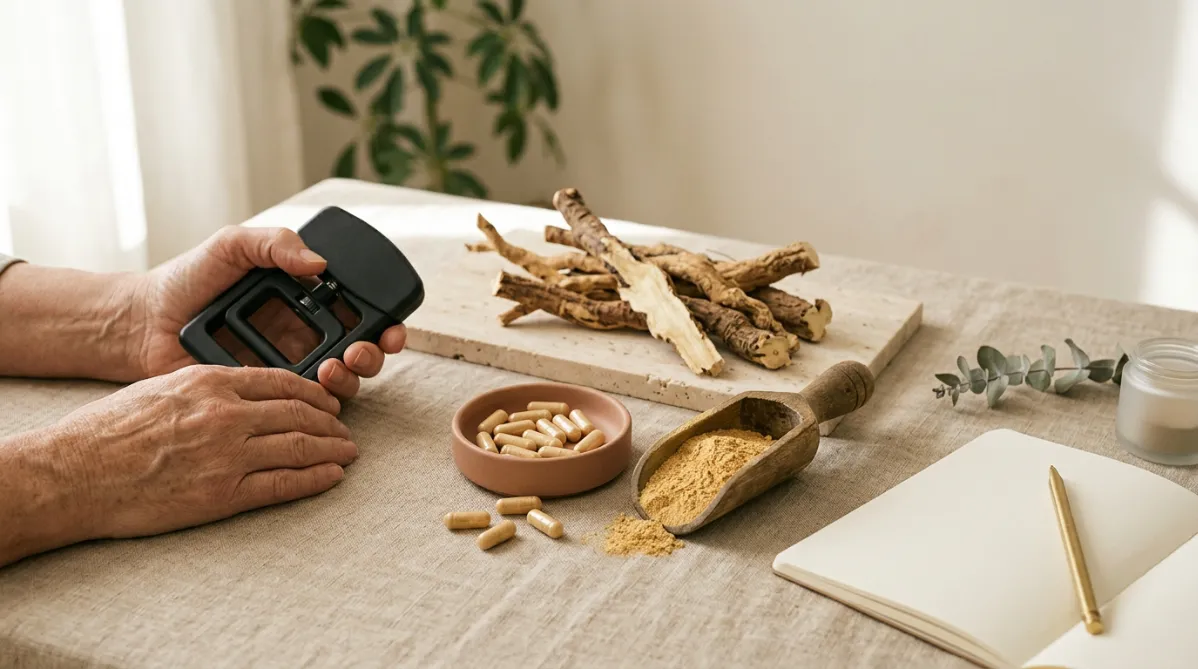
A Southeast Asian root with a cult following in the testosterone-booster aisle just got a small but interesting piece of human data. In a pilot study, 25 active seniors took 400 mg of Tongkat Ali extract a day for 5 weeks. Both total and free testosterone rose, and so did muscle force. Before you add it to your cart, here is what the study showed and what it didn't.
What the Study Did
The paper is Tongkat Ali as a potential herbal supplement for physically active male and female seniors: a pilot study by Henkel RR, Wang R, Bassett SH, Chen T, Liu N, Zhu Y and Tambi MI. It was published in Phytotherapy Research in 2014 (Epub 2013) and is indexed on PubMed (DOI: 10.1002/ptr.5017).
The researchers recruited 13 physically active men and 12 physically active women aged 57 to 72. Each person took 400 mg of Tongkat Ali (Eurycoma longifolia) extract daily for 5 weeks.
The team tracked a wide panel of markers:
- Total and free testosterone
- Dihydroepiandrosterone (DHEA)
- Cortisol
- Insulin-like growth factor-1 (IGF-1)
- Sex hormone-binding globulin (SHBG)
- Blood urea nitrogen (a kidney function marker)
- Creatine kinase (a muscle damage marker)
- Standard blood counts
- Muscle strength, measured with a simple handgrip test
The Results: What Actually Moved
The headline finding is that treatment produced significant increases in total and free testosterone and in muscular force, in both men and women. The authors say this affirms the ergogenic (performance-supporting) benefit of Tongkat Ali through enhanced muscle strength.
There were some other details:
- Men and women still differed after treatment. Hemoglobin, testosterone, DHEA, the total testosterone/cortisol ratio and muscle force all remained significantly lower in the women than in the men. Women improved, but they did not close the gap.
- Women's free testosterone rose because SHBG fell. The authors attribute the increase to a significant decline in sex hormone-binding globulin, the protein that binds testosterone in the blood.
- Red blood cell markers edged up in men. Hematocrit and erythrocyte count increased slightly in the men and were significantly higher than in the women.
The abstract does not report percentage changes or absolute hormone values, so we won't quote any. The "real numbers" here are the design and the direction of the effect: 25 people, 400 mg, 5 weeks, and significant rises in testosterone and strength.
Why It Might Work
The paper's starting point is that Tongkat Ali is known to raise testosterone and to ease symptoms of aging in males. The only mechanism the abstract points to is the SHBG drop in women. Less binding protein means more free, usable testosterone. That is a plausible lead, but the study wasn't built to prove how the herb works. Any explanation beyond that is speculation.
It also makes sense that the researchers measured grip strength. Testosterone is linked to muscle function, so a hormonal rise alongside a strength gain fits together. But the study can't show that one caused the other.
Limitations: Promising, Not Proof
This is a small, uncontrolled pilot. Treat the findings accordingly:
- No placebo group. The design is before-and-after, so the study can't separate the supplement's effect from expectation, practice effects on the grip test, or natural variation.
- Only 25 participants. The groups are tiny, especially once you split by sex.
- Active 57-72 year olds. Older adults often have lower baseline testosterone, so there may be more room to improve. Results in young lifters with healthy hormone levels may differ, and may be smaller.
- Handgrip is a narrow strength test. It doesn't tell you whether squat, bench or deadlift numbers would change.
- Only 5 weeks. Long-term safety and durability of the effects weren't addressed.
- Small shifts in red blood cell markers in men are worth noting. They are a reason to monitor bloodwork rather than assume everything is harmless.
The authors call it a pilot and a "potential" supplement for good reason. This is a green light for better trials, not a verdict.
Who Might Want to Try It (and Who Should Skip It)
Potentially interested: active adults, especially older lifters, curious about a natural option with at least some human data behind it, who are willing to treat it as an experiment.
Be cautious or skip it:
- Anyone taking prescription medication, since interactions haven't been addressed here.
- Anyone with hormone-sensitive conditions.
- Anyone with blood-count or kidney concerns, given the markers the study monitored.
- Anyone expecting steroid-like results. Nothing in this paper supports that.
Practical Takeaways
- Dose used in the study: 400 mg per day of Tongkat Ali extract.
- Duration: 5 weeks. The study doesn't tell us what happens beyond that.
- Timing: the abstract doesn't specify a time of day, so there is no evidence-based timing rule here.
- Quality matters: supplements vary widely. Look for a standardized extract with third-party testing, and match the product to the 400 mg/day used in the research.
- Talk to a doctor first if you're on medication or have a hormone-sensitive condition. Baseline and follow-up bloodwork is smart if you're doing this seriously.
- Keep the basics first. Training, protein, sleep and calories will do more for your strength than any herb.
Bottom Line
Tongkat Ali's reputation as a testosterone booster got a modest boost from this study. Twenty-five active seniors saw significant rises in testosterone and muscle force after 5 weeks at 400 mg a day. But with no placebo group and a very small sample, it is a reason for larger controlled trials, not a reason to expect the same in a 25-year-old lifter. Read the full record on PubMed.