Dr. Gymbro
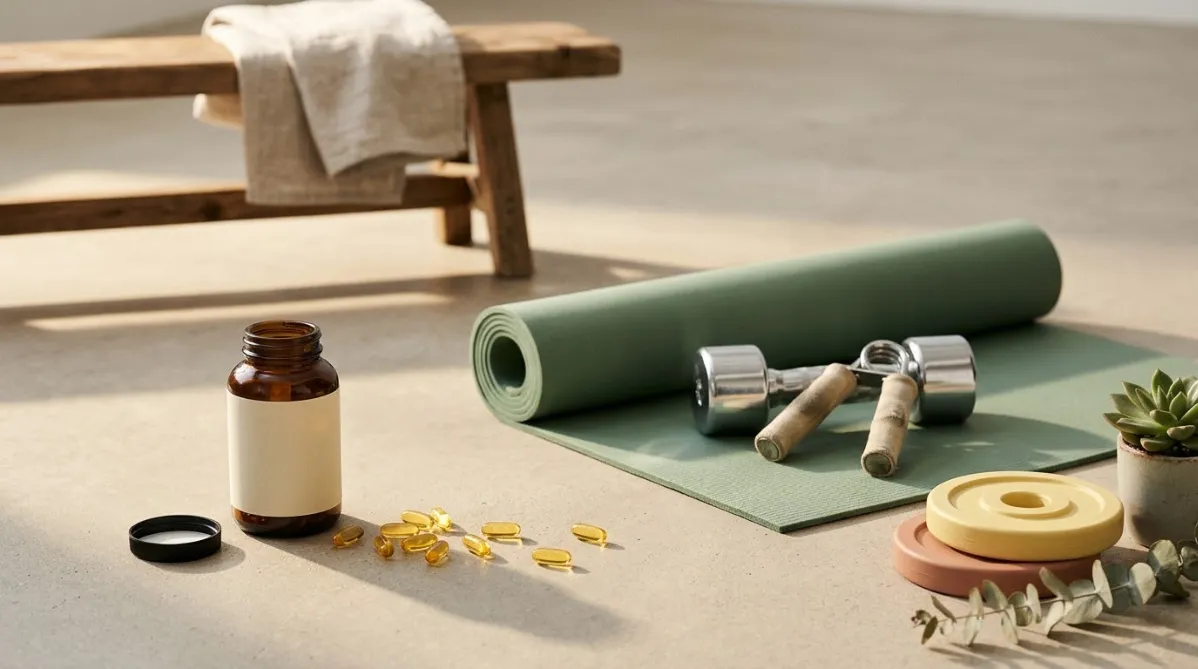
A soft-lit editorial still life on a pale warm-gray concrete surface, shot from a slightly elevated three-quarter angle in a wide landscape frame. On the left, a single amber glass supplement bottle with a minimalist cream label, its lid set beside it. A few golden-yellow softgel capsules are scattered in a loose arc across the surface, catching the light like small drops of honey. At the center-right, a matte sage-green yoga mat is partly unrolled, with a polished chrome dumbbell resting on it. Next to the dumbbell sits a worn canvas hand gripper, a nod to the handgrip finding. Behind them, a wooden gym bench is slightly out of focus, and a folded linen towel sits on top of it.

Warm morning sunlight enters from the upper left through a large window. It casts long, gentle diagonal shadows and a faint golden glow across the scene, a quiet reference to vitamin D and sunshine. A sprig of dried eucalyptus or a small potted succulent adds an organic touch near the bottom right. A small, neatly stacked pile of two or three matte pastel-toned weight plates in butter yellow and dusty terracotta adds color blocking.

The palette is muted and modern: butter yellow, sage, warm sand, soft terracotta, and off-white, with a single strong amber accent from the bottle. The depth of field is shallow, with crisp focus on the capsules and bottle and a creamy blur falling off toward the background. The negative space on the upper right is clean and uncluttered, which leaves room for a headline overlay. The overall feel is calm, minimalist, and contemporary, like a premium health and wellness magazine or a trendy online journal. The grain is subtle, the contrast gentle, and the textures tactile: brushed metal, frosted glass, linen, and concrete. There are no people, no text, and no futuristic elements.
Science & Research

Vitamin D Won't Shred You or Build Muscle, With One Exception

Dr. Gymbro · · 4 min read

If you've been stacking vitamin D on top of your training in hopes of leaner abs and bigger lifts, a new meta-analysis has some blunt news. Vitamin D reliably raised blood levels of vitamin D. It did not make people leaner, and it did not make them meaningfully stronger across the board. There is one exception worth knowing about, and it matters most if you're older or running low on the vitamin.

The Study: 28 Trials, 1,675 Adults

The paper, published in Nutrition Reviews, is a systematic review and dose-response meta-analysis of randomized controlled trials. The researchers searched PubMed, Web of Science, and Scopus through April 1, 2024. They included studies that compared vitamin D supplementation plus exercise against exercise alone.

That comparison is the important part. The question was not whether exercise works. It was whether adding vitamin D gives you something extra. In total, 28 studies with 1,675 participants were pooled. Outcomes included blood 25-hydroxyvitamin D [25(OH)D], body weight, BMI, fat mass, body fat percentage, fat-free mass, and strength measured by handgrip, leg press, and knee extension. The authors also used fractional polynomial modeling to test whether dose (IU per week) and intervention length changed the results.

What Worked: Blood Levels Went Up

The supplement did its basic job. Vitamin D plus exercise raised 25(OH)D by a weighted mean difference of 34.11 nmol/L compared with exercise alone (P = .001). The increase appeared in both healthy and unhealthy adults.

This tells us the pills were absorbed and the trials were not failing on delivery. When body composition didn't budge, it wasn't because the vitamin D never reached the bloodstream. Raising a lab value is not the same as improving how you look or perform, and this analysis shows how far apart the two can be.

What Didn't Work: Body Composition

The fat-loss and muscle-building hopes did not hold up. The analysis found no significant effects on:

  • Body weight
  • BMI
  • Fat mass
  • Body fat percentage
  • Fat-free mass

All of these came back with P > .05. The authors concluded that vitamin D plus exercise does not improve body composition more than exercise alone. If your goal is to drop fat or add lean mass, the training and the diet are doing the work. Vitamin D, at least in these trials, was not adding to it.

Strength: Mostly a Miss, With One Exception

Strength results were mixed and mostly underwhelming. Leg press strength showed no significant benefit. Knee extension strength did improve modestly, by 4.36 kg (P = .039). Handgrip strength improved significantly in older adults and in those receiving higher vitamin D doses.

That's the exception, and it deserves careful framing. The knee extension gain was modest, and the authors' overall conclusion was that muscular strength was not significantly affected. The handgrip finding was limited to specific subgroups: older adults and higher-dose regimens. Handgrip is a simple measure often used as a marker of general strength in aging, but this paper does not show that vitamin D transforms performance in younger, healthy lifters.

Who Might Actually Benefit

The signals point toward particular groups rather than everyone:

  • Older adults: This was the group where handgrip gains showed up.
  • People receiving higher doses: Higher dosing was linked to handgrip improvement, though that should not be read as a green light to megadose on your own.
  • People with low vitamin D: The abstract does not detail baseline status, but raising levels is where the supplement clearly delivered, so those who are deficient have the clearest reason to supplement.

Practical Takeaways

1. Don't buy vitamin D as a body-composition supplement. Across five body composition outcomes, there was no added benefit over exercise alone.

2. Test before you supplement. A blood test for 25(OH)D tells you whether you have a gap to fill. Supplementing blindly is the weakest version of this strategy.

3. Older adults have the strongest case. If you're older and training, the handgrip results are encouraging, and it's worth discussing with a clinician.

4. Keep expectations realistic. A 4.36 kg bump in knee extension is modest, and leg press showed nothing.

5. Prioritize the fundamentals. Progressive resistance training, adequate protein, calorie control, and sleep still drive the results this study found vitamin D could not improve.

Limitations and Context

This is a pooled analysis of randomized trials, which is strong evidence for the specific question asked. Still, the findings reflect the populations, doses, and durations of the included studies. The abstract notes that subgroup and dose-response analyses were performed, and the strength benefits appeared only in certain subsets. Those subgroup findings are best treated as signals for future research rather than firm guarantees.

The Bottom Line

Vitamin D plus exercise lifted blood levels by about 34 nmol/L, but it did not shred fat, add lean mass, or boost leg press strength beyond training alone. The modest wins in knee extension and handgrip, especially in older adults and at higher doses, are the exception. Fix a deficiency if you have one, but don't expect a vitamin to do the job of the barbell.

Original study

Read the original research on pubmed.ncbi.nlm.nih.gov →

This article summarizes published research for general information. It is not medical advice.

DG

Written by

Dr. Gymbro

Dr. Gymbro writes for Dr. Gymbro: science-backed fitness, nutrition & performance.

Related Articles

A softly lit, minimalist strength-training studio photographed in a modern editorial style. In the foreground, a matte black barbell loaded with weight plates rests on a light oak platform, with fine chalk dust floating in warm morning light. Beside it on a pale concrete bench sits a simple ceramic scoop of white creatine powder, with a small spill of fine crystals catching the light, next to a minimal frosted glass jar with no label. A matte sage-green shaker bottle and a folded cream towel sit nearby. In the soft-focus background, tall windows let in diffused golden sunlight, casting long, gentle shadows across the floor. A rack of neatly arranged dumbbells is blurred in muted charcoal tones.

The color palette is calm and sophisticated: warm off-white, sand, sage green, soft charcoal, and touches of terracotta. A small open notebook with a pencil lies on the bench, suggesting research and data tracking, with abstract hand-drawn bar graph lines faintly visible on the page but not legible. The composition follows the rule of thirds, with the barbell and powder on the left and generous negative space on the right for headline text. Shallow depth of field, crisp textures on the metal knurling and powder grains, subtle film grain, and a contemporary wellness-magazine look. Clean, airy, and editorial, with a grounded, scientific yet approachable mood. Landscape 16:9 composition.
science research

Creatine Plus Lifting: Bigger Strength Gains, No Dosing Winner

BY DR. GYMBRO ·

A meta-analysis of 63 studies and 1,489 participants asked how much creatine adds on top of lifting. The strength boost was moderate and consistent in both upper and lower body, while the lean mass gain was smaller and fat mass didn't significantly change. The surprise is that dosing strategy, daily dose and protocol did not significantly influence the results. Age emerged as the one exploratory clue, with larger strength effects in younger participants. Here is what the paper actually found, and what it can't tell you.

A wide, editorial-style still life photographed in soft natural window light on a pale oak gym bench. In the foreground, a small rustic ceramic bowl in warm sand tones holds a mound of fine golden-beige ashwagandha root powder, with a few dried gnarled ashwagandha roots and a sprig of green leaves with tiny orange-red berries resting beside it. A wooden scoop dusted with powder lies at an angle. Just behind, a matte black barbell with a single chalk-dusted steel plate sits slightly out of focus, a light haze of white chalk hanging in the air and catching the sunlight.

On the left side, a neat stack of printed research papers with a sharp black pen and a few muted sage-green sticky tabs. One page shows a simple, abstract forest-plot-style line graph with small squares and horizontal lines, subtly out of focus, hinting at statistics without legible text. A pair of minimal round reading glasses rests on the pages. A small linen gym towel is folded near the edge of the bench.

The palette is restrained and modern: warm cream, soft sage green, muted terracotta, charcoal black, and brushed steel highlights. The background is a softly blurred minimalist studio space with a pale plaster wall and a long soft shadow cast by a window frame, giving a calm, contemplative mood. Shallow depth of field, crisp detail on the powder and roots, gentle film-like grain, and generous negative space on the right third of the frame for a headline overlay. The overall look is a clean, trendy health-and-science journal cover, thoughtful and skeptical rather than promotional, balancing the natural herbal element against the discipline of strength training.
nutrition

Ashwagandha for Lifters: Strength Boost or Statistical Mirage?

BY DR. GYMBRO ·

Ashwagandha is sold to lifters as a strength and size booster, and a new meta-analysis of resistance-training RCTs found bench and squat 1RM gains that look impressive on paper. But only three trials with 161 participants could be pooled. Both strength results lost significance under stricter HKSJ testing, and each leaned on a single influential trial. GRADE rated the evidence low to very low, and there was no dependable effect on body fat. Here is what the review actually shows, and who might still want to try it.

A landscape editorial photograph of a rustic kitchen table in soft morning window light. On a weathered light oak surface, a loose arrangement of fresh red onions, a few halved to show their purple-white rings, and crisp red and green apples, one sliced open to reveal pale flesh. A small ceramic bowl holds a pinch of golden-yellow quercetin powder, with a wooden spoon resting beside it. In the softly blurred background, an older woman in a cream linen shirt lifts a modest dumbbell near a sunlit window, her posture strong and relaxed. Her silhouette is out of focus, which keeps the produce as the main subject.

The palette is warm and natural: deep magenta onion skins, glossy apple reds, buttery yellow accents, and creamy neutrals. A gentle shallow depth of field gives creamy bokeh in the background. The light is diffused and golden, with delicate shadows and a few dried onion skin flakes scattered across the wood for texture. A folded linen napkin and a small sprig of thyme add a curated, modern lifestyle-magazine feel.

The composition follows the rule of thirds, with the produce at lower left and negative space on the right, where the blurred lifter and window glow provide balance. The overall look is clean, calm, and contemporary, like a premium health and wellness journal cover: natural, tactile, and optimistic, with fine film-like grain and true-to-life color.
nutrition

Quercetin Tripled Strength Gains in Older Lifters—Without More Muscle

BY DR. GYMBRO ·

A cheap flavonoid found in onions and apples may have just boosted strength gains in older lifters far beyond what training alone delivered. In a randomized, double-blind trial, older adults taking 200 mg/day of quercetin glycosides gained about 15% in knee strength over six weeks, versus about 5% on placebo. Strangely, muscle mass didn't change in either group. The edge appeared to come from the nervous system, with higher-threshold motor units firing faster. Here's what the study found, how to apply it, and why the small sample demands caution.

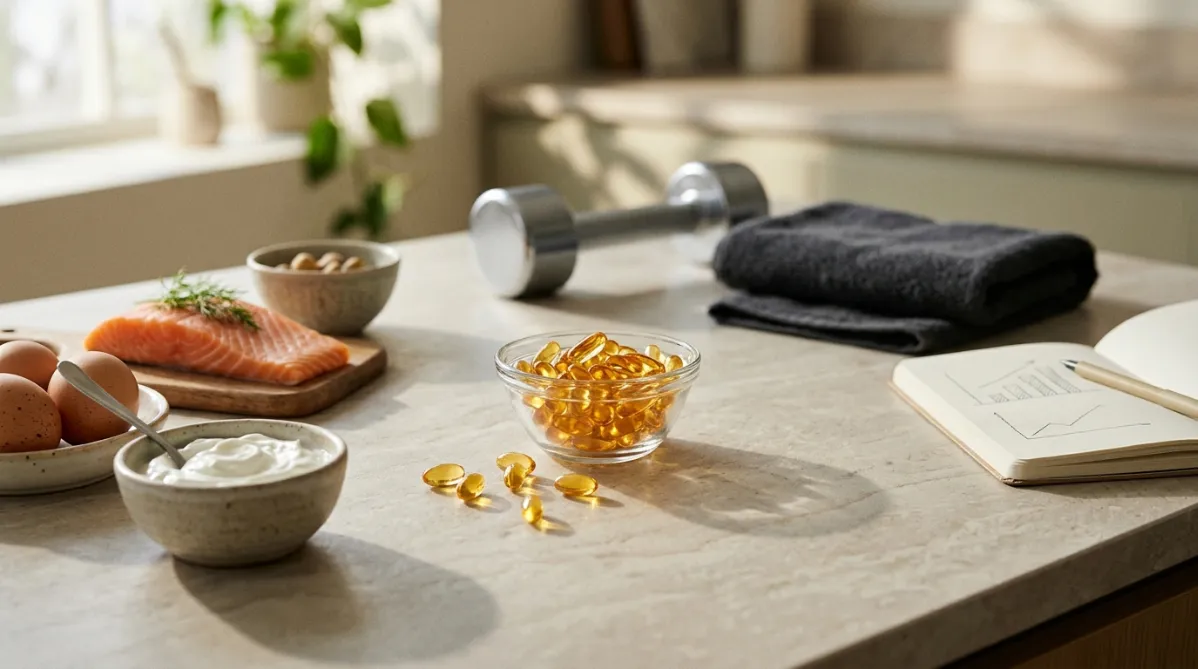
A bright, modern editorial still life shot from a slightly elevated angle on a pale warm-gray stone countertop, bathed in soft natural window light with gentle diffused shadows. In the center, a small glass bowl holds a scatter of translucent golden-amber fish oil softgel capsules, a few spilled casually onto the surface and catching the light like tiny glowing beads. Beside the bowl sits a single chrome dumbbell with a matte finish, slightly out of focus, and a neatly folded charcoal gym towel. To the left, a clean arrangement of alternative "better spent" items: a ceramic dish of raw eggs, a wedge of salmon fillet on a wooden board with a sprig of dill, and a small bowl of Greek yogurt with a spoon, all styled with restraint. A minimalist notebook with a thin pen lies at the right edge, with faint, abstract pencil-drawn bar charts and a flat horizontal line suggesting "no effect," legible only as soft shapes with no readable text. The color palette is muted and sophisticated: warm cream, soft sage green, sandy beige, and pops of golden amber from the capsules, with a single accent of coral from the salmon. Shallow depth of field keeps the capsules crisp while the background melts into a creamy blur of a sunlit kitchen with a hint of green plant leaves. The composition leaves generous negative space on the right third for title overlay, in a 16:9 landscape format. The mood is calm, thoughtful, and quietly skeptical, in the style of a contemporary health and science magazine, with a crisp editorial photography look, fine grain, and natural color grading. No people, no futuristic elements, and no text.
science research

Fish Oil for Gains? 8 Trials Say Don't Count on It

BY DR. GYMBRO ·

Fish oil has long been sold as a recovery and muscle-building booster, but a new meta-analysis in Nutrition says the evidence isn't there. Pooling four trials for fat-free mass and eight trials (22 effects) for strength in healthy non-obese adults, researchers found no clear benefit for either. The strength result was essentially zero, while the fat-free mass estimate was too imprecise to say anything. Certainty of evidence was very low, so this isn't proof of no effect, but it's no reason to buy fish oil for gains. Here's what the numbers mean and where your money is better spent.

This page is available in