What is CBL-514? Does it burn fat?
Say "fat-burning injection" and most lifters picture one of two things: a cut-cycle supplement stack or an Ozempic-style weight-loss shot. CBL-514 is neither. It is an investigational, small-molecule injection lipolysis drug from Caliway Biopharmaceuticals. In clinical trials it is given as many subcutaneous shots into a marked patch of abdominal fat, with the goal of shrinking that local pad, not dropping scale weight. (If you searched "CL-514," that is a common typo. The compound is CBL-514.)
What CBL-514 actually is
CBL-514 is an investigational injectable intended for targeted reduction of abdominal subcutaneous fat. It is not a supplement, not an oral pill, and not an approved consumer product. As of the Phase 2 paper, it is not FDA-approved. Investigators administer it in a clinical trial setting, not at a gym or from a vendor.
The only FDA-approved injectable for fat reduction mentioned in the paper is ATX-101 (deoxycholic acid, sold as Kybella). It is approved only for submental, or under-chin, fat. That context matters because CBL-514 is aimed at a much larger area, the abdomen, but it remains in the research pipeline.
The papers do not disclose CBL-514's chemical structure or exact chemical identity. Any website listing an "ingredient breakdown" or a receptor profile is guessing.
The proposed mechanism: fat-cell death, not calorie burning
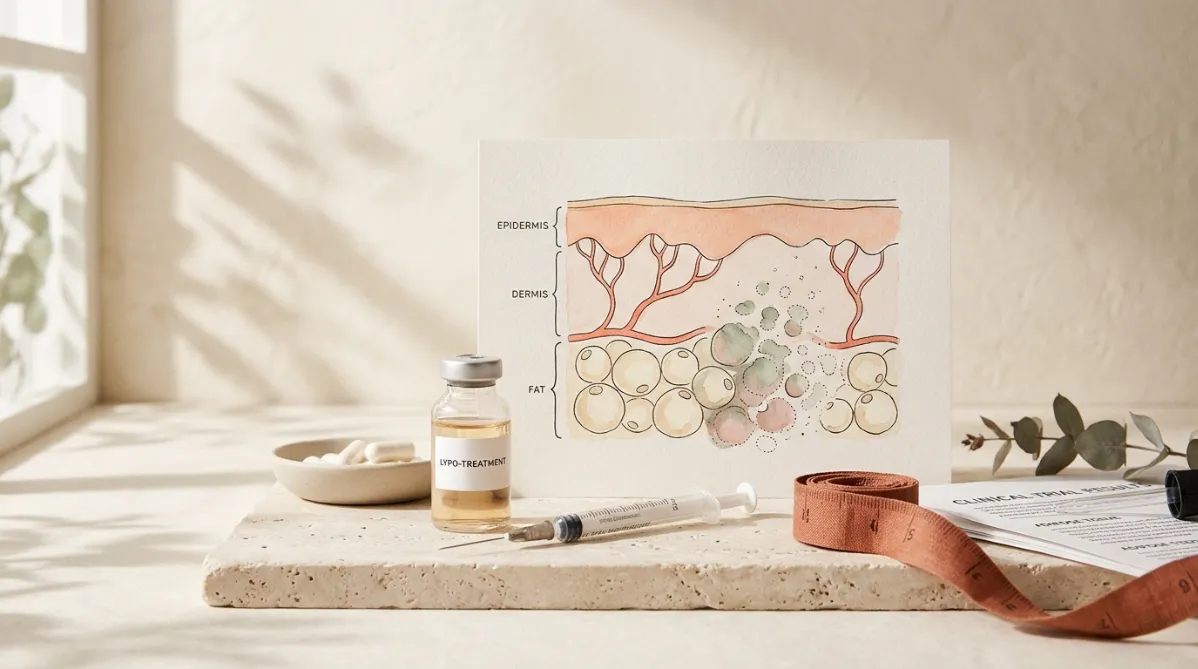
According to the authors, CBL-514 is a small-molecule injection lipolysis agent that promotes adipocyte apoptosis, meaning programmed fat-cell death, and targeted subcutaneous fat reduction in nonclinical studies. Those claims rest on animal and in vitro work, including unpublished confidential company reports and an earlier, smaller, open-label Phase 2a study. That earlier paper reported that CBL-514 inhibits the cell survival kinase DYRK1b and upregulates apoptosis mediators such as caspase 3 and Bax/Bcl-2.
None of this describes a drug that raises metabolic rate, increases energy expenditure, or suppresses appetite. The idea is to kill fat cells in the injected zone and let the body clear them. That is why "burn fat" is a misleading frame.
The human evidence: a 2025 Phase 2 trial
The main human data come from a randomized, single-blind, placebo-controlled Phase 2 trial in Aesthetic Surgery Journal (2025;45(6):611-620). It enrolled participants at five centers in the United States and Australia. Of 76 randomized, 50 were assigned to CBL-514 and 26 to placebo (normal saline). Participants received up to four treatments at 4-week intervals, with follow-up 4 and 8 weeks after the last one. Each treatment involved 25 to 50 injections of 2.4 mL each, at 2 mg/cm² and up to 600 mg per treatment.
This is human clinical research, not an animal-only story. Fat was measured by ultrasound at four scan points, with volume calculated across a 300 cm² treatment area. The primary endpoint was the share of participants losing at least 150 mL of subcutaneous fat volume.
What the results showed
Among all randomized participants (intention-to-treat), 63.9% of CBL-514 participants (23/36) reached at least 150 mL of loss at 4 weeks, versus 17.4% on placebo (4/23). At 8 weeks it was 69.6% (16/23) versus 0.0% (0/16). Both comparisons had P < .001. The average between-group difference was about −206.62 mL at 4 weeks and −216.28 mL at 8 weeks. Among the 28 CBL-514 participants who hit the 150 mL mark, 12 did so after one treatment and 10 after two.
In the small per-protocol group of just 30 people, average loss versus baseline was −314.70 mL at 4 weeks. One participant lost more than 750 mL. The authors reported little or no skin laxity in post-treatment images, but that was a visual impression, not a formal endpoint. The authors also said results were "comparable to that achieved with liposuction," which is their interpretation, not a head-to-head trial. They compared the numbers to cryolipolysis studies too, but the measurement methods differed, so this is not proof CBL-514 beats CoolSculpting.
So, does it burn fat?
In this trial, CBL-514 reduced ultrasound-measured abdominal subcutaneous fat volume compared with placebo. But body weight barely moved. The CBL-514 group changed by +0.45 kg at the 4-week follow-up and +0.02 kg at 8 weeks, while placebo changed by −0.76 kg and −0.26 kg. The paper reports no significant change in mean weight or BMI, and says localized fat loss appeared even in some participants who gained more than 1 kg.
That is local contouring, not systemic fat burning. A drug that shrinks a treated fat pad while the scale stays flat is a different tool from a weight-loss medication or a cutting plan. It also does nothing about visceral fat or whole-body composition.
Caveats lifters should not skip
This was a Phase 2 study, level of evidence 2, with an exploratory sample size. It was single-blind: participants were blinded, but investigators, site staff, and the sponsor remained unblinded. Caliway was involved in the study design, data collection, analysis, interpretation, writing, and the decision to submit for publication.
Dropout was heavy. Of 75 treated participants, 38 completed the study and 37 did not, a non-completion rate of 49.3%. Reasons included loss to follow-up, withdrawal, weight instability, schedule problems, and four adverse events. That is why denominators shrink across the results, from 36 to 23 in the CBL-514 group, and why the intention-to-treat (n=76) and per-protocol (n=30) analyses differ so much. No adjustment was made for multiple testing. The participants were also mostly women (94% in the CBL-514 group) with a mean BMI near 27, so the findings may not apply to everyone. Safety was tracked through adverse events, injection-site reactions, labs, vitals, and ECGs; read the full safety tables in the paper before drawing conclusions.
The practical takeaway
CBL-514 is clinic-trial medicine. It is not something to buy, source, or self-inject, and there is no gym protocol, stack, or dose for it. If you want to follow the science, read the open-access paper: PMC12080885, PMID 40037659, or doi.org/10.1093/asj/sjaf032. For now, the honest answer to "does it burn fat?" is that it appears to shrink a treated abdominal fat pad in a controlled trial. It is not a metabolic fat burner, and it is not an approved product.
More from this CBL-514 series
This article is part of our CBL-514 series. For the full Phase 2 trial overview, start here: CBL-514 Fat-Loss Injections: The Phase 2 Trial Lifters Should Read.