Dr. Gymbro
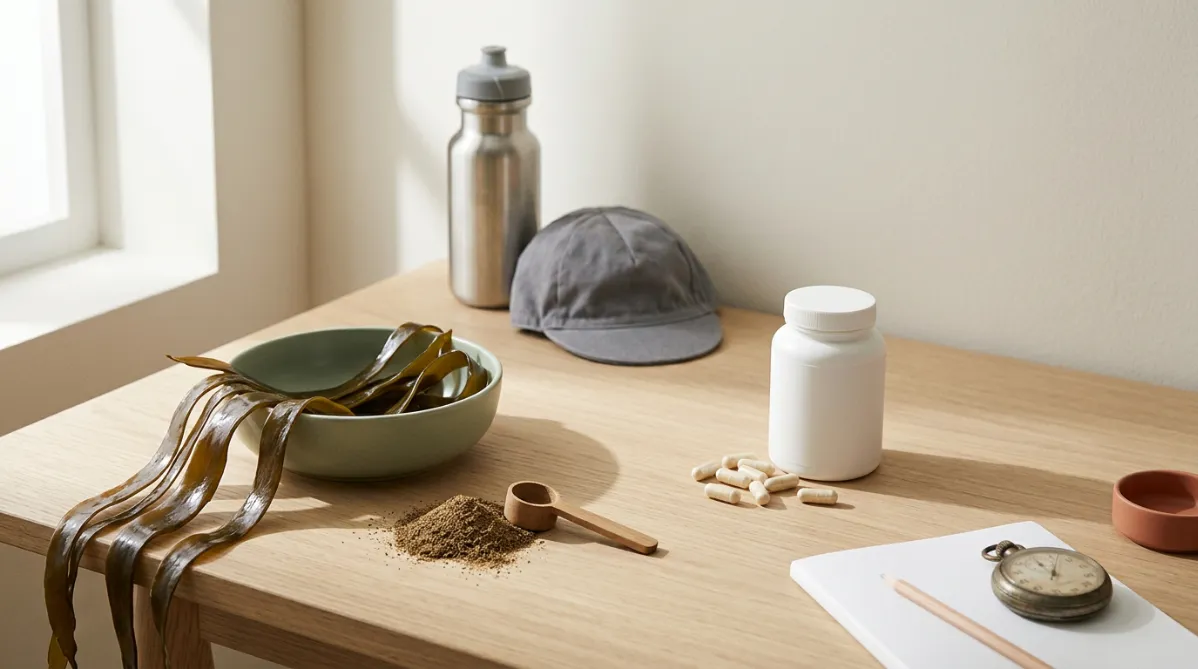
A landscape editorial still life in soft natural window light, set on a pale oak tabletop with a matte warm-white wall behind it. In the center-left, a few glossy strands of dark olive-brown kelp (Ecklonia cava) drape in an elegant curve over a shallow ceramic bowl in muted sage green. Next to the bowl, a small pile of fine, dry brown seaweed powder sits beside a minimalist wooden scoop. On the right, an unbranded matte-white supplement tub and a few loose cream-colored capsules are spilled neatly across the surface. A brushed steel cycling water bottle stands slightly out of focus in the background, with a folded gray cycling cap beside it. In the foreground, a clean white notebook with a thin pencil rests next to a simple analog stopwatch, hinting at a performance trial without any text or numbers visible.

The palette is earthy and calm: sage, olive, warm sand, cream and soft charcoal, with one subtle terracotta accent from a small ceramic dish. Long soft shadows fall diagonally across the table, and a gentle highlight catches the wet sheen of the seaweed. Shallow depth of field, with a creamy blurred background and crisp detail on the seaweed texture and capsules. The composition leaves generous negative space on the upper right for a headline overlay. Shot as if with a 50mm lens at f/2.8, top-down angle tilted about 30 degrees, in a modern wellness-magazine style that is minimalist, tactile and refined, with a subtle film-like grain and natural color grading.
Nutrition

Hilft brauner Seetang im Pre‑Workout wirklich?

Dr. Gymbro · · 4 min read

Du hast es vielleicht schon einmal übersehen: Ecklonia cava, ein brauner Seetang‑Extrakt, versteckt sich in der Zutatenliste mancher Pre‑Workouts oder Fat‑Burner. Eine kürzlich veröffentlichte randomisierte Studie hat genau diesen Inhaltsstoff bei trainierten Radfahrern unter die Lupe genommen. Das Ergebnis: Der Blutzucker stieg leicht, aber weder Sprintleistung, Laktat, Sauerstoffaufnahme noch Fettverbrennung wurden beeinflusst.

Was die Forschenden getestet haben

Die Studie, veröffentlicht in Nutrients 2026 von Ali et al., stellte eine einfache Frage: Verändert eine Einzeldosis Ecklonia cava (EC) die physiologische Reaktion auf kontinuierliches Radfahren oder die Leistung bei anschließenden Sprints?

Zwölf erfahrene männliche Radfahrer nahmen teil. Das Design war eine randomisierte, doppelblinde, placebokontrollierte Crossover‑Studie – ideal für kleine Probandengruppen, weil jeder Sportler als sein eigener Kontrollwert dient. Jeder Teilnehmer absolvierte sowohl die EC‑ als auch die Placebo‑Bedingung, und weder die Probanden noch die Forschenden wussten während des Tests, welche Bedingung vorlag.

Die Autoren erklärten, dass keine Interessenkonflikte bestanden.

Das Protokoll, Schritt für Schritt

  • Dosis: 263 mg EC‑Extrakt bzw. Placebo
  • Timing: 30 Minuten vor dem Training eingenommen
  • Stetige Belastung: 60 Minuten bei 55 % der maximalen Arbeitsrate jedes Teilnehmers
  • Sprint‑Block: drei maximale 20‑Sekunden‑Sprints direkt im Anschluss

Während der Ausdauerphase wurden Blutglukose, Blutlaktat, Herzfrequenz, Sauerstoffaufnahme und das respiratorische Austauschverhältnis (RER) gemessen. Das RER gibt Aufschluss darüber, ob der Körper eher Fett oder Kohlenhydrate verbrennt. Während der Sprints wurden Spitzenleistung, mittlere Leistung, Glukose und Laktat erfasst. Die Daten wurden mit linearen Mixed‑Effects‑Modellen ausgewertet, wobei Behandlung, Zeit, deren Interaktion, Testperiode und Reihenfolge der Bedingungen berücksichtigt wurden.

Was sich änderte: ein kleiner Glukose‑Anstieg

Die durchschnittliche Blutglukose lag nach EC bei 4,23 ± 0,23 mmol/L, nach Placebo bei 4,02 ± 0,33 mmol/L. Der Mittelwertunterschied betrug 0,213 mmol/L (95 %‑KI 0,046 – 0,379; p = 0,023).

Der Unterschied ist klein und beide Werte liegen im normalen Bereich. Die Interaktion Behandlung × Zeit war nicht signifikant (p = 0,939), sodass sich der Verlauf des Glukosespiegels während der Fahrt nicht unterschied. Es handelte sich also um eine moderate Gesamterhöhung, nicht um ein klares, zeitabhängiges Muster. Die Autoren bezeichnen das selbst als „modeste Gesamterhöhung“.

Was unverändert blieb: praktisch alles andere

EC hatte keinen Einfluss auf submaximales Blutlaktat, Herzfrequenz, Sauerstoffaufnahme oder RER (alle p ≥ 0,096). Das ist wichtig für die oft behauptete „Fat‑Burner“-Wirkung: Wäre das Extrakt wirklich fettverbrennend, müsste sich das im RER zeigen – das tat es nicht.

Auch die Sprint‑Parameter blieben nahezu gleich:

  • Spitzenleistung: Unterschied –2,58 W (95 %‑KI –29,51 – 24,35; p = 0,832)
  • Mittlere Leistung: Unterschied +5,93 W (95 %‑KI –2,47 – 14,33; p = 0,167)
  • Glukose nach Sprint: p = 0,481
  • Laktat nach Sprint: p = 0,060
  • Behandlung × Zeit‑Interaktionen: keine für irgendeinen Sprint‑Parameter (alle p ≥ 0,267)

Der Laktat‑Wert nach dem Sprint lag nahe an der üblichen Schwelle, überschritt sie jedoch nicht; die Autoren werten ihn deshalb nicht als signifikant.

Wie viel Aussagekraft hat das Ergebnis?

Sei ehrlich zu den Limitationen: Zwölf Teilnehmende sind eine sehr kleine Stichprobe. Das 95‑%‑KI für die Spitzenleistung reicht von etwa –30 W bis +24 W, sodass ein kleiner Effekt in irgendeine Richtung nicht ausgeschlossen werden kann. Fehlende Evidenz ist kein Beweis für das Nichtvorhandensein eines Effekts.

Alle Probanden waren erfahrene männliche Radfahrer, sodass die Ergebnisse nicht automatisch auf Frauen, Anfänger oder andere Sportarten übertragbar sind. Die Studie testete nur eine einmalige Dosis, ein Zeitfenster von 30 Minuten und ein spezifisches Belastungsformat. Sie sagt nichts über eine längerfristige Einnahme, andere Dosierungen oder mögliche Effekte auf Regeneration, Entzündungen oder Körperzusammensetzung aus – hierfür wären weitere Studien nötig.

Es handelt sich um eine Humanstudie, nicht um eine Tier‑ oder Zelluntersuchung, was ein Pluspunkt ist. Dennoch bleibt sie klein, und die Autoren schließen, dass die Befunde „keine akute ergogene Wirkung“ unter den getesteten Bedingungen unterstützen.

Praktische Schlussfolgerungen

Dosis und Timing: 263 mg 30 Minuten vor dem Training. Die Ergebnisse liefern keinen Hinweis darauf, dass dieses Protokoll die Leistung steigert; es gibt also keine evidenzbasierte Dosierungsempfehlung für sportliche Zwecke.

Wenn du es für Leistung kaufst: Die Evidenz rechtfertigt keinen Aufpreis. Für Rennen oder harte Trainingseinheiten ist dein Geld besser in bewährte Maßnahmen zu investieren – zum Beispiel ausreichende Kohlenhydrat‑Zufuhr, Koffein, konsequenten Schlaf und eine ausgewogene Ernährung. Diese Strategien sind durch umfangreiche sporternährungswissenschaftliche Forschung gestützt, auch wenn sie in diesem Paper nicht getestet wurden.

Wenn du es als Fat‑Burner kaufst: Die Studie zeigte keinen Effekt auf das RER, also keinen Hinweis darauf, dass der Brennstoffwechsel während moderatem Radfahren umgeschaltet wird.

Wer trotzdem interessiert sein könnte: Forscher und Personen, die sich für Glukoseregulation interessieren, finden den leichten Glukose‑Anstieg eventuell spannend. Menschen mit einer Erkrankung, die den Blutzucker betrifft, oder solche, die blutzuckerbezogene Medikamente einnehmen, sollten vor der Einnahme eines konzentrierten Seetang‑Extrakts Rücksprache mit einem Arzt halten – diese Gruppen wurden in der Studie nicht untersucht.

Etikett prüfen: Pre‑Workouts enthalten häufig zahlreiche Zutaten, sodass schwer zu sagen ist, welche – falls überhaupt – die Wirkung liefert. Ein einzelnes Ergebnis zu einer Zutat erinnert daran, dass ein trendiger Name auf der Verpackung keine Evidenz bedeutet.

Fazit

Bei trainierten Radfahrern führte eine Einzeldosis von 263 mg Ecklonia cava‑Extrakt zu einem leichten Anstieg der Blutglukose, während Leistung und die übrigen gemessenen physiologischen Parameter im Wesentlichen unverändert blieben. Die Studie ist klein, also nicht das letzte Wort, aber sie liefert keinen Grund, am Renntag einen akuten Leistungsboost von diesem Seetang zu erwarten.
Original study

Read the original research on pubmed.ncbi.nlm.nih.gov →

This article summarizes published research for general information. It is not medical advice.

DG

Written by

Dr. Gymbro

Dr. Gymbro writes for Dr. Gymbro: science-backed fitness, nutrition & performance.

Related Articles

A wide editorial still life on a pale, warm-toned concrete surface in soft morning window light. In the center-left, a shallow matte ceramic bowl holds a small pile of bright red coffee cherries with glossy skins, a few sliced open to reveal pale mucilage and paired green-tan beans. Beside it, a small glass dish of fine, golden-brown powdered extract with a tiny wooden scoop resting on its edge. A sprig of coffee plant leaves, deep green and waxy, arcs across the foreground.

On the right side, slightly out of focus, a sleek road cyclist's handlebar and a matte black water bottle lean against a light plaster wall, suggesting athletic training without showing a person. A minimalist analog stopwatch with a clean white face and thin black hands sits in the mid-ground, angled toward the camera, its hands paused near the fifteen-minute mark. A folded linen cloth in oatmeal beige and a single small espresso cup with a thin crema ring add quiet texture.

The color palette is restrained and modern: cherry red, sage green, cream, soft terracotta, and charcoal accents. Light comes from the left, casting long, gentle shadows with a subtle warm glow and a hint of dust in the air. Shallow depth of field with crisp focus on the cherries and stopwatch, creamy bokeh in the background. Composition leaves open negative space in the upper right for a headline overlay. The overall feel is a clean, trendy health-and-science magazine cover: tactile, natural, minimal, and calm, shot in a 16:9 landscape frame with fine film-like grain and true-to-life tones.
nutrition

Kaffeekirsch‑Extrakt: 200 mg Koffein steigern die Radfahrleistung um 4,6 %

BY DR. GYMBRO ·

Eine niedrige Dosis von 200 mg Koffein aus einem Vollkaffeekirsch‑Extrakt ließ trainierte Radfahrer in einem 15‑Minuten‑Zeitfahren 4,6 % mehr Arbeit leisten. Die verbreitete Annahme, dass es die Glykogen‑Wiederauffüllung beschleunigt, konnte jedoch nicht bestätigt werden. Die randomisierte, doppelblinde Crossover‑Studie umfasste nur 12 Radfahrer, wurde von der Industrie finanziert und enthält keine reine Koffein‑Kontrollgruppe. Im Folgenden sehen Sie, was die Daten zeigen, was nicht und für wen das Produkt interessant sein könnte.

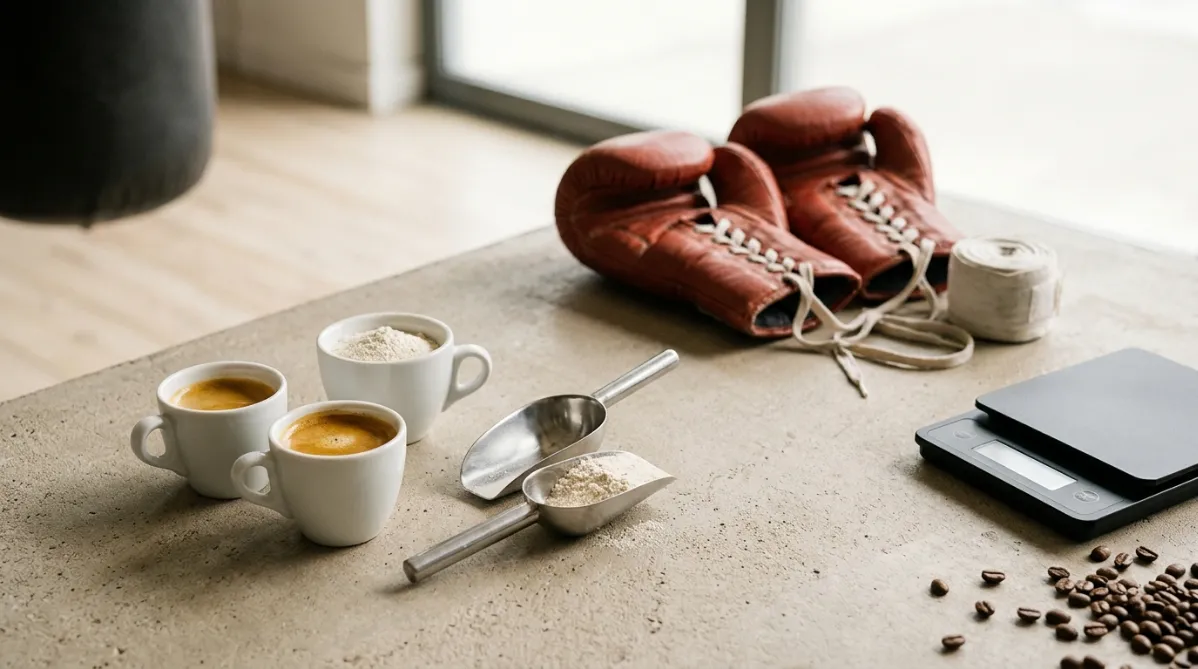
A landscape editorial photograph with a modern, clean magazine feel, shot on a pale warm-gray concrete surface in soft natural window light from the left. In the foreground, two matte white ceramic espresso cups sit side by side. The left cup holds a small amount of dark espresso with golden crema. The right cup is filled twice as high. Beside them, two small stainless steel scoops hold fine coffee-colored powder, one half full and one heaped, suggesting a dose comparison without any text or labels. A pair of worn red leather boxing gloves rests slightly out of focus behind the cups, laces loosely draped, with a white hand wrap rolled neatly beside them. A minimalist digital kitchen scale in matte black sits at the edge of the frame, with a few roasted coffee beans scattered across the surface. In the soft-focus background, a boxing gym corner appears: a hanging heavy bag in muted charcoal, pale wood plank flooring, and a tall window with diffused morning light. The palette is warm cream, espresso brown, brick red, and soft slate gray, with gentle shadows and a shallow depth of field. The composition follows the rule of thirds, with the cups and scoops in the lower left third and open negative space on the right for headline overlay. The look is tactile and refined, like a high-end health and performance journal. It has natural grain, subtle contrast, and a calm, confident mood. There are no people, no text, no logos, and no futuristic elements.
nutrition

Doppelte Koffeinmenge hilft Boxern kaum – das hat die Studie gezeigt

BY DR. GYMBRO ·

Denkst du, ein doppelter Löffel Pre‑Workout verdoppelt die Leistung? Eine aktuelle Studie mit 15 Wettkampf‑Boxern zeigt, dass das nicht zwangsläufig stimmt. Sowohl 3 mg/kg als auch 6 mg/kg Koffein verbesserten die Sprungleistung, jedoch war die höhere Dosis nicht durchgängig überlegen. Nur bei einzelnen Tests, etwa beim ballistischen Liegestütz und dem Knie‑Drehmoment, brachte die größere Dosis einen kleinen Vorteil. Wichtig ist zudem, dass das eigentliche Boxen – also das Schlagen – nie untersucht wurde.

A landscape editorial photograph of a lone runner's hands resting on a weathered wooden table beside a small white ceramic dish of fine white powder and a clear glass of water, shot in soft morning light. A slim matte aluminum energy drink can, unbranded with a minimalist pale sage-green label, stands slightly out of focus in the background, with a single scoop of powder dusted lightly on the tabletop. A pair of worn running shoes and a folded gray towel sit at the edge of the frame. Through a large window behind them, a blurred misty trail winds through green trees at sunrise, with warm golden light spilling across the scene.

The color palette is calm and modern: creamy off-white, sage green, warm honey gold, and soft charcoal. The composition follows the rule of thirds, with the dish and glass in the lower left third and generous negative space on the right for a title overlay. The depth of field is shallow, with a crisp focus on the powder's delicate texture and tiny glints of light on the glass rim. The mood is clean, thoughtful, and quietly energetic, like a contemporary health and science magazine feature. Natural grain, subtle film-like softness, and gentle shadows give it an authentic lifestyle-editorial look. There are no text, logos, or futuristic elements, only tactile, real-world materials like wood, ceramic, glass, cotton, and metal.
nutrition

Die Energy‑Drink‑Zutat, die die Ausdauer allein steigert

BY DR. GYMBRO ·

Jeder spricht über Koffein, doch die zweite Zutat in der Energy‑Drink‑Dose arbeitet leise für sich selbst. Eine Meta‑Analyse von 2018 mit zehn Studien zeigte, dass isoliertes Taurin die Ausdauerleistung verbesserte (Hedges' g = 0,40) und dass eine einmalige Dosis offenbar ausreichte. Weder die Dosis (1–6 g) noch die Einnahmedauer beeinflussten den Effekt merklich. Die Evidenzbasis ist jedoch klein und die Konfidenzintervalle breit, sodass es eher ein vielversprechendes Signal als eine Garantie ist. Hier erfahren Sie, was die Studie ergab und wie man Taurin sinnvoll ausprobiert.

A landscape editorial photograph in soft natural morning light. In the foreground on a rustic light oak table, a small cluster of fresh Rhodiola rosea plants with thick succulent blue-green leaves and tiny golden-yellow flower clusters rests beside a few dried, knobby amber-brown rhizome pieces. A matte ceramic cup of pale golden herbal tea sits beside them, with a thin curl of steam and a small linen cloth. The plants and roots are sharp, with fine texture and dewy highlights.

In the softly blurred background, a lean cyclist in a fitted charcoal jersey stands beside a road bike on a quiet country lane at sunrise. Rolling green hills fade into pale mist behind them, and warm light rims the rider's shoulders. The cyclist tightens a glove, calm and focused, in a pre-ride moment of preparation. A water bottle is mounted on the bike frame, and a simple analog stopwatch with a brushed metal casing lies on the table near the herbs, hinting at timed effort.

The palette is muted and modern: sage green, warm cream, soft gold, and slate gray, with gentle peach tones from the sunrise. Shallow depth of field, a clean, airy composition with generous negative space on the right third for headline text, and subtle film grain. The mood is calm, health-conscious, and quietly athletic, like a premium wellness and sports science magazine cover. No text, no logos, no futuristic elements.
science research

Rhodiola Rosea – ein koffeinfreies Pre‑Workout für intensives Cardio?

BY DR. GYMBRO ·

Eine Crossover‑Studie aus dem Jahr 2013 zeigte, dass eine Einzeldosis von 3 mg /kg Rhodiola rosea, eine Stunde vor einem 6‑Meilen‑Radzeitfahren verabreicht, die Zielzeit von 25,8 auf 25,4 Minuten verkürzte. Die Herzfrequenz beim Aufwärmen sank von 140 auf 136 bpm und die wahrgenommene Anstrengung von 6,6 auf 6,0. Der Gewinn ist gering – rund 1,5 % – und stammt von nur 18 Probanden, also kein Wundermittel. Dennoch ist die reduzierte Anstrengungswahrnehmung ein interessanter, koffeinfreier Ansatz für Ausdauersportler. Im Folgenden zeigen wir, was die Daten belegen und wie man das Präparat sinnvoll testet.

This page is available in