Dr. Gymbro
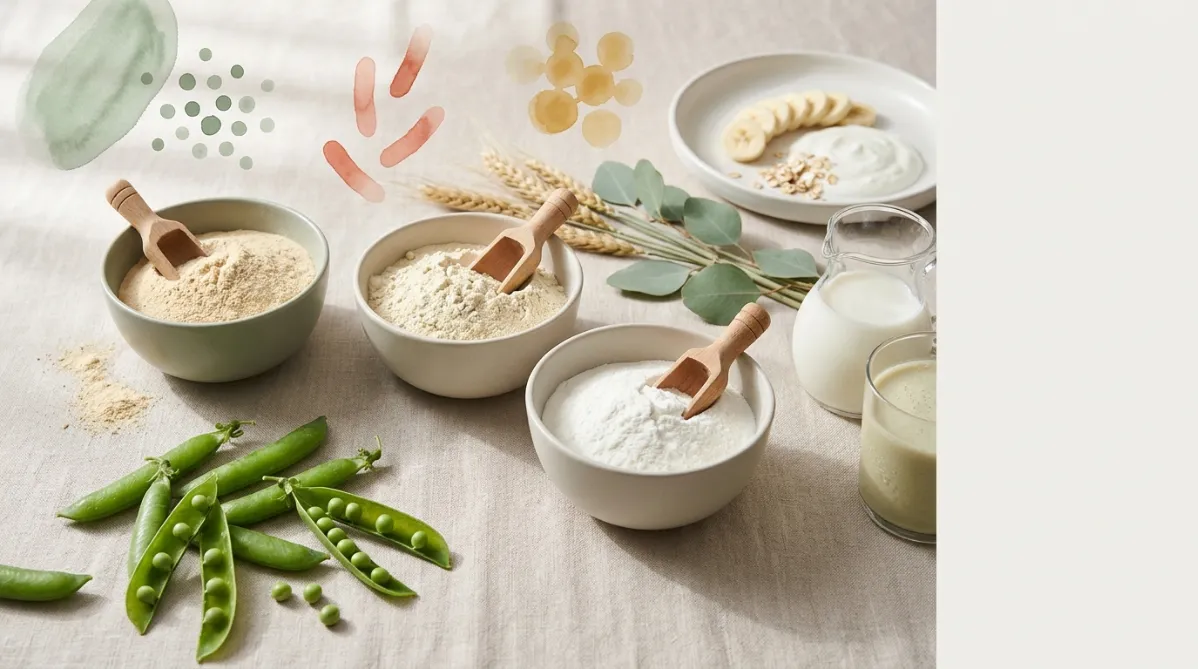
A wide, softly lit editorial flat-lay on a pale oat-colored linen surface, shot from slightly above. Three matte ceramic bowls sit in a loose diagonal across the frame. One holds fine, creamy beige pea protein concentrate, another holds paler, powdery pea protein isolate, and the third holds bright white whey protein isolate. Each bowl has a small wooden scoop resting beside it, with a few fine dustings of powder on the linen. Fresh green pea pods, split open to show round peas, spill naturally in the left foreground. A small glass pitcher of milk sits near the right edge, next to a half-full glass of a smooth, pale green-beige shake with condensation on the surface.

Behind the bowls, a few sprigs of dried wheat and soft eucalyptus leaves add organic texture. In the upper right, a shallow white ceramic plate holds a small arrangement of gut-friendly foods: sliced banana, a spoonful of plain yogurt, and a few oats. Delicate watercolor-style abstract shapes in sage green, warm coral, and soft mustard float subtly in the background. They suggest microscopic organisms, like loose dots, rods, and clustered circles, but stay painterly and minimal, not scientific or futuristic.

Natural window light enters from the left, casting long, gentle shadows and a warm, airy glow. The palette is muted and modern: sage green, cream, warm beige, blush, and touches of terracotta. The composition leaves generous clean negative space on the right third for a headline overlay. The depth of field is shallow, with the nearest pea pods and the front bowl crisp and the background softly blurred. The style is high-end wellness magazine photography with a subtle tactile, handmade feel, calm, fresh, and contemporary, in a 16:9 landscape format.
Science & Research

Welches Proteinpulver formt deinen Darm neu? Erbsenprotein schafft es in 4 Wochen

Dr. Gymbro · · 3 min read

Dein Proteinshake könnte mehr tun, als nur deine Muskeln zu füttern. Eine neue schwedische, randomisierte Studie legt nahe, dass die Art des Proteinpulvers, das du wählst, die Bakterien in deinem Darm bereits nach vier Wochen verändern kann. Zwei Formen von Erbsenprotein bewirkten das, und jede begünstigte andere Mikroben.

Die Studie: Drei Pulver, eine Dosis, vier Wochen

Forscher*innen der Örebro‑Universität veröffentlichten eine randomisierte, doppelblinde, parallel‑geführte Studie mit drei Armgruppen im European Journal of Nutrition. Gesunde Erwachsene nahmen eines von drei Supplementen zu sich: Erbsenprotein‑Konzentrat (PPC), Erbsenprotein‑Isolat (PPI) oder Molkenprotein‑Isolat (WPI). Die Dosis betrug 0,5 g Protein pro kg Körpergewicht pro Tag über vier Wochen.

Die Zusammensetzung der Darmmikrobiota war das primäre Ergebnis. Das Team sammelte wöchentlich Stuhlproben und Lifestyle‑Fragebögen. Zusätzlich wurden nüchterne Blut‑ und 24‑Stunden‑Urinproben zu Beginn, zur Halbzeit und am Ende der Intervention entnommen, um metabolische Marker zu erfassen. Dabei handelt es sich um Human‑Research, nicht um eine Maus‑ oder Petrischalen‑Studie. Die Studie ist unter der Registrierungsnummer NCT05611138 gelistet.

Die Forschenden stellten zwei Vergleiche an: PPC vs. PPI und PPI vs. WPI. Damit konnten sie sowohl pflanzliches gegen tierisches Protein als auch die beiden pflanzlichen Produkte mit unterschiedlichen Lebensmittel‑Matrizen gegenüberstellen.

Das Hauptergebnis: Erbsenprotein verändert die Diversität

Beide Erbsenprotein‑Pulver führten zu messbaren Verschiebungen. Die Supplementierung mit PPC und PPI reduzierte die α‑Diversität (die Artenvielfalt innerhalb einer Person) und erhöhte die β‑Diversität (wie unterschiedlich die Gemeinschaft von Probe zu Probe ist). Die Autor*innen weisen darauf hin, dass diese Effekte teilweise vom BMI moduliert wurden.

Ein Rückgang der α‑Diversität kann alarmierend wirken, da höhere Diversität häufig als Indikator für einen gesunden Darm gilt. Der Abstract sagt nicht, ob diese Veränderung hier gut, schlecht oder neutral zu bewerten ist. Die Autor*innen betonen, dass die rein kompositorischen Veränderungen noch mit funktionellen Konsequenzen verknüpft werden müssen – also kein abschließendes Urteil.

Die Bakterien, die zunahmen

Auf Arten‑Ebene zeigten die beiden Erbsenproteine unterschiedliche Muster:

  • Erbsenprotein‑Konzentrat (PPC): Anaerobutyricum hallii und Bifidobacterium longum nahmen signifikant zu.
  • Erbsenprotein‑Isolat (PPI): Lactobacillus crispatus und Limosilactobacillus frumenti nahmen signifikant zu.

Die Autor*innen bezeichnen diese Arten als potenziell vorteilhaft und schließen daraus, dass verschiedene diätetische Proteine sie selektiv modulieren. Der Abstract nennt keine Änderungen im Whey‑Gruppe, sodass aus dieser Quelle kein Vergleich auf Arten‑Ebene möglich ist. Der PPI‑vs‑WPI‑Kontrast war im Studiendesign vorgesehen, wird aber im Abstract nicht detailliert.

Was die Studie nicht beweist

Ein paar Vorbehalte, bevor du deine Packung wechselst:

  • Nur gesunde Erwachsene. Die Ergebnisse lassen keine Rückschlüsse auf Personen mit Verdauungsstörungen zu.
  • Zusammensetzung, nicht Funktion. Weitere Studien sind nötig, um zu prüfen, wie sich die mikrobiellen Verschiebungen auf die tatsächliche Funktion des Mikrobioms auswirken.
  • Metabolische Marker fehlen im Abstract. Blut‑ und Urinproben wurden zwar genommen, aber im Abstract werden keine Ergebnisse dazu berichtet.
  • Individuelle Reaktionen zählen. Die Autor*innen betonen, dass individuelle Unterschiede – unter anderem BMI – die Diversitätseffekte modulieren.
  • Vier Wochen sind kurz. Es bleibt unklar, ob die Verschiebungen dauerhaft, stärker oder wieder rückgängig werden.

Praktische Konsequenzen: Wie du dein Pulver wählst

Dosierung. Die Studie setzte 0,5 g/kg Körpergewicht pro Tag an. Für eine Person mit 80 kg sind das 40 g Protein täglich aus dem Supplement. Der Abstract gibt keinen Hinweis auf das Timing (z. B. vor oder nach dem Training), sodass keine evidenzbasierte Empfehlung zum Einnahmezeitpunkt abgeleitet werden kann.

Erbsenprotein‑Konzentrat. In dieser Studie war PPC mit einem Anstieg von B. longum und A. hallii verbunden. Wenn du ein pflanzliches Pulver bevorzugst und an Darm‑Effekten interessiert bist, könnte das eine Option sein. Konzentrate sind generell weniger stark verarbeitet als Isolate, aber diese Annahme wird im Abstract nicht getestet.

Erbsenprotein‑Isolat. PPI zeigte Zunahmen von L. crispatus und L. frumenti. Es ist die stärker gereinigte Form, die von vielen Sportlern wegen der hohen Proteindichte bevorzugt wird.

Molkenprotein‑Isolat. WPI diente als tierischer Vergleich. Im Abstract gibt es keine Hinweise darauf, dass Whey schädlich ist – lediglich werden keine spezifischen bakteriellen Vorteile berichtet. Ein Darm‑Vorteil von Whey lässt sich daraus also nicht ableiten.

Für wen ist das relevant?

  • Pflanzlich orientierte Sportler*innen profitieren am meisten. Wenn du Erbsenprotein nutzt, ist das nicht neutral für den Darm; es beeinflusst bestimmte Bakterien, und die gewählte Form kann dabei eine Rolle spielen.
  • Menschen mit gastrointestinalen Beschwerden sollten vorsichtig sein. Die Teilnehmenden waren gesund, sodass die Ergebnisse nicht ohne Weiteres auf IBS, IBD oder ähnliche Zustände übertragbar sind. Wer bereits empfindlich reagiert, sollte neue Pulver langsam einführen und ggf. Rücksprache mit einer Fachkraft halten.

Fazit

Vier Wochen Erbsenprotein – egal ob Konzentrat oder Isolat – veränderten die mikrobielle Gemeinschaft im Darm gesunder Erwachsener. Die beiden Formen förderten unterschiedliche, potenziell nützliche Arten. Die große offene Frage bleibt, welche gesundheitlichen Konsequenzen diese Verschiebungen haben. Bis dahin sollte die Wahl des Proteinpulvers als ein weiterer Faktor im Zusammenspiel mit deinem Darm‑Ökosystem gesehen werden, nicht nur als Makronährstoff‑Quelle.
Original study

Read the original research on pubmed.ncbi.nlm.nih.gov →

This article summarizes published research for general information. It is not medical advice.

DG

Written by

Dr. Gymbro

Dr. Gymbro writes for Dr. Gymbro: science-backed fitness, nutrition & performance.

Related Articles

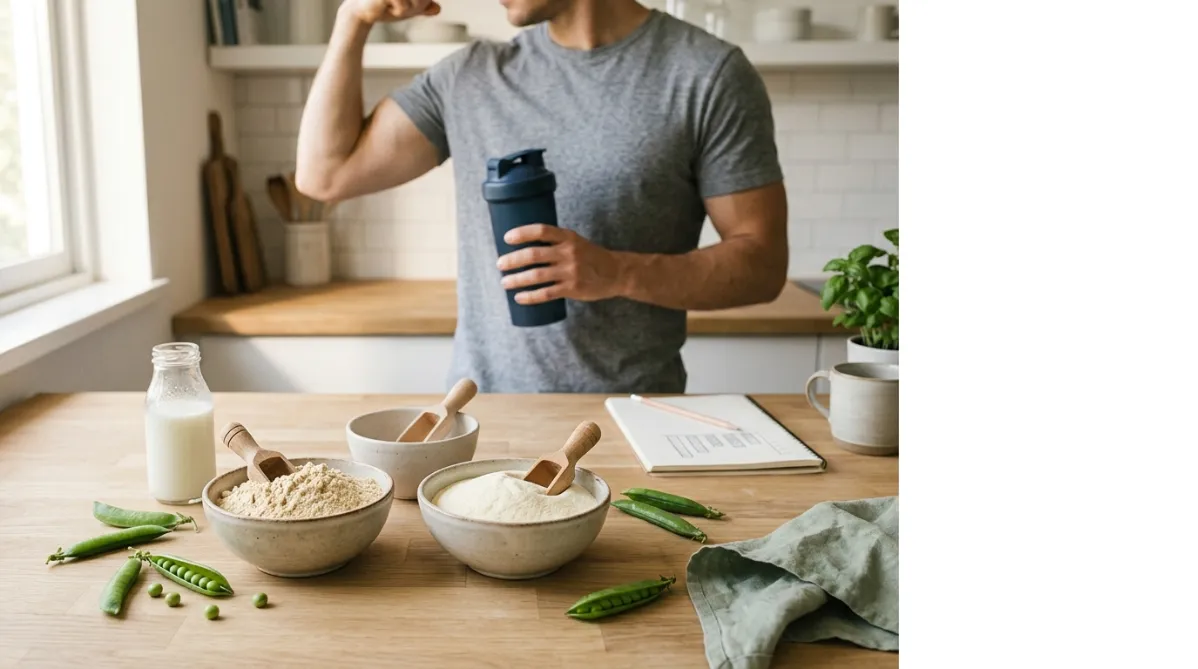
A bright, airy, minimalist kitchen counter in soft morning light, shot from a slightly elevated three-quarter angle in a wide landscape composition. Two matching ceramic bowls sit side by side on a pale oak butcher-block surface. The left bowl holds fine, creamy-beige pea protein powder with a small wooden scoop resting in it. The right bowl holds smooth, ivory-white whey powder with an identical scoop. Between and slightly behind them sits a third, smaller empty bowl with a plain scoop, hinting at the placebo. Scattered around the bowls are fresh green pea pods, some split open to reveal bright, round peas, and a small glass bottle of milk with delicate condensation. A sage-green linen napkin is folded loosely at the edge of the frame.

In the soft-focus background, a young man in a fitted heather-gray t-shirt is seen from the shoulders down, casually flexing one arm while holding a matte shaker bottle, the biceps subtly defined and the pose relaxed and natural. A minimalist notebook with a pencil and a simple hand-drawn bar chart lies open on the counter, suggesting analysis without legible text. A small potted herb plant and a ceramic mug add warmth.

The color palette is muted and editorial: warm cream, sage green, soft terracotta, pale wood, and touches of charcoal. Light streams in from a window on the left, casting gentle long shadows and a subtle golden glow across the powders so their textures look fine and tactile. Shallow depth of field keeps the bowls crisp while the background melts into a creamy blur. The look is modern lifestyle-magazine photography, clean and uncluttered, with generous negative space on the right third of the frame for headline overlay. It is natural, appetizing, and trustworthy, in the style of a contemporary wellness and nutrition journal.
nutrition

Erbsenprotein vs. Whey: Das überraschende Ergebnis bei Anfängern

BY DR. GYMBRO ·

Kann pflanzliches Protein wirklich Muskeln aufbauen wie Whey? In einer 12‑wöchigen Studie mit 161 Männern wurden Erbsenprotein, Whey und ein Placebo direkt verglichen. Bei Anfängern zeigte sich ein Zuwachs von +20,2 % Bizepsdicke für Erbsenprotein gegenüber +8,6 % für das Placebo. Der Gesamteffekt war jedoch nur ein Trend, und das auffällige Ergebnis stammt aus einer Untergruppen‑Analyse. Hier erfährst du, was die Studie gezeigt hat, was sie nicht beweist und wie vegane oder laktoseintolerante Trainierende sie nutzen können.

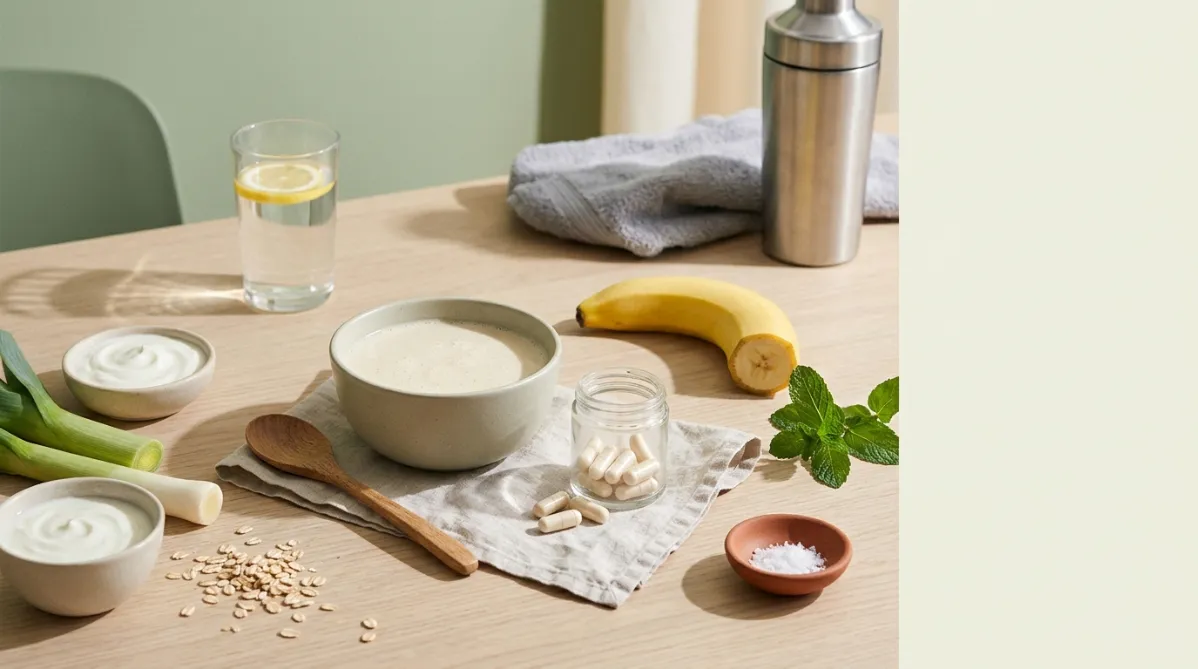
A bright, minimalist still life on a soft sage-green and warm cream backdrop, shot from a slightly elevated angle in natural morning window light. In the center sits a matte ceramic bowl of creamy vanilla protein shake with a wooden spoon resting beside it. Next to it, a small glass jar with a few off-white probiotic capsules spilling onto a pale linen napkin. Around them are fresh, gut-friendly foods arranged with editorial restraint: a halved ripe banana, a small bowl of plain yogurt with a swirl on top, a few stalks of leeks, a handful of oats scattered on the surface, and a sprig of fresh mint. A tall glass of water with a lemon slice catches the light and casts a delicate caustic shadow across the table.

In the background, slightly out of focus, a folded gray gym towel and a sleek stainless steel shaker bottle hint at an athletic lifestyle without dominating the scene. The surface is a pale oak tabletop with subtle grain. A soft diffused shadow falls to the left, giving gentle depth.

The palette is calm and modern: sage green, oatmeal, warm white, soft butter yellow, and touches of terracotta from a small clay dish holding a pinch of sea salt. The composition leaves generous negative space on the right third for headline overlay. The mood is clean, wellness-focused, and quietly editorial, like a feature in a contemporary health and science journal. Shallow depth of field, crisp focus on the capsules and bowl, subtle film grain, and natural color grading. No people, no text, no logos, no futuristic elements.
nutrition

Protein‑Furze? Probiotikum BB536 reduziert Geruch, aber nur in manchen Darmtypen

BY DR. GYMBRO ·

Whey‑Shakes können nicht nur Muskeln, sondern auch unangenehme Gerüche produzieren. Eine kleine, explorative Studie untersuchte das Probiotikum *Bifidobacterium longum* BB536 bei jungen Sportlern mit hoher Proteinzufuhr. In der Gesamtheit zeigte das Probiotikum keinen Unterschied zum Placebo, doch in bestimmten Mikrobiom‑Subgruppen wurden geruchsverursachende Metaboliten reduziert. Die Ergebnisse sind vorläufig, vom Hersteller finanziert und gelten nur für gesunde, junge Männer. Hier erfährst du, was BB536 ist, warum dein individuelles Mikrobiom entscheidend sein kann und welche günstigen Maßnahmen du zuerst ausprobieren solltest.

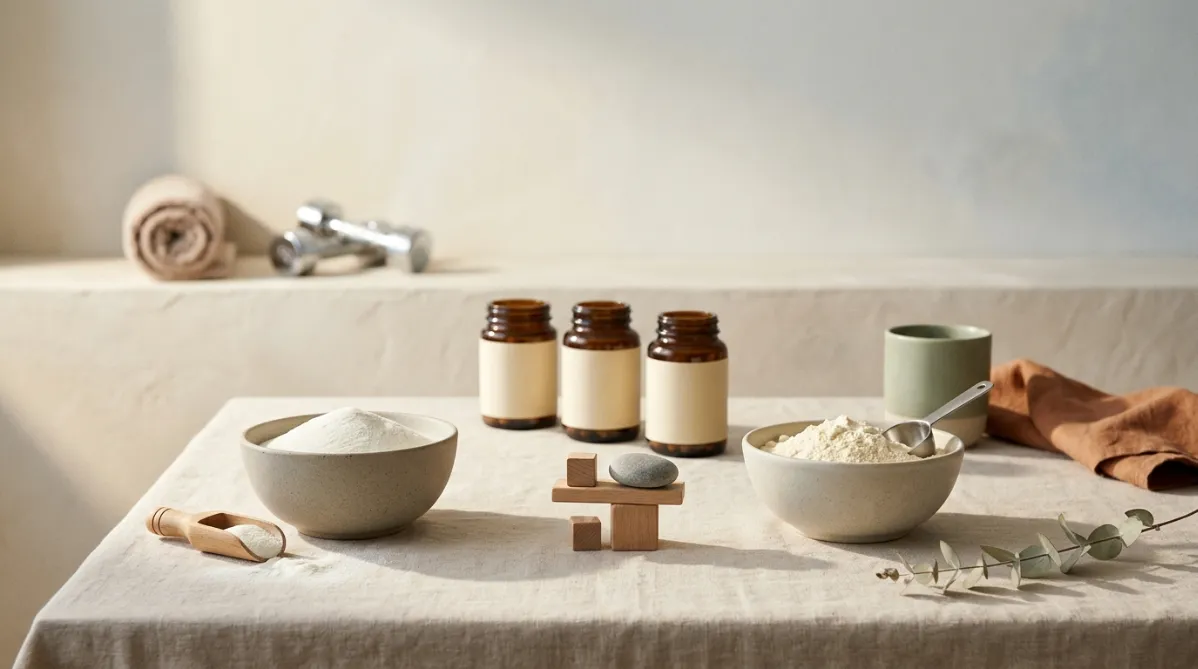
A bright, minimalist editorial still life on a pale oat-colored linen surface, shot from a slightly elevated three-quarter angle in soft natural window light. On the left, a matte ceramic bowl of fine white collagen powder with a wooden scoop resting beside it, a light dusting of powder spilling across the linen. On the right, a matching bowl of creamy off-white whey powder with a brushed-steel scoop. Between them sits a small, neatly balanced stack of simple geometric wooden blocks and a single smooth gray stone, hinting at a scale or comparison without showing a literal scale. Behind them, a lightly blurred row of three clean amber glass supplement jars with plain cream labels, unbranded. A single rolled yoga towel and a pair of small chrome dumbbells sit softly out of focus in the background on a pale plaster shelf. Accents of muted sage green and warm terracotta appear in a ceramic cup and a folded napkin, giving the palette a calm, contemporary wellness-magazine feel. A thin, elegant sprig of dried eucalyptus lies at the edge of the frame. Shadows are long, gentle, and slightly cool, with a creamy shallow depth of field and fine grain. The composition leaves generous negative space across the upper third for title overlay, with a subtle gradient from warm ivory to pale gray-blue in the background wall. The styling is clean and modern like a trendy health journal website, with a refined, tactile, editorial photography look, balanced symmetry, and no text, no people, no futuristic or laboratory elements.
nutrition

Kollagen schlägt Whey beim Muskelaufbau – Ergebnis einer Analyse von 78 Studien

BY DR. GYMBRO ·

Eine Netzwerk‑Metaanalyse aus dem Jahr 2026, die 78 randomisierte Studien mit 4 755 Teilnehmenden einschloss, setzte Kollagen beim Kraft‑ und fettfreien Massezuwachs vor Whey an die Spitze. Noch überraschender: Keines der anderen Proteinpräparate übertraf das Placebo. Da Kollagen ein unvollständiges, leucinarmes Protein ist und die Konfidenzintervalle breit ausfallen, muss das Ergebnis kritisch hinterfragt werden. Im Folgenden zeigen wir, was die Zahlen wirklich bedeuten, warum direkte Vergleichsstudien nötig sind und wie Sie Ihren Supplement‑Stack heute sinnvoll gestalten können.

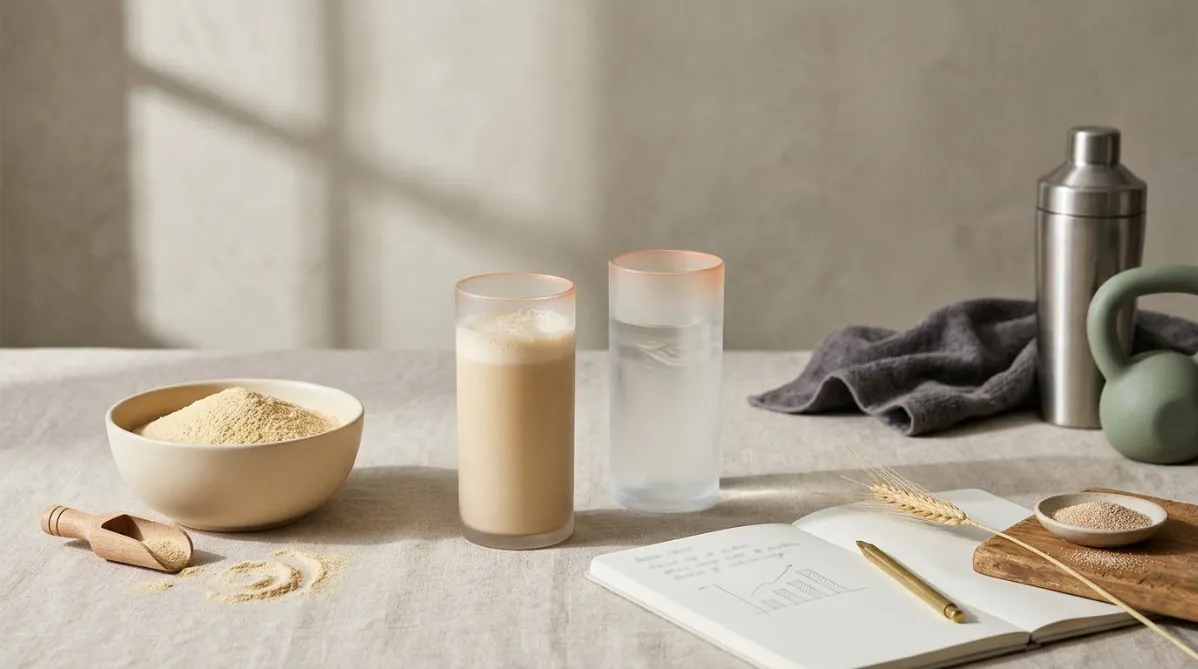
A wide, softly lit editorial still life on a pale oat-colored linen surface, shot from a slightly elevated three-quarter angle. On the left, a matte ceramic bowl in warm cream holds fine, pale golden-beige yeast protein powder, with a small wooden scoop resting beside it and a few loose dusty swirls on the linen. In the center, two tall frosted glass tumblers stand side by side. One holds a creamy, light tan shake with a delicate froth, and the other holds clear water with a faint ripple, creating a quiet visual contrast. On the right, a loosely folded charcoal gym towel, a brushed-steel shaker bottle, and a single small kettlebell in muted sage green sit slightly out of focus.

A few elements hint at the science without looking clinical. A minimalist matte-white notebook lies open with soft, blurred handwriting and a hand-drawn bar chart in thin pencil. Beside it rests a slim brass pen. A single sprig of dried wheat and a small dish of baker's yeast granules on a wooden board nod to the ingredient's fermentation origin.

Natural morning window light enters from the upper left, casting long, gentle shadows and a warm highlight along the glass rims. The palette is earthy and calm: oat, cream, soft terracotta, sage, and warm gray, with a subtle peachy glow in the background. The backdrop is a smooth plaster wall in muted putty tone, with a faint shadow of a window frame across it.

The composition leaves generous negative space in the upper third for a title overlay. Shallow depth of field keeps the glasses and bowl crisp while the gym props melt softly into the background. The overall mood is modern, wholesome, and trustworthy, with the feel of a contemporary health and nutrition magazine. The photograph has fine film-like grain and natural texture, and no text, logos, or labels appear anywhere.
recovery

Hefeiweiß‑Mischung konkurriert mit Whey bei Muskelkater und CK – mit einem Vorbehalt

BY DR. GYMBRO ·

Hefeiweiß findet immer häufiger Verwendung in Proteinpulvern und wird als nachhaltige, milcharme Alternative zu Whey vermarktet. Eine kürzlich veröffentlichte randomisierte Studie in *Nutrients* untersuchte, ob eine Hefeiweiß‑Whey‑Mischung die Regeneration nach intensivem exzentrischem Training unterstützt – und welche Einschränkungen die Ergebnisse haben.

This page is available in