Dr. Gymbro
←

#male fertility

1 article
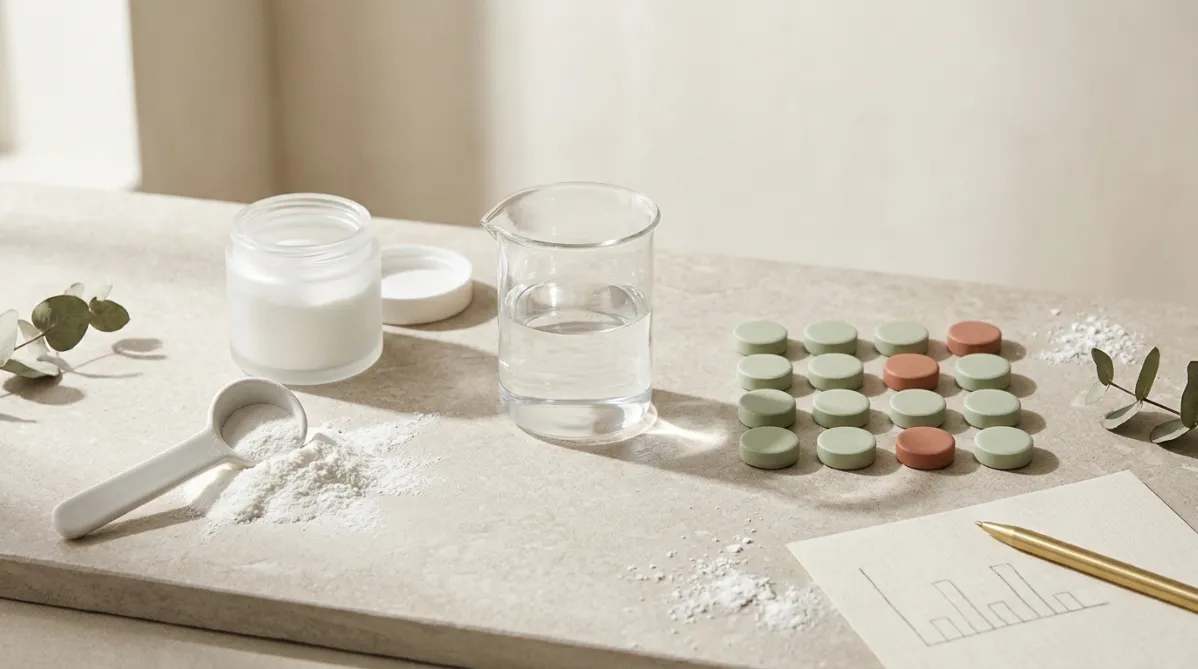
A wide, editorial still-life photographed from slightly above on a pale warm-gray stone surface, lit by soft natural window light with gentle long shadows. On the left, a matte white ceramic scoop rests in a small mound of fine white creatine powder. Beside it sits a minimalist frosted glass jar with its lid off. In the center, a clear glass beaker with a few ounces of water catches the light, with soft caustic reflections across the stone. On the right, a neat row of fifteen small, identical pale sage-green ceramic tokens sits in a precise grid of three rows of five. Twelve are sage green and three are a muted terracotta, hinting at sample size and the "catch" without any text. Scattered at the edge of the frame are a few loose powder grains, a sprig of dried eucalyptus, and a slim brushed-brass pen lying across a blank cream notecard with faint, abstract pencil-drawn bar graph lines, unreadable and softly out of focus.

The palette is calm and modern: bone white, warm stone, sage, dusty terracotta, and subtle brass accents. The background fades into a creamy, softly blurred neutral tone with shallow depth of field, so the foreground tokens and powder are crisp. The composition follows the rule of thirds, with generous negative space on the upper right for a headline overlay. The mood is clean, thoughtful, and scientific without being clinical, like a contemporary health and science journal feature. The image is high-resolution and has subtle film-like grain, with no people, no text, no lab equipment clichés, and no futuristic elements.
science research

Kreatin und Spermienzahl: Erste Humanstudie mit 15 Männern und einem Fallstrick

BY DR. GYMBRO ·

Kreatin könnte über das Fitnessstudio hinaus wirken – die allererste Humanstudie untersucht seine Effekte auf das Sperma. In einem achtwöchigen Pilotversuch hatten 60 % der Kreatin‑nutzer eine höhere Spermienkonzentration, während nur 20 % der Placebo‑Gruppe das zeigten. Der Kreatin‑Gehalt im Sperma stieg um 35,8 %. Die Studie umfasste jedoch nur 15 Männer, und der durchschnittliche Anstieg der Spermienkonzentration (7,4 Millionen /ml) war statistisch nicht signifikant. Der Hauptautor hat zudem finanzielle Verbindungen zur Kreatin‑Industrie. Hier erklären wir, welche Ergebnisse solide sind, welche nicht und was man daraus schließen kann.

This page is available in