Dr. Gymbro
A bright, minimalist editorial still life on a soft warm-white linen surface, shot from a slightly elevated angle in natural morning window light. In the center, a small shallow ceramic bowl in matte oatmeal tones holds several glossy, translucent coral-red softgel capsules, with a few spilled onto the surface in a gentle arc. Beside the bowl, a single ripe peach-pink shrimp-like krill shape is absent; instead a delicate scatter of tiny coral-orange dried krill-pink petals and a sprig of pale green seaweed hint at the marine origin. To the left, an empty clear glass of water and a folded cream napkin suggest fasting. To the right, a simple matte white plate sits bare with a silver fork resting across it. In the soft-focus background, a pair of sage green hand weights and a neatly rolled yoga mat in dusty blue add a quiet nod to muscle and strength. Soft shadows fall diagonally across the scene, giving gentle depth. The palette is calm and modern: warm ivory, coral red, sage green, dusty blue, and soft beige. Shallow depth of field with crisp focus on the capsules, which catch small bright highlights. Clean negative space on the left third of the frame for headline text. The overall feel is a contemporary wellness magazine or health journal cover, airy, refined, and editorial, with subtle film-like grain and natural color grading. Landscape 16:9 composition.
Nutrition

L’huile de krill réduit jusqu’à six fois la perte musculaire lors d’un jeûne intermittent, selon un essai

Dr. Gymbro · · 5 min read

L’huile de krill réduit jusqu’à six fois la perte musculaire lors d’un jeûne intermittent, selon un essai

Réduire rapidement son poids entraîne généralement une perte de muscle en même temps que des graisses. Un nouvel essai randomisé publié dans Obesity suggère qu’une capsule d’huile de krill pourrait atténuer cette perte. Les deux groupes ont perdu la même quantité de poids, mais le groupe krill a conservé presque toute sa masse maigre ; le groupe placebo, lui, ne l’a pas fait.

Le résultat est encourageant, mais l’étude reste petite et la capsule contenait plusieurs ingrédients actifs. Voici ce que les chercheurs ont trouvé et ce que cela signifie pour votre propre programme de coupe.

L’étude en bref

Des chercheurs de l’Université de Glasgow ont mené un essai randomisé, en double‑aveugle, contrôlé par placebo (ClinicalTrials.gov NCT06001632) chez des adultes en surpoids ou obèses. Tous les participants ont suivi 8 semaines de jeûne intermittent à jour alterné (ADF). Ils ont été assignés à prendre quatre capsules par jour d’huile de krill ou d’un placebo à base d’huile végétale.

  • Participants complets : 41 (25 femmes, 16 hommes)
  • Âge moyen : 39 ± 10 ans
  • IMC moyen : 31,1 ± 4,2 kg/m²
  • Mesures : masse corporelle, masse sans graisse (FFM) et force de préhension (HGS), avant et après l’intervention

L’essai a été publié en 2025 par Alblaji, Gray, Almesbehi, Morrison et Malkova. Les auteurs n’ont déclaré aucun conflit d’intérêts.

Composition des capsules

Chaque capsule d’huile de krill contenait :

  • 191 mg d’EPA
  • 94 mg de DHA
  • 78 mg de choline
  • 100 µg d’astaxanthine

À raison de quatre capsules par jour, la dose quotidienne était :

  • EPA : 764 mg
  • DHA : 376 mg
  • Choline : 312 mg
  • Astaxanthine : 400 µg

L’huile de krill est un « package » : des oméga‑3 liés à des phospholipides, de la choline et l’antioxydant astaxanthine. L’étude ne peut donc pas identifier quel composant, ou quelle combinaison, est responsable de l’effet observé. « Oméga‑3 » reste un raccourci pratique, mais les participants ont reçu la capsule entière.

Les chiffres : même perte de poids, différence musculaire marquée

Perte de poids corporelle : pratiquement identique. Le groupe krill a perdu 4,6 ± 1,4 kg, le groupe placebo 4,5 ± 1,9 kg (p > 0,05).

Masse sans graisse (FFM) :

  • Krill : ‑0,2 ± 0,9 kg (variation non significative)
  • Placebo : ‑1,2 ± 2,0 kg (réduction significative, p < 0,05)

Environ 1 kg de différence dans le tissu maigre ; le groupe placebo a perdu cinq à six fois plus de masse maigre que le groupe krill. Cette différence était statistiquement significative.

Force de préhension :

  • Krill : ‑0,2 ± 0,5 kg (pas de changement significatif)
  • Placebo : ‑0,9 ± 0,7 kg (baisse significative, p < 0,05)

La force de préhension, bien que simple, constitue un indicateur fiable de la fonction musculaire.

La perte de graisse était‑elle identique ?

Le résumé rapporte la perte totale de poids, pas directement la masse graisseuse. Puisque la perte totale était comparable et que le groupe krill a perdu moins de masse maigre, l’arithmétique implique que le groupe krill a perdu au moins autant de graisse que le groupe placebo. Il s’agit d’une inférence, non d’un résultat principal, et la précision dépend de la méthode de mesure de la FFM.

Points de vigilance

  • Échantillon restreint. Quarante‑et‑un participants complets restent modestes. La variation du changement de FFM dans le groupe placebo était grande (± 2,0 kg).
  • Durée courte. Huit semaines ne permettent pas d’évaluer le maintien à long terme du muscle ou de la force.
  • Ingrédients groupés. Astaxanthine et choline étaient présentes aux côtés de l’EPA et du DHA ; l’effet ne peut donc pas être attribué uniquement aux oméga‑3.
  • Population spécifique. Adultes en bonne santé, en surpoids ; les résultats ne sont pas forcément généralisables aux athlètes minces, aux personnes âgées ou aux patients atteints de pathologies.
  • Essai unique. Une réplication, idéalement avec un plus grand nombre de participants et un contrôle de l’entraînement en résistance, est nécessaire.

Implications pratiques

Qui pourrait en bénéficier

  • Les personnes suivant un déficit calorique important et craignant de perdre du tissu maigre.
  • Ceux qui pratiquent le jeûne à jour alterné ou un autre protocole de jeûne intermittent, contexte dans lequel l’essai a été réalisé.

Posologie utilisée dans l’étude

Quatre capsules par jour, soit environ : 764 mg d’EPA, 376 mg de DHA, 312 mg de choline et 400 µg d’astaxanthine, pendant 8 semaines. Vérifiez l’étiquette de votre produit : la concentration des capsules d’huile de krill varie largement. L’important est d’atteindre les apports quotidiens totaux de l’étude, pas simplement le nombre de capsules.

Timing

Le protocole ne précise pas le moment exact de la prise ni si elle a eu lieu les jours de jeûne. En pratique, les suppléments liposolubles sont souvent consommés avec un repas, ce qui, sous ADF, signifie les jours où l’on mange. Il s’agit d’une suggestion pragmatique, pas d’une conclusion de l’étude.

Qui doit faire preuve de prudence ou s’abstenir

  • Allergie aux crustacés : le krill en est un.
  • Anticoagulants ou troubles de la coagulation : de fortes doses d’oméga‑3 peuvent influencer la coagulation ; consultez votre médecin.
  • Grossesse, allaitement ou maladie chronique : demandez un avis médical avant de commencer.
  • Recherche de solution miracle : l’huile de krill ne remplace pas un apport protéique suffisant, un entraînement de résistance ou un déficit calorique raisonnable.

Conclusion

Dans cet essai randomisé de 8 semaines, l’huile de krill n’a pas influencé la quantité de poids perdu lors d’un jeûne à jour alterné, mais elle a semblé préserver la masse maigre (‑0,2 kg vs ‑1,2 kg) et la force de préhension (‑0,2 kg vs ‑0,9 kg). Le résultat est intrigant pour quiconque suit une coupe stricte. Cependant, avec seulement 41 participants complets et une capsule contenant plusieurs ingrédients actifs, il convient de le considérer comme une piste prometteuse plutôt que comme une vérité établie. Si vous décidez d’essayer, veillez à maintenir un apport protéique adéquat et à poursuivre un entraînement de résistance ; ce sont les meilleures défenses contre la perte musculaire pendant un régime.
Original study

Read the original research on pubmed.ncbi.nlm.nih.gov →

This article summarizes published research for general information. It is not medical advice.

DG

Written by

Dr. Gymbro

Dr. Gymbro writes for Dr. Gymbro: science-backed fitness, nutrition & performance.

Related Articles

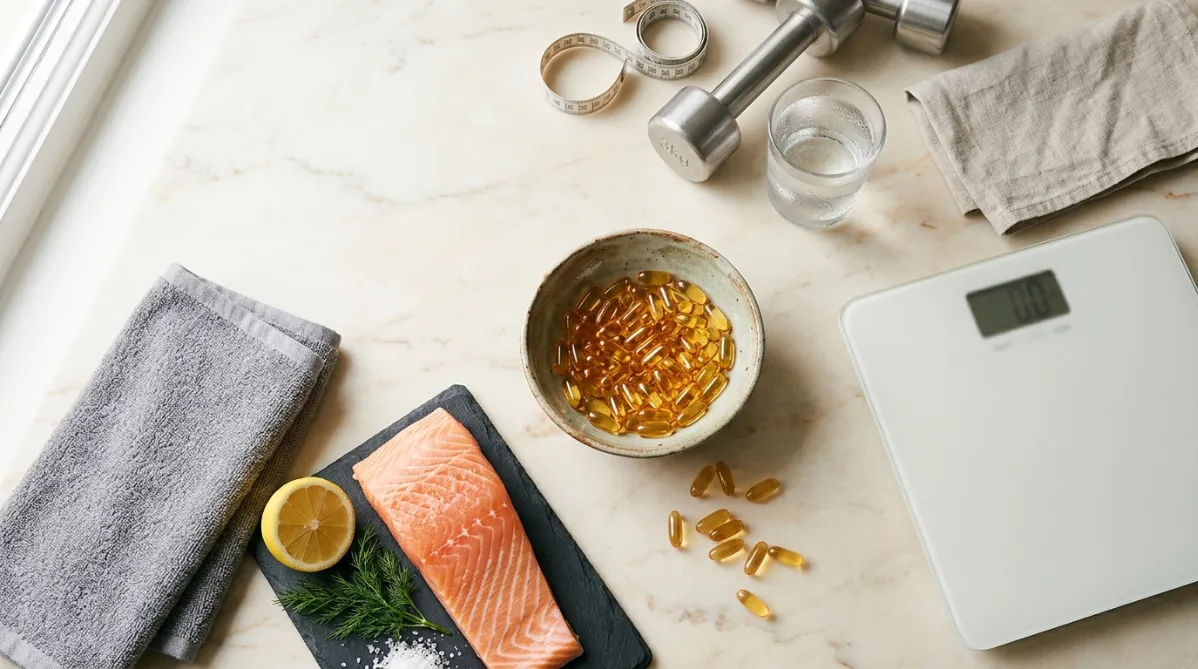
A wide, editorial-style flat lay photographed from above on a pale, warm-toned marble surface with soft natural window light coming from the left. At the center sits a shallow ceramic bowl filled with glistening golden-amber fish oil capsules, a few spilled casually onto the marble. Beside the bowl, a sleek minimalist bathroom scale in matte white sits at the right edge, its digital display blurred so it appears static. To the left, a neatly folded heather-gray athletic towel rests beside a small cluster of fresh ingredients: a halved lemon, a sprig of dill, and a fillet of raw salmon on a slate board, its coral-pink flesh with delicate white marbling catching the light. Near the top of the frame, a pair of brushed-steel dumbbells in a light finish and a soft tape measure curl loosely across the surface, suggesting body composition tracking without being clinical. A small glass of water with condensation and a linen napkin add quiet lifestyle detail. The color palette is calm and modern: cream, soft sage green, warm gold, coral, and muted gray. Shadows are soft and diffused, with gentle highlights on the capsules making them glow like tiny amber beads. The composition has generous negative space on the upper left for headline text, with a shallow depth of field that keeps the capsules and salmon crisp while the edges fall softly out of focus. The overall mood is clean, health-conscious, and contemporary, like a high-end wellness magazine or science journal cover, with a subtle film-like grain and natural, true-to-life tones. No people, no text, no futuristic elements.
nutrition

L’huile de poisson échange de la graisse contre du muscle en 6 semaines : le poids reste stable

BY DR. GYMBRO ·

Et si le chiffre sur la balance restait le même, tandis que votre corps échangeait discrètement de la graisse contre du muscle ? Un essai en double‑aveugle réalisé chez 44 adultes en bonne santé a montré qu’une supplémentation de 6 semaines en huile de poisson (environ 2,4 g d’EPA + DHA par jour) modifiait la composition corporelle d’environ un demi‑kilogramme dans chaque sens, sans modifier le poids total. Une baisse du cortisol salivaire accompagnait ces changements, bien que ce lien ne soit que corrélatif. Le métabolisme de repos est resté stable, et l’échantillon était limité. Voici ce que révèlent réellement les chiffres et comment les interpréter avec discernement.

A wide, landscape editorial photograph shot from slightly above on a pale oak wooden surface, styled like a modern wellness magazine cover. On the left, a rustic ceramic bowl in matte oatmeal glaze holds ground cinnamon in a soft mound. Beside it sit several whole cinnamon sticks tied with natural twine, and a small wooden spoon dusted with warm reddish-brown powder. A loose cinnamon swirl spills across the surface in a graceful, organic arc. On the right, a minimalist fitness scene flows into the frame: a matte sage-green yoga mat partly unrolled, a stainless steel interval timer reading 00:20, a pair of clean white training sneakers, and a compact black kettlebell. A folded linen towel and a glass bottle of water add quiet, lifestyle-oriented detail. The two halves are linked by a thin line of scattered cinnamon powder that runs across the table like a brushstroke, joining the kitchen and the workout.

Soft morning window light enters from the upper left. It casts gentle, long diffused shadows and highlights the texture of the spice, the grain of the wood, and the curled bark of the sticks. The palette is warm and earthy: cinnamon brown, terracotta, cream, sage green, and soft charcoal, with one small accent of burnt orange. The background is a softly blurred neutral wall with a hint of a leafy plant in the top corner, giving shallow depth of field. The composition leaves generous negative space at the top and center-right for headline text. The mood is calm, fresh, health-forward, and trustworthy, with a subtle scientific-journal sophistication. Crisp focus on the cinnamon, creamy bokeh in the background, and a fine film-like grain. The image is realistic, tactile, and uncluttered, with no people, no text, no logos, and nothing futuristic.
nutrition

Cannelle + Tabata dépassent l’entraînement seul pour la perte de graisse lors d’un essai de 8 semaines

BY DR. GYMBRO ·

Une simple épice de cuisine pourrait offrir un petit plus aux pratiquants du Tabata. Dans une étude de huit semaines, les hommes ayant consommé 1,5 g de cannelle chaque jour en plus des séances à haute intensité ont perdu 7,86 % de masse grasse, soit nettement plus que ceux qui s’entraînaient sans supplément (p = 0,013). L’inflammation a diminué et l’irisine a le mieux augmenté dans le groupe combiné, tandis que les variations d’insuline se sont manifestées dans tous les groupes d’entraînement. Avec seulement une dizaine d’hommes par groupe et la cannelle seule ne reproduisant pas les effets du combo, il s’agit d’un résultat prometteur mais non confirmé.

A sunlit outdoor running track in late afternoon, shot from a low angle with shallow depth of field. In the foreground, a matte black bottle with a minimal off-white label sits on the edge of a warm terracotta-colored track lane, beside a folded white towel and a small glass of amber liquid catching golden light. Condensation beads on the bottle. A faint heat shimmer rises from the track surface and softens the background.

In the midground, slightly out of focus, a lean athlete in a sage-green tank top and charcoal shorts runs on a treadmill-like stretch of track, a thin sheen of sweat on their shoulders, their expression focused and calm. Their motion is gently blurred, suggesting endurance and rhythm. Long soft shadows stretch across the lane lines.

The background fades into hazy peach, apricot, and pale yellow tones, with the suggestion of tall trees and a distant stadium wall. Warm sun flare enters from the upper right, creating a subtle glow and a few soft light streaks across the frame.

Subtle editorial touches: a small notebook with a pencil and a stopwatch rest beside the bottle, hinting at data and timing without any text legible. The color palette is warm and muted, with terracotta, cream, sage, and charcoal accents, and a fine film-like grain. The composition leaves open negative space on the left third for a headline overlay. The overall mood is clean, modern, and health-journal inspired, natural and aspirational, with a calm scientific curiosity rather than hype.
nutrition

Boissons cétoniques sous la chaleur : plus d'endurance et une mémoire plus vive ?

BY DR. GYMBRO ·

Les boissons cétoniques sont souvent présentées comme le carburant des biohackers qui souhaitent brûler les graisses. Une nouvelle étude, menée sous stress thermique, suggère qu’elles pourraient également vous aider à tenir plus longtemps. Chez 17 hommes entraînés, le monoester cétonique associé à de la caféine a prolongé le temps d’épuisement à 8,9 minutes contre 7,0 minutes avec des glucides et de la caféine, après 90 minutes d’effort sur tapis à 34 °C. La précision de la mémoire de travail sur la tâche 1‑back s’est également améliorée, tandis que la fréquence cardiaque et la température centrale n’ont pas présenté de différences significatives. En revanche, les tâches 2‑back, le temps de réaction et le test « hit‑and‑avoid » n’ont montré aucun bénéfice, et l’étude était petite, masculine et limitée à une seule session. Voici ce que les données prouvent, et ce qu’elles ne prouvent pas.

A clean, modern editorial flat-lay on a pale oat-colored linen surface, shot from slightly above in soft diffused natural window light. At the center sits an amber glass supplement bottle with a minimalist cream label, unbranded, with a few capsules spilling onto the fabric in soft greens and ivory tones. Around it are fresh botanical elements: a sprig of green tea leaves, sliced ginger root, a small bundle of dried hibiscus petals, and a few pale green pineapple and papaya slices hinting at digestive enzymes. A small ceramic bowl of creamy plain yogurt with a wooden spoon suggests probiotics. To the left, a flexible tailor's measuring tape in soft blush pink loosely curls across the linen, with a slim brushed-brass scale partly visible at the frame edge. On the right, a minimalist white notebook lies open with a hand-drawn simple line chart showing two diverging lines, one trending downward and one flat, with no readable text. A pair of reading glasses with thin gold frames rests beside it, and a tiny pair of balanced brass scales sits in the background, subtly suggesting weighing evidence and caution.

The palette is muted sage green, warm cream, soft terracotta, and touches of blush and brass. Shadows are gentle and long, the depth of field is shallow with a creamy blurred background, and the negative space on the left third of the frame leaves room for a headline overlay. The overall feel is a contemporary health and science journal, calm, trustworthy, and slightly skeptical, in the style of a premium wellness magazine photographed with a 50mm lens, with crisp texture on linen, glass, and botanicals.
nutrition

Le mélange probiotique‑enzymatique SlimSEB surpasse le placebo — mais attention à un détail

BY DR. GYMBRO ·

Un mélange de probiotiques, d’enzymes et de plantes appelé SlimSEB a surpassé le placebo dans un essai randomisé de 12 semaines mené chez 87 adultes à risque de diabète de type 2. Les participants obèses ont perdu 4,5 kg de plus que le groupe placebo et ont réduit leur tour de taille de 11 cm, tandis que le cholestérol et la résistance à l’insuline se sont également améliorés. Cependant, le produit a été fourni par son fabricant, l’étude était petite et courte, et la formule à multiples ingrédients empêche d’attribuer les effets à un composant unique. Voici ce que montrent les données, comment elles se comparent aux médicaments GLP‑1, et à qui il faut rester prudent.

This page is available in