Dr. Gymbro
←

#recovery

14 articles
A serene, softly lit bedside scene in a modern minimalist bedroom, photographed in a warm editorial style. On a pale oak nightstand sit two matching frosted glass tumblers of creamy white protein shake, one slightly closer to the camera in sharp focus, the other gently blurred behind it. Beside them rests a small analog alarm clock with a matte cream face, its hands showing a late-evening hour, and a single ceramic scoop dusted with fine white powder on a linen coaster. A folded gray gym towel and a pair of worn sneakers are tucked at the edge of the frame, hinting at an earlier workout.

In the background, a neatly made bed with textured oatmeal linen bedding and a rumpled cream throw blanket glows under the amber light of a small paper-shade lamp. A sheer curtain filters deep indigo twilight from a window, with a faint crescent moon visible. The palette is muted and calming: warm cream, soft sand, dusty blue, and touches of terracotta from a small clay vase holding a dried pampas stem.

Shallow depth of field, gentle film-like grain, soft window light mixing with the warm lamp glow, long soft shadows across the wood grain. Composition follows the rule of thirds with the glasses on the left third and open negative space on the right, suitable for headline overlay. The mood is quiet, thoughtful, and contemporary, like a lifestyle and science feature in a trendy wellness journal. Clean, natural, tactile, with no text, no people, and no futuristic elements.
nutrition

Le lactosérum avant le coucher réduit de moitié le temps d'endormissement, la caséine non

BY DR. GYMBRO ·

Tout le monde considère la caséine comme la protéine de nuit, mais une petite étude randomisée, en double‑aveugle et en crossover, montre un résultat surprenant. Après une séance de musculation, 40 g de whey pris 30 minutes avant de se coucher ont fait chuter le temps médian d’endormissement à 9 minutes contre 19 minutes avec un placebo glucidique, tout en réduisant les courbatures du lendemain. La caséine n’a pas dépassé le contrôle de façon significative. À noter : l’échantillon ne compte que neuf participants, et le lactosérum n’a pas été statistiquement supérieur à la caséine en comparaison directe.
A sunlit, minimalist home gym corner photographed in soft golden morning light, with a young athletic man seated on a wooden bench, leaning forward with his elbows resting on his knees, catching his breath after a hard leg session. He wears a muted sage-green t-shirt and charcoal shorts, his face turned slightly away from the camera, calm and focused. A matte ceramic dish in the foreground holds a few small, translucent golden softgel capsules, with a glass of water beside it catching the light and casting a soft caustic shadow across a pale oak floor. Behind him, a loaded barbell rests on a squat rack, slightly out of focus, and a tall window pours warm sunlight diagonally across the scene, creating long gentle shadows and a hazy glow. A small potted green plant sits on a shelf at the edge of the frame. The color palette is warm and editorial: cream, soft gold, sage green, pale wood, and charcoal accents. Shallow depth of field, with crisp focus on the capsules and glass in the lower third and a creamy bokeh background. The composition leaves generous negative space on the right side for a headline overlay. The mood is clean, modern, and aspirational, like a high-end wellness magazine or a trendy health journal feature. Shot on a 50mm lens, natural light, fine film grain, subtle matte finish, landscape 16:9 framing.
recovery

La vitamine D accélère la récupération de force chez les hommes non déficients

BY DR. GYMBRO ·

Des hommes dont le taux de vitamine D était déjà normal récupèrent plus rapidement leur force après une séance intensive d’entraînement des jambes lorsqu’ils prennent 4 000 UI par jour. Dans cet essai randomisé contrôlé par placebo, portant sur 28 hommes actifs, la force isométrique maximale a rebondi d’environ 8 % à 24 h. Les marqueurs de dommages musculaires (ALT et AST) ont également augmenté moins fortement, mais aucune réduction des courbatures n’a été observée. Voici ce que l’étude a démontré, ses limites, et qui pourrait réellement en bénéficier.
A softly lit bedside table in a calm, modern bedroom at dusk, photographed in wide landscape format with shallow depth of field. In the foreground, a matte white shaker bottle sits beside a tall frosted glass of creamy, pale vanilla-colored protein shake, with a few condensation droplets catching warm light. Next to the glass rests a slim fitness band on a dark charcoal fabric strap, its small LED glowing a gentle green, lying casually on a light oak wooden surface. A small scoop of fine white protein powder rests on a ceramic dish nearby, with a light dusting of powder on the wood.

In the soft-focus background, a neatly made bed with oatmeal-colored linen bedding and a textured knit throw blanket. A sheer curtain filters the last peach and lavender light of evening from a large window. A small potted olive branch in a terracotta vase and a closed paperback book add a quiet editorial touch. A bedside lamp with a warm, cream-colored shade casts a golden glow across the scene and creates gentle highlights on the glass.

The palette is muted and harmonious: warm cream, soft sand, oatmeal beige, faint sage green accents, and touches of dusty lavender in the window light. The mood is peaceful, reassuring, and clean, like a contemporary wellness magazine or a trendy health journal feature. Lighting is natural and cinematic, with soft shadows and a subtle film-like grain. The composition follows the rule of thirds, with the shake and band on the left third and open negative space on the right for headline overlay. Minimalist, Scandinavian-inspired styling, high-end lifestyle photography, crisp details, and a tranquil, premium editorial feel.
recovery

La caséine avant de se coucher ne ruine pas votre sommeil, selon les données WHOOP

BY DR. GYMBRO ·

Un shake de 40 g de caséine avant de se coucher sabote-t-il secrètement votre sommeil ? Un essai randomisé, en double‑aveugle et en cross‑over mené chez 21 sportives de Division I de la NCAA, suivi avec les bracelets WHOOP 4.0, n’a trouvé aucune détérioration du temps de sommeil, de son efficacité, de la fréquence cardiaque au repos ou de la variabilité de la fréquence cardiaque. L’α‑lactalbumine et les glucides ont donné les mêmes résultats. Mais il y a un rebondissement : aucun de ces apports n’a amélioré le sommeil non plus. Voici ce que révèlent les données, les limites de l’étude et qui devrait encore éviter le shake nocturne.
Wide landscape editorial photograph of a mountain biker mid-ride on a dusty red-orange singletrack trail in the South African Western Cape, golden hour light raking across the scene. The rider is in sharp focus on the right third of the frame, wearing a weathered cycling kit with a race number plate on the handlebars, dust kicking up from the rear tire. Behind them, rolling hills covered in fynbos shrubland and silhouetted protea plants fade into soft, hazy blue mountains. Warm amber sunlight creates long shadows and a soft rim light around the rider and bike.

In the lower left foreground, slightly out of focus, a small minimalist glass vial and a clear water bottle sit on a flat sun-bleached rock, with a few drops of liquid catching the light. Next to them, a simple matte paper notecard and a pencil suggest data collection, with no legible text. The vial and bottle are clean, understated, and modern, with no branding.

The color palette is earthy and refined: terracotta, ochre, sage green, dusty teal sky, and cream highlights. The composition uses shallow depth of field, a generous negative space in the upper left sky for headline overlay, and subtle film grain. The mood is contemplative, skeptical, and quietly sophisticated, like a feature photograph from a high-end outdoor sports and science magazine. Natural, candid, cinematic, shot on a 50mm lens with soft contrast and muted saturation. No futuristic elements, no glowing effects, no molecular graphics, no text.
science research

Ketone IQ a augmenté les corps cétoniques au Cape Epic, mais n’a servi à rien

BY DR. GYMBRO ·

Lors du Cape Epic, course de huit jours, les coureurs ont consommé du Ketone IQ deux fois par jour, atteignant environ 1 mM de corps cétoniques dans le sang. Pourtant, leur fatigue, leur fréquence cardiaque, leurs temps de réaction et leur récupération n’ont pas différé de ceux du groupe placebo. Cette étude en double aveugle a testé le R‑1,3‑butanediol en conditions de course réelles, et non en laboratoire. Les auteurs concluent que la cétose modeste n’était pas efficace et précisent que le butanediol ne doit pas être confondu avec les esters cétoniques. Avec seulement 18 participants, l’étude reste limitée, mais elle constitue une donnée précieuse pour quiconque envisage un supplément cétonique coûteux pour la récupération.
A wide, editorial-style still life photographed in soft natural window light, set on a pale oak gym bench or light wooden table. In the foreground, a matte ceramic scoop rests in a small mound of fine white creatine powder, with a few loose grains scattered across the surface. Next to it sits a minimalist frosted glass jar with a plain unbranded label. Beside the jar is a clear glass of water with delicate condensation. A pair of worn chalk-dusted hands is out of focus in the background, wrapping a lifting strap around a barbell. The barbell is a brushed steel bar with a few muted sage-green and warm gray bumper plates.

On the right side of the frame, a small stack of three different supplement capsules and tablets in neutral cream, terracotta, and soft blue sits next to a single clean white scoop of powder. This subtly contrasts the "stack" with the "plain" option. A folded linen towel in oatmeal beige drapes over the end of the bench. A small leather-bound notebook lies open, with a simple hand-drawn line graph showing two lines, one rising steadily and one flat, in pencil.

The background is softly blurred and shows a bright, airy, modern home gym with large windows, pale plaster walls, and a few green plants. Warm morning sunlight casts long, gentle shadows diagonally across the scene. The color palette is muted and sophisticated: cream, warm white, sage green, soft terracotta, and charcoal accents. Shallow depth of field with a crisp focus on the powder and scoop. Generous negative space on the left third for headline overlay. The mood is calm, thoughtful, and trustworthy, like a high-end health and science magazine cover, with subtle film grain and natural textures. No text, no logos, no futuristic elements.
nutrition

Un stack de créatine augmente la masse musculaire chez les débutants — mais pas la force. Pourquoi ?

BY DR. GYMBRO ·

Un essai randomisé a administré à des novices de musculation un mélange de suppléments à base de créatine pendant quatre semaines, révélant une prise de masse musculaire, un profil testostérone/cortisol plus favorable et une récupération améliorée. En revanche, le 1RM au leg‑press n’a guère progressé davantage que le placebo. Les explications évoquent les gains neuraux typiques des débutants, la courte durée de l’étude et une rétention d’eau précoce, bien que l’article ne puisse les confirmer. Les marqueurs rénaux sont restés normaux, mais l’étude était petite, uniquement masculine, financée par l’industrie et ne détaillait pas la formule complète. Pour les nouveaux haltérophiles, la solution la plus sûre et la mieux étayée reste la créatine monohydrate pure.
A landscape editorial still life shot from slightly above on a pale oat-colored linen surface, lit by soft morning window light with gentle long shadows. On the left, in warm golden sunlight, sits a small ceramic bowl of dried ashwagandha root pieces and a scatter of fine tan powder. Beside it are a few rough, rosy-gold slices of Rhodiola rosea root and a sprig of tiny succulent-like green leaves with yellow blossoms. A matte sand-colored stoneware mug of steaming tea and a simple glass of water stand nearby. A small amber glass bottle with a minimal unbranded label tips out two capsules.

The right side of the frame is cooler and bluer, as if dusk is arriving. It holds a muted indigo ceramic dish with a few pale capsules, a small bundle of dried chamomile flowers (the source of apigenin), and a few green tea leaves. A slim, unlit beeswax candle and a folded charcoal wool blanket suggest evening. The warm and cool halves meet softly in the center, where a rumpled white cotton napkin sits beneath a small brass spoon.

In the background, out of focus, a wooden shelf holds a worn paperback, a small potted plant, and the edge of a kettlebell in matte black, hinting at an active lifestyle. Subtle film grain, shallow depth of field, and a muted palette of cream, terracotta, sage green, and deep indigo give it a clean, modern wellness-magazine feel. Leave generous negative space in the upper third for a headline overlay. No text, no logos, no people.
recovery

Ashwagandha + Rhodiola : le combo du matin porte ses fruits, le stack du soir n’apporte rien

BY DR. GYMBRO ·

Un nouvel essai en quatre bras surprend les adeptes de la cumulation de compléments. Chez 103 adultes en bonne santé et actifs, un combo matinal de 600 mg d’ashwagandha et 300 mg de Rhodiola rosea a réduit le stress perçu, amélioré la qualité du sommeil et boosté l’humeur. Le stack nocturne populaire de magnésium L‑thréonate, L‑théanine et apigénine n’a rien ajouté, et le combiner avec les adaptogènes a même tendance à détériorer l’affect positif. Voici ce que révèle l’étude, ses limites et comment les pratiquants pourraient s’en servir.
A softly lit bedroom nightstand scene in landscape format, photographed in a modern editorial lifestyle style. In the center of the frame sits a handmade ceramic mug in warm oatmeal tones, filled with a pale creamy drink. A thin wisp of steam rises from it. Beside the mug, a small wooden scoop rests on a matte linen-textured surface with a fine dusting of white collagen powder. A minimal amber glass jar with a cream label stands just behind, with no readable text. The nightstand is pale oak with subtle grain.

To the left, a neatly folded pair of gray cotton athletic socks and a worn leather-bound training journal with a pen on top hint at a lifter's routine. A small brass alarm clock reads about 9:30 and is slightly out of focus. On the right side, a sheer curtain filters the last blue-violet twilight from a window, while a warm bedside lamp with a linen shade casts a honey-colored glow across the scene. The glow contrasts gently with the cool dusk tones.

Behind the nightstand, the edge of a rumpled bed with soft white and sand-colored bedding is visible, with a dumbbell resting quietly on the floor in the soft-focus background to suggest recovery after training. The depth of field is shallow, with the mug and scoop in crisp focus and the background dissolving into creamy bokeh.

The palette is calm and earthy: warm beige, soft cream, muted terracotta, and dusk blue accents. The lighting is cinematic and low-key, with gentle highlights on the ceramic rim and a subtle rim light on the steam. The composition follows the rule of thirds, with the mug placed on the left third and generous negative space on the right for title overlay. The mood is serene, restorative, and quietly scientific without any clinical elements. The finish is clean, high-end, and magazine-worthy, with fine film grain and natural color grading, like a wellness feature in a contemporary online journal.
recovery

Le collagène à raison de 15 g au coucher : réduction de 27 % des réveils nocturnes

BY DR. GYMBRO ·

Se réveiller plusieurs fois pendant la nuit peut discrètement compromettre votre récupération, même si votre entraînement et votre alimentation sont impeccables. Un petit essai a montré que 15 g de peptides de collagène, pris une heure avant le coucher, réduisaient le nombre de réveils enregistrés par polysomnographie, passant de 29,3 à 21,3, soit environ 27 %. Les participants ont également obtenu de meilleurs scores au test Stroop matinal. En revanche, la durée totale du sommeil, la latence d’endormissement et l’efficacité du sommeil n’ont pas changé, et l’étude ne portait que sur 13 hommes suivis pendant 7 nuits, avec un produit fourni par l’industrie.
A wide, softly lit editorial still life on a pale oatmeal-colored linen surface, shot from a slightly elevated three-quarter angle. In the center-left, a small matte ceramic dish holds a tiny pile of fine white powder, with a single minuscule measuring spoon resting beside it. To the right, a much larger wooden scoop is heaped high with the same pale powder, spilling gently onto the linen, creating a striking visual contrast of tiny versus large quantity. Behind them, a cream-colored supplement tub with a blank, minimalist label sits slightly out of focus, along with a few amber glass capsules scattered casually.

In the soft-focus background, a runner's well-worn sneaker and a chalk-dusted, wrapped knee sleeve rest on a light ash-wood bench, hinting at gym and road without showing a person. A thin brushed-steel stopwatch lies in the foreground, its hands paused, subtly suggesting timing and endurance. A sprig of dried eucalyptus and a folded sheet of paper with out-of-focus handwritten notes add a quiet, editorial research feel.

Natural morning light streams in from the left through a sheer curtain, casting long, gentle shadows and a warm, creamy glow. The palette is restrained and modern: warm ivory, sand, soft sage green, muted terracotta, and touches of brushed silver. Shallow depth of field with crisp detail on the powders and stopwatch, creamy bokeh in the background. The composition leaves open negative space on the right third for headline text. The overall mood is calm, trustworthy, and contemporary, like a premium health and wellness journal cover, with fine film-like grain and clean, minimalist styling.
recovery

Une dose de 40 mg de collagène double le temps avant la douleur au genou : le hic

BY DR. GYMBRO ·

Les genoux vous font souffrir sous la barre ou sur la route ? Un essai randomisé a montré que seulement 40 mg/j de collagène de type II non dénaturé (UC‑II) retardait l’apparition de la douleur de 1,4 à 2,8 minutes et améliorait l’extension du genou. C’est environ 250 fois moins que la cuillère typique de 10 g de collagène hydrolysé, et il s’agit d’un produit totalement différent. Mais l’étude était petite, financée par l’industrie et réalisée chez des personnes saines, pas chez des patients arthritiques. Voici ce que montrent les données, le contexte nécessaire au titre, et comment lire une étiquette.
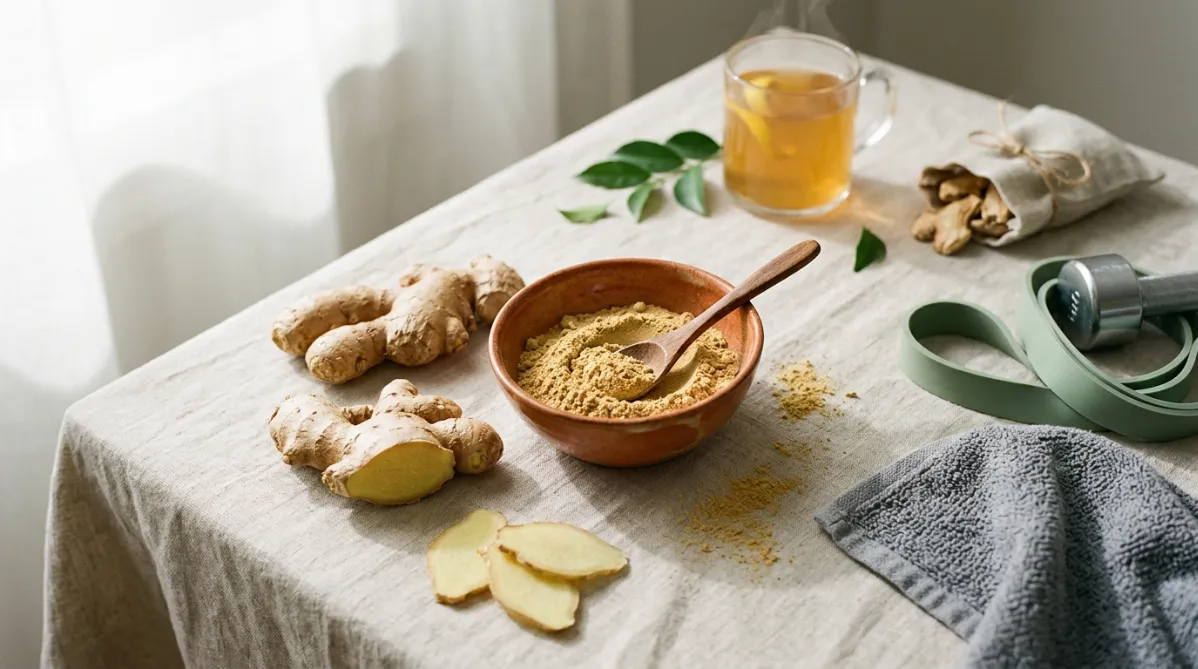
A wide, editorial-style still life photographed from slightly above on a pale oat-colored linen surface, lit by soft natural window light from the left. At the center sits a rustic ceramic bowl of finely ground golden-tan ginger powder, with a small wooden spoon resting in it and a light dusting of spice across the cloth. Beside it lie several whole ginger rhizomes, knobby and honey-brown. One is sliced open to show its pale yellow, fibrous interior, and a few paper-thin slices fan out in the foreground. On the right, a folded heather-gray gym towel, a matte sage-green resistance band coiled loosely, and a single brushed-steel dumbbell sit just inside the frame, softly out of focus. A glass of warm amber ginger tea steams faintly near the upper right, with a thin curl of lemon peel inside. A few fresh green leaves and a small linen pouch of dried ginger add texture. The palette is warm and muted: cream, soft gold, sage, terracotta, and charcoal accents. The shallow depth of field keeps the ginger bowl and sliced root crisp while the gym elements melt into a gentle blur. Shadows are long and soft, and the negative space on the upper left leaves room for a headline. The mood is calm, clean, and modern, like a contemporary wellness or science journal cover. It is a natural, tactile, high-resolution photograph with subtle film grain and no text, no people, and no futuristic elements.
recovery

Deux grammes de gingembre réduisent d’environ 25 % la douleur musculaire du lendemain, selon deux essais

BY DR. GYMBRO ·

Une épice de cuisine courante vient de s’attaquer à l’une des plaintes les plus fréquentes en salle de sport : les courbatures du lendemain. Dans deux essais en double‑aveugle, des participants ayant pris 2 g de gingembre chaque jour pendant 11 jours ont signalé environ 25 % de douleur en moins, 24 heures après un entraînement excentrique intense. Le gingembre n’a toutefois pas montré d’effet notable sur la force ou le gonflement, et aucune comparaison avec l’ibuprofène n’a été réalisée. Voici ce que révèle la recherche, pourquoi cela pourrait fonctionner, quelles sont ses limites et à qui cela pourrait convenir.
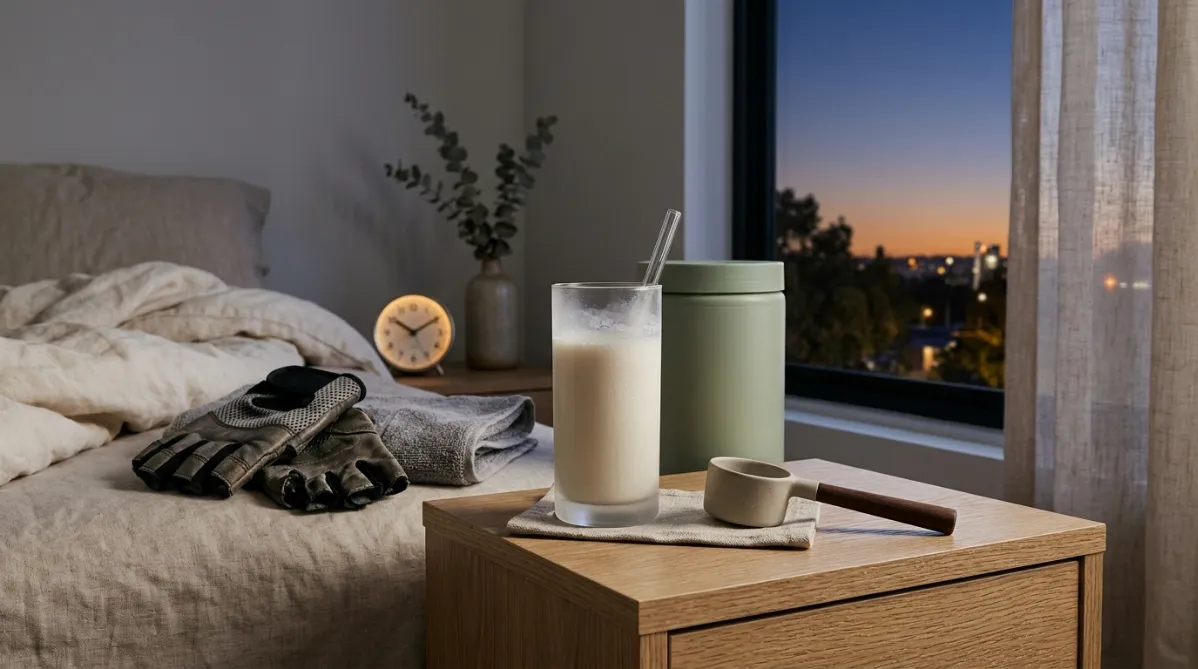
A quiet bedside scene at dusk, shot in soft natural light with a shallow depth of field. A tall frosted glass of creamy, pale-white shake sits on a light oak nightstand, with a thin film of condensation on the glass and a faint milky residue near the rim. Beside it, a matte ceramic scoop rests on a small linen coaster. A minimalist tub of unbranded protein powder in muted sage green sits slightly out of focus in the background.

To the left, a neatly made bed with oatmeal-colored linen sheets and a rumpled cream duvet. A pair of worn lifting gloves and a folded gray gym towel sit on the edge of the bed, suggesting an evening workout just finished. A small analog alarm clock reads about 10:30 PM, its soft face glowing faintly. A sprig of dried eucalyptus in a small stoneware bud vase adds an organic touch.

Through a large window on the right, deep indigo twilight fades into a warm amber horizon, and the last light spills across the wall in long, gentle gradients. A sheer curtain moves slightly. The palette is warm neutrals (cream, oak, sand, soft terracotta) with a few muted blue-violet accents from the evening sky.

The composition uses the rule of thirds, with the glass at the left-center foreground and generous negative space on the right, where headline text could sit. The mood is calm, restorative, and editorial, like a modern wellness and nutrition journal. The lighting is gentle and diffused, with subtle film grain and slightly lifted shadows. The textures of linen, wood, glass, and ceramic are crisp. The image is clean and uncluttered, with no text, logos, or people, and no futuristic or sci-fi elements.
nutrition

Le shake de 40 g avant le coucher : ce que la caséine pré‑sommeil fait pendant la nuit

BY DR. GYMBRO ·

Faire une séance de musculation le soir, puis jeûner pendant les huit heures qui suivent, compromet-il la récupération ? Une étude de 2012 a administré 40 g de caséine à 16 jeunes hommes, 30 minutes avant le coucher, et a suivi les effets pendant la nuit. La protéine a été digérée et absorbée, la synthèse protéique totale a bondi (311 vs 246 µmol/kg) et le bilan protéique net est passé d’un léger déficit à un excédent. La synthèse des protéines musculaires était environ 22 % plus élevée, bien que la différence ne soit que marginalement significative. Voici ce que ces résultats impliquent, leurs limites et comment les exploiter.
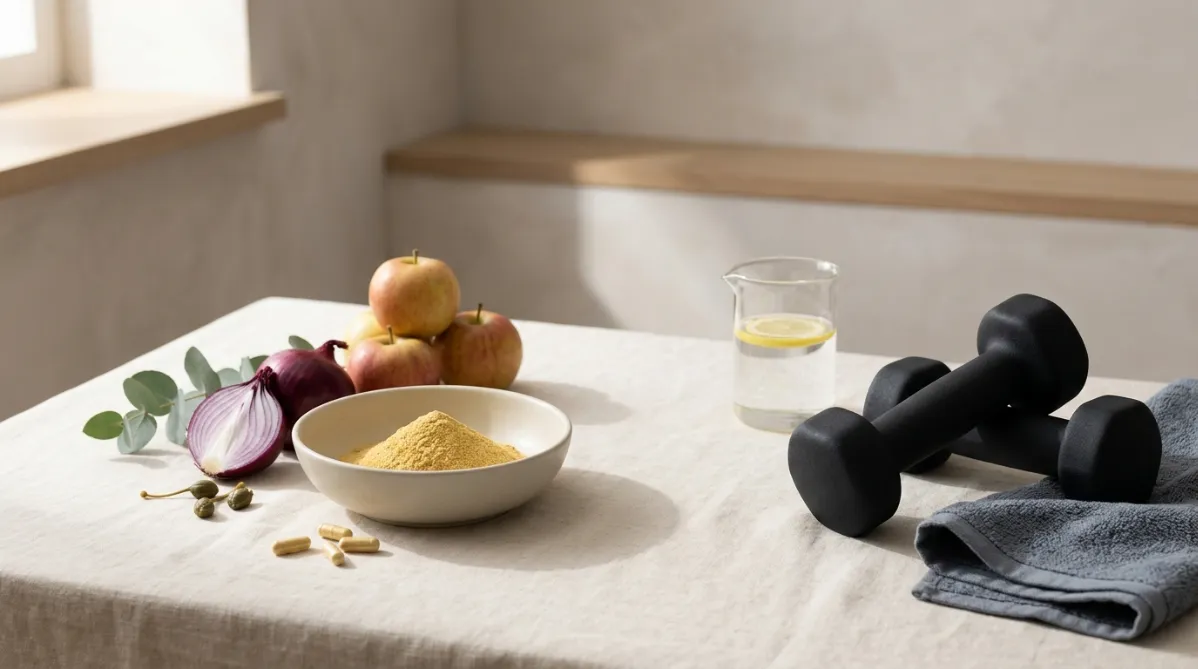
A wide, softly lit editorial still life on a warm off-white linen surface. At the center-left, a matte ceramic bowl holds a small mound of fine golden-yellow quercetin powder, with a few scattered capsules beside it. Next to the bowl sit fresh red onions (one halved to show its translucent purple layers), a few capers, and a small cluster of ripe apples with the skin on, all natural quercetin sources. On the right side of the frame, a sleek matte-black dumbbell rests at an angle beside a folded slate-gray gym towel. A minimalist glass beaker of water with a thin lemon slice sits just behind it.

Soft diffused morning window light enters from the upper left, casting gentle long shadows and subtle highlights on the powder and glossy onion skin. The color palette is muted and sophisticated: butter yellow, deep plum, warm cream, charcoal, with small touches of sage green from a single eucalyptus sprig. A subtle, out-of-focus background of pale plaster wall and a wooden shelf adds depth.

Shallow depth of field, shot from a slightly elevated three-quarter angle with a 50mm lens feel. Generous negative space in the upper right for a title overlay. The mood is clean, calm, and modern, like a premium wellness and science journal feature: tactile textures, natural materials, restrained composition, high-end editorial photography, and no text or logos.
science research

1 g/j de quercétine avant les curls excentriques : le twist IGF

BY DR. GYMBRO ·

Que se passe‑t‑il lorsqu’on consomme 1 g/j de quercétine pendant 14 jours avant d’entamer des curls excentriques ? Dans une petite étude croisée contre placebo, les marqueurs de dommages musculaires (CK, LDH, myoglobine) et l’IL‑6 ont diminué, tandis que la réponse IGF‑I s’est amplifiée et le pic d’IGF‑II est survenu plusieurs jours plus tôt. Avec seulement douze participants et aucune donnée d’hypertrophie, il s’agit d’un signal prometteur de récupération, mais pas d’une garantie de prise de muscle. Voici ce que l’étude a révélé et comment l’utiliser de façon judicieuse.
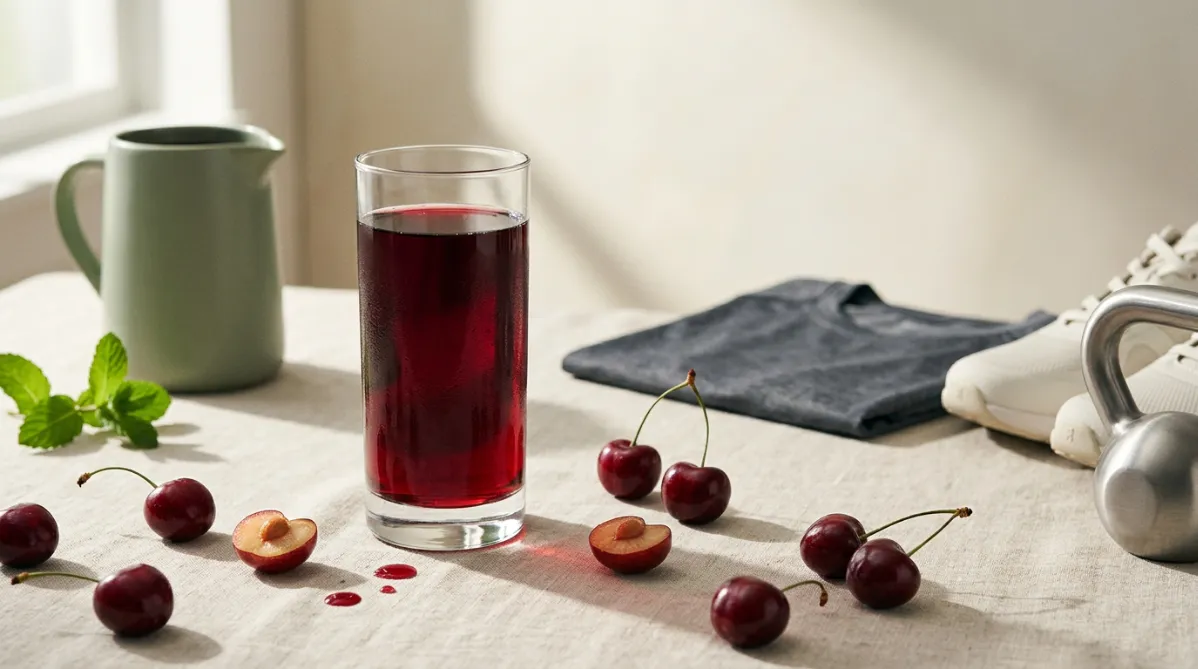
A wide, softly lit editorial still life on a pale oatmeal linen surface. In the center sits a tall, clear glass filled with deep garnet-red tart cherry juice, with condensation beading on the outside and a faint ruby glow where light passes through it. Around it are a scattering of fresh Montmorency cherries, some with stems and some halved to show pale amber flesh and a single pit. A few drops of juice have splashed onto the linen, leaving small crimson stains. To the right, slightly out of focus, lies a folded charcoal-gray running shirt, a pair of minimalist off-white running shoes, and a small brushed-steel kettlebell, suggesting both endurance and strength training without a gym in view. On the left, a ceramic pitcher in matte sage green holds more juice, and a sprig of fresh mint adds a small contrast.

Window light comes from the upper left, casting long, gentle shadows and creating a warm morning feel. The palette is restrained and modern: deep burgundy, cream, sage, and soft slate, with plenty of negative space in the upper right for headline text. The camera angle is a shallow three-quarter view from slightly above, with a shallow depth of field. The foreground cherries are razor sharp and the background melts into a creamy blur. Subtle film grain, natural color grading, and a clean, minimalist composition give it the polished feel of a contemporary health and science magazine. No text, no logos, no people, and no futuristic elements. The overall mood is calm, fresh, and restorative, hinting at recovery and balance.
recovery

Le jus de cerise acidulée : récupération de la force plus rapide, IL‑6 réduit

BY DR. GYMBRO ·

Marathoniens et adeptes de musculation jurent par le jus de cerise acidulée pour récupérer plus vite, et une étude contrôlée par placebo le confirme : force isométrique restaurée plus rapidement (P = 0,024), IL‑6, CRP et acide urique en baisse, statut antioxydant +10 %. Par contre, créatine kinase, LDH et courbatures restent inchangés, ce qui nuance le battage médiatique. Voici le protocole, les résultats et qui peut réellement en profiter.
A wide, editorial-style still life photographed on a pale limestone countertop in soft morning window light. At the center sits a matte white scoop of fine white powder resting beside a frosted glass tumbler of cloudy, pale pink-orange water, with a few watermelon slices and a halved wedge showing glossy coral flesh and thin green rind, a nod to citrulline's natural source. To the left, a neatly folded charcoal gym towel and a brushed steel dumbbell rest at the edge of the frame, slightly out of focus. To the right, a minimalist open notebook with a few hand-drawn tally marks and a simple line graph sketched in black ink rises toward the right edge, next to a slim mechanical pencil and a small analog stopwatch with a clean white face. A few loose grains of powder are scattered across the stone, catching the light. Soft diagonal shadows fall across the surface from a nearby window, and a gentle sage-green wall in the background adds calm contrast. The palette is warm cream, watermelon coral, sage green, and soft graphite gray, with plenty of negative space on the upper left for headline overlay. Shallow depth of field, crisp focus on the powder scoop and watermelon, subtle film grain, natural tones, and a clean, modern wellness-journal aesthetic. Shot at eye level with a slight downward angle, like a contemporary health and science magazine cover. No text, no logos, no people.
nutrition

8 g de Citrulline Malate = 53 % de répétitions en plus et 40 % de courbatures en moins ? Ce que montre l’étude

BY DR. GYMBRO ·

Un essai croisé de 2010 a révélé qu’une dose unique de 8 g de citrulline malate permettait d’enchaîner environ 53 % de répétitions supplémentaires au développé couché lors du dernier set testé, tout en réduisant d’environ 40 % les courbatures ressenties à 24 et 48 h. L’effet se manifestait surtout en fin de séance, quand la fatigue était déjà bien installée. Tous les participants ont montré ce bénéfice, mais il ne s’applique pas aux séries légères avec de longues pauses. Environ 15 % des sujets ont signalé des troubles gastriques, un point à ne pas négliger.
A close-up, golden honey drop suspended mid-air, crystalline and luminous, falling toward a background of defined human muscle fibers rendered in anatomical detail. The muscle tissue glows with a subtle protective golden aura where the honey makes contact. In the background, abstract representations of antioxidant molecules and anti-inflammatory compounds float like microscopic shields around the muscle strands. The scene has a scientific yet warm aesthetic, with honeycomb hexagonal patterns subtly integrated into the composition. Soft, amber lighting bathes the entire image, creating depth and highlighting the honey's natural transparency and the muscle's healthy pink-red tones. Small particles of pollen and natural honey crystals drift through the frame, emphasizing the organic nature of this protective relationship between honey and muscle tissue.
general

Étude révolutionnaire révèle comment le miel protège les muscles lors du surentraînement

BY DR. GYMBRO ·

Une étude iranienne révolutionnaire montre que la supplémentation en miel peut protéger les muscles contre la dégradation liée au surentraînement, offrant aux athlètes une solution naturelle à l’un des problèmes les plus tenaces du sport. Grâce à son mélange unique d’antioxydants, de composés anti‑inflammatoires et de glucides spécifiques, le miel crée une barrière protectrice contre les dommages musculaires induits par l’effort. Ces résultats suggèrent qu’une intervention simple et accessible pourrait transformer les protocoles de récupération, du sportif d’élite aux « guerriers du week‑end ». Avec le syndrome de surentraînement qui toucherait jusqu’à 60 % des athlètes au cours de leur carrière, le miel apparaît comme un allié inattendu pour la performance optimale et la préservation musculaire.

This page is available in