Dr. Gymbro
A wide, editorial-style flat lay photographed from above on a pale warm-gray concrete surface, lit by soft natural window light with gentle shadows. On the left, three small matte ceramic bowls in sage green, soft terracotta, and cream, each holding a different white crystalline powder. The textures vary subtly: fine and powdery, slightly granular, and glittery with tiny crystalline flecks. Beside them rest three minimalist wooden scoops, a few scattered grains catching the light. In the center-right, a worn classic black-and-white soccer ball sits slightly off-frame, partially cropped by the edge, with a pair of muted navy cleats resting nearby, laces loosely draped. A small stopwatch with a brushed-steel finish and a folded sheet of graph paper with a hand-drawn bar chart in soft coral and teal pencil add a subtle sense of data and measurement. A few blades of fresh-cut grass and a sprig of eucalyptus add organic accents. The palette is calm and modern: warm neutrals, sage, terracotta, and muted navy, with one pop of coral. The composition leaves generous negative space in the upper right for headline text. The mood is clean, curious, and trustworthy, like a contemporary health and science journal. Shallow depth of field, crisp focus on the powders, with the soccer elements slightly softer. High-end editorial photography, 16:9 landscape.
Science & Research

Creatina HCl batte il monoidrato nei calciatori — Non buttarla ancora

Dr. Gymbro · · 4 min read

La confezione economica di creatina monoidrato nel tuo armadietto ha appena perso una sfida diretta contro i suoi cugini più costosi e alla moda. Ma prima di ricomprarla, leggi le piccole stampe: questo studio ha dei limiti reali e il risultato va contro ricerche precedenti.

Cosa hanno realmente testato i ricercatori

Un team del Dipartimento di Scienze Sportive dell'Università Medica di Wenzhou, in Cina, guidato da Duan, ha pubblicato una sperimentazione randomizzata, controllata con placebo, sul Journal of the International Society of Sports Nutrition nel 2026. Hanno reclutato 40 calciatori universitari maschi e li hanno divisi in quattro gruppi paralleli da 10:

  • Creatina monoidrato (Cr‑Mon)
  • Creatina ethyl ester (Cr‑Ee)
  • Creatina hydrochloride (Cr‑HCl)
  • Placebo

Tutti hanno seguito la stessa fase preparatoria di quattro settimane di allenamento sprint ripetuto, tre sessioni a settimana per un totale di 12 sessioni. Prima e dopo l’intervento, i giocatori sono stati valutati con salto verticale a contrazione eccentrica (CMVJ), sprint di 20 m, test di agilità a “L‑run”, test di potenza anaerobica di Wingate (potenza di picco, potenza media e indice di affaticamento) e test incrementale per VO₂max.

Il risultato principale: le forme "di tendenza" hanno preso il sopravvento

Prima di tutto, la parte scontata: ogni gruppo è migliorato, incluso il placebo, cosa che ci si aspetta da un mese di sprint strutturato. I gruppi creatina, però, hanno registrato miglioramenti significativamente maggiori rispetto al placebo in performance fisica, potenza di picco e indice di affaticamento (p = 0,001).

Il colpo di scena arriva qui: secondo l’abstract, le forme ethyl ester e HCl hanno prodotto guadagni superiori (p < 0,05) in performance fisica e potenza di picco rispetto al monoidrato. Gli autori sottolineano in particolare il CMVJ, lo sprint di 20 m, il L‑run e la potenza di picco come le aree in cui Cr‑Ee e Cr‑HCl hanno aggiunto un vantaggio extra.

Quindi, in questa prova, le formulazioni più costose e molto pubblicizzate non solo hanno pareggiato il monoidrato, ma lo hanno superato nelle misure esplosive, brevi e cruciali per il calcio.

Dove le forme NON hanno mostrato differenze

Non tutto è stato diviso per tipologia. L’abstract riporta nessuna differenza significativa tra i gruppi per potenza media o VO₂max. Questo rientra nel quadro usuale della creatina come aiuto per sforzi brevi e ad alta intensità, più che per capacità aerobica.

Perché non dovresti ancora abbandonare il monoidrato

Qui entra in gioco una lettura onesta, più che un click‑bait.

I gruppi erano minuscoli. Con solo 10 atleti per braccio, qualche individuo particolarmente responsivo può spostare le medie di gruppo. Gli studi piccoli sono utili per generare ipotesi, ma non per chiudere il dibattito.

Quattro settimane sono poche. Nulla di questo riguarda performance a lungo termine, marcatori di salute o confronti su un’intera stagione.

Il campione è molto specifico. Tutti i partecipanti erano giovani calciatori universitari maschi. I risultati potrebbero non valere per donne, adulti più anziani, altri sport o persone che non si allenano.

L’abstract non riporta la creatina muscolare. Senza misurazioni dirette del contenuto muscolare, non possiamo sapere se le forme nuove hanno davvero aumentato le scorte di creatina o se qualcos’altro spiega il vantaggio. Inoltre, l’abstract non indica le dosi usate, quindi non possiamo affermare che i gruppi fossero equivalenti per contenuto di creatina; non dovremmo darlo per scontato.

Contraddice studi precedenti. Un noto lavoro del 2009 di Spillane e colleghi ha dimostrato che la creatina ethyl ester non era migliore del monoidrato per composizione corporea e performance, ed era associata a livelli più alti di creatinina sierica. Un singolo nuovo studio non annulla quel risultato, e i due risultati sono difficili da conciliare senza ulteriori dati.

Il monoidrato ha ancora il vantaggio dell’evidenza. È la forma di creatina più studiata, ampiamente disponibile e, di solito, la più economica. Una forma può batterla in un piccolo studio e restare comunque un acquisto più costoso senza prove convincenti.

Gli autori non dichiarano conflitti di interesse, il che è rassicurante, ma non risolve le limitazioni metodologiche.

Suggerimenti pratici

Dose: L’abstract non specifica la dose per ogni forma, quindi non copiare il protocollo da questo articolo. Se usi il monoidrato, segui il dosaggio indicato sull’etichetta di un prodotto affidabile o le indicazioni di un dietista sportivo qualificato. Se provi l’HCl, segui l’etichetta di quel prodotto.

Tempistica: Lo studio prevedeva integrazione giornaliera per quattro settimane in parallelo a un blocco di allenamento sprint ripetuto, tre sessioni a settimana. L’abstract non precisa a che ora è stata assunta la dose; l’effetto della creatina dipende più dalla costanza che dal momento preciso della somministrazione.

Chi potrebbe beneficiarne: Atleti di campo e di palestra che vogliono migliorare sprint, salto e agilità, soprattutto in un blocco pre‑stagionale. Chi trova il monoidrato duro per lo stomaco potrebbe considerare l’HCl, anche se lo studio non ha valutato la tollerabilità, quindi è una considerazione pratica più che un risultato.

Chi dovrebbe essere cauto o evitarla: Persone con patologie renali o altre condizioni mediche, chi assume farmaci, e chi ha meno di 18 anni dovrebbero consultare un medico prima di usarla. L’ethyl ester merita cautela extra alla luce dei precedenti dati sulla creatinina. Chi è soddisfatto dei risultati con il monoidrato non ha motivi solidi per cambiare basandosi solo su queste evidenze.

Conclusione

Questo studio rappresenta un segnale interessante: la creatina HCl e l’ethyl ester potrebbero dare un vantaggio in salto, sprint, agilità e potenza di picco in un breve blocco di allenamento. Però 40 atleti, quattro settimane e l’assenza di una ripartizione delle dosi lo rendono più un invito a ulteriori ricerche che una motivazione per buttare via il monoidrato. Fino a quando non arriveranno studi più ampi, più lunghi e con misurazioni della creatina muscolare, il monoidrato resta la scelta provata, economica, mentre l’HCl rimane il contendere intrigante da tenere d’occhio.
Original study

Read the original research on pubmed.ncbi.nlm.nih.gov →

This article summarizes published research for general information. It is not medical advice.

DG

Written by

Dr. Gymbro

Dr. Gymbro writes for Dr. Gymbro: science-backed fitness, nutrition & performance.

Related Articles

A modern editorial still life photographed from a slightly elevated angle on a pale, matte stone surface in soft natural window light. On the left, a heaping mound of fine white creatine monohydrate powder spills from a matte ceramic scoop, with a few crisp grains scattered across the surface. In the center, a small, minimalist amber glass capsule bottle sits tipped on its side, with a handful of off-white capsules spilling out. The label is blank and clean. On the right, a neat row of three clear glass lab-style vials rests on a slim oak tray. The vials hold different amounts of white powder: the first nearly empty, the second slightly fuller, the third filled almost to the brim. This quietly suggests the difference in dose and result. Beside the tray lies a simple stainless steel measuring spoon and a folded sheet of cream paper with soft, abstract bar-chart lines in muted sage green and terracotta. The lines are hand-drawn and unlabeled.

Behind the objects, slightly out of focus, a lean athletic forearm in a gray linen sleeve rests on the edge of the surface, one hand loosely holding a matte shaker bottle. This hints at a training context without showing a face. A single sprig of eucalyptus in the corner adds a soft organic touch.

The palette is warm neutral: bone white, oatmeal, soft sage, muted terracotta, and touches of amber. Shadows are gentle and long, with a shallow depth of field that gives creamy bokeh in the background. The mood is calm, clean, and trustworthy, like a premium health and science journal's feature spread, with generous negative space at the top and right for headline overlay. The composition is wide, balanced, and uncluttered, with subtle film-like grain and a natural, true-to-life color grade. No text, no logos, no futuristic elements.
nutrition

La dose consigliata di Kre‑Alkalyn non aumenta la creatina muscolare: le biopsie lo dimostrano

BY DR. GYMBRO ·

La creatina tamponata, come la Kre‑Alkalyn, promette un’assorbimento migliore, dosi più basse e meno gonfiore. Uno studio in doppio cieco della Texas A&M, condotto su 36 sollevatori esperti per 28 giorni, ha messo alla prova queste affermazioni con biopsie muscolari. Con la dose indicata di 1,5 g al giorno, la creatina muscolare è rimasta praticamente invariata, mentre il monoidrato l’ha aumentata in modo evidente. Forza, composizione corporea ed effetti collaterali non hanno mostrato alcun vantaggio per il prodotto tamponato. Ecco i dati e le indicazioni per dosare correttamente la creatina.

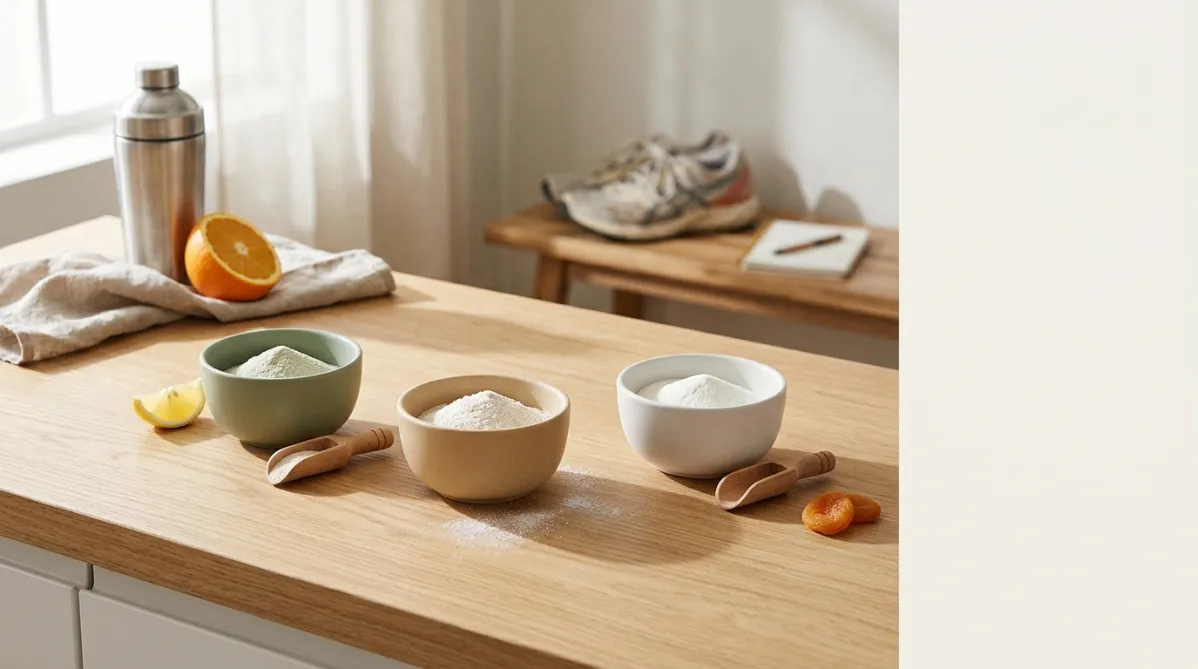
A landscape editorial photograph of a clean, sunlit kitchen-counter or light oak table, shot from slightly above at a gentle angle. Three small matte ceramic bowls in muted sage green, warm sand, and soft white sit in a loose row. Each holds a different fine white powder, and each has a small wooden scoop resting beside it. The middle bowl is slightly closer to the camera and sharper in focus, with a faint dusting of powder spilling onto the surface. In the soft-focus background, a stainless steel shaker bottle and a half-peeled orange sit beside a folded linen napkin, suggesting citrus without being literal. A single lemon wedge sits near the left bowl, and a small dried apricot sits near the right, a subtle visual nod to citrate and pyruvate.

In the background, a blurred athletic scene: a running shoe resting on a wooden bench and a small notebook with a pen, suggesting a training log. Soft diffused morning light enters from the left through a window and casts long, gentle shadows. The palette is warm neutrals, creamy whites, soft greens, and a hint of terracotta orange. The look is a modern wellness magazine with a shallow depth of field, a fine-grain film feel, and generous negative space on the right third of the frame for title text. The mood is calm, trustworthy, and scientific yet approachable, with no text, labels, or logos.
nutrition

Creatina Piruvato vs Citrato: Una Forma Mantiene la Forza più a Lungo

BY DR. GYMBRO ·

Due forme di creatina “di lusso” hanno superato il placebo in una sperimentazione di 28 giorni, ma solo una ha mantenuto la forza muscolare elevata in tutti i dieci intervalli di sforzo massimo, mentre l’altra è svanita. La creatina piruvato ha aumentato la forza in ogni intervallo (p < 0.001), mentre il beneficio della creatina citrato è scomparso già al sesto intervallo. Solo il piruvato ha inoltre migliorato la velocità di rilassamento e il consumo di ossigeno a riposo. Prima di abbandonare la tua confezione, c’è un grosso vincolo: lo studio non ha incluso un gruppo con creatina monoidrato. Ecco cosa mostrano i numeri, cosa non mostrano e come scegliere.

A wide, landscape editorial photograph of a clean, sunlit kitchen counter or pale stone tabletop, styled like a modern wellness magazine spread. Two scoops sit side by side on a matte ceramic surface. The left one is a plain, humble wooden scoop heaped with fine white creatine powder. The right is a glossy, ornate brushed-gold scoop holding the same white powder, which hints at "premium" branding. Behind each scoop stands a tub. The left tub is minimal, matte, and cream-colored with simple sans-serif lettering and no readable words. The right tub is sleek black with metallic gold accents and an overly polished look. A few fine grains of powder are scattered across the surface, catching the light.

The composition uses a shallow depth of field. The foreground scoops are crisp, and the background softly blurs into a warm neutral palette of oatmeal, soft sage green, and muted terracotta. Soft morning window light comes in from the left, casting long, gentle shadows and a subtle highlight along the scoops' edges. A small price tag shape, blank and unmarked, sits near the gold scoop, with a slightly crumpled paper texture to suggest the "pricey" angle without any text. A glass of water with condensation and a folded linen napkin sit at the edge of the frame. A single green sprig or eucalyptus stem adds a natural accent.

The overall mood is calm, intelligent, and quietly skeptical, with the plain option feeling confident and the flashy one a bit overdressed. The color grading is soft and slightly desaturated with creamy highlights, and there is fine film grain. The layout leaves generous negative space on the right third for a headline overlay. It looks like a high-end lifestyle and science journal cover, with a minimalist, tactile, trendy feel and no futuristic or sci-fi elements.
science research

Creatina etil‑ester vs monoidrato: la formula costosa è da dimenticare

BY DR. GYMBRO ·

I produttori di integratori adorano promuovere la “creatina avanzata” come più facilmente assorbibile rispetto alla formula tradizionale. Uno studio in doppio cieco del 2009 ha confrontato la creatina etil‑ester con il monoidrato e con un placebo su 30 uomini non allenati, sottoposti a sette settimane di intenso allenamento. Il CEE ha mostrato livelli più bassi di creatina nel siero e un marcato aumento della creatinina, indice di rapida degradazione. La concentrazione di creatina muscolare è aumentata in entrambi i gruppi di integrazione, ma forza, potenza e composizione corporea non sono variate tra i gruppi. Conclusione: ignora le formulazioni premium e resta sulla semplicità.

A wide, editorial-style still life photographed from slightly above on a pale oat-colored linen surface, lit by soft morning window light from the left. In the center sits a small matte ceramic bowl holding a mound of fine white powder, with a minimalist wooden scoop resting beside it. Next to the bowl is an open amber glass supplement jar with a plain cream label, and a few white capsules spill across the linen in a loose arc.

To the right, a neatly arranged cluster of analog "study" objects suggests careful measurement: a vintage stopwatch with a clean white face, a slim notebook with a sage-green cover open to a hand-drawn bar chart (blurred, no legible text), and a mechanical pencil lying across the page. A small row of six identical ceramic dishes, each holding a pinch of powder, is lined up along the top edge of the frame to hint at the six-week trial. One dish is slightly out of alignment, a subtle visual cue for ambiguity.

A shallow glass of water and a single sprig of green eucalyptus add a calm, organic note in the foreground. Soft, long shadows fall across the textured linen, and the palette stays restrained: warm cream, soft sage, muted terracotta, pale gray, and touches of amber from the glass jar. A few translucent paper cutouts in two tones (sage and blush) overlap in the upper right corner as a modern graphic accent, evoking overlapping data points without showing any numbers.

Depth of field is shallow, with the bowl and stopwatch in crisp focus and the edges gently softened. The composition leaves generous negative space on the left third for title text overlay. The overall mood is thoughtful, balanced, and quietly skeptical, in the style of a contemporary wellness and science magazine: clean, tactile, minimal, with a subtle film-like grain and natural color grading. No people, no futuristic or sci-fi elements, no readable text or logos.
nutrition

GAA: potenziatore cerebrale? Il risultato della prova di 6 settimane è complesso

BY DR. GYMBRO ·

Il GAA, precursore della creatina commercializzato come potenziatore cerebrale, è stato testato in uno studio doppio cieco di sei settimane su 58 adulti sani. Sono emersi tempi di reazione più rapidi e lievi miglioramenti dell’umore, ma la maggior parte dei test cognitivi è rimasta invariata e molte conclusioni sono solo tendenze.

This page is available in