Dr. Gymbro
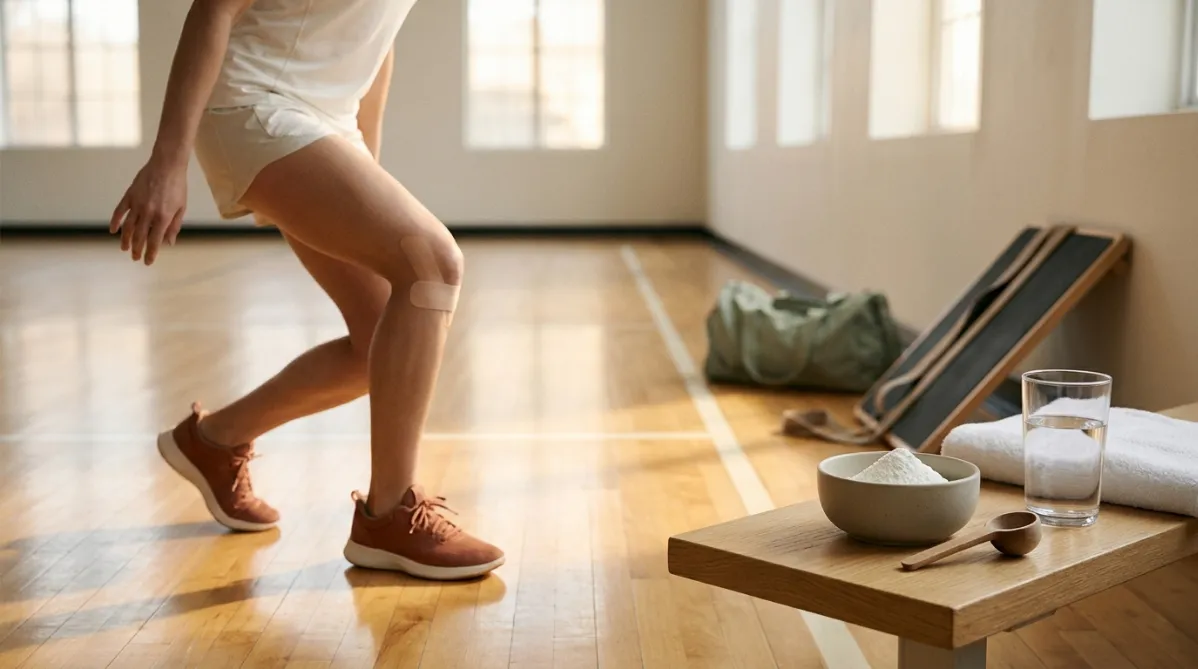
A wide, editorial-style photograph of a volleyball player mid-landing from a jump on a sunlit indoor court, captured from a low side angle. The athlete's knee is slightly bent and the patellar tendon area is in sharp focus, with soft natural muscle definition and a light strip of kinesiology tape just below the kneecap. The polished honey-toned hardwood floor reflects warm window light, and the background falls away into a creamy blur of pale court lines and tall windows.

In the lower right foreground, slightly out of focus, a matte ceramic bowl holds a small mound of fine white creatine powder. A wooden scoop rests beside it, next to a clear glass of water and a folded white towel. This sits on a light oak bench at the edge of the court. A resistance band and a slanted decline board, used for eccentric rehab, lean softly against the wall behind the bench.

The palette is warm and natural: cream, soft white, honey oak, muted sage green accents from a gym bag, and a touch of terracotta from the athlete's sneakers. Light is golden-hour and diffused, with gentle shadows and a subtle film-grain finish. The composition follows the rule of thirds, with the athlete on the left and the supplement still life on the right. Negative space in the upper portion leaves room for a headline overlay.

The overall mood is calm, modern, and health-focused, like a contemporary wellness or sports-science journal cover. Shallow depth of field, a clean minimalist aesthetic, and true-to-life color. No text, no logos, no futuristic or digital elements.
Recovery

Creatina per il ginocchio del saltatore? Sollievo dal dolore già alla quarta settimana

Dr. Gymbro · · 5 min read

Hai provato gli squat eccentrici, hai sopportato le sedute di terapia a onde d’urto e il tuo ginocchio continua a lamentarsi ad ogni atterraggio. E se un integratore economico e ben studiato potesse abbreviare questo percorso? Un nuovo studio randomizzato fornisce una risposta preliminare, e i dettagli contano più del titolo.

Versione breve

I ricercatori hanno testato creatina monoidrato (Creapure®) in combinazione con un programma di riabilitazione strutturato su atleti affetti da tendinopatia patellare, più comunemente nota come ginocchio del saltatore. Alla settimana 8, sia il gruppo creatina sia quello placebo hanno registrato miglioramenti significativi. La differenza è emersa prima: alla settimana 4 solo il gruppo creatina ha mostrato un guadagno statisticamente significativo nel punteggio VISA‑P, un questionario che valuta dolore e funzionalità. Inoltre, solo il gruppo creatina ha evidenziato un aumento significativo dell’altezza del salto con contrazione (CMJ).

È promettente, ma non costituisce una prova definitiva. I dettagli più approfonditi seguono.

Cosa ha fatto realmente lo studio

Lo studio, guidato da Sánchez‑Gómez e colleghi, è stato pubblicato nel Journal of the International Society of Sports Nutrition (2026). Si tratta di una sperimentazione tripla cieca e randomizzata. Venti atleti federati (età media 34 anni) con diagnosi di tendinopatia patellare sono stati suddivisi in due gruppi: creatina (n = 9) e placebo (n = 11).

Tutti i partecipanti hanno seguito lo stesso protocollo di riabilitazione, composto da:

  • Allenamento eccentrico quotidiano più stretching;
  • Terapia a onde d’urto extracorporea (ESWT) ogni 10 giorni;
  • Terapia manuale sul tendine e sui muscoli circostanti.

L’integratore è stato assunto subito al termine di ogni sessione di allenamento eccentrico: tre capsule di creatina monoidrato Creapure per il gruppo attivo, oppure l’equivalente quantità di saccarosio per il placebo. Le valutazioni sono state effettuate al basale, a 4 settimane e a 8 settimane, misurando VISA‑P, spessore del tendine mediante ecografia, composizione corporea con bioimpedenza, altezza del CMJ e il 5‑RM di estensione del ginocchio sulla gamba infortunata.

I numeri che hanno attirato l'attenzione

Dolore e funzione (VISA‑P): i punteggi sono aumentati in modo significativo nel tempo in entrambi i gruppi. A 8 settimane il gruppo creatina è passato da 60,6 a 78,0 punti, mentre il gruppo placebo è passato da 60,0 a 75,2. A quel punto i due gruppi risultavano simili.

La differenza si è osservata a metà percorso. Il gruppo creatina ha raggiunto 70,2 al VISA‑P alla settimana 4, un miglioramento significativo rispetto al valore basale (p = 0,027). L’abstract non riporta alcun cambiamento significativo per il placebo alla settimana 4.

Altezza del salto (CMJ): nel gruppo creatina il salto è passato da 34,3 cm a 36,8 cm alla settimana 4 (p = 0,019), per poi arrivare a 37,6 cm alla settimana 8 (p = 0,015). Per gli sport di salto questo è rilevante, perché indica una ricostruzione del tendine capace di sopportare carichi più elevati.

Spessore del tendine e forza: entrambi i gruppi hanno mostrato miglioramenti nel tempo nello spessore ecografico del tendine e nel 5‑RM di estensione. La creatina non ha apportato un beneficio netto su questi parametri, il che suggerisce che la riabilitazione stessa sia stata la principale responsabile.

Le avvertenze oneste

Prima di inserire la creatina nel tuo piano riabilitativo, è utile tenere presente cosa i dati effettivamente dimostrano e cosa non dimostrano.

  • Campione ridotto. Solo 20 atleti in totale, di cui 9 hanno ricevuto la creatina: i risultati sono fragili.
  • L’interazione è solo una tendenza. Il test di interazione (cambiamento differente tra gruppi nel tempo) ha dato p = 0,099 (η² parziale = 0,126). Non raggiunge la soglia consueta di 0,05. Dire “la creatina ha funzionato alla settimana 4 e il placebo no” confronta la significatività all’interno di ciascun gruppo, una evidenza più debole rispetto a una differenza significativa tra gruppi.
  • Il ritorno al gioco non è stato misurato. L’idea di un “ritorno più veloce al campo” è un’inferenza basata su un sollievo più rapido del dolore e su guadagni di salto. Nessuno ha cronometrato il ritorno alla competizione.
  • Follow‑up breve. Otto settimane non consentono di trarre conclusioni sulla recidiva o sulla salute a lungo termine del tendine.
  • Popolazione eterogenea. Gli atleti avevano una media di 33,7 anni; i risultati potrebbero non essere applicabili ad adolescenti o a professionisti di élite.

Gli autori concludono che la creatina “potrebbe essere considerata” un ausilio ergogenico di recupero. È una formulazione prudente, che dovrebbe rimanere tale.

Chi potrebbe trarne beneficio

Il gruppo più rilevante è gli atleti di sport di salto o di carico (pallavolo, basket, atletica, ecc.) che stanno già eseguendo un programma eccentrico strutturato per la tendinopatia patellare e cercano un piccolo vantaggio. La creatina è uno degli integratori più studiati nello sport e ha un costo contenuto. Per un adulto sano il rischio di assunzione è generalmente considerato basso, sebbene chi ha problemi renali o altre condizioni mediche debba consultare prima un professionista.

Non è un sostituto del carico di lavoro. In questo studio la creatina era un’aggiunta a un programma impegnativo che includeva lavoro eccentrico quotidiano, terapia a onde d’urto e trattamento manuale. Tutti hanno migliorato spessore tendineo e forza principalmente grazie a quel programma.

Indicazioni pratiche: dose e tempistica

  • Tempistica: nello studio la creatina è stata assunta subito dopo ogni sessione eccentrica. È facile da replicare, anche se lo studio non dimostra che questo momento sia migliore rispetto ad altri momenti della giornata.
  • Dose: l’abstract specifica tre capsule di creatina monoidrato Creapure al giorno, ma non indica il contenuto in grammi per capsula. Molti studi utilizzano circa 3‑5 g al giorno; si tratta di un riferimento generale, non di un dato specifico di questo lavoro. Controlla il testo completo o l’etichetta del prodotto.
  • Forma: è stato impiegato creatina monoidrato, la forma più studiata e di alta purezza. Non ci sono evidenze a favore di versioni più elaborate.
  • Aspettative: considerala un possibile piccolo acceleratore nel primo mese, non una cura. Alla settimana 8 il gruppo placebo ha praticamente raggiunto gli stessi punteggi di dolore.
  • Collabora con il tuo clinico: la riabilitazione della tendinopatia dovrebbe essere guidata da chi può modulare il carico in base ai tuoi sintomi.

Conclusione

Questo studio pilota suggerisce che la creatina possa accelerare il sollievo dal dolore e il recupero del salto nelle prime settimane di riabilitazione del ginocchio del saltatore. Poiché l’interazione tra gruppi è solo una tendenza (p = 0,099) e il campione comprende solo 20 atleti, serve ancora conferma con studi più ampi e non è ancora motivo di riscrivere i protocolli di riabilitazione. Se usi già la creatina o la stai valutando, ora hai una motivazione plausibile. Il lavoro eccentrico resta comunque indispensabile.

Fonte: Sánchez‑Gómez et al. “Could creatine supplementation combined with physical rehabilitation accelerate return to play in athletes with patellar tendinopathy?” J Int Soc Sports Nutr (2026). DOI: https://doi.org/10.1080/15502783.2026.2718846 | PubMed
Original study

Read the original research on pubmed.ncbi.nlm.nih.gov →

This article summarizes published research for general information. It is not medical advice.

DG

Written by

Dr. Gymbro

Dr. Gymbro writes for Dr. Gymbro: science-backed fitness, nutrition & performance.

Related Articles

A wide, editorial-style still life photographed from slightly above on a pale oat-colored linen surface, lit by soft morning window light from the left. In the center sits a small matte ceramic bowl holding a mound of fine white powder, with a minimalist wooden scoop resting beside it. Next to the bowl is an open amber glass supplement jar with a plain cream label, and a few white capsules spill across the linen in a loose arc.

To the right, a neatly arranged cluster of analog "study" objects suggests careful measurement: a vintage stopwatch with a clean white face, a slim notebook with a sage-green cover open to a hand-drawn bar chart (blurred, no legible text), and a mechanical pencil lying across the page. A small row of six identical ceramic dishes, each holding a pinch of powder, is lined up along the top edge of the frame to hint at the six-week trial. One dish is slightly out of alignment, a subtle visual cue for ambiguity.

A shallow glass of water and a single sprig of green eucalyptus add a calm, organic note in the foreground. Soft, long shadows fall across the textured linen, and the palette stays restrained: warm cream, soft sage, muted terracotta, pale gray, and touches of amber from the glass jar. A few translucent paper cutouts in two tones (sage and blush) overlap in the upper right corner as a modern graphic accent, evoking overlapping data points without showing any numbers.

Depth of field is shallow, with the bowl and stopwatch in crisp focus and the edges gently softened. The composition leaves generous negative space on the left third for title text overlay. The overall mood is thoughtful, balanced, and quietly skeptical, in the style of a contemporary wellness and science magazine: clean, tactile, minimal, with a subtle film-like grain and natural color grading. No people, no futuristic or sci-fi elements, no readable text or logos.
nutrition

GAA: potenziatore cerebrale? Il risultato della prova di 6 settimane è complesso

BY DR. GYMBRO ·

Il GAA, precursore della creatina commercializzato come potenziatore cerebrale, è stato testato in uno studio doppio cieco di sei settimane su 58 adulti sani. Sono emersi tempi di reazione più rapidi e lievi miglioramenti dell’umore, ma la maggior parte dei test cognitivi è rimasta invariata e molte conclusioni sono solo tendenze.

A bright, minimalist flat-lay photograph of two supplement scoops on a pale warm-gray stone surface, shot from directly above in soft natural window light. On the left, a matte ceramic scoop holds fine white creatine monohydrate powder, heaped in a clean mound. On the right, a second scoop of the same shape holds slightly coarser off-white beta-alanine powder, with a small, deliberate gap between the two. Each scoop sits in its own soft shadow, which suggests separation rather than combination. Between them, a thin brushed-brass ruler or a single slim line of fine powder runs across the surface and subtly divides the composition.

Around the scoops, a few restrained props in a muted editorial palette of sage green, cream, terracotta, and soft charcoal: a small glass jar with a minimalist label that has no readable text, a folded linen napkin, a single sprig of eucalyptus, and a stainless-steel shaker bottle softly out of focus in the upper corner. A few loose powder grains are scattered naturally across the stone. A small stack of blank cream index cards with a pencil rests in the lower right, hinting at research and note-taking without any legible writing.

The composition follows a clean rule-of-thirds layout, with generous negative space on the right third for headline overlay. The lighting is gentle and diffused, with long, soft shadows falling to the lower left. The color grading is calm and slightly desaturated, with creamy highlights and a subtle film-like grain. The overall look is a modern wellness and science journal cover, with an airy, trustworthy, contemporary editorial feel, shallow depth of field, and crisp detail on the powders.
nutrition

Creatina + beta‑alanina: il beneficio dello stack che i ricercatori non hanno riscontrato

BY DR. GYMBRO ·

Lo stack creatina + beta‑alanina è pubblicizzato come la coppia perfetta per migliorare le prestazioni, ma una nuova meta‑analisi a rete su 52 studi randomizzati non ha riscontrato alcuna sinergia tra i due. La sola creatina ha migliorato in modo significativo sprint, salto, sprint ripetuti e la resistenza della parte superiore del corpo rispetto al placebo. Gli effetti della beta‑alanina si sono rivelati non significativi o contingenti al contesto, e la combinazione non ha apportato alcun beneficio aggiuntivo rispetto alla sola creatina. Scopri come è stato condotto lo studio, quali sono i suoi limiti e cosa implica per il tuo budget di integratori.

A wide, cinematic landscape photograph of a freediver suspended mid-water in a calm, sunlit turquoise sea, shot from slightly below so the surface glimmers above like rippling silver glass. The diver wears a sleek matte black wetsuit and a long, elegant pair of carbon fins. Their body is streamlined, arms relaxed at their sides, head tilted slightly down in a state of serene focus. Shafts of soft golden sunlight pierce the water diagonally and illuminate fine floating particles and a trail of tiny bubbles rising from the diver's fins. A single thin dive line descends vertically into deeper blue at the right of the frame, adding a graphic compositional element.

In the lower left foreground, slightly out of focus, a minimalist still-life element rests on a pale sandy seabed: a small, clean white scoop with a mound of fine white powder, casually echoing creatine without any text or labels. The scoop is softly lit and has a shallow depth of field blur, creating a gentle visual link between supplement and sport.

The color palette is refined and modern: deep teal, aquamarine, soft cerulean, warm cream highlights, and touches of sunlit gold. The water gradients smoothly from bright, luminous turquoise near the top to a rich inky navy at the bottom, giving depth and a sense of quiet intensity. Leave generous negative space on the left third of the image for headline placement, with the diver positioned on the right third following the rule of thirds.

The mood is calm, athletic, and contemplative, like an editorial image from a premium health and science magazine. Style: high-end editorial photography, natural light, subtle film grain, soft contrast, crisp detail on the diver and gentle bokeh in the background. No text, no logos, no futuristic or sci-fi elements, no graphics overlays.
nutrition

La creatina funziona anche quando non respiri: lo studio sugli apneisti lo dimostra

BY DR. GYMBRO ·

La creatina è celebre per aiutare a sollevare carichi più pesanti e a sprintare più forte, ma può essere utile quando non respiri affatto? Un nuovo studio in doppio cieco su apneisti allenati ha scoperto che una fase di carico di 7 giorni, con 20 g al giorno, aumenta il lavoro totale e il tempo all’esaurimento in un test di ciclismo a apnea. Curiosamente, il lattato ematico risulta più basso nel gruppo creatina rispetto al placebo, nonostante le prestazioni migliori. Ecco come è stato condotto lo studio, a chi può interessare e perché, con un campione di appena 20 apneisti, è necessario mantenere le aspettative sotto controllo.

A wide, landscape editorial photograph shot from slightly above, showing a rustic matte-white ceramic bowl of dried tribulus terrestris, spiky star-shaped seed pods in warm tan and khaki tones, with a few fresh green trailing vines and tiny yellow flowers draped beside it. The bowl sits at the left third of the frame on a pale ash-wood table. Scattered nearby are two identical sets of plain, unlabeled amber supplement capsules, one pile slightly apart from the other, hinting at a placebo comparison. To the right, slightly out of focus, a worn leather rugby ball rests next to a chalk-dusted steel barbell plate and a folded charcoal-gray athletic towel.

Soft diffused natural light streams in from a window on the left, creating gentle long shadows and a calm, clean atmosphere. The background is a muted sage-green and cream gradient with a shallow depth of field, leaving generous negative space on the right side for title overlay. A small, minimal notebook with a pencil and a simple balance scale made of brushed brass sits subtly in the midground, suggesting scientific scrutiny without any laboratory clutter.

The color palette is earthy and refined: sage green, sand, warm amber, charcoal, and off-white. The style is modern lifestyle-magazine photography, crisp textures, subtle film grain, and a high-end wellness journal feel. The composition is balanced, uncluttered, and minimalist, with a quiet, thoughtful mood that conveys skepticism and evidence-based inquiry. No text, no logos, no people, no futuristic or sci-fi elements.
science research

Tribulus Terrestris deluso nei giocatori di rugby d’élite: studio di 5 settimane

BY DR. GYMBRO ·

Il Tribulus terrestris è pubblicizzato come potenziatore naturale del testosterone capace di aumentare la massa muscolare in meno di un mese. Per verificare queste affermazioni, dei ricercatori lo hanno testato su giocatori di rugby d’élite in uno studio in doppio cieco. I risultati mostrano che tutti gli atleti sono diventati più forti e hanno guadagnato massa magra, ma il gruppo placebo ha registrato gli stessi miglioramenti. Inoltre, l’integratore non ha modificato il rapporto urinario testosterone/epitestosterone (T/E). Scopri cosa ha rivelato lo studio, i suoi limiti e dove conviene davvero spendere i soldi.

This page is available in